
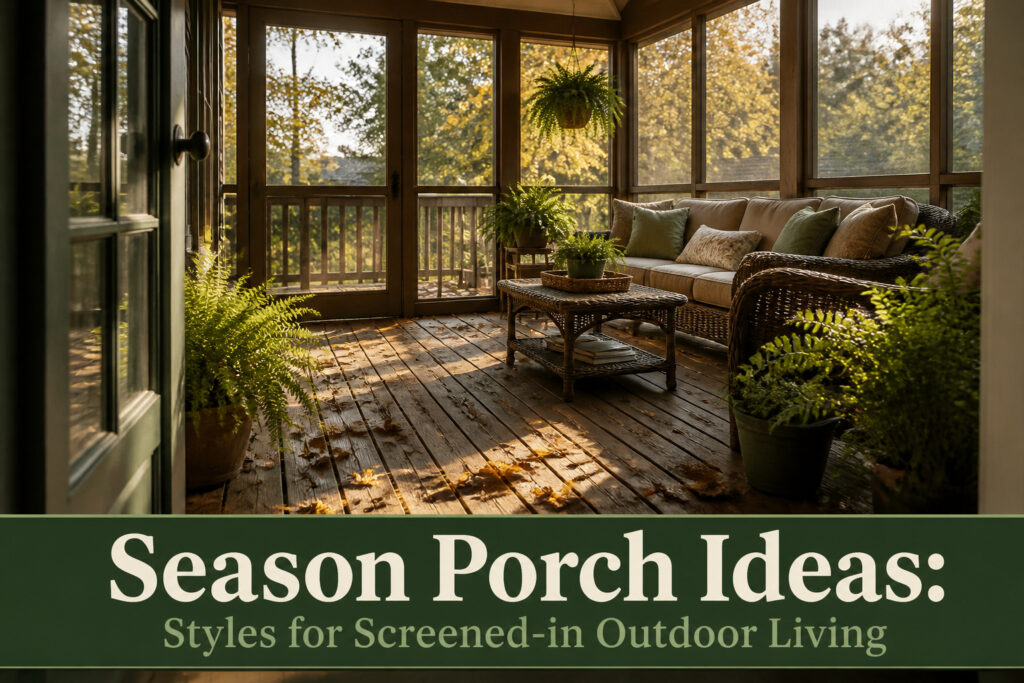
A three-season porch is an enclosed outdoor space built for spring through fall use, with enough shelter to keep rain and bugs out but no insulation for deep winter. The catch is knowing where the line sits: forcing windows open after a hard freeze warped the track and cracked the sash in one project here, a lesson that cost the entire extension. September through November is the real season, not December through March, and the difference is what separates a space you use from a space you repair.
1. Breezy Garden Escape
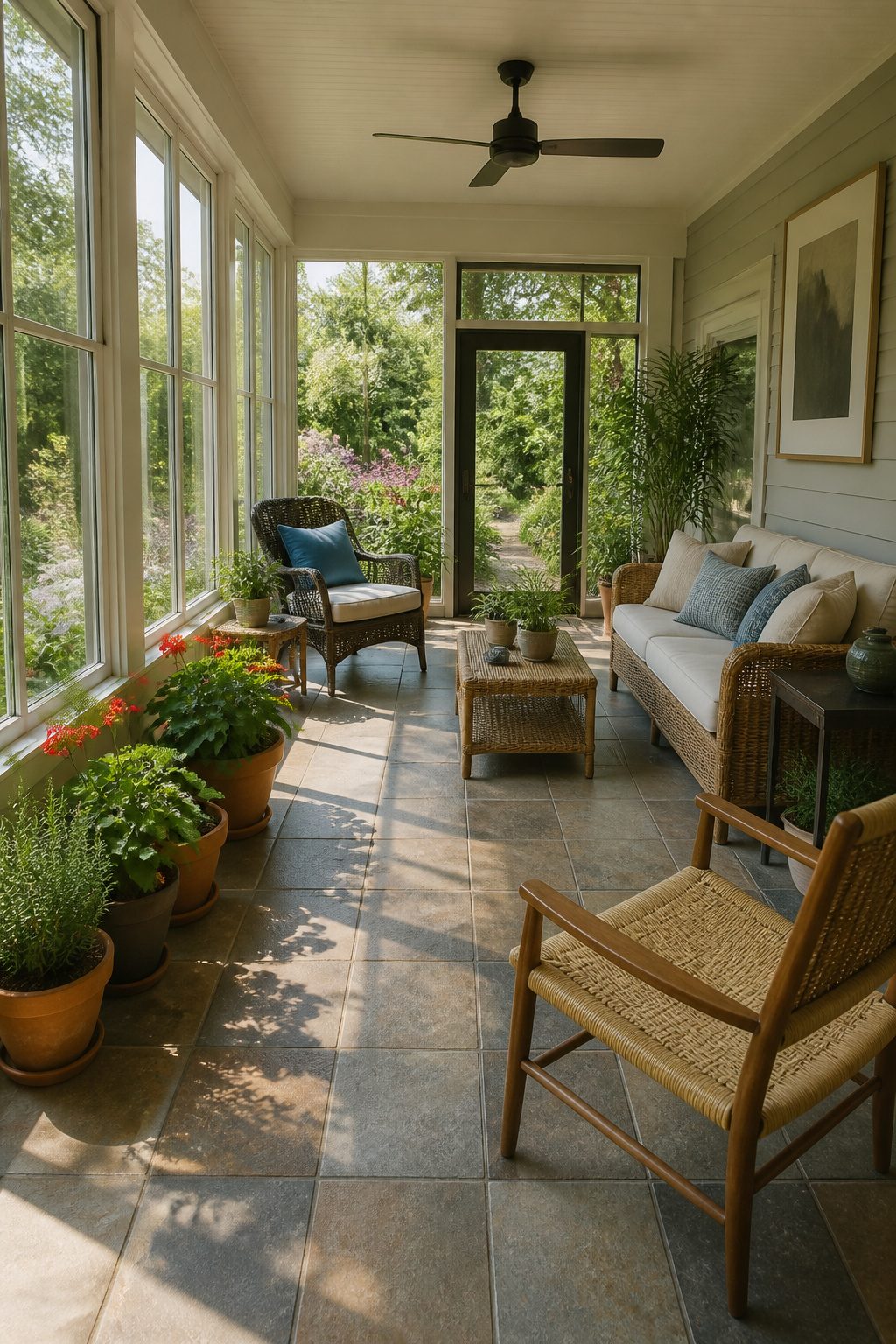
Light pours through the full-height windows at the south end of my porch from mid-morning until late afternoon, and the glass doors on the east wall frame a view of the garden bed I replanted last spring. That positioning matters: the potted plants I keep in here, mostly zonal geraniums and a rosemary that would not survive our winter outside, sit on the tile floor near those east doors where they get direct sun for four hours and reflected light the rest of the day. Wicker and rattan furniture has held up better than I expected against that humidity; the chair frames I bought secondhand five years ago still carry weight without sagging, though I re-wove one seat with new cane last winter.
The Bayview Escape ceiling fan moves air without the buffet of wind that comes through open windows during storms. I ran it on medium speed about six hours a day through June, July and August. At roughly 65 watts, that added maybe $15 to my summer electric bill, less than I spent on the two replacement fern baskets I killed by overwatering in July.
2. Woodland Hideaway
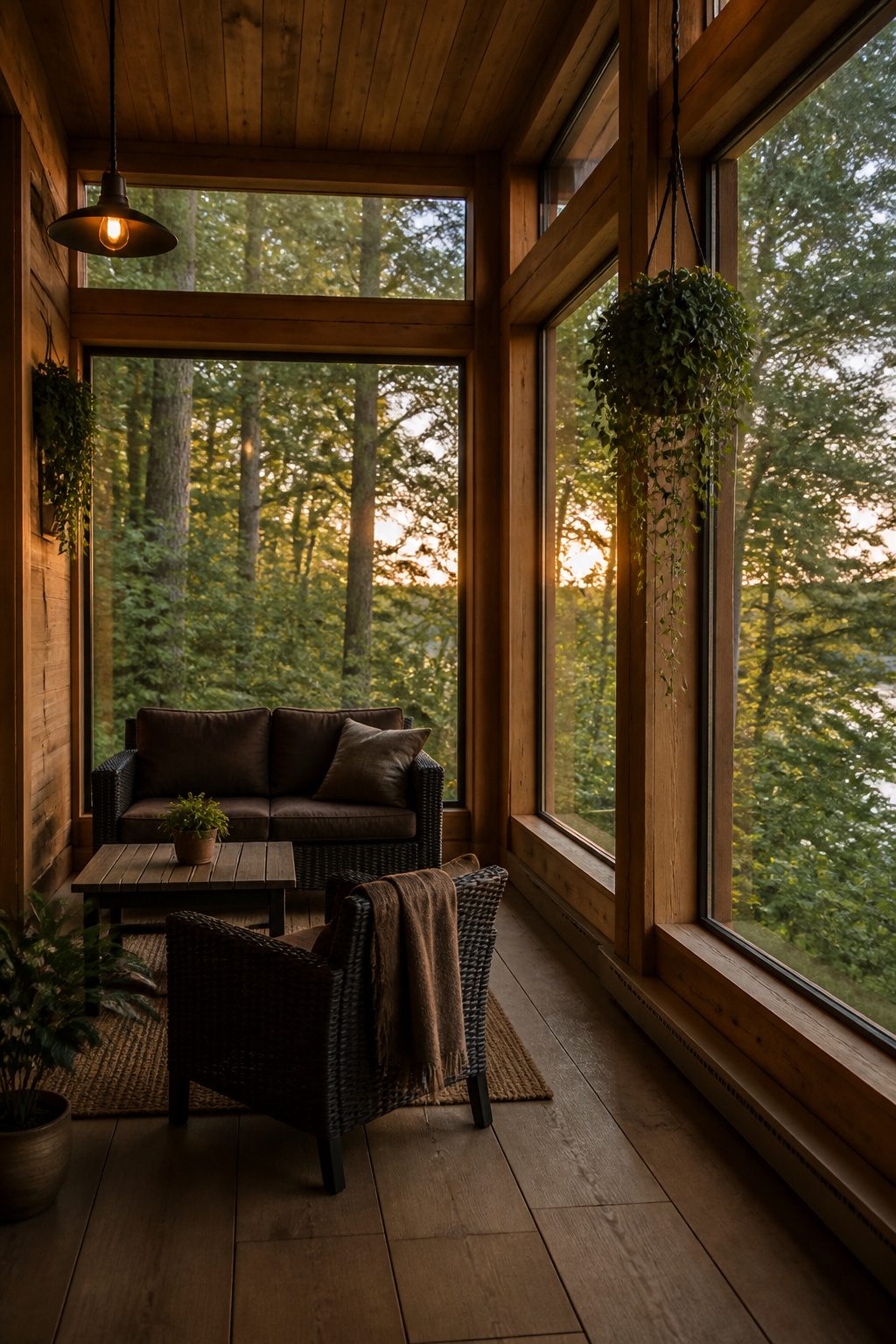
Cedar posts from a local mill give a three-season porch its bones, but the finish matters more than I expected. I stained the first batch too dark, nearly black in the evening light, and the whole room felt like a cave before the furniture even arrived. Sanding back to raw timber and leaving it there brought the forest tone I wanted, something closer to birch bark than bark mulch.
Baseboard heat fits this look better than a wall unit because the raw posts draw the eye upward and the floor line stays quiet. A 72-inch baseboard heater runs about $50 for the unit, and furniture placement hides most of what you don’t want to see. Two units, one on each long wall, each on its own thermostat, kept the space warm enough to sit in when temperatures outside dropped into the teens. That is far less than the $2,000–$4,000 a mini-split demands, and it installs without a pro if you are comfortable with basic wiring.
3. Sun-Kissed Comfort
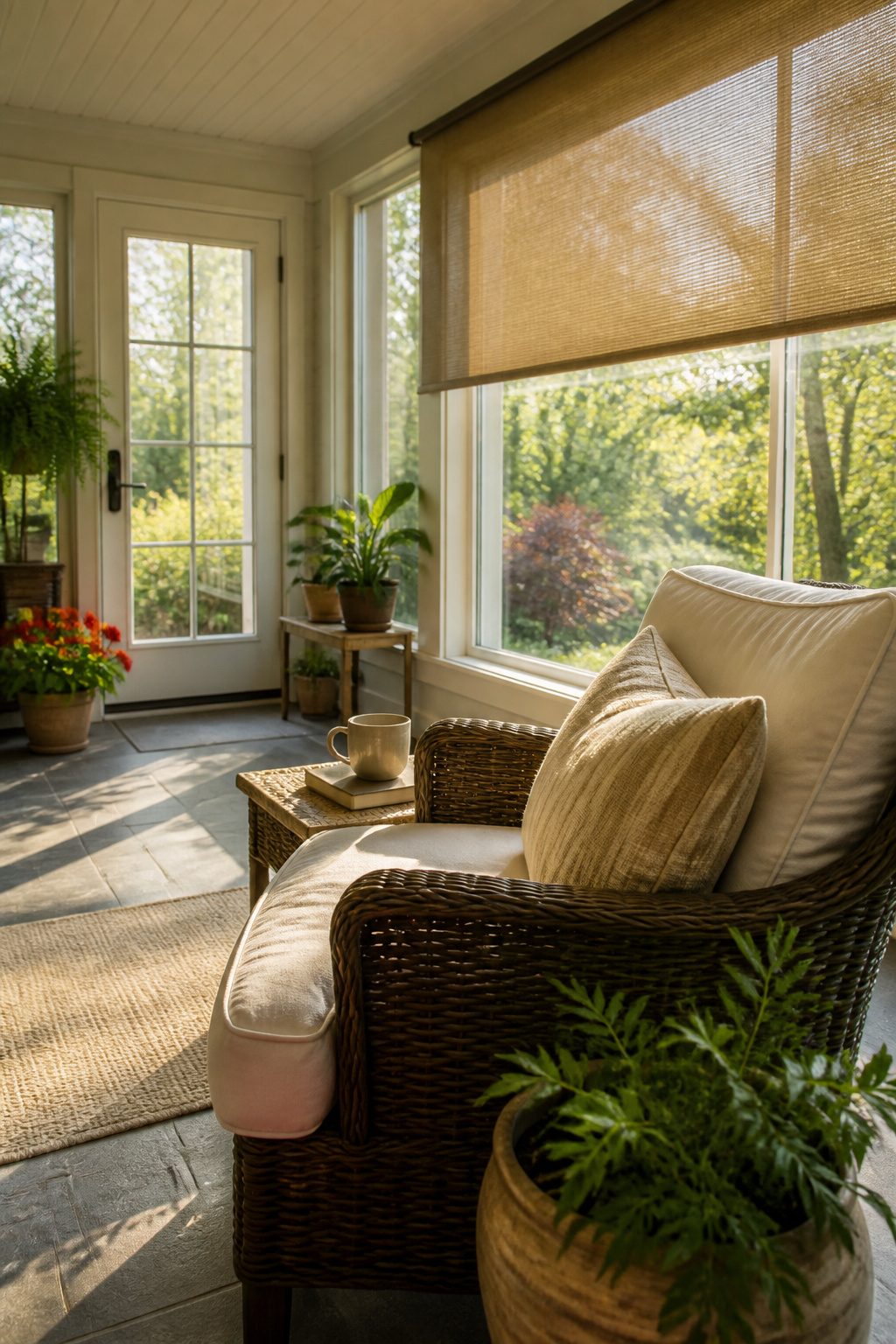
Morning light hits my three-season porch from the east, which seats where I need coffee by 9 a.m. The south-facing glass wall behind it was a different story: August sun turned that corner into a greenhouse by two in the afternoon, and the seating there went unused until I tracked down a motorized shade that drops by remote. Now that bank of windows reads as bright, not punishing, and the corner chairs get used through July and August.
For flooring I wanted something that could handle the garden mud my boots track in without holding heat. 12×24 slate tile ran about $4 per square foot here, laid in a staggered bond. It stays cool under bare feet on 90-degree days, wipes clean with a damp mop, and the dark color hides the grime that light tile would broadcast. The slate was worth the weight; lifting those boxes from the truck was the only part I would not volunteer to repeat.
4. Modern Nature Haven
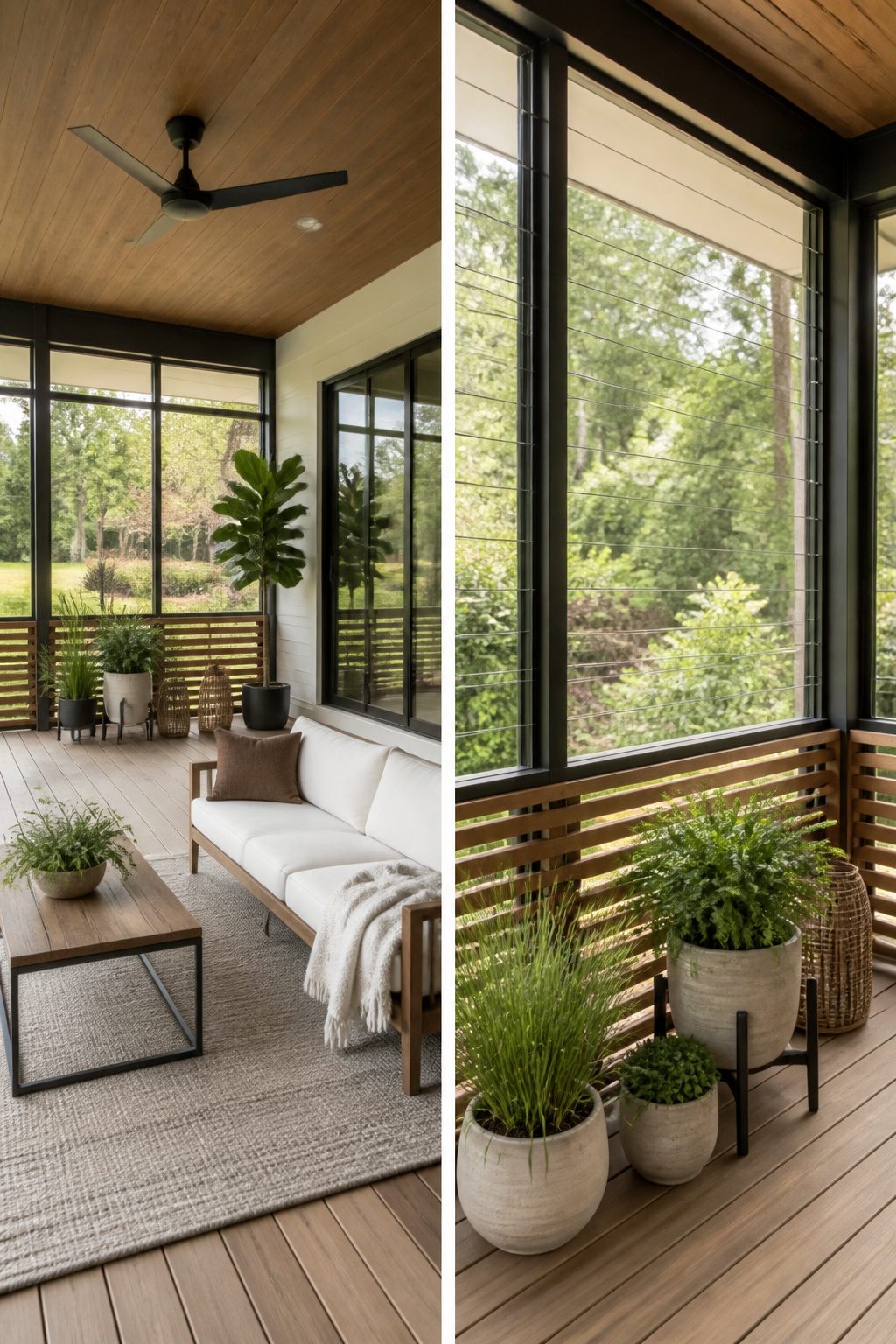
Clean lines and raw wood feel good in a porch until the plants arrive. The first summer I tried minimalism here, a single fiddle-leaf fig looked lonely against the concrete planter, and by August I had twenty pots stacked along the rail. The tension never really resolves; you just decide which day of the week you want to look at.
I priced Eze-Breeze vinyl windows at $2,800 for my opening sizes. The tracking system is elegant, the panels slide and stack, and the finished wall reads almost like glass. What stopped me was the cost per linear foot and the realization that my porch faces northwest, so the summer breeze matters more than the winter seal.
Stock storm doors with screen inserts cost $900 assembled as panels, roughly one-third the price. I hung them in the existing rough opening with surface-mounted hinges, which left visible fasteners along the frame. The look is more workshop than showroom, but the function is identical: removable glass for fall, mesh for summer, and a stop against driving rain. Where I compromised was the gap between panels; Eze-Breeze owns that seam, and mine has a quarter-inch shadow line I notice every April and forget by June.
Buy the storm-door version if you spend your money on plants instead of profiles.
5. Airy Pastel Retreat
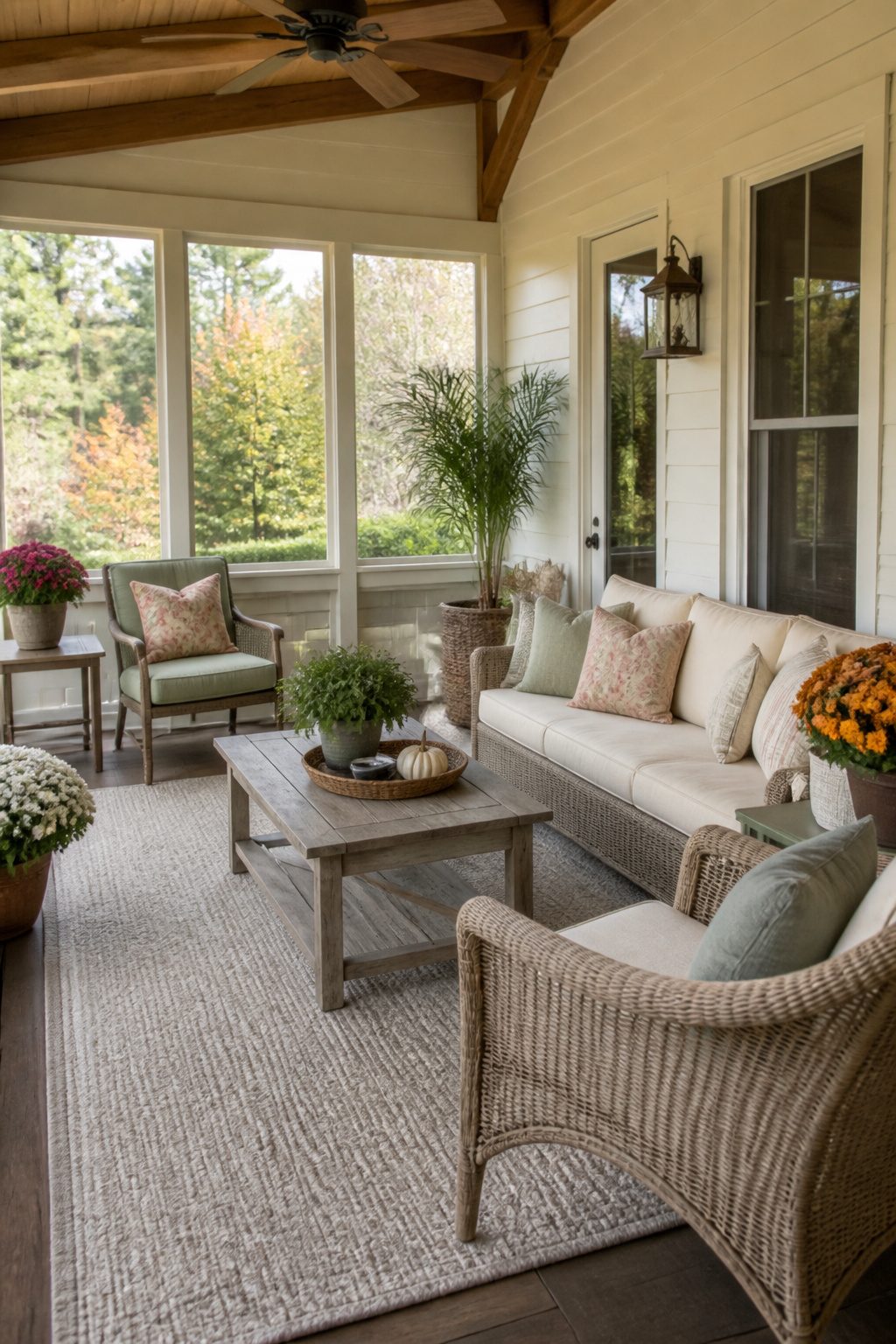
A soft wall color reads differently once the screens go in and the light turns indirect. I learned that the hard way with pale blue. By three o’clock the porch took on the flat glow of a clinic waiting room, something I hadn’t seen in the paint-store swatch under direct bulbs. I painted over it twice, landing finally on a warm cream that pulls the same notes as unstained cedar framing. The cushion covers cost me about forty dollars each for the set, a swap I make twice a year. Cream against raw wood handles the shift from summer annuals to fall chrysanthemums without fighting either palette, where that first blue would have clashed hard against rust and burgundy come October.
6. Cozy Modern Cabin
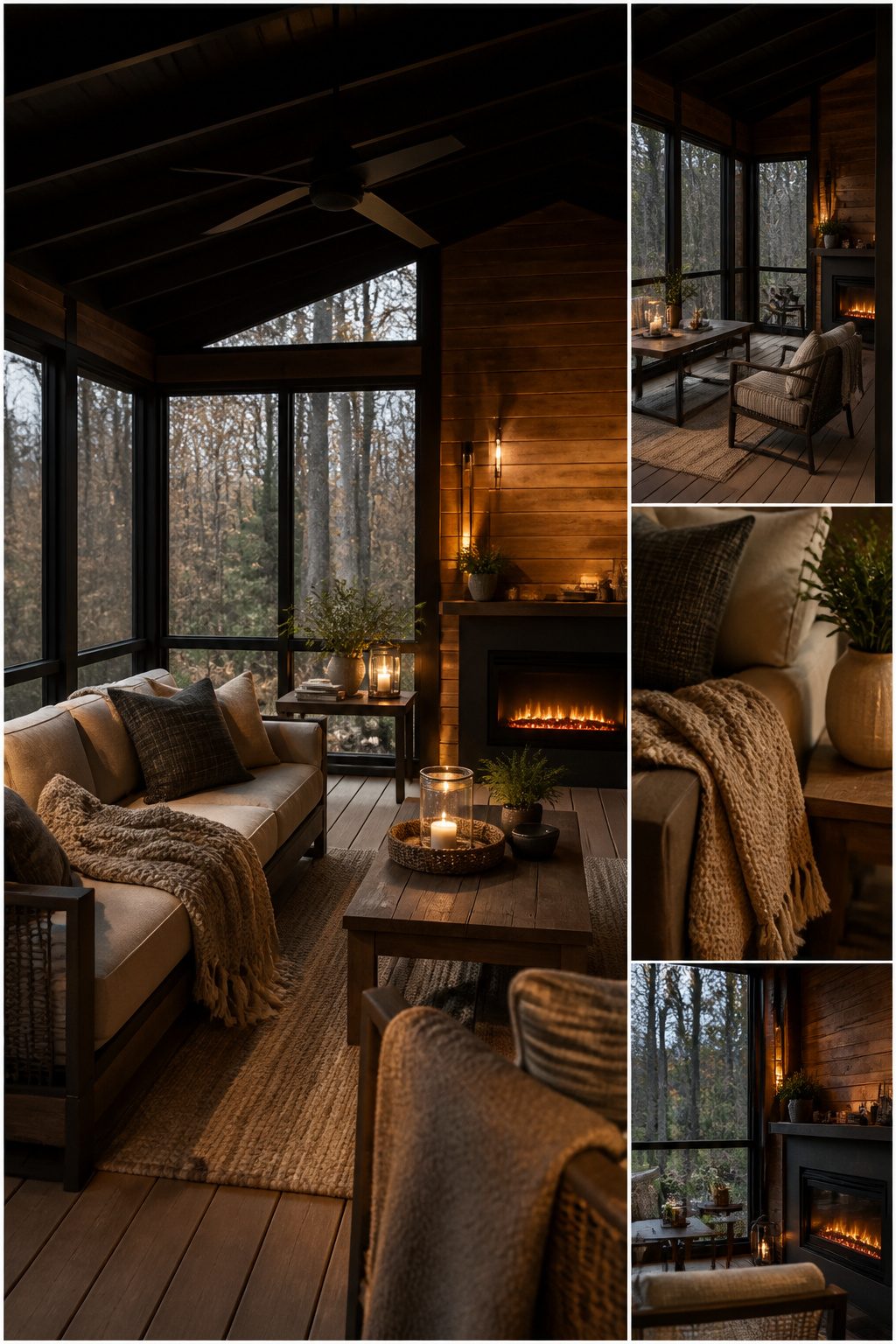
Thick textiles and warm light can still read modern if the structure underneath stays clean. I learned that the hard way after installing an electric fireplace for real heat, not just mood, and discovering the unit pulled 12.5 amps at peak. My existing porch circuit had the TV, string lights, and a phone charger already. The heater alone on high would trip the breaker every twenty minutes. Running a dedicated 20-amp line from the panel through the crawlspace added about $600 to the job, and that was with me doing the trench work outside. Heater plus electrical ran just under $1,400 total.
For layers that actually hold up, I bought three wool throws at a nearby farm auction for $18 total. Synthetic fleece I tried first looked plush in the package but pilled into bobbles within a single season of porch sitting. The wool still sheds a little, and moths are a real concern in summer storage, but after two years it looks like something worth sitting under rather than something ready for the dog bed.
7. Natural Light Lounge
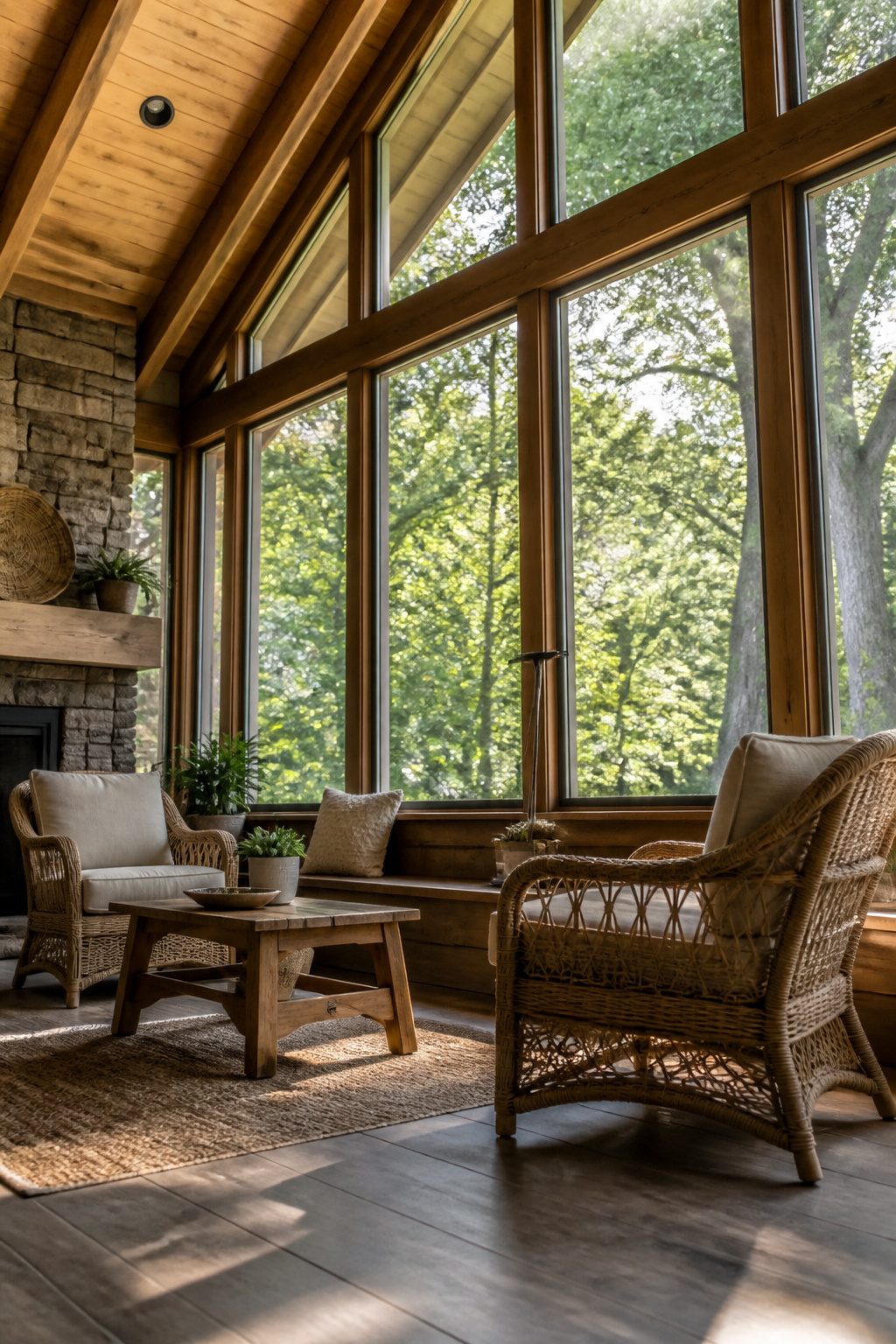
A wall of windows turned out to be the whole point of this porch, so the seating had to turn with them. I started with the sofa against the house wall, facing inward like a living room, and sat down to test it. The glass was behind me. I was looking at siding. That first layout lasted one evening before I dragged everything around. Two chairs and a low bench now face the glass directly, angled slightly toward each other so the view stays central even in conversation.
The rearrangement fixed the room, but maintenance crept up on me. Those windows collect pollen in spring and dust all summer; I assumed a rag and spray would handle it in fifteen minutes. The first round took forty-five, streaked, and ended with me climbing down to fetch more paper towels. A simple squeegee and a bucket of warm water with a drop of dish soap changed the job entirely. Wet the glass, squeegee top to bottom, wipe the blade between strokes. Twenty minutes now, and no lint.
8. Elevated Serenity
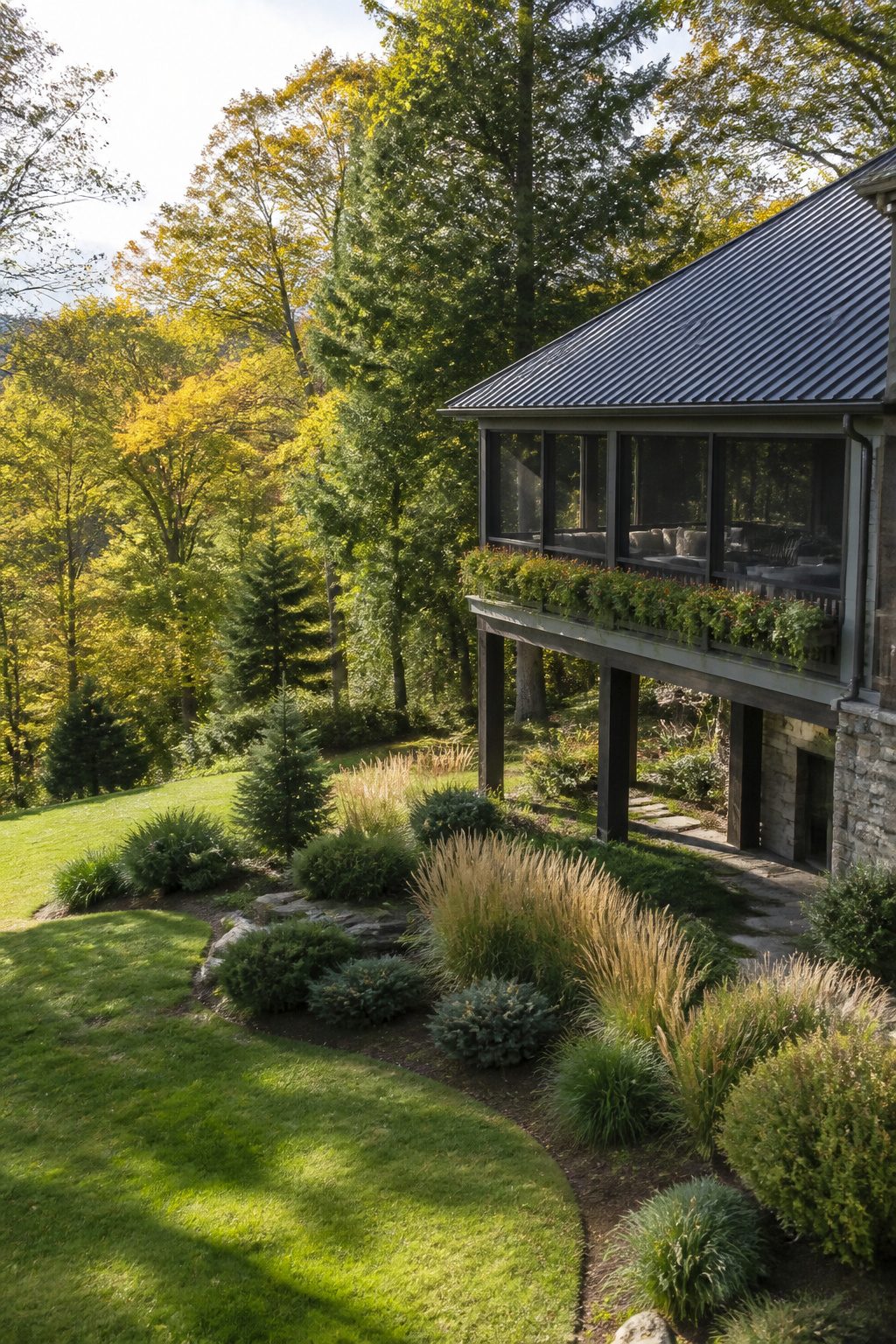
A raised porch changes how you use a three-season space. The structure costs more than ground-level builds; I priced a basic elevated platform at around $3,000, but with roofing and screening included, my total landed near $15,000. The height bought views down into the yard, which was worth it to me, but I stopped short of full enclosure.
Wind at twelve feet up is different. Gusts that barely ripple ground-level beds shredded my first attempts with ferns and coleus. I switched to plants that take abuse: ornamental grasses like miscanthus and pennisetum hold their shape, and juniper ‘Blue Star’ shrugs off desiccation that would crisp hostas. In my zone, sedum ‘Autumn Joy’ and creeping thyme along the railing boxes have survived three years of direct exposure without complaint.
The open sides mean I lose the porch earlier into fall. A space heater would be pointless; the wind pulls warmth straight out. For me, that trade was acceptable. The garden below reads like a living map from up there, and in storm light, the view repays the unfinished walls.
9. Classic Porch Chic
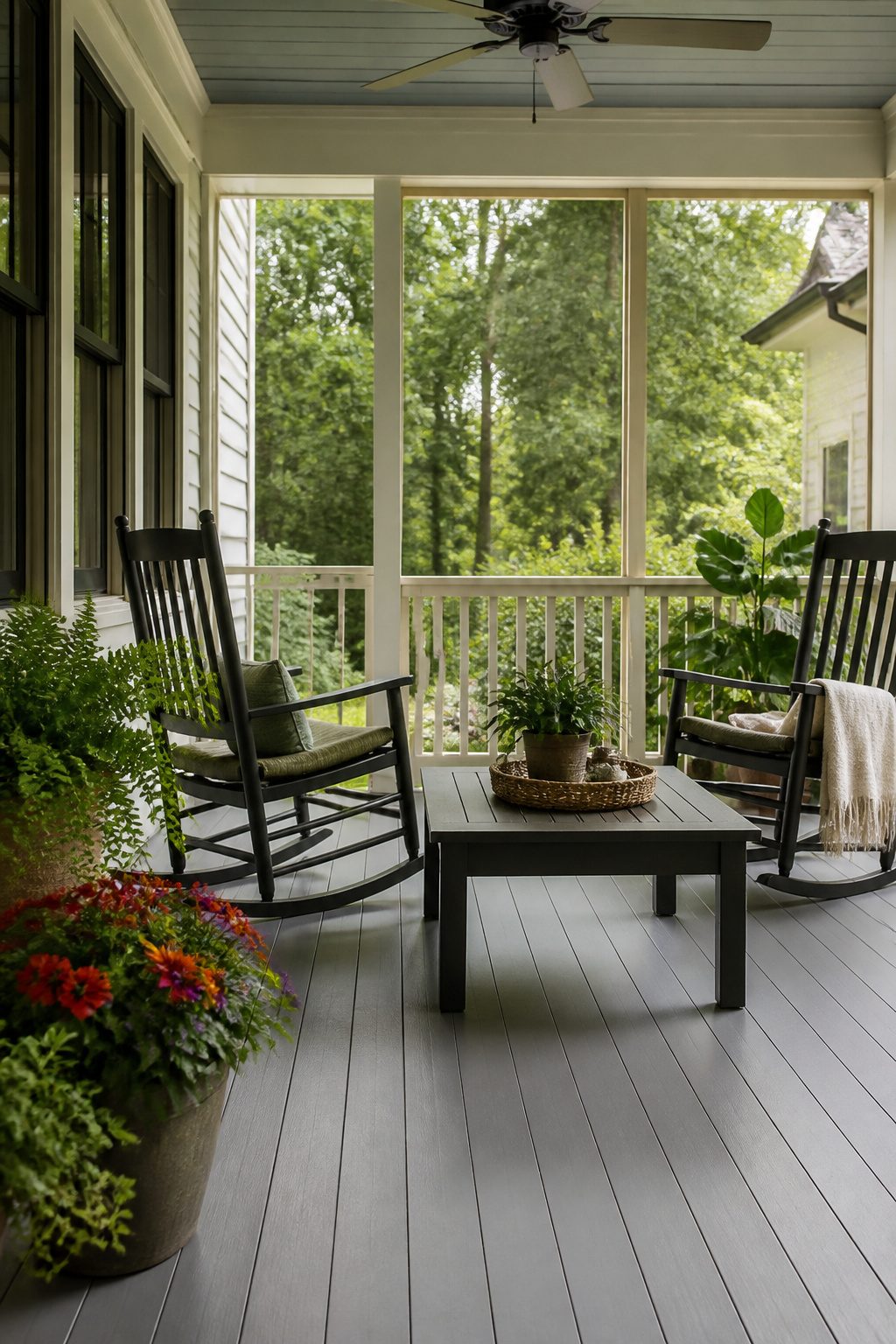
Painted porch floors carry the weight of tradition, and the color choice stopped me longer than it should have. The old haint blue, meant to spirits according to Southern folklore, is a piece of history I read about for an hour and then set aside. Practicality won out: modern gray hides dirt from boots and garden soil far better than any blue I have tested against one muddy March.
The rocking chairs came flat-packed with cryptic hardware and a diagram that looked drawn for another product entirely. I assembled the first chair with the side rail joints reversed, the bolt holes misaligned by a thumb’s width. The redo meant backing out four bolts, flipping the rails so the counterbored faces sat inward, and finding that the seat slats only lined up one way hidden by the stamp marks. Gray floor, righted chairs, and a porch that reads as updated traditional without winking at its own references.
10. Timber Tranquility
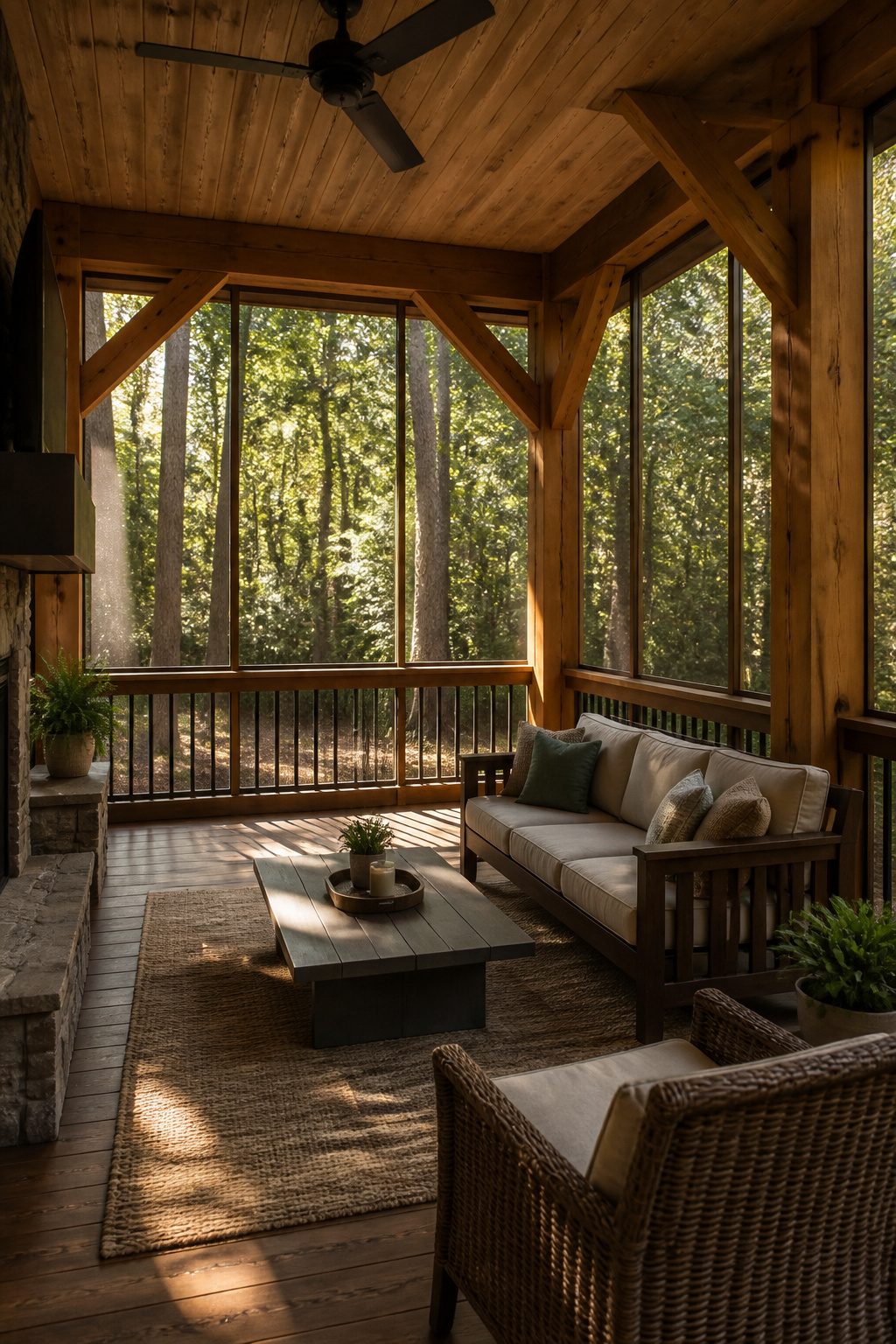
Douglas fir beams set the whole tone of my porch and took the most planning before a single board went up. The species is heavy, really heavy, and that weight matters more than I expected. My contractor flagged it early: the existing footings needed an engineer to sign off on whether they could handle the load, and that inspection ran $400 for the report. The beams went in fine, but after the first winter the surface checking started, those shallow cracks that open along the grain as the wood seasons. I spent a season worrying they were failing before I understood it is normal, even desirable, for the look. Now I take the checking as character and re-oil the beams every second spring with a penetrating finish cut for exterior use. The reapplication is a weekend with a sprayer and a brush, nothing elaborate, but skipping it leaves the silver-gray almost immediately and the surface gets rough enough to snag sleeves.
11. Autumn Light and Plush Layers
A three-season porch dies in January, and trying to revive it taught me where the line sits. Two years back, I forced the windows open after a hard freeze. The track had warped just enough that the sash shuddered, then cracked along the corner joint. That was the lesson: September through November is the real extension, not December through March.
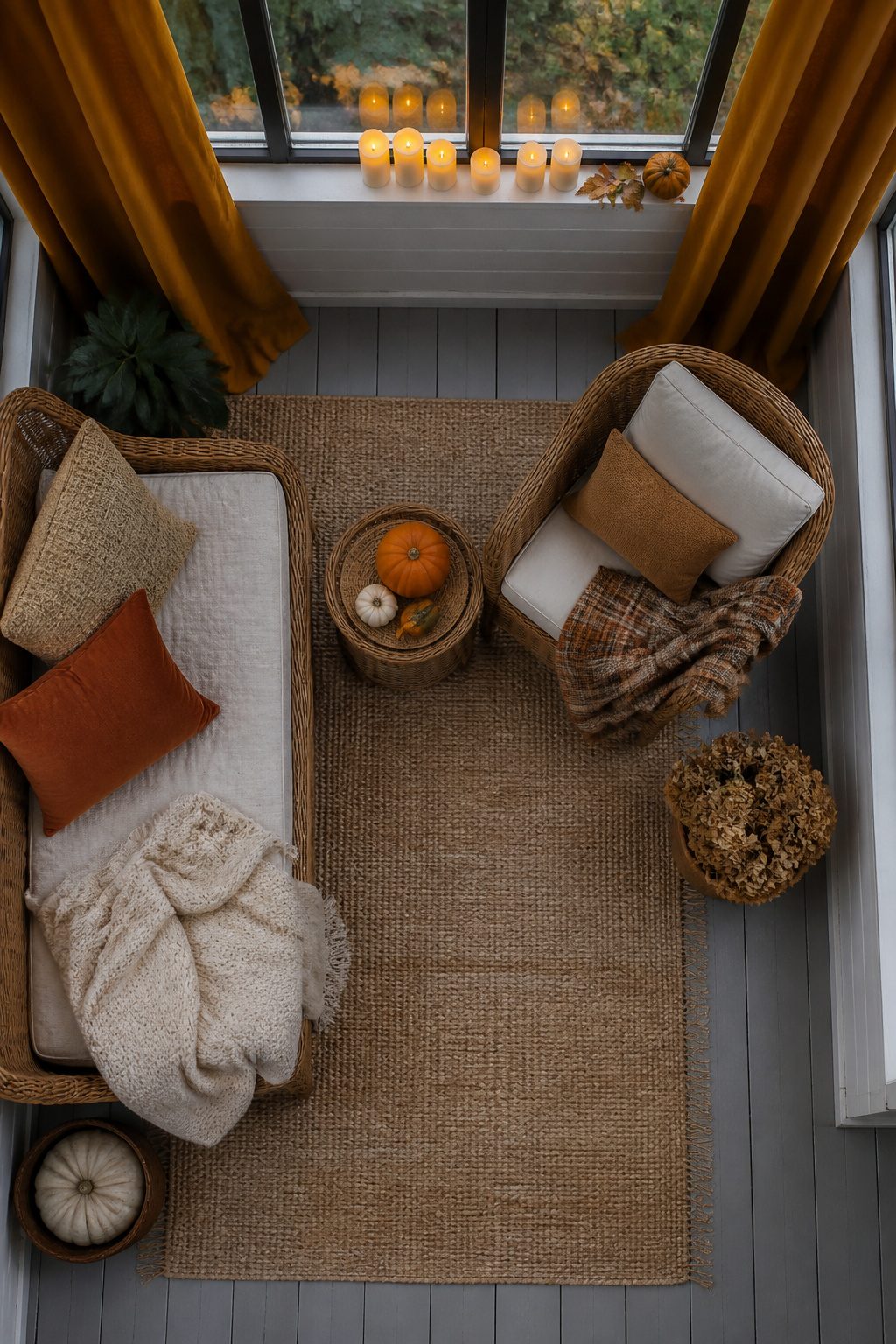
The shift happens with textiles. In early September, a wool rug goes down over the painted floor. It is the same weight I would use indoors in a living room, nothing billed as outdoor-safe, because by October the humidity has dropped enough that mildew is not the threat. Heavier curtains go up on tension rods fitted inside the window frame. I use a cotton-linen blend in a deeper ochre than the summer sheers, and the rods press against the screen track without drilling. They stay open all day. Around five, I draw them and the porch holds heat for another hour.
The candles are the last piece, and the only concession to gadgetry. Battery-powered pillars with amber LEDs and a soft, random flicker sit on the sill. From ten feet out in the yard, the glow reads as flame. Up close, the absence of heat is obvious, which is the point: no open flame where curtains brush wood. Wool, weight, and simulated flame: that is the September recipe. I light them at dusk and read there until the first real cold front, the one that drops the temperature twenty degrees overnight and sends me back inside for good.
12. Cozy Winter Glow
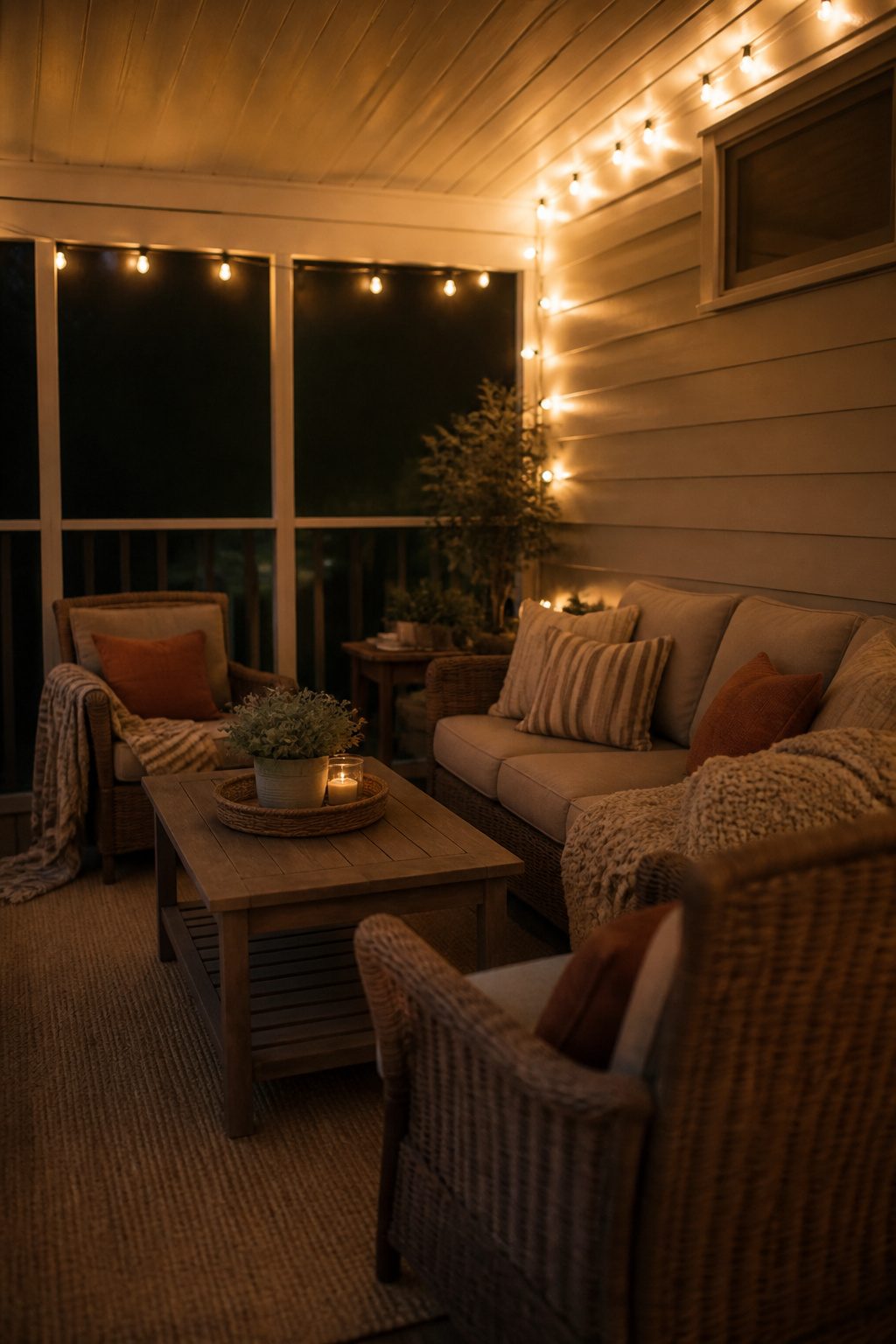
String lights left up through January turned out to be the cheapest mood-setter I have tested. A single strand of warm white LEDs ran every evening from Thanksgiving to New Year’s and added maybe three dollars to the December bill. The same length in old incandescent bulbs I tried the year before cost closer to fifteen. The difference convinced me, but the shade convinced me more. Cool white LEDs made the porch look like a loading dock at dusk; warm white made it glow like a room someone had just stepped out of.
That glow matters more than usability. From the kitchen window on nights below twenty degrees, the porch reads as an extra room rather than a locked annex. I pay for the illusion of warmth, not the fact of it.
The first strand I bought failed after one season, water getting in where the socket met the wire. The replacement cost eight dollars more and is finishing its fourth winter now. The price difference works out to about two dollars a year for something that actually lasts, which is the figure I should have run first.
13. Bright Meets Earthy
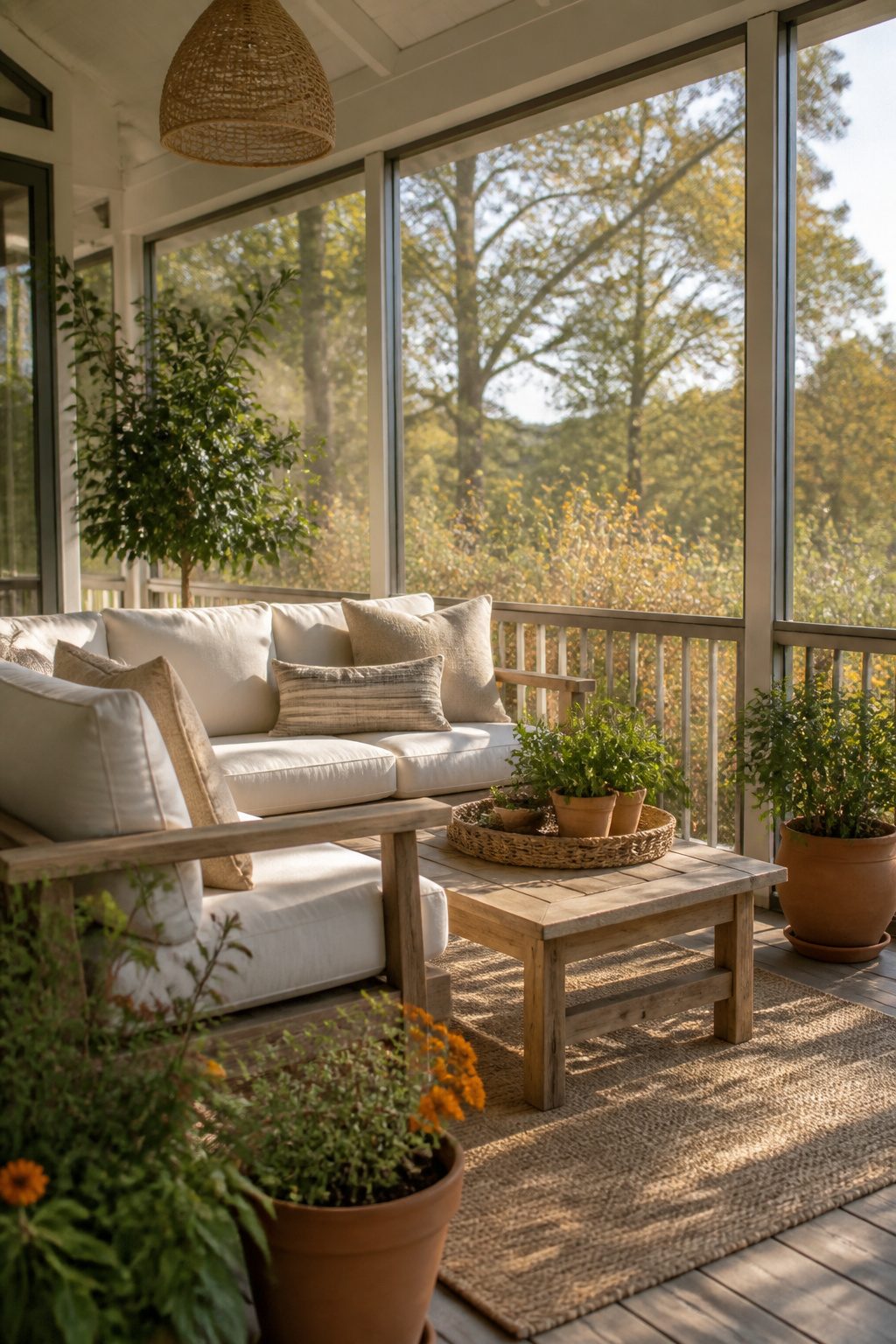
White and cream against raw wood and clay tones sounds simple on paper, but the balance is trickier than it looks. Too much white and the porch reads sterile, like a waiting room with better light. I tried a half-dozen samples before landing on a white with real yellow in the base, not just warm undertones, something that held its warmth through the long afternoon glare. Pair that with raw cedar or red oak, and the wood pulls the cream toward honey rather than gray.
Terracotta pots were an accident I kept. I started with cheap plastic to test layouts, then the clay ones went on sale at a nursery closing for winter. The weight alone keeps them steady in wind, but water seeped through the raw clay and left rust-brown rings on the pale tile I had just sealed. Saucers solved it. Use them even when you think the pot is glazed enough; the unglazed rim wicks water straight through. I learned that after three afternoons of scrubbing with baking soda paste.
The fiddle leaf fig was optimism in plant form. It looked magnificent for six weeks in the brightest corner, then dropped leaves in handfuls. The direct light through screens is still more intense than a fiddle wants, and the dry air finished it. A Sansevieria took its spot, almost as vertical, nearly as sculptural, and indifferent to the same conditions that killed the fig. Two years later it has pupped twice and asks for nothing beyond the water I already give the pots.
14. Rustic Modern Retreat
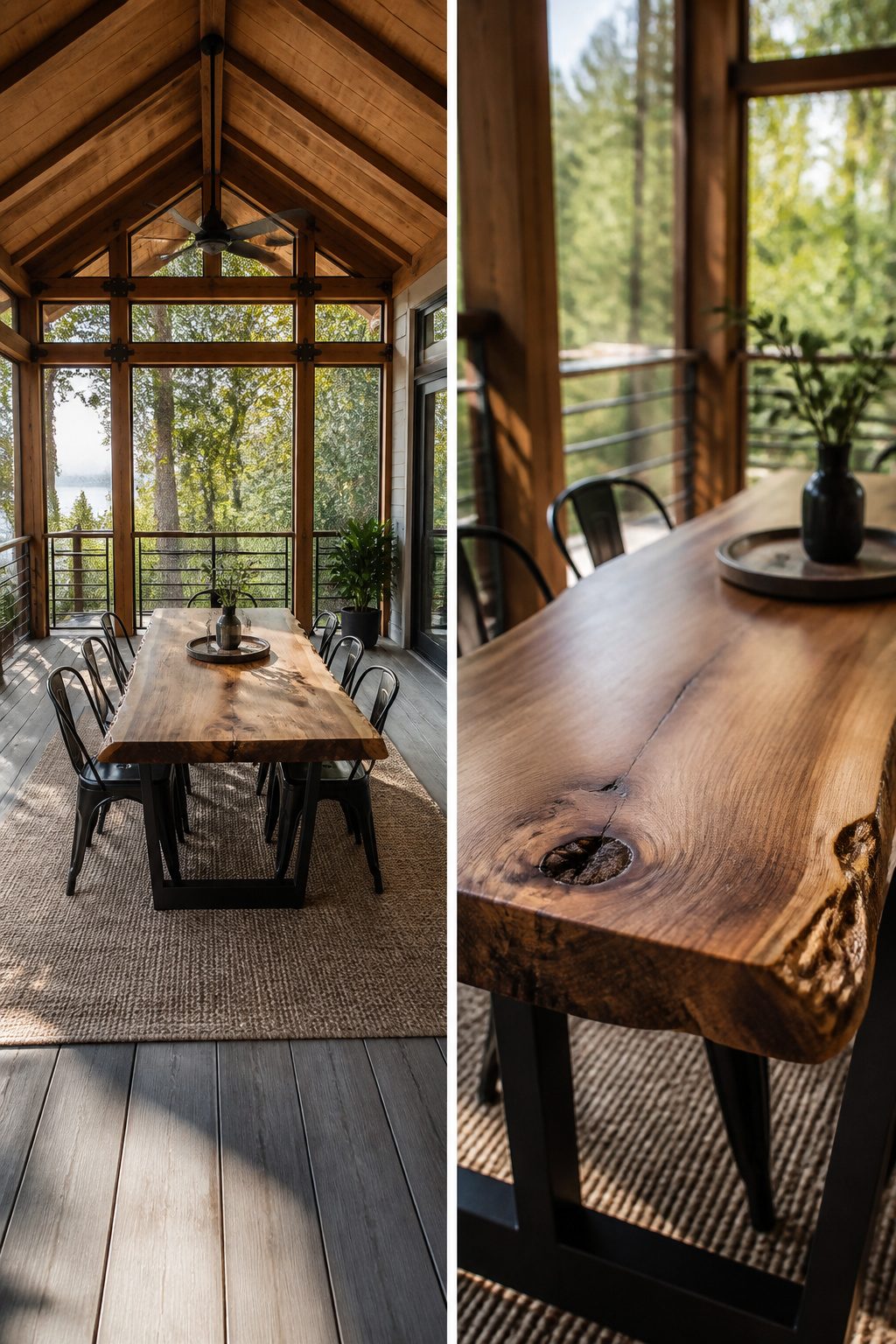
Rough material needs restraint to read as modern rather than costume. I learned this the slow way with a maple slab I bought green and dried myself.
Six months of stacking stickers in my basement, flipping the pile every few weeks, checking with a moisture meter I borrowed from a friend in construction. I got impatient at month four, thought the numbers looked close enough, and built the live-edge table: hand-planed the top flat, sanded to 220, finished with rubbed oil. The steel hairpin legs went on next, that cold industrial line against the bark edge exactly the contrast I wanted. Two weeks into humid July the slab cracked clean through the pith,because checking the center without waiting for the surface to read the same is a mistake that costs the piece. I had to butterfly the split with walnut bowties, which honestly improved the look, but the lesson stuck.
The porch where that table now sits has only three elements with any rustic weight: the table, one rough-hewn cedar post I left unsanded, and a wool throw in natural oatmeal. I tried adding a reclaimed barn-wood bench last spring, and the space tipped into something that felt like a restaurant chain’s idea of a lodge. Two rustic notes read as intentional; four read as theme. Let one piece carry the story and keep everything else clean: flatweave rug, simple cotton cushions, powder-coated metal chairs. The tension lives in the restraint.
15. Tailored and Traditional
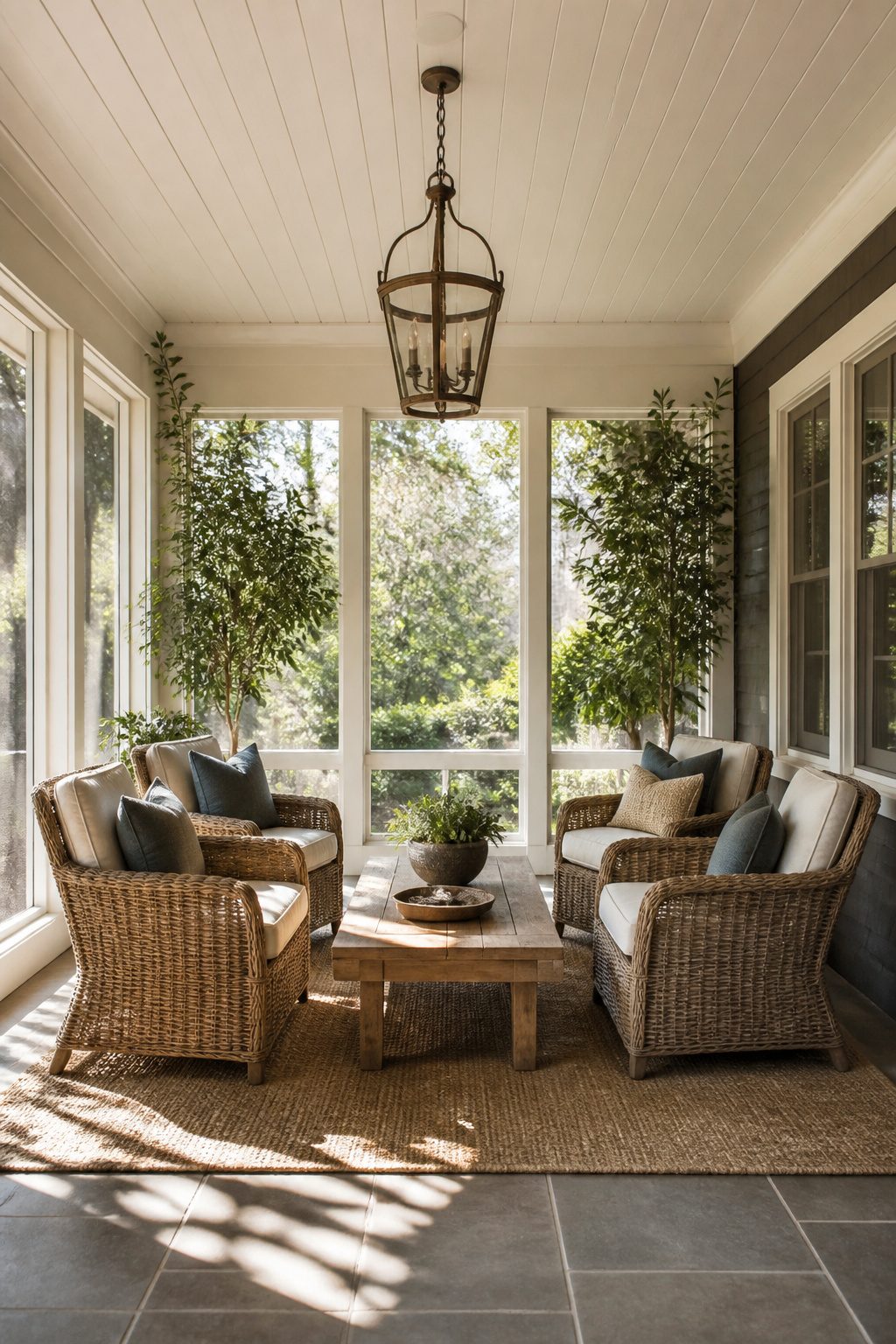
Symmetry reads as intention on a porch, and a central light fixture is the quickest way to get there. I planned the whole layout around one, then opened the ceiling box and found the junction four inches off-center, a lag from whoever wired the space decades ago. A plaster patch, sanded flush, moved the mount without replacing wire. The fixture I hung is a simple seeded-glass pendant, $180 at a big-box store, against a nearly identical hand-finished model at $450 that would have eaten a quarter of my annual budget. Pairs of wicker armchairs flanking a low table now look deliberate. Last season I tried one eclectic set, and it looked like I had collected leftovers. Two matching pairs, even inexpensive ones, signal that someone made a choice.
16. Fresh Lodge Feels
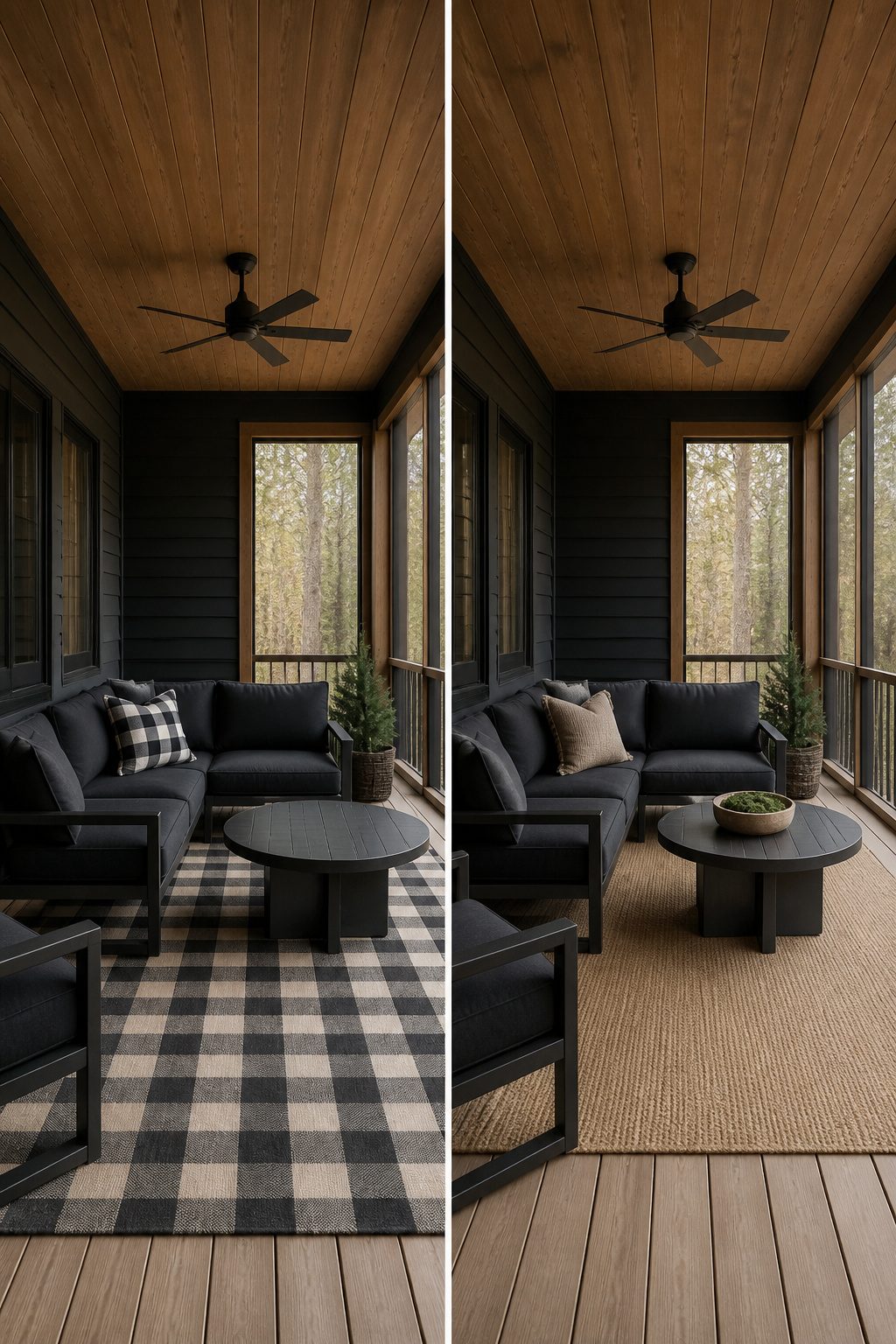
Buffalo check reads fast as costume if you let it spread. A full set of plaid curtains against screens turned my first pass into a theme park version of north-woods living. The fix was using the pattern twice and small: one throw pillow in black-and-cream check, one 2×3 flat-weave rug with the same grid. Both sit against solid charcoal upholstery and bare pine floor. The eye registers the pattern without the room shouting it.
The antler piece cost a lesson. Real shed antlers on a wall plaque felt wrong as soon as they went up; the weight and the slight organic irregularity pulled focus toward taxidermy and away from the trees visible through the screens. A resin cast went up instead, lighter and more uniform, and it reads as graphic rather than literal. Fake worked better here because it keeps the reference without the biological claim.
Scent was the last detail. A pine diffuser oil sat on the shelf for two weeks before the chemical edge got to me. A small potted pine, the dwarf kind sold as a living Christmas tree, sits in the corner now. It gives the real resin smell on warm days and goes back outside in hard winter.
17. Cottagecore Meets Cabin
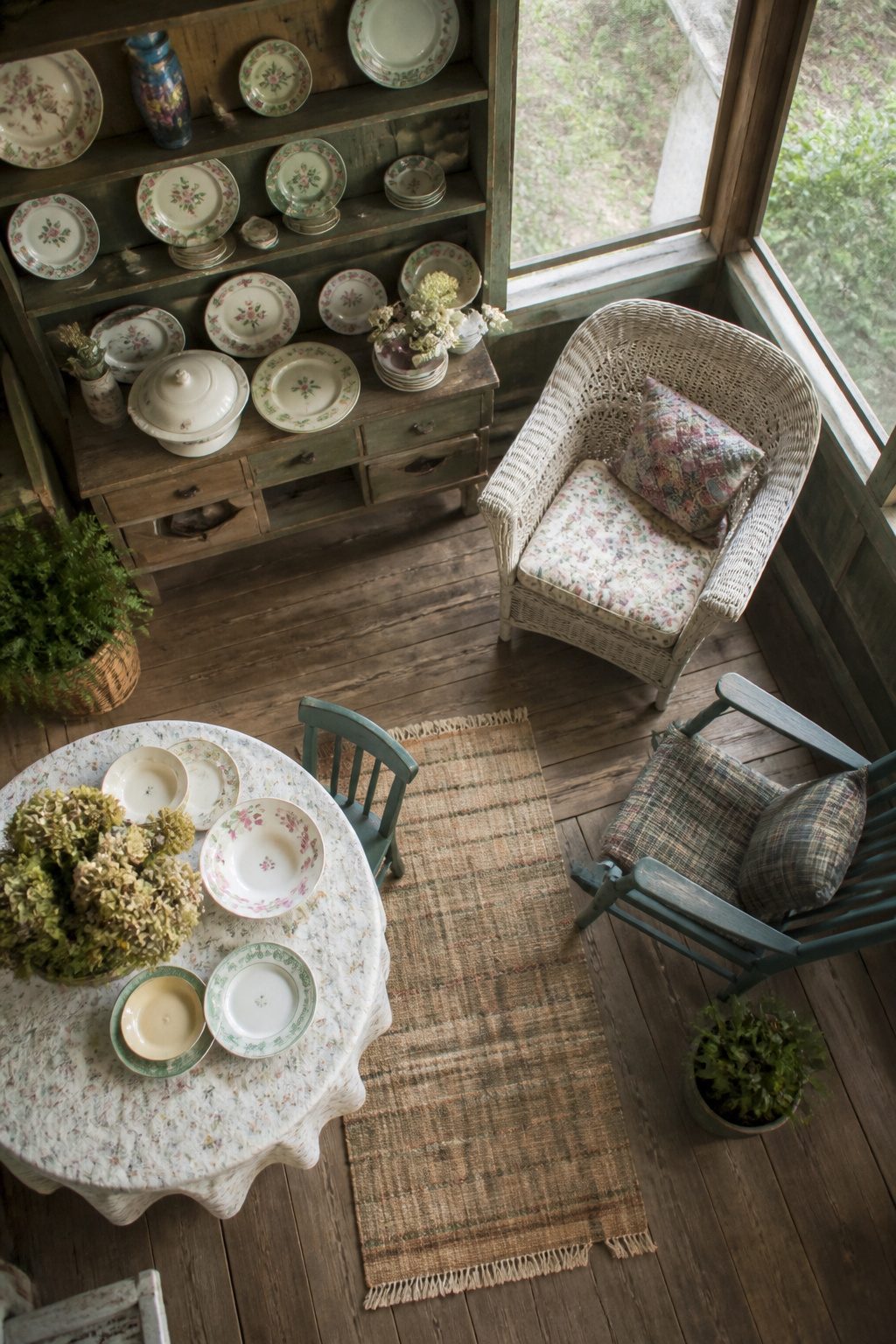
Cottagecore and cabin style share the same DNA: both lean on weathered wood, found objects, and the feeling that nothing in the room came from a single store. The line I draw sits on the difference between collected and manufactured. Floral transferware with a chip on the rim belongs; vines from a craft-store bin do not. Real aging costs patience, not money.
I built my porch dish set from estate sales in two counties. The first pieces, a blue-and-white saucer and three mismatched bread plates, cost eight dollars at a closing farm auction. Over two years I added a gravy boat with a hairline crack, a soup bowl with faded cabbage roses, and enough plates for six settings. The total ran about $60. Last spring I spotted a reproduction set online, same general look but uniform glaze and no wear, priced at $140. The difference is not just the forty dollars saved. The chip on my saucer came from someone’s kitchen in the 1940s, not a factory flaw designed to look like time. That story lives in the object, and a three-season porch is exactly the place for objects that have already survived weather.
18. Black and White Chic
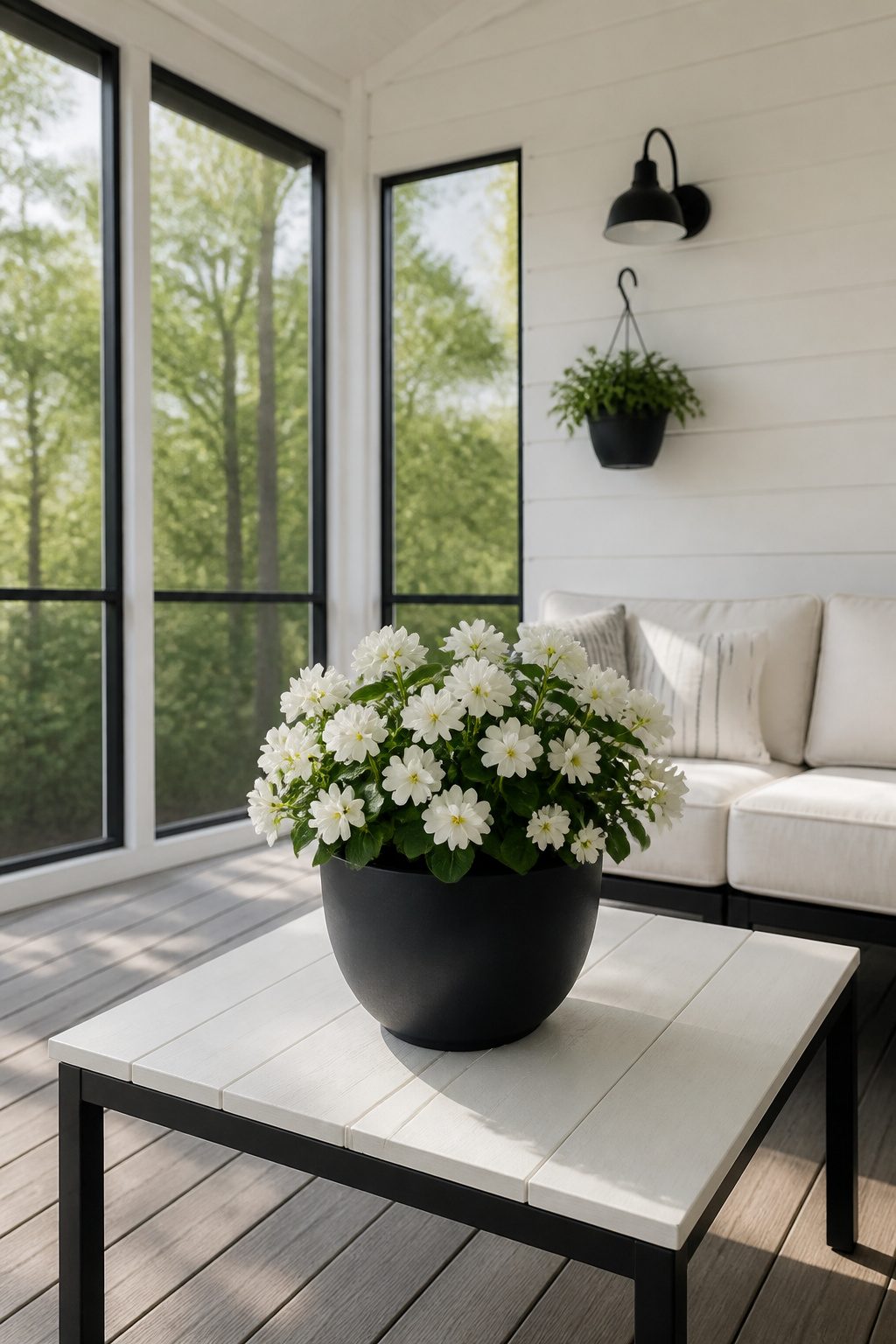
White paint keeps a three-season porch from turning into a mudroom the moment you bring in wicker, wood, and all those textured natural materials. Black, on the other hand, risks cooking the space: I priced out painted black window frames and sat with the sample in afternoon sun just long enough to notice the frame was already warm at the touch. Rejected them on the spot. The compromise settled on black furniture legs and light fixtures, which absorb nothing critical and still give the contrast I wanted against white cushions.
Those cushions need more washing than I budgeted for. Dirt shows immediately, and pollen season turns the seat backs green-gray within a week.
The single black pot anchors the whole setup. A white begonia fills it, the same variety I overwinter in the laundry room. Something about that reversed silhouette, dark container and pale bloom, reads as deliberate rather than accidental in a space that can so easily drift toward beige.
19. Fireside in the Forest
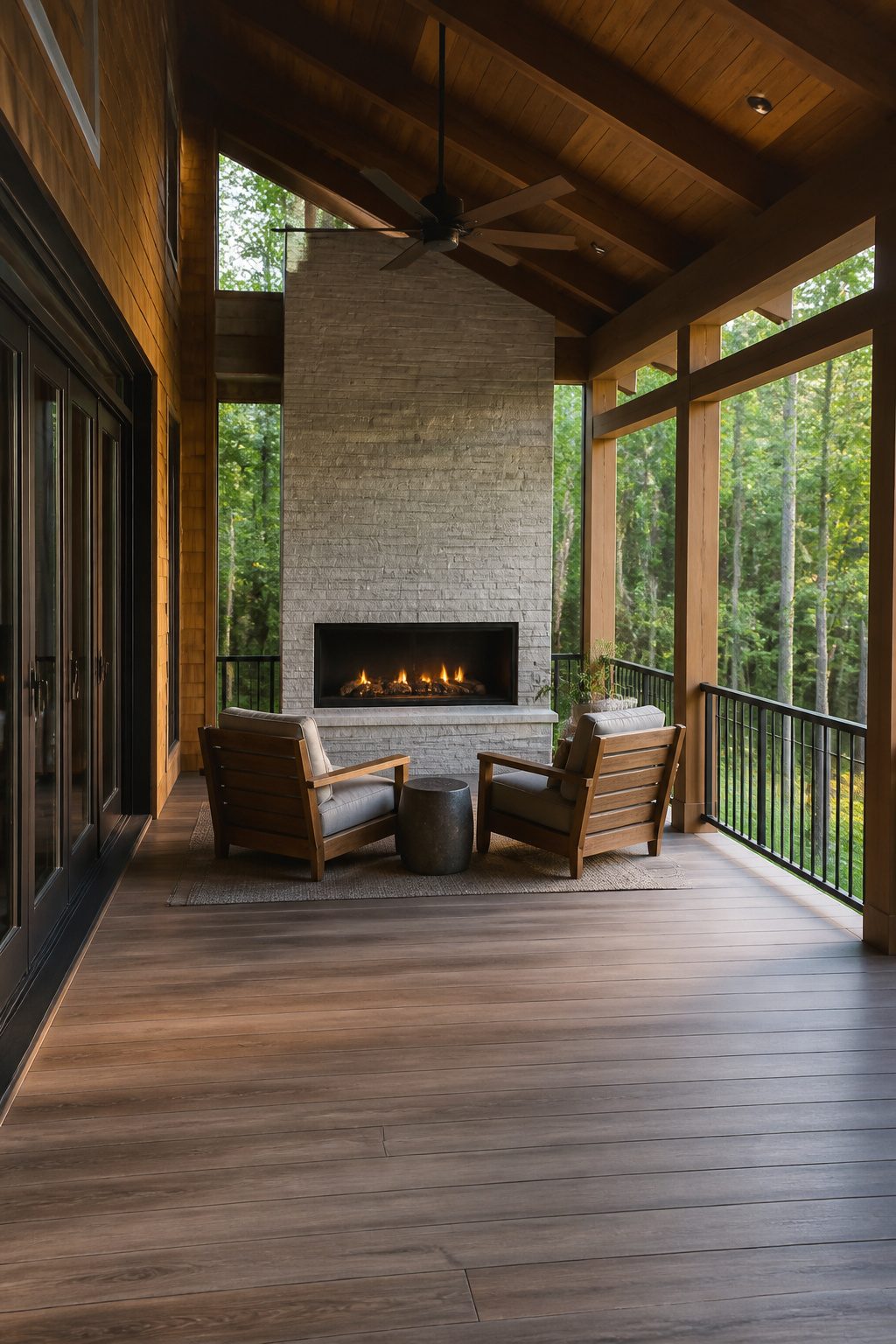
A working fireplace turned out to be the single decision that changed how we use our porch from March through November. I wanted a wood-burning unit, the kind with real split logs and that particular smell, and found a basic model for $800. Local code required a masonry chimney and eighteen-inch clearance on all sides, which would have eaten half the room. The gas insert cost $3,500 installed, but the venting ran through the wall and the surrounding stone could sit flush against the cedar.
The ceramic logs look real enough that guests still ask where I keep the wood. From two feet back you do not notice the difference, and the heat output keeps the space usable at forty degrees outside.
Clearance rules shaped every seating choice afterward. The chair backs stop twenty-four inches from the stone surround, not the twelve I initially planned. That gap feels wider than it sounds, but the chairs still face each other across the hearth without crowding. Two armchairs and a narrow side table fit the width; a loveseat would have blocked the walking path to the screen door.
20. Lodge-Inspired Luxe
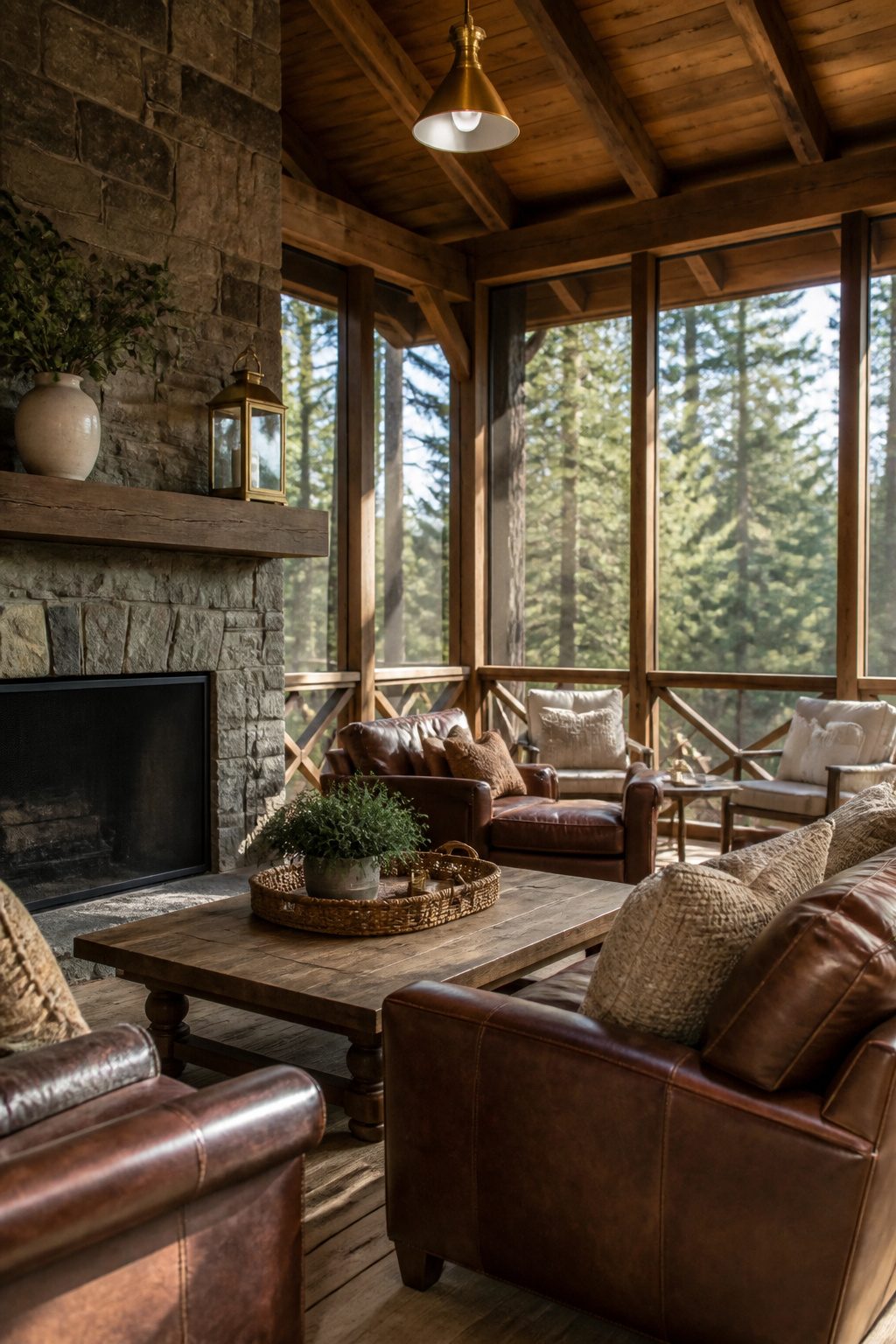
Leather cushions in a rustic space sound right until you price full-grain hide at $85 per square foot and do the multiplication for a 20-by-14 porch. The number stopped me. I considered bonded leather, read the accounts of peeling after one humid summer, and crossed it off the list. What I commissioned instead was a single row of three cushions in full grain, 22 inches square, with canvas backs against the screen frame where no one sits. Brass fixtures came from a salvage yard in Troy, rewired at $75 each. Two flank the door; the space looked crowded with a third, so I stopped there.
21. Fireside Elegance
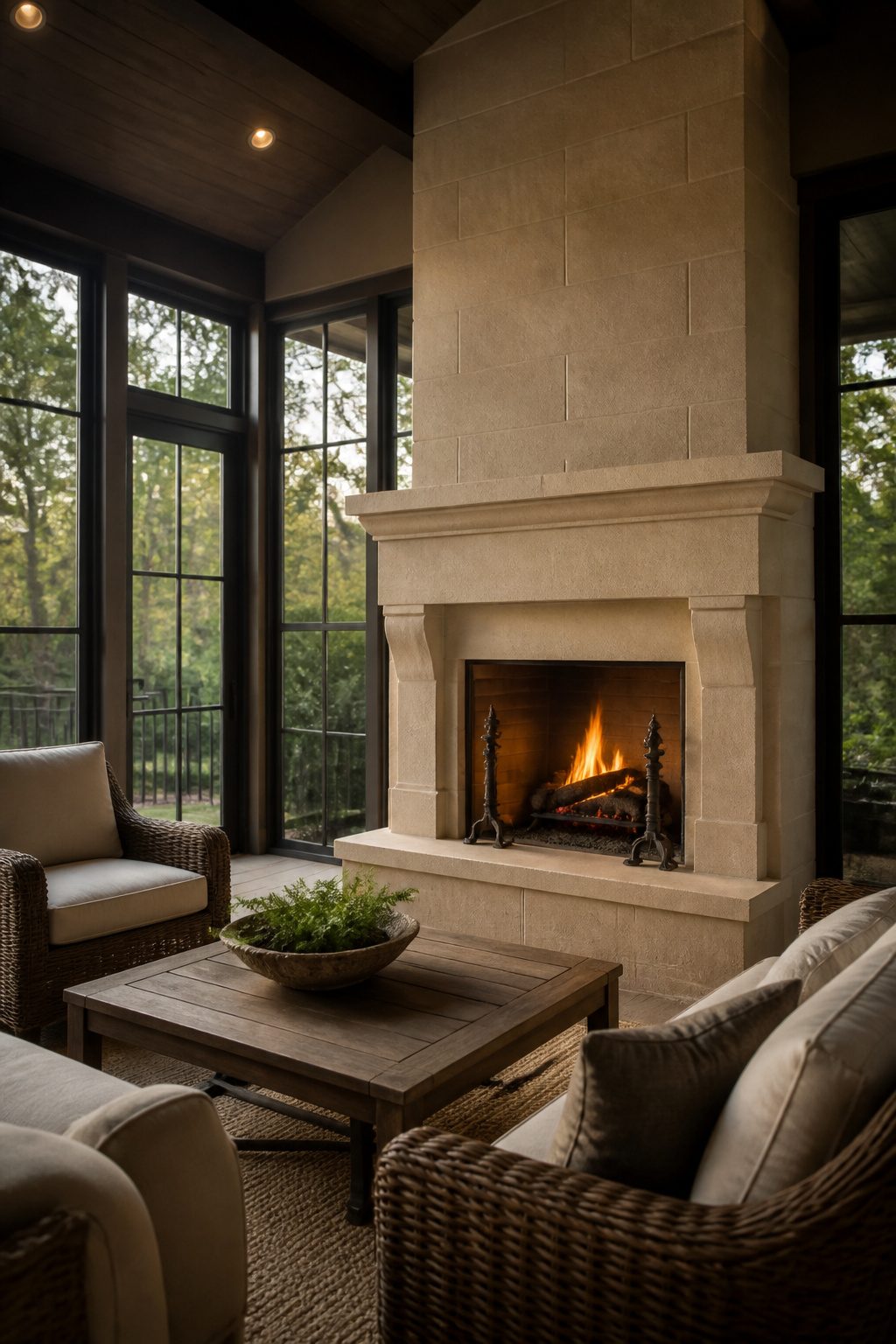
A limestone surround reads quieter than brick against a screened porch envelope. I chose Buff Indiana limestone with a honed finish, and the pale matte pulled light into the room even on a gray October afternoon. In year two a dark stain seeped in from a planter I set too close during a wet spring; the stone drank the tannin and the mark looked like a bruise that would not fade. A poultice of diatomaceous earth and acetone, pressed under plastic wrap and left for thirty-six hours, drew the stain back out to the surface where it wiped away.
The gas insert needs no andirons, but the grate looked bare without a visual anchor. Decorative andirons, cast iron with a simple ball-top finial, cost $120 and do nothing functional except catch the eye. They suggest a hearth that works by hand, and that suggestion matters in a porch straddling the invented and the real.
22. Modern Rustic Glow
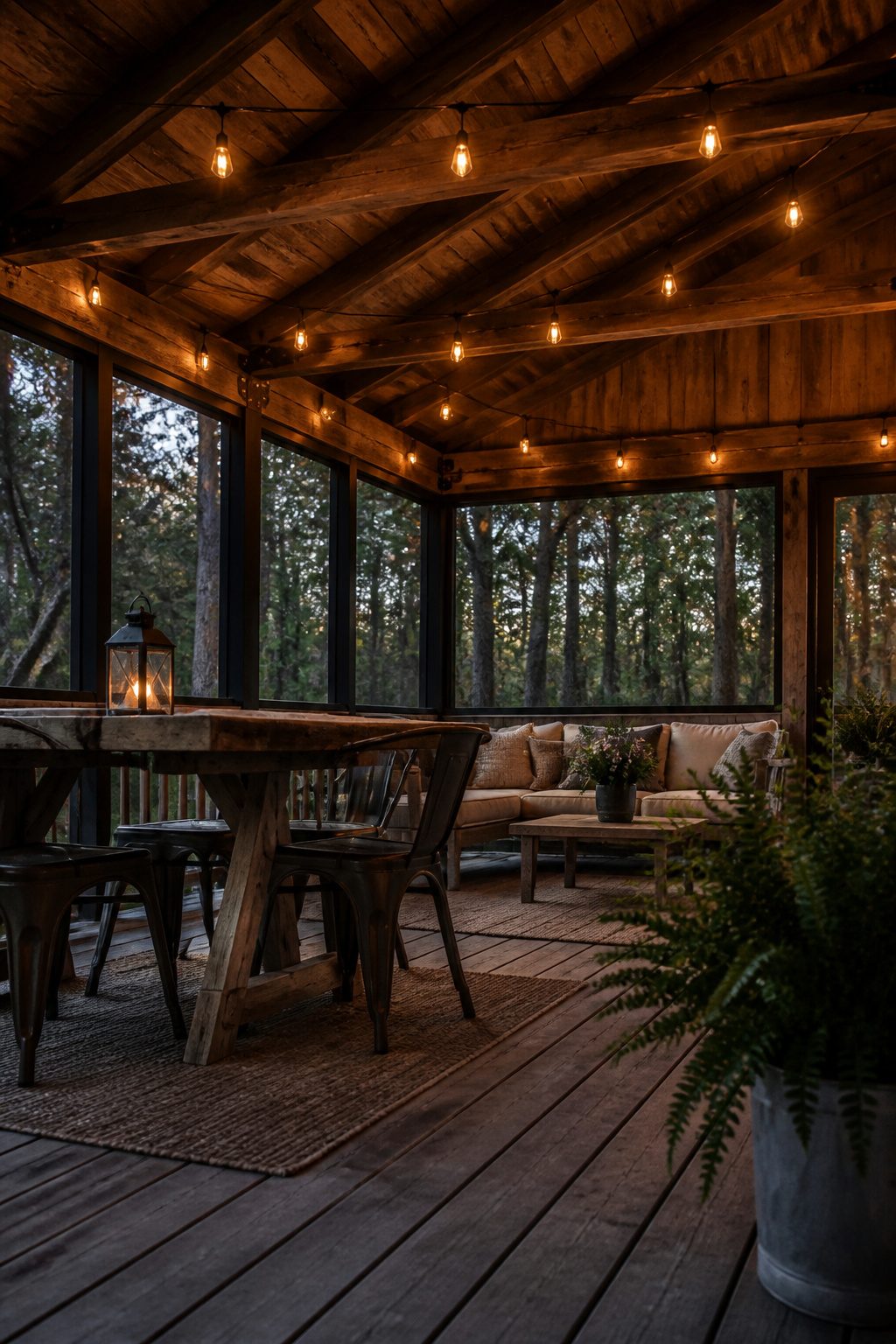
String lights with LED Edison bulbs turned out to be what pulled my porch together after the reclaimed wood and steel furniture kept fighting each other. The rough timber needed something warm, and the 2200K bulbs read like actual flame instead of that 4000K doctor’s-office glare most LEDs default to. 2200K is the number to ask for, not "warm white," which the box can mean almost anything by now.
I chose fixtures with the filament exposed, old-globe shapes where you can see the amber coil through the glass. The look is intentional, not hidden behind a shade. They hang on a dimmer I installed myself after learning the old wiring in my place wouldn’t talk to the newer smart ones. The electrician I called to sort the compatibility ran $95 an hour and spent forty-five minutes rewiring the switch loop. Worth it to avoid flicker, and now I can drop the light to barely there on nights when the porch is background, not stage.
23. Simple Serenity
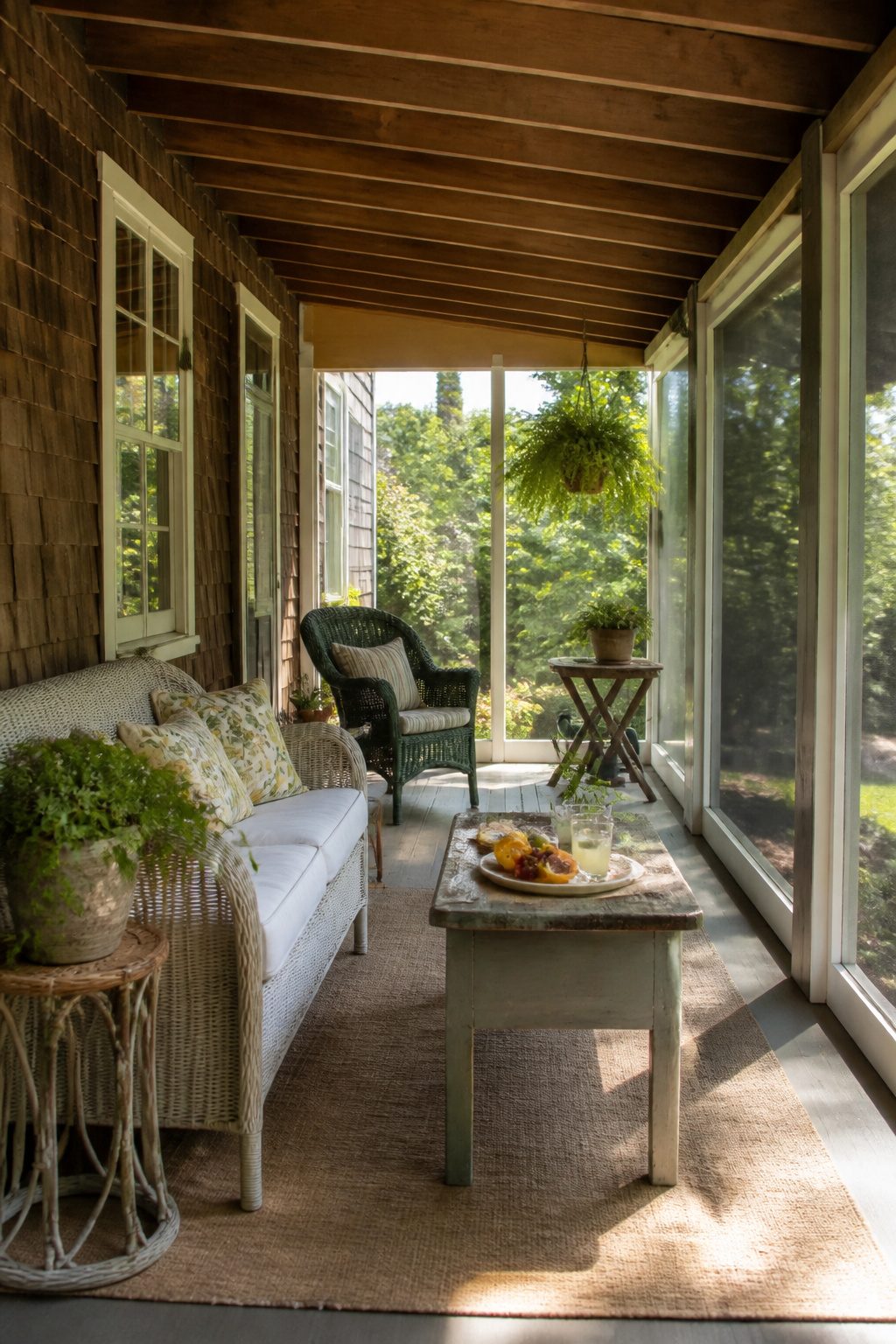
The porch I built for about $3,000 still sits at the back of my house, and it taught me nearly everything I use. I skipped the foundation work entirely, built off an existing slab and roof overhang, and pieced together secondhand furniture from estate sales. No insulation, no HVAC tie-in, no floor-to-ceiling windows. The average sunroom runs $4,000 to $30,000, and this version landed below even that floor because I refused the upgrades I thought I needed at the time.
What I added later: better screening, a small electric heater for October mornings. What I never missed: the integrated heating and cooling, the Thermal wall systems, the glass roof panels. Those belong in the $35,000 builds I have since toured and felt no pull to replicate. A three-season room relies on large windows and natural ventilation anyway, so the gap between my stripped-down space and the fully loaded ones turned out to be smaller than the price tag suggests. The money I did not spend went toward plants that now crowd every threshold, which is where I actually sit.
24. Nature-Loving Nook
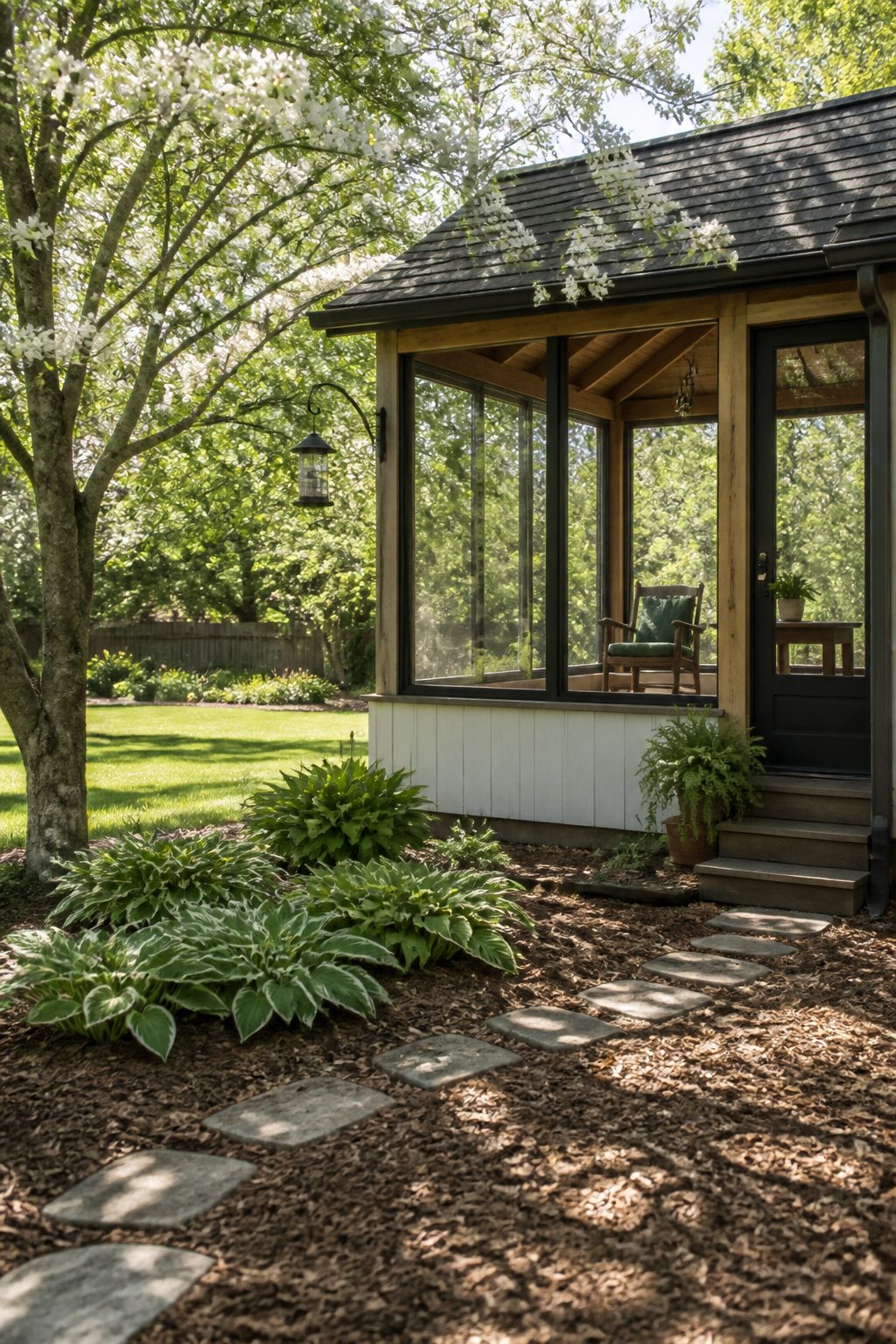
An eight-by-ten-foot porch doesn’t sound like much until you sit in it. I had sketched a twelve-by-sixteen first, the way you’re supposed to want room for a table and six folding chairs you’ll use twice a year. Material quotes came back at roughly $4,000 more for that extra space, and the footprint would have jutted into a dogwood that warblers pass through every April. The smaller frame let me keep the tree and keep four thousand dollars.
My chair faces the southeast corner where a hopper feeder hangs from a galvanized bracket I bolted to the rafter. A second bracket beside the door holds binoculars on a short leash, good ones, 8×42, nothing that needs a tripod. The feeder sits seven feet out, close enough that I don’t need the glasses for the usual sparrows and finches, far enough that they settle again within a minute of my sitting down.
The hummingbird came the third morning after I moved the feeder to that spot. Male ruby-throat, August 14, first light. He fed twice, hovered, and dropped to the water dish I keep on the rail. A twelve-by-sixteen would have put me farther from that rail, farther from the sound his wings made, which is not a hum but a continuous low note, something between a reed and a motor idling. I sat still for eleven minutes. That was the sitting I had actually wanted.
What Three-Season Means
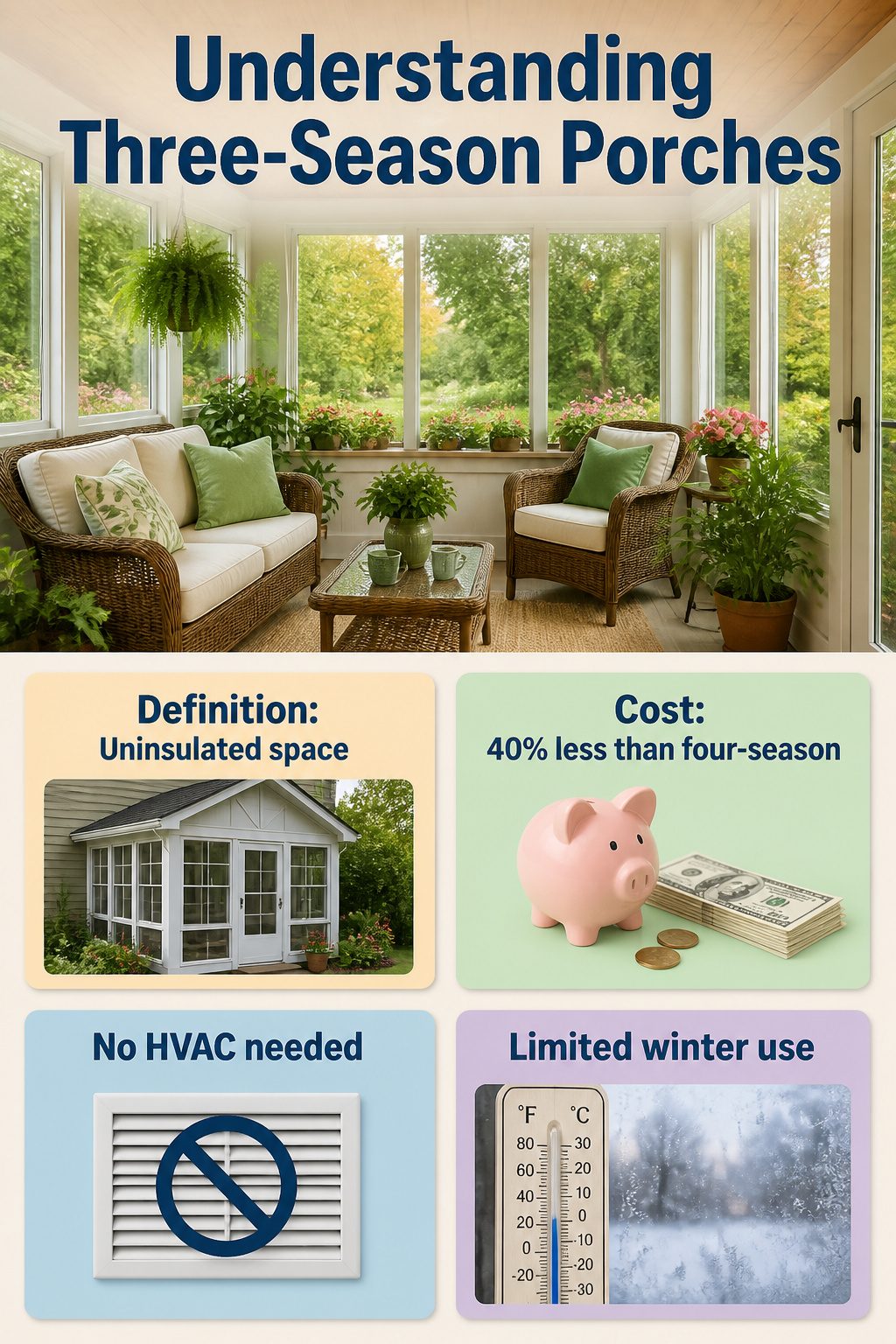
A three-season porch is uninsulated space enclosed with glass or vinyl windows, usable spring through fall but not engineered for deep winter. That definition cost me a Thanksgiving dinner and a window’s worth of frozen condensation to learn firsthand.
The construction gap from a four-season room is HVAC integration. Four-season additions tie into your home’s heating and cooling with insulation rated for year-round occupancy. Three-season builds skip all of it: no foundation extension for frost depth, no ductwork, no thermal-break windows. When I collected quotes for my own build, the three-season route ran about 40% less than the four-season equivalent. The savings sat right where I needed them for a gardener’s budget running roughly $500–$800 a year.
I did try pushing the season once. A portable heater ran that November dinner, and by dessert the glass frames wore a sheet of ice inside. The vinyl windows had condensed, frozen, and begun weeping meltwater onto the sill. The room held 55 degrees at chest height and 38 at the floor. The turkey made it to the table; the guests did not stay long after.
That mismatch between ambition and build type is why I leave the porch unheated now. Spring planting starts out there with coffee. Summer evenings run until the mosquitoes would have driven us inside. October tomatoes finish ripening on the counter by the window wall. November through March, the furniture stays stacked and I walk past it to the back door without lingering.
Windows and Walls
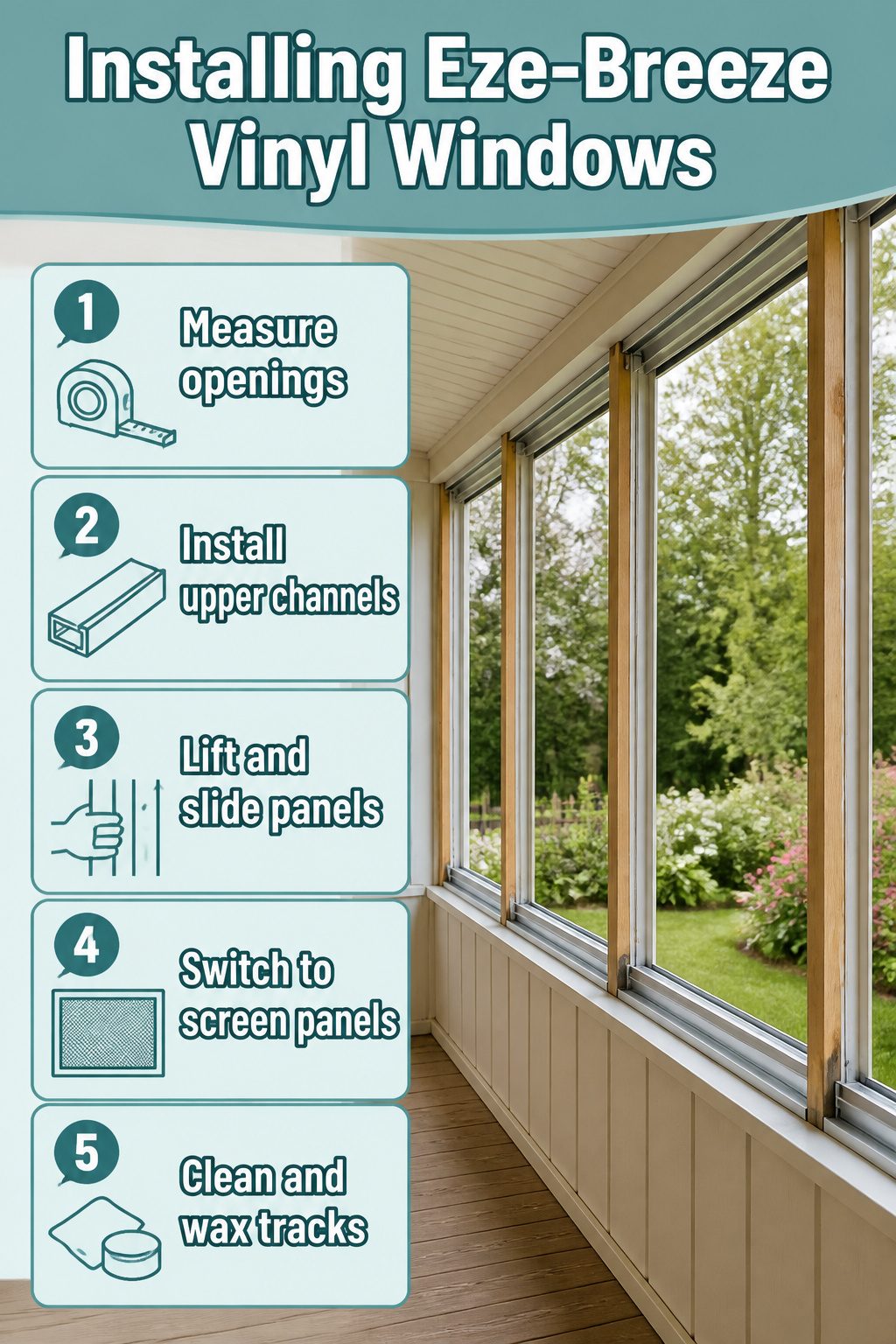
The Eze-Breeze vinyl windows I chose over glass came down to weight and forgiveness. Each panel lifts out of its aluminum track with one hand, something glass would not allow, and the vinyl flexes when a storm flings a branch instead of shattering. The track system itself took a full Saturday to install that first spring, and another to realize I had mounted the upper channels with just enough tilt that panels bound in humid July. I pulled everything down, releveled with a longer level, and learned to trust a 1/4-inch slope toward the exterior for drainage.
By June the vinyl panels come out and screen panels slide into the same tracks, identical heights so the fit is seamless, swapped again in October for the storm panels that stack flat in the garage. The first season I stacked them unmarked and spent an October morning holding panels to windows like a puzzle. Now painter’s tape on the top corner reads "north wall, left of door," and the job takes four hours instead of seven.
The maintenance reality is two full days each spring and fall: one to swap, one to scrub pollen and leaf grit from the vinyl with mild soap, then wax the tracks so next season’s panels glide. It is not optional work. Skip a season and the grooves clog with enough debris that a panel jams mid-storm, which is how I bent a corner learning what "weather-ready" actually costs in hours.
Flooring That Lasts
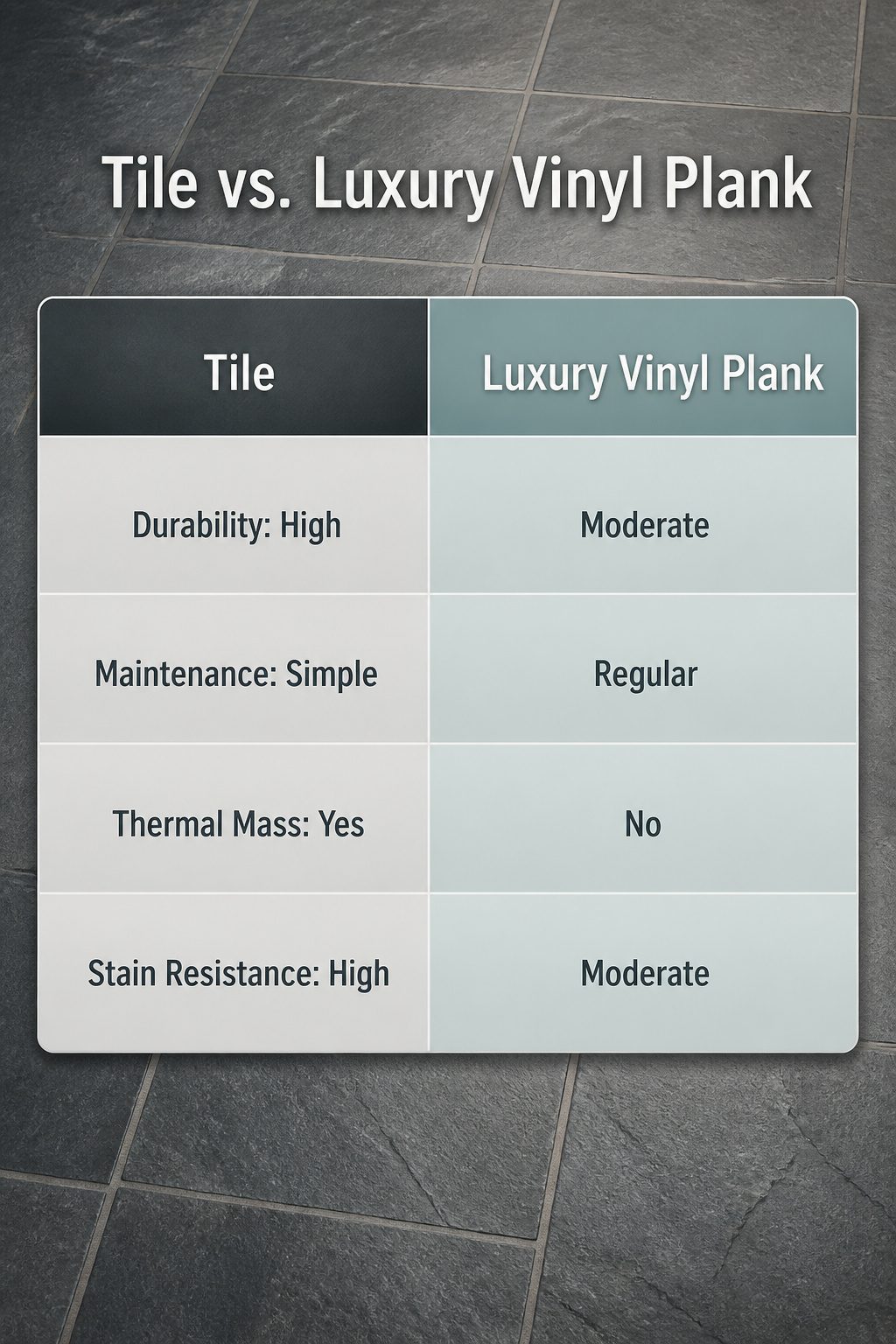
Tile won out over wood and luxury vinyl plank the moment the dog came back inside with muddy paws. The slate tiles I finally settled on, 12 by 24 inches, went down in a staggered pattern that kept enough grout lines to grip wet shoes without turning the floor into a grid. The light gray grout I started with stained inside four weeks, so I scraped it back out and went a shade darker, warm charcoal, and that has held through three years of tracked-in mulch and leaf tannins. An acrylic sealer goes on every spring, after I scrub the whole surface with a deck brush.
The surprise was thermal mass. On an August afternoon last year, the porch sat at 78 degrees while an upstairs room hit 86, measured with the same thermometer an hour apart. The slate absorbs morning coolth and releases it slow enough that the ceiling fan hardly has to run until evening.
Heating for the Shoulder Seasons

Baseboard resistance heaters were the first thing I tried, the kind you wire to a dedicated 240-volt circuit. A 1,500-watt unit kept my 12 x 14 porch at 62 degrees through most of October, which felt like a win until the November nights dropped into the twenties and the unit ran nonstop without catching up. That first heater, only 750 watts, taught me the hard way what undersized means: it clicked on at dusk and never clicked off, and the meter spun like a slot machine. For electric heat on a porch, size to the wattage or don’t bother.
A ceiling fan with reverse rotation did more good than I expected, pushing that stratified heat back down to chair height. The real relief came later with a ventless gas fireplace at 20,000 BTU. I tracked two winters of bills: electric ran about $85 a month in the shoulder season, gas around $40 for the same stretch. I still flip on the baseboard for quick morning coffee when frost is thin, and light the gas for evenings when the temperature plans to stay low. Each has its condition, and neither one alone would have stretched the season as far as both together.
Frequently Asked Questions
What is a 3-season porch?
A 3-season porch is an uninsulated addition enclosed with glass or vinyl windows, usable in spring, summer, and fall but not engineered for year-round heating or cooling. It sits on an existing patio or slab without tying into your home’s HVAC system, which keeps the cost lower than a four-season room. The windows are the defining feature: large panels that open and close like regular windows, unlike the fixed screens of a screened porch.
How much does a 3-season porch cost?
Costs run from about $3,000 for a basic elevated platform up to $35,000 for a full sunroom with roofing and screening. A raised porch with structure and enclosure landed near $15,000 in one example from the article. DIY storm-door panels with removable glass and screen inserts cost around $900 assembled, while Eze-Breeze vinyl tracking systems ran $2,800 for the same opening sizes.
How do you winterize a 3-season porch?
Layer in textiles as the weather cools: a wool rug over the floor in early September, heavier cotton-linen curtains on tension rods inside the window frames, and wool throws for seating. Battery-powered LED pillars with amber flicker add warmth without open flame near fabrics. Two baseboard heaters on separate thermostats, at about $50 each, kept one porch usable into the teens without the $2,000–$4,000 cost of a mini-split system.