Desert landscaping ideas turn spare water and harsh sun into coherent outdoor space, but only if you repeat what actually survives. Scatter one of every cactus across a small yard and the eye has nowhere to rest; plant totem pole and golden barrel cactus at intervals, as one gardener did with hundreds over years, and the repetition pulls a visitor through like punctuation. The real cost is patience, not water: both species take full sun and reflected heat without pampering once established, yet most beginners buy variety instead of enough of the same thing to matter.
Repeat Plants That Thrive
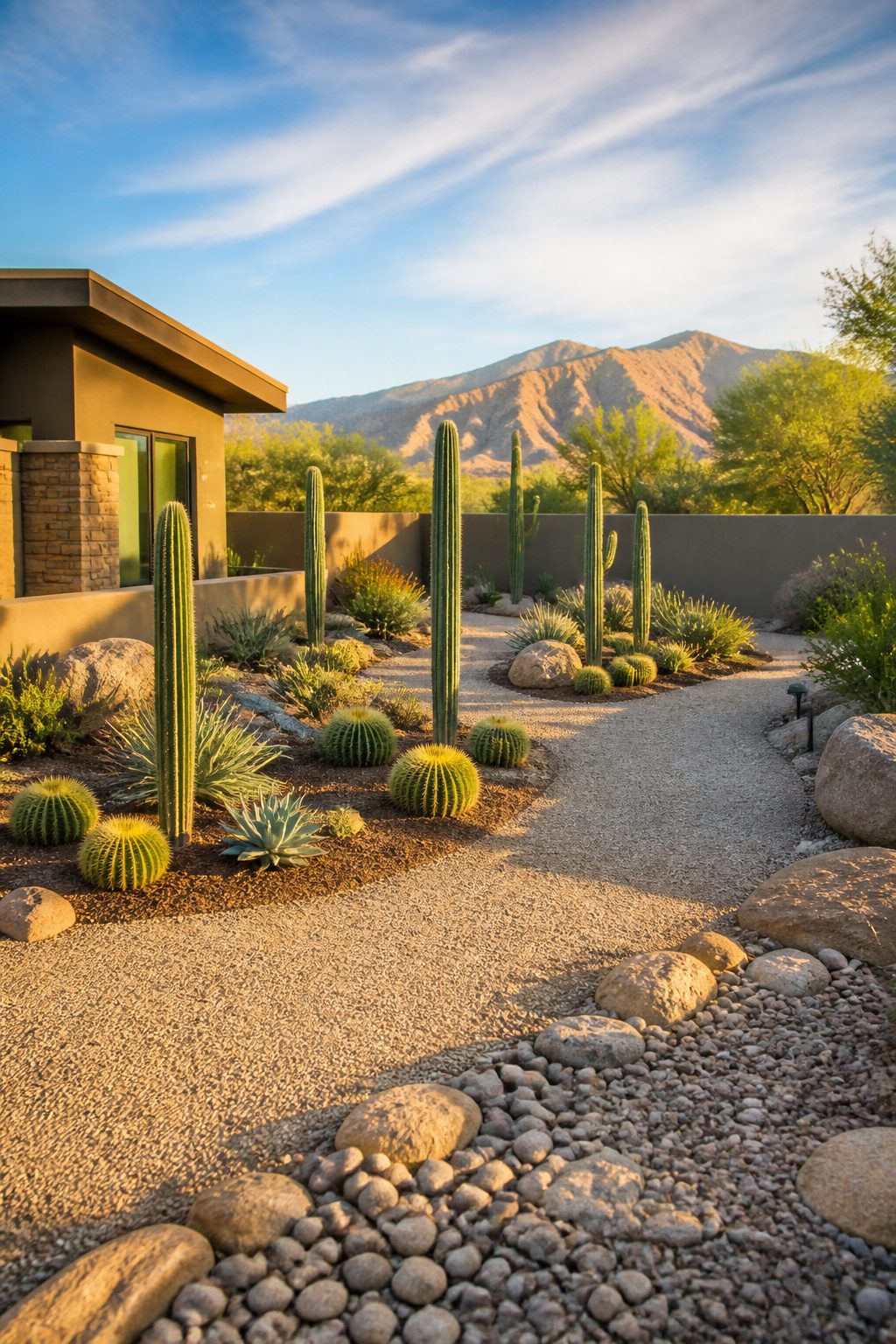
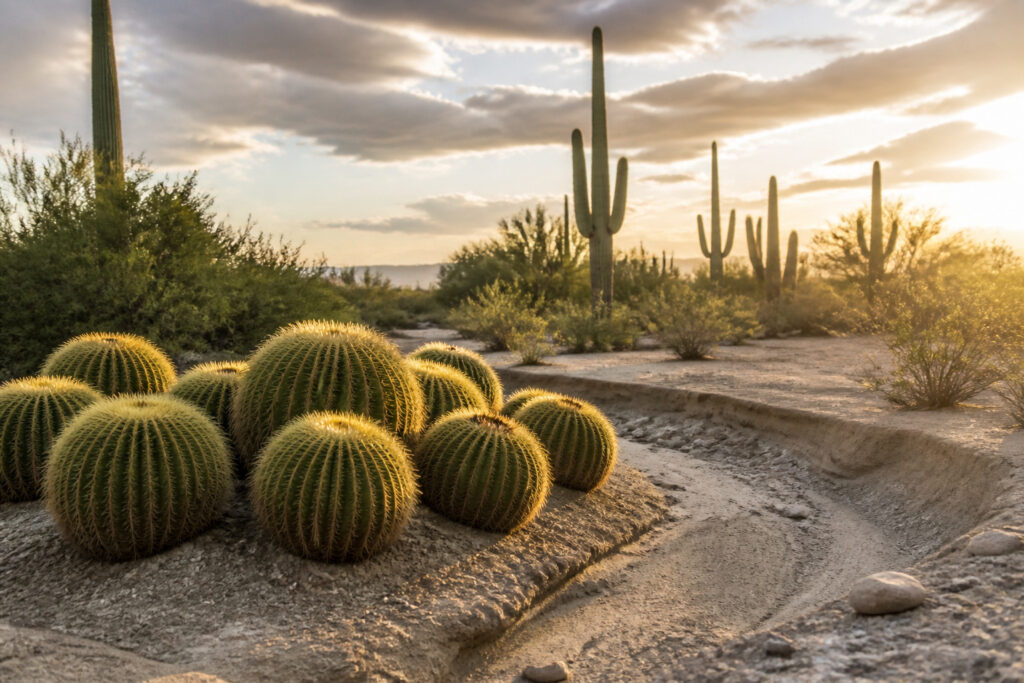
A repeat planting of totem pole cactus and golden barrel cactus does more for a small yard than scattering one of every species across the space. Both are zone-9 succulents with low water needs, and both hit a tidy two feet at maturity: the totem pole stays that tall in columnar form, while the golden barrel spreads the same in a sphere. Repeating them at intervals pulls the eye through the yard like punctuation marks in a sentence.
I learned this from watching gardens that failed the opposite way. A neighbor once planted fifteen different cacti, each single and precious, and the result looked like a plant sale left out overnight. No rest for the eye, no path through the space. Janet, on a property nearby, went the other direction with hundreds of totem poles and golden barrels propagated over years. The repetition gave her garden a coherence that random variety never achieves. Both species take full sun, both handle reflected heat off hardscape, and neither asks for pampering once established. For a gardener spending carefully on a small desert yard, that reliability matters more than novelty. Plant three, then five, then seven of the same thing before you reach for something new. The design will tell you where to stop.
Architectural Salvage and Local Sculpture
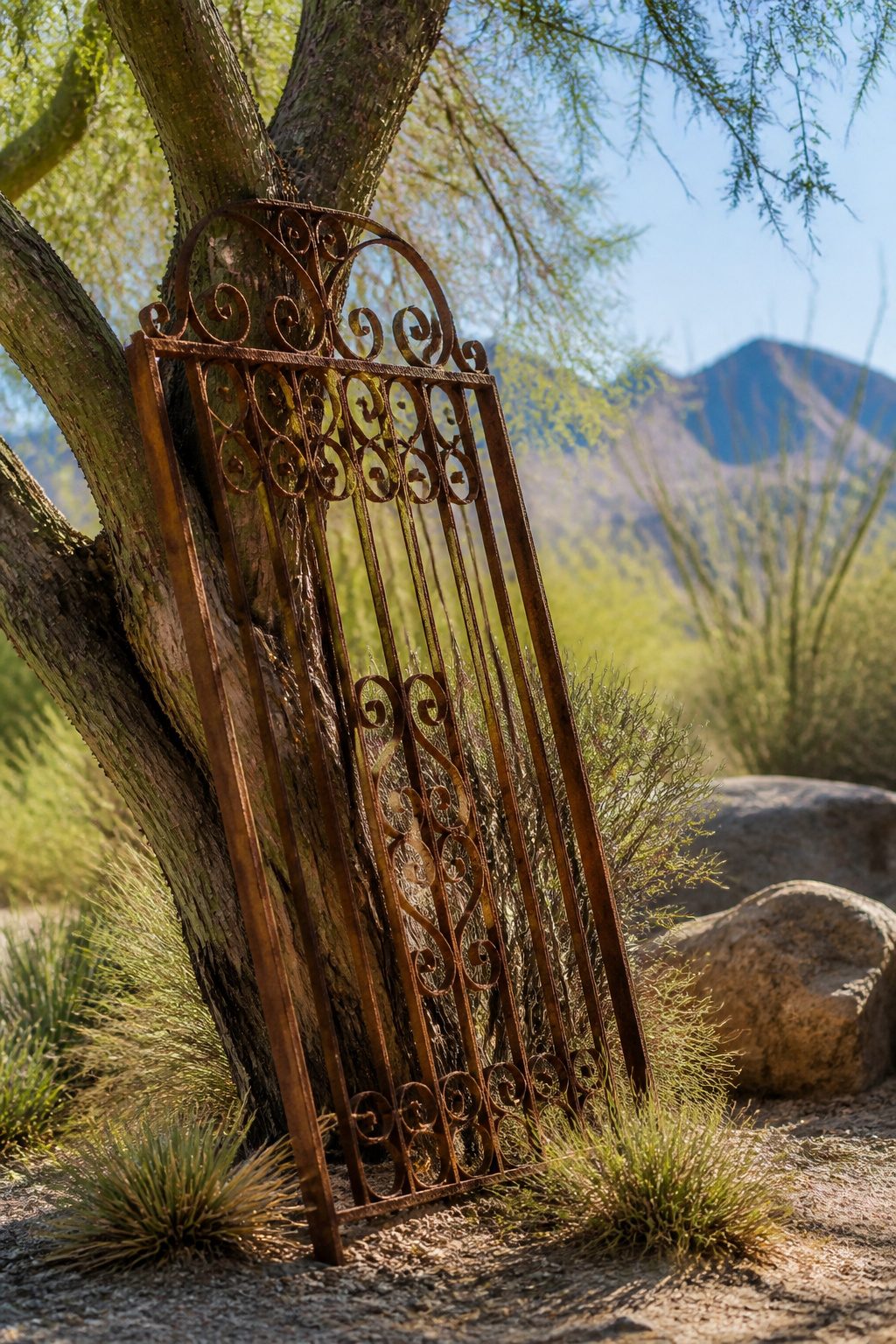
A rusted gate leans against my palo verde and does more work than any garden-center angel ever could. The trick is provenance. Salvaged iron, old warehouse windows, or a grill pried from a demolished facade carry the actual history of where you live. They weather in place instead of arriving pre-weathered.
I hunt salvage yards after spring rains, when metal shows its real rust pattern and I can test heft. A piece that topples in March wind belongs in a corner with sagebrush anchoring it, not center stage. Heavy gates work as backdrops for agave; lighter grates need wall mounting or they wander.
Local sculptors matter here too. Hunt down artists in your county who work in steel or rammed earth. A piece forged two towns over collects the same dust and sun-bleaching your garden does, so the conversation between object and slope feels honest. One sculptor I followed for a year does** perforated cubes that throw lattice shadow at 3 p.m.** That predictable geometry against wild creosote is the whole point.
Cost stays flexible. Salvage runs from scrap price to antique markup. Set your ceiling before you walk in. I do not buy on story alone; the story is free, the iron is not.
Color and Whimsy in Ceramic and Metal
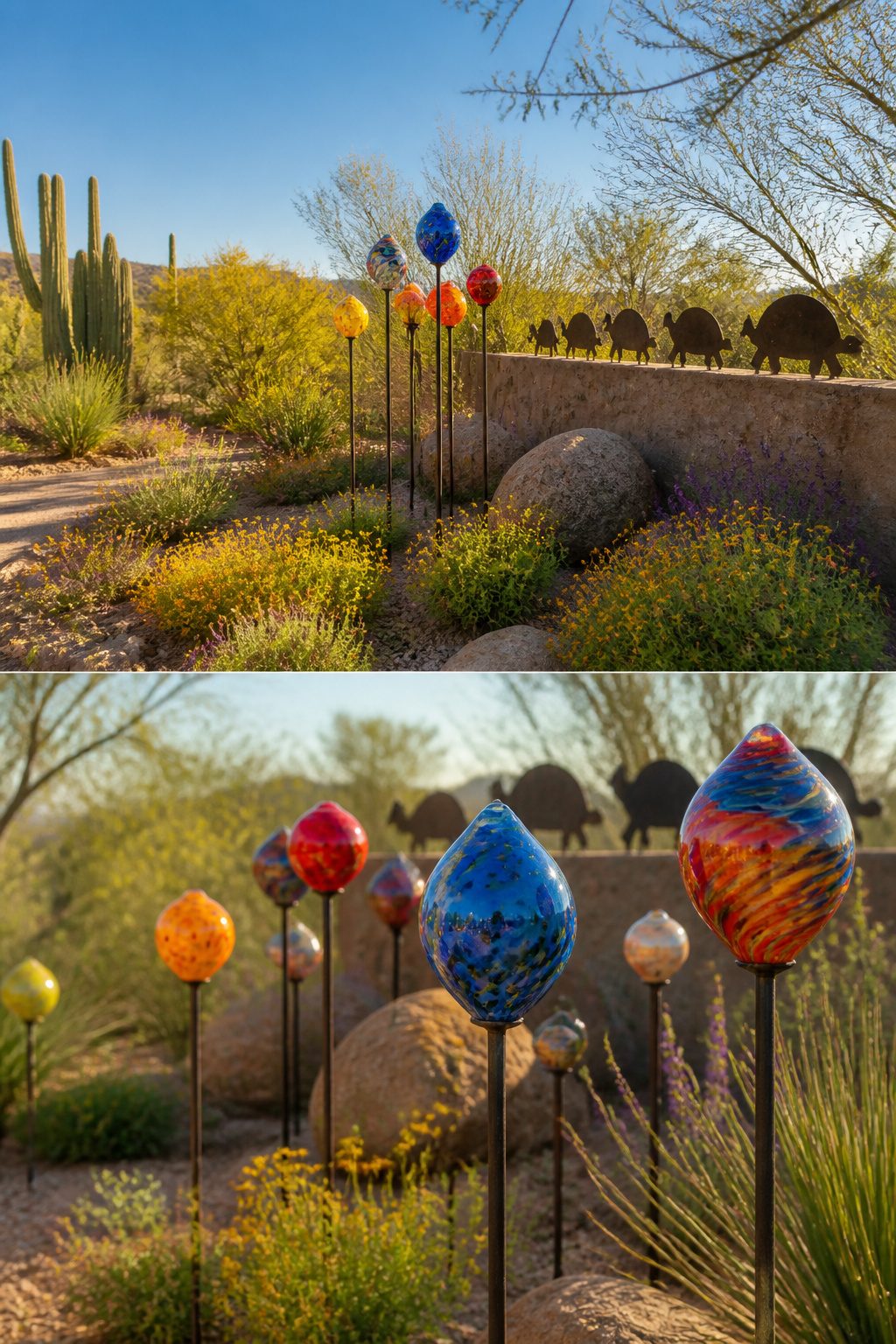
Bright ceramic sculptures and metal art keep the eye moving through a desert garden without adding thirsty plants. Janet Orr stacks ceramic balls and cylinders on rebar poles threaded through their centers, an anchor trick that also works for spray-shaped poles and pincushion forms. The pieces read playful because the shapes are simple and the glazes are saturated; they stop short of junkyard whimsy because someone made decisions about proportion and placement.
Metal tortoises in one dimension, just silhouettes, trapse along a garden wall and hold up to sun and dryness far better than painted wood ever would. For longer-term pieces, a local ironworker can weld found objects into something custom and give it a powder-coated finish that lasts decades. Wrought-iron medallions, gates, or realistic cactus and agave sculptures all benefit from this, and the same shop can curve or cut rods to whatever height the garden needs.
Powder coating beats paint for anything that will bake outside. The metal guy, if you find one who takes residential work, transforms raw material into a vignette that survives 120-degree afternoons without chipping or fading.
Find a Metal Guy
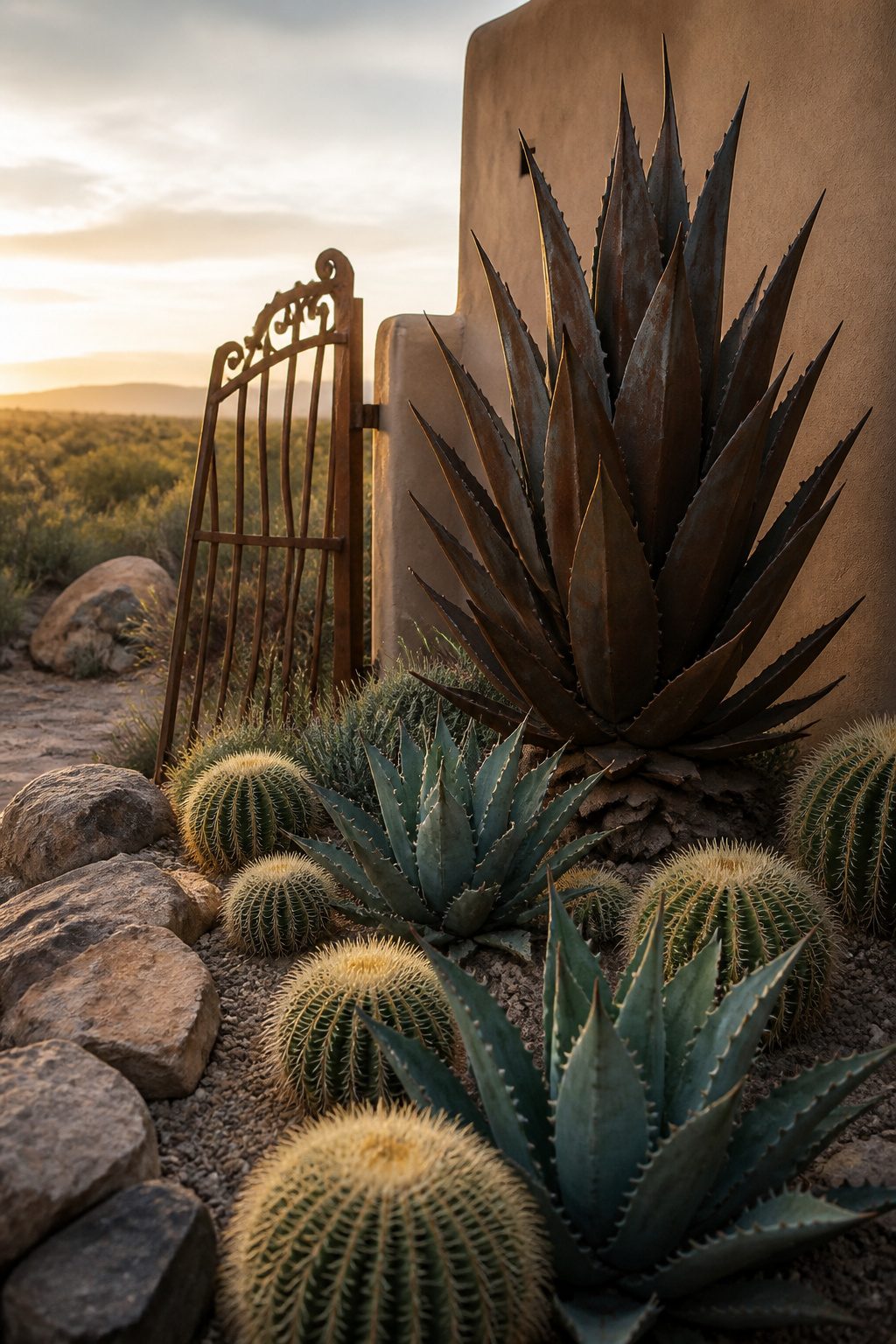
Steel left outside in the desert does not rust away the way it might in a wetter climate. It weathers to a mottled, warm surface that already looks like it belongs there, and it lasts decades without the touch-up paint that wood or resin demands every few seasons.
A local fabricator who welds gates or railings can build you pieces sized for your actual yard, not a shipping crate. Janet’s metal worker made her a wrought iron medallion, a gate, and realistic sculptures of cacti and agaves that sit among living golden barrels and Agave macroacantha. She also sourced a metal-and-glass butterfly and boulders herself, so the scene reads as gathered rather than ordered from a catalog.
Powder coating lets you choose the exact color without annual repainting. The real savings come once you factor in size and freight. A steel agave tall enough to read against an adobe wall costs far more to ship cross-country than to cut and weld twenty miles from your house. A gas-welding shop can also transform found objects, something no mass producer will do. The piece arrives on a truck you could have walked to.
Paint Block Walls
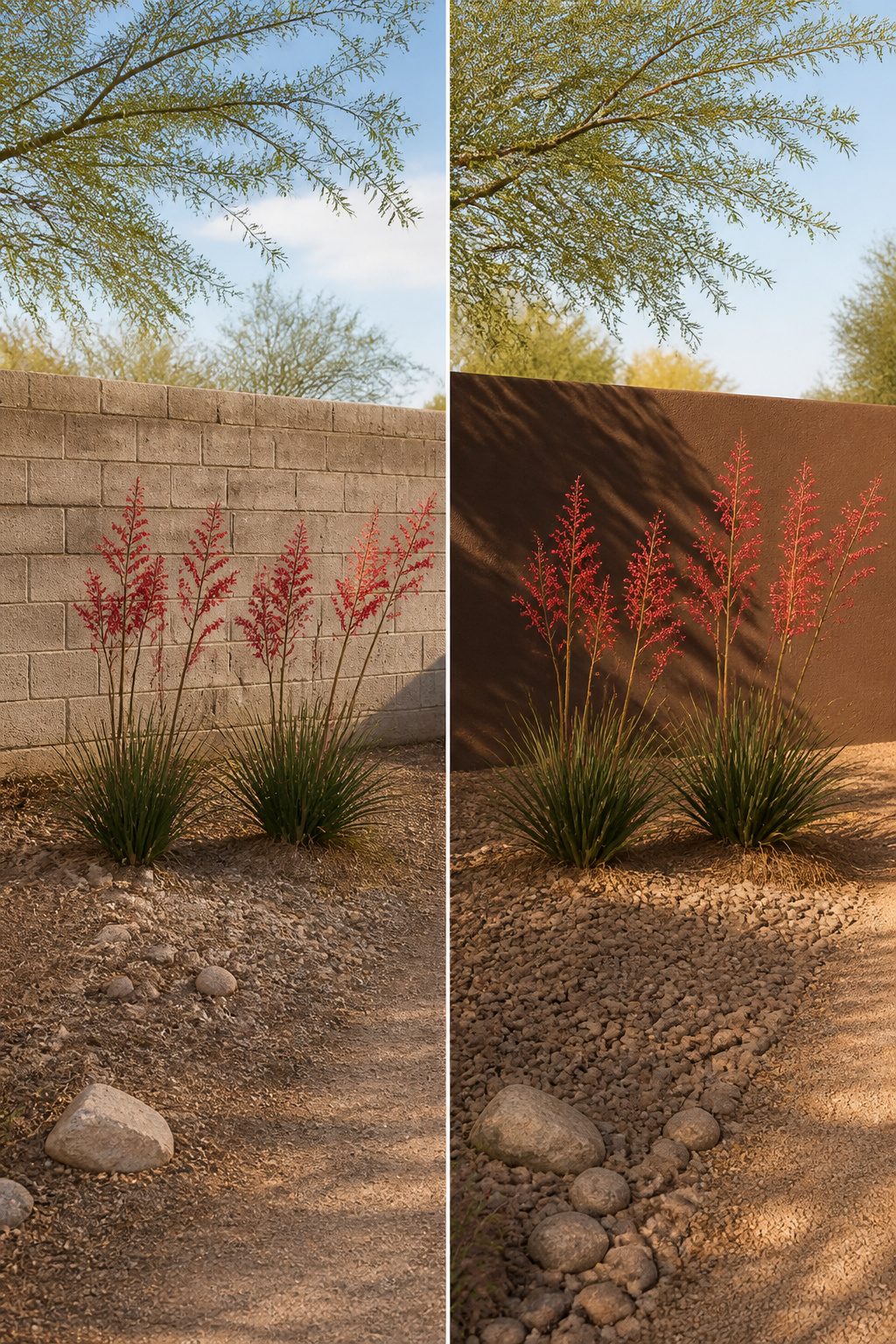
Concrete block walls read like prison yards: gray, pitted, and built to endure rather than invite. A gallon of chocolate brown or reál red changes that entirely. The warm color turns the surface into a deliberate frame, and against it a cluster of cacti or a piece of garden art reads as intentional rather than accidental.
I like this approach because it needs no demolition permit and no contractor. The wrong paint, though, peels in two seasons under desert sun. A quality exterior masonry primer and an elastomeric topcoat cost more upfront than the hardware store’s flat interior, but the job holds for years rather than blistering by the next monsoon. Paint it once, paint it right is the rule here.
Not every wall wants to stay brown forever. Unlike stone or stucco, a painted block wall is reversible. If the color starts to feel heavy in summer, you roll over it. That flexibility matters when you are still learning what your outdoor space wants to become.
Scale and Proportion
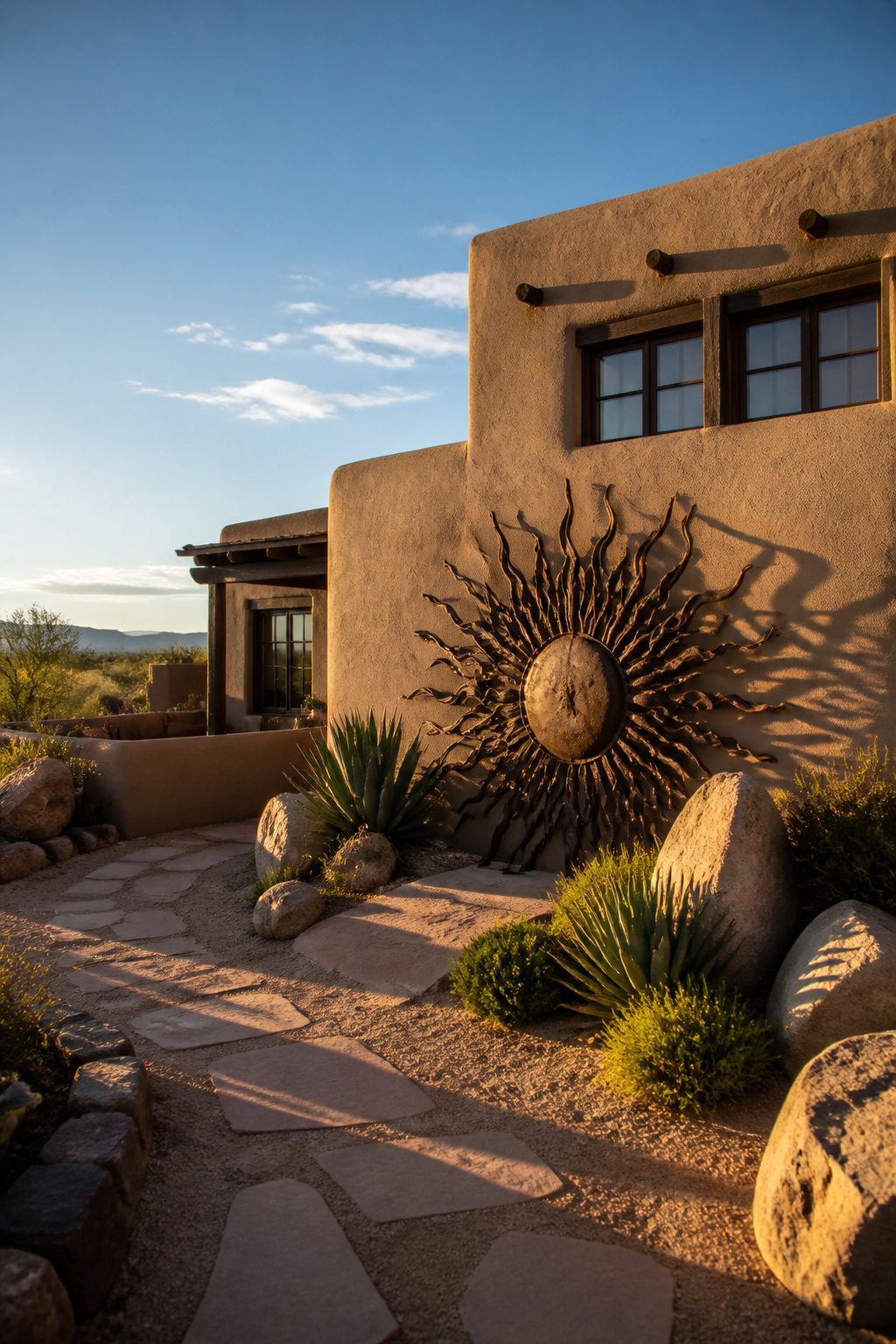
A three-foot sculpture against a two-story wall vanishes. I learned that the hard way with a metal sun disk I thought would read as bold. From fifteen feet back it looked like a dime. Measure twice, place once; the wall needed something taller than me, or nothing at all. The opposite mistake is just as common. A twelve-inch ceramic lizard I set on a narrow path between raised beds became a tripping hazard. Guests stepped around it like it was a rock in a stream. Now I set small pieces inside beds where gravel frames them, or let the wall carry the statement and keep the ground clear. Scale works in plantings too. A single Parry’s agave, thick blue-gray leaves in a tight rosette, outperforms a crowded bed of small succulents. Pair it with two or three boulders that match your local stone and leave open gravel around the grouping. The shape stays visible from a distance and the ground plane stays walkable. Dwarf varieties suit small patios better than full-sized specimens ever will. A bistro set beats a six-chair dining arrangement on a ten-by-ten concrete pad; the space breathes. I check dimensions with a tape before I buy now, not after the truck arrives.
Habitat Planting for Wildlife
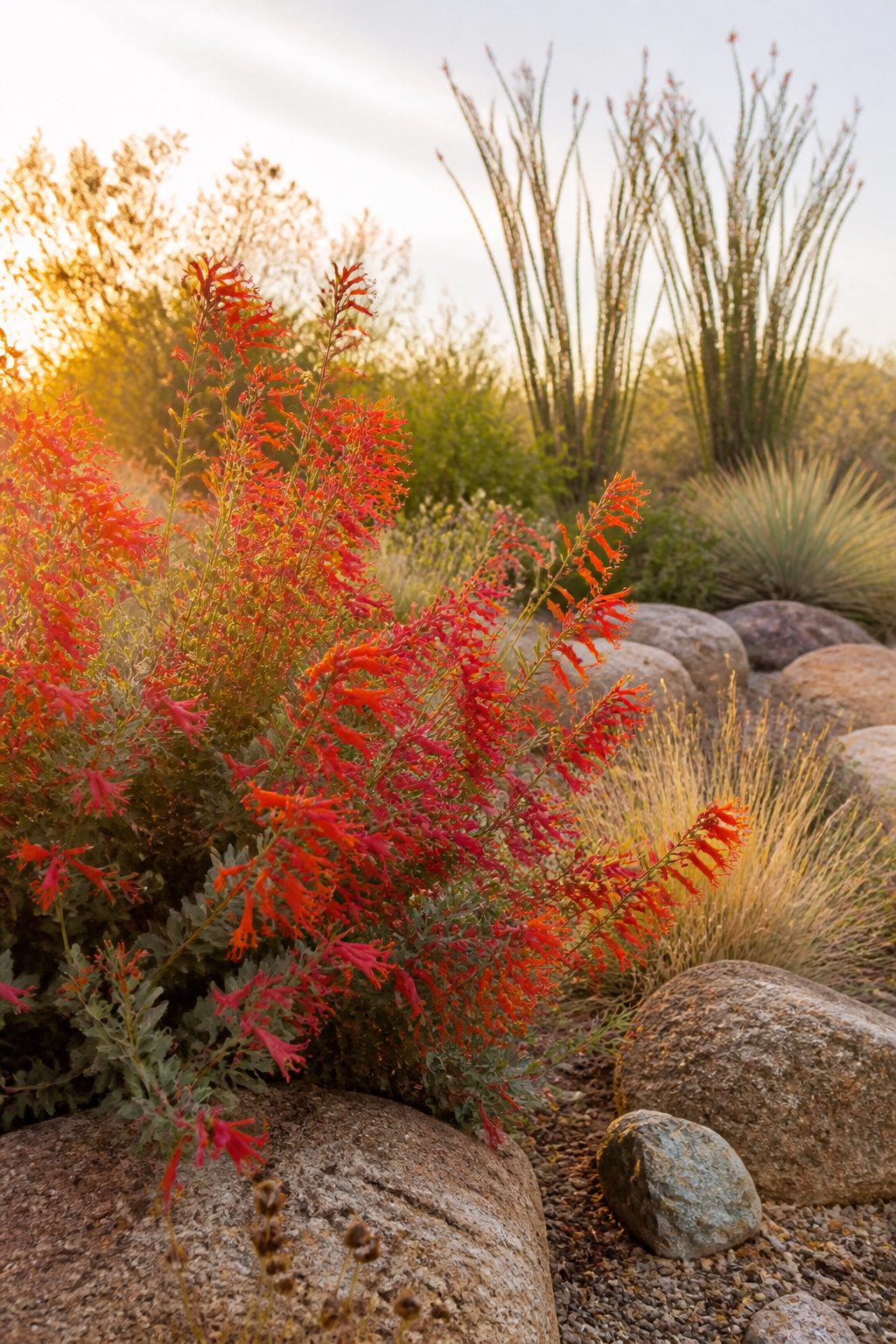
Hummingbirds run on memory. Once a chuparosa shrub trains them to your yard, they will beat the same path through your garden for the rest of the season, and the trick is planting enough of it that they do not drain one plant before the next blooms. Justicia californica, the name nursery tags use, keeps red tubular flowers going through the hottest months when other nectar sources have checked out.
I came to this after watching a single dried-up penstemon strand a male Anna in my neighbor’s gravel. A yard that moves is not a yard full of motion-blur. It means something checks in, feeds, and leaves, and you notice the route when you notice the plant. Chuparosa in a corner brings hummers from the utility line to the porch and back out past the ocotillo, which is the same pattern a wash runs in nature. Bees and butterflies take the same deal if you leave the blooms on and let seedheads form for next year’s volunteers.
A habit of heavy pruning ruins that circuit. The birds already mapped it. They will hover at the twig where the flower was, decide the restaurant closed, and not come back to test again until next migration. Plant two or three where you want them, water through the first summer so roots run deep enough to handle your neglect, then step away. The living part of a desert garden is not what you build; it is what you stopped building long enough to let arrive.
Translucent Plants for Backlight Drama
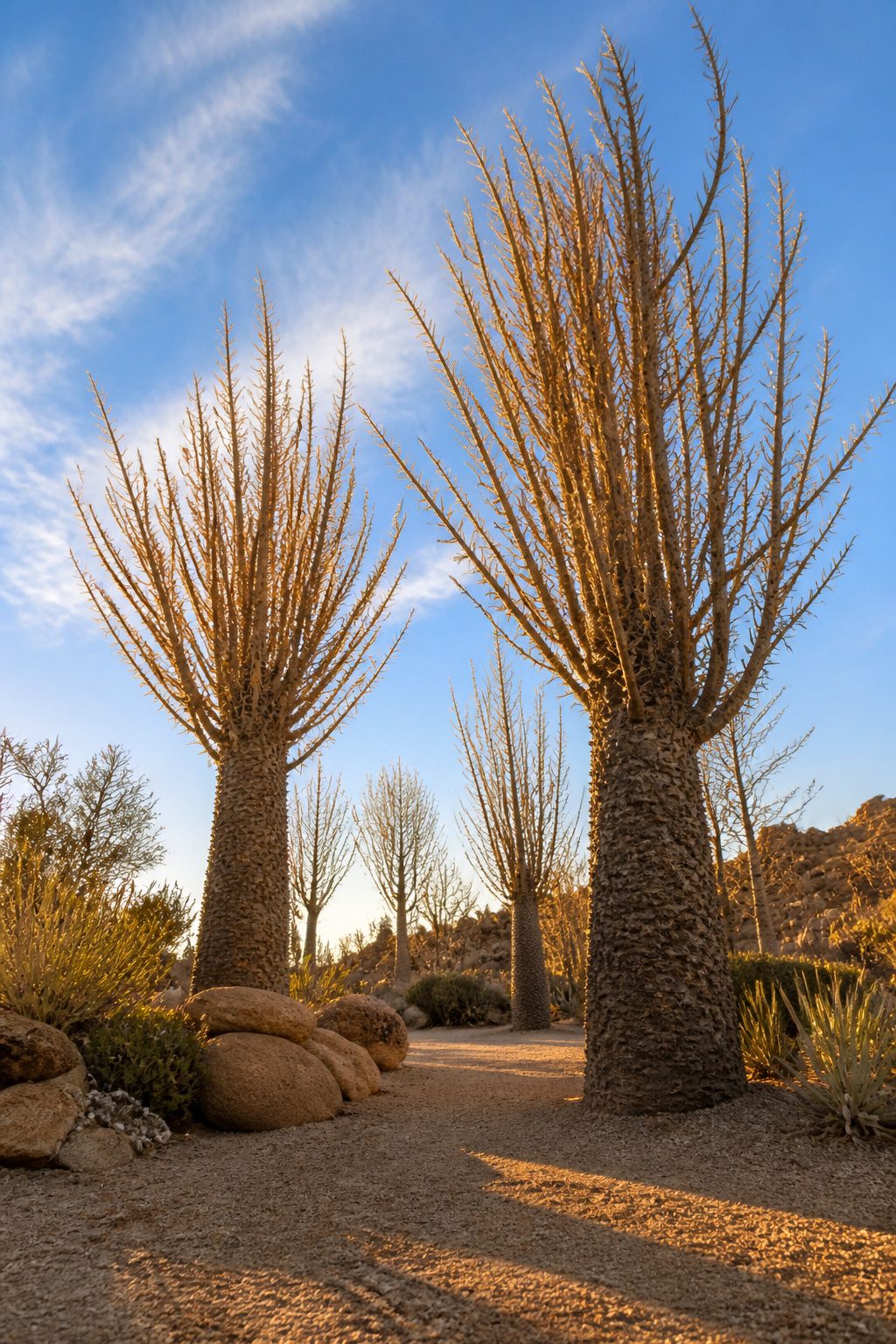
Boojum trees drop their leaves in spring, leaving pencil-thin branches and a tapering trunk that turn into living filaments when the low sun hits them. I first noticed this by accident, not design. The glow shifts from pale gold to near-white as the angle changes, and by evening the whole silhouette goes copper against the sky. Placing one where western light passes through it turns a single specimen into a moving installation.
Fouquieria columnaris asks for patience; the drama is worth the wait. Senna artemisioides works the same trick on a smaller scale, the feathery pods catching backlight like loose seed pearls. Both give you something worth looking at during the hours when desert light is already doing half the work. Position matters more than plant choice here: six feet to the left and you get shadow, six feet to the right and you get glare. The sweet spot is narrow, but once you find it the effect repeats every clear evening without another decision from you.
Circles Against Lines
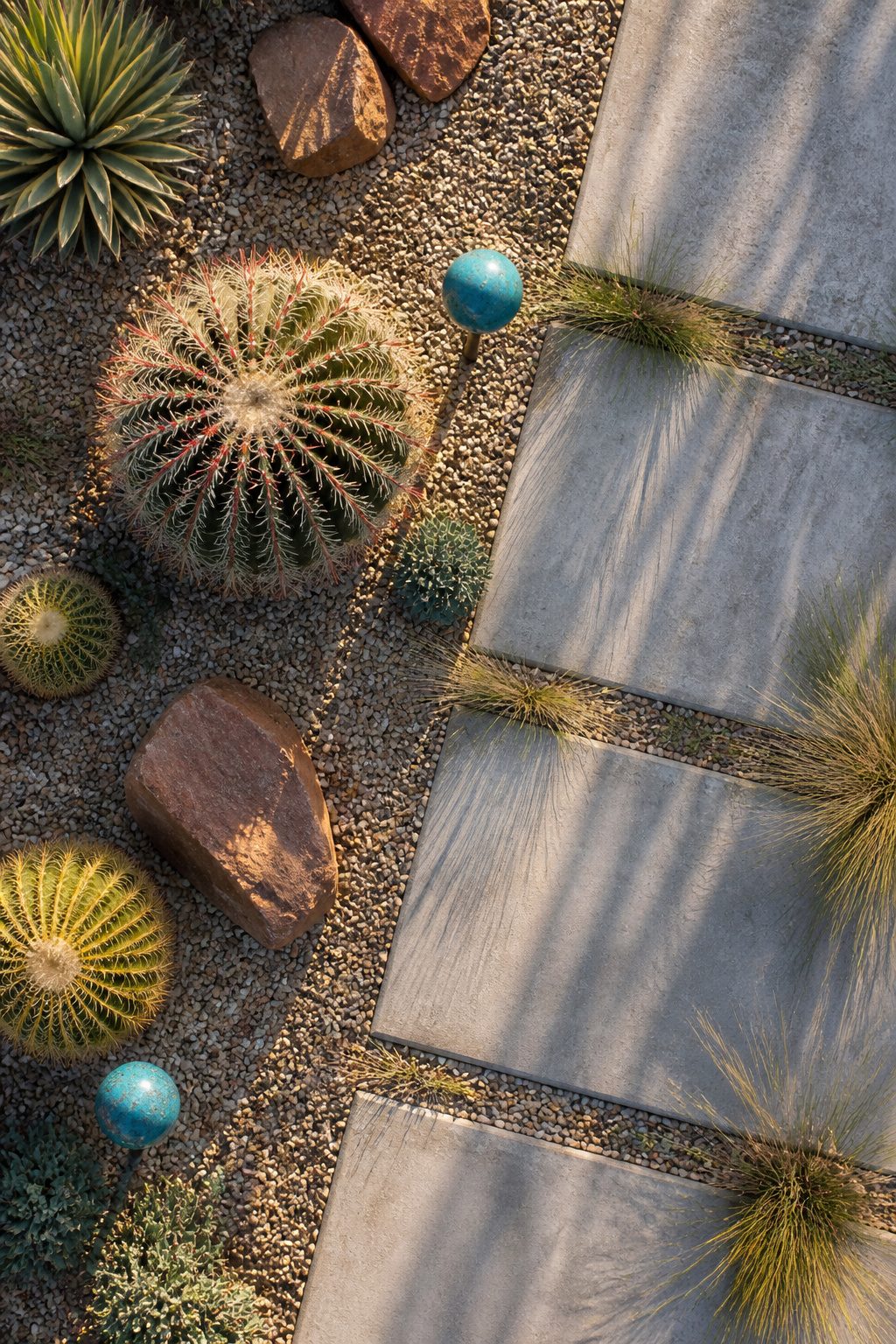
The eye flattens a desert yard fast. Long walls and straight concrete walkways read as one flat plane unless something interrupts them. Barrel cacti, round planters, and curved paths break that sameness by giving the eye a reason to stop and circle back.
I noticed this first on a small patio where a Ferocactus hamatacanthus sat against a painted block wall. The cactus matures to about 3 feet tall and 1.5 feet wide, a nearly perfect orb of ribs and tubercles, and it made the wall behind it look intentional rather than leftover. Two cold-turquoise glazed orbs on short rebar stakes repeated the round form at waist height, so the gesture carried from ground to mid-air.
Curved paths do the same work at ground level. A curved walk edgeworked with broken concrete, the irregular pieces sometimes called urbanite, keeps a straight property line from dictating how you move through the space. The curves slow the walk and hide what comes next, which matters when the lot is small. A circling of rip-rap rock around a French drain opening turns a functional eyesore into a deliberate shape.
The contrast itself is the design. Round against straight, soft geometry against hard. Without it, even expensive materials look flat.
Silvery Gray to Rest the Eye
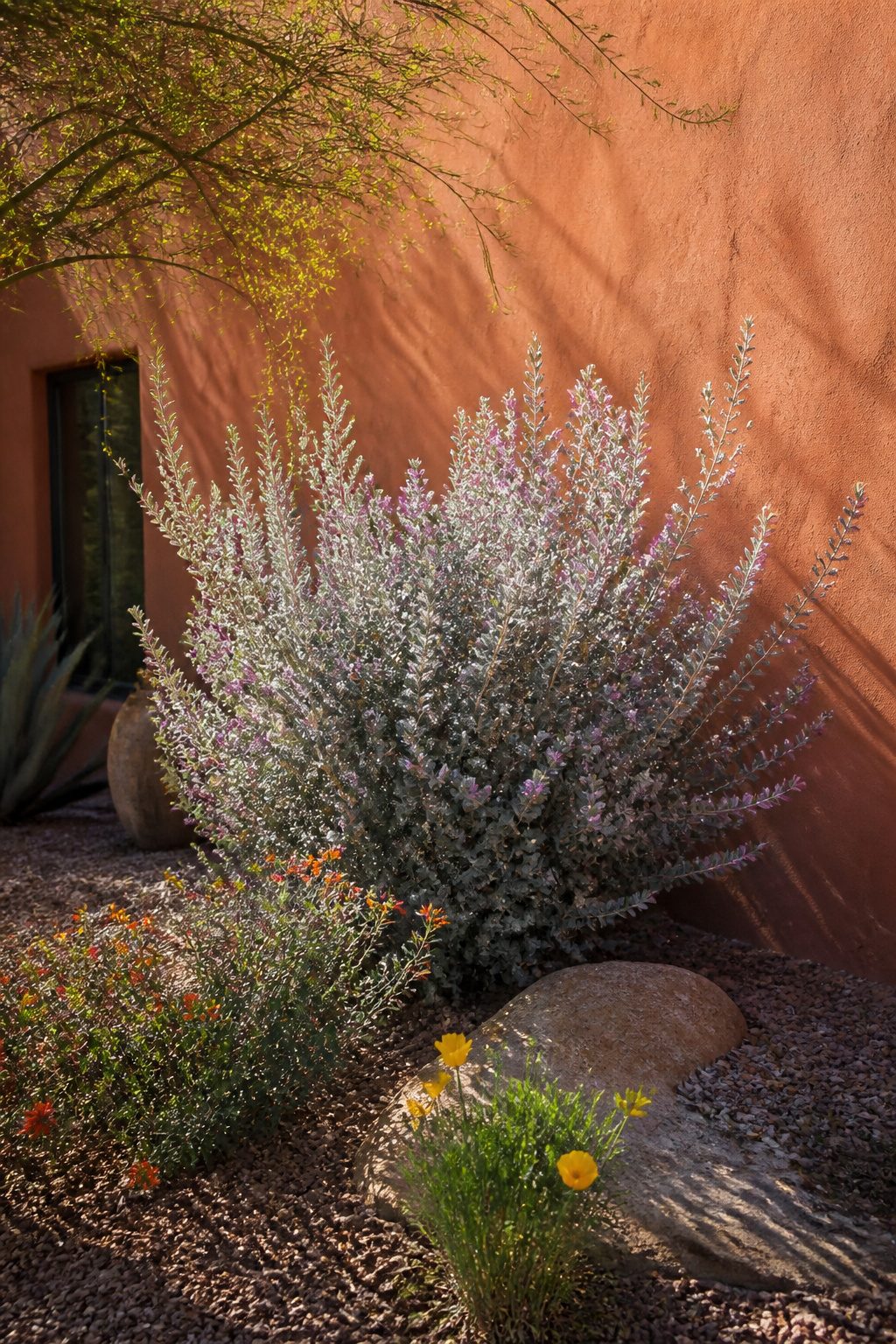
Texas sage sits at the corner of my patio wall where the late sun hits hardest, and that is exactly why it works. The gray foliage reads cool even at noon, a visual pause between the burnt terracotta wall and the orange blooms of globe mallow that come up behind it. Leucophyllum frutescens carries its color in the leaf itself, a silvery green that reflects rather than absorbs, so the eye rests there before moving on.
I cluster the bold stuff first: the red yucca spikes, the marigold yellow, whatever flower is shouting that week. Then I tuck the Texas sage in between, letting it keep a rounded natural shape rather than boxing it in. Some varieties stay compact; others push six feet or more, so checking the mature size before planting saves the mistake of a midseason chop that ruins the form.
Desert snow bush and dusty miller do the same job in tighter spaces, but the sage gives you structure too. Screen an ugly view, soften a corner, or just break up the heat of too much color in one drift. The gray handles the drama so the rest can keep it.
Frame Your Views
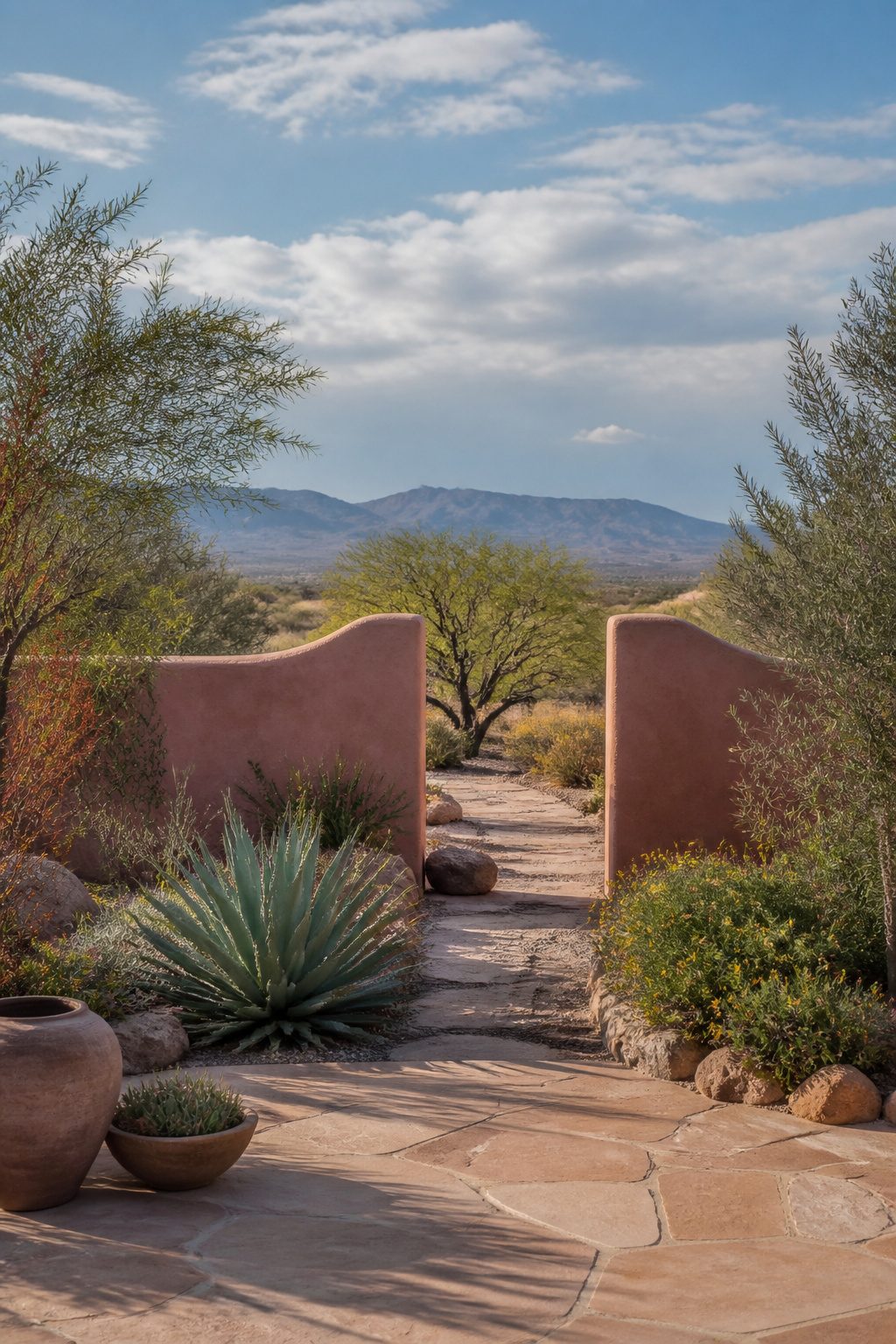
The best desert landscaping I have seen treats the yard as a gallery walk where every few steps deliver a new framed view. A stucco wall painted in warm desert pink or burnt orange does not just hold the property line; it stops the eye and turns whatever sits beyond it into a picture. I position those walls, or a tight cluster of ocotillo, so a neighbor’s mature mesquite or a borrowed slice of mountain appears through a deliberate gap. The frame costs less than the view it steals.
Seat placement matters as much as planting. A curved path or an open gate creates the vantage, and a low adobe bench or flat boulder at the turn gives the walker a reason to pause. From there, a sculptural agave against a tan wall reads as foreground, middle, and sky in one glance. I move the pieces like a photographer cropping a postcard, shifting rocks and spiky plants until the negative space between them holds its own weight. Adobe walls in place of fencing sometimes fail at privacy but win here; they edit the horizon without blocking it entirely.
Shade First
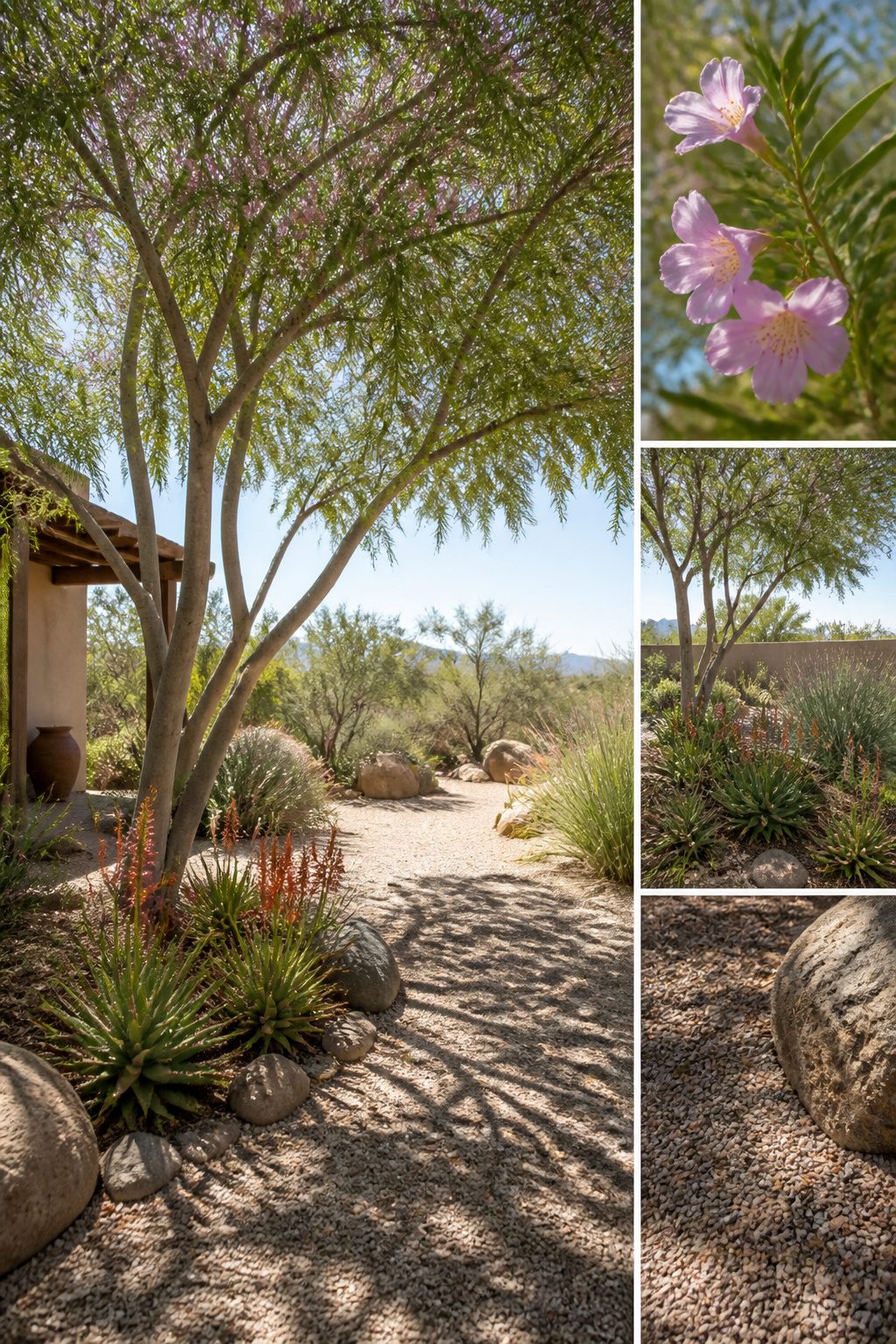
A desert willow starts giving you usable shade in two or three years, which is about as fast as trees get out here. Its canopy stays open enough that light filters through in patches, so the ground underneath does not turn into the dead zone you get under a solid tree. That filtered cover is what lets you keep aloes and other soft-skinned plants from frying. I have watched sun-scorched agaves recover once a little shadow moved over them by afternoon.
Some sources push palo verde or mesquite, and both are decent trees in time. But if you are planting one thing first, make it a desert willow near where you actually sit. Chilopsis linearis is deciduous, so you lose the leaf cover in winter. That matters less than you think: summer cooking is the problem, and winter sun on the patio is usually welcome. Give it room away from walls and foundations; it needs space to grow into its natural form rather than fighting concrete. The pink and lavender trumpet flowers are a side benefit, though honestly the hummingbirds notice those more than I do.
Watering Without Waste
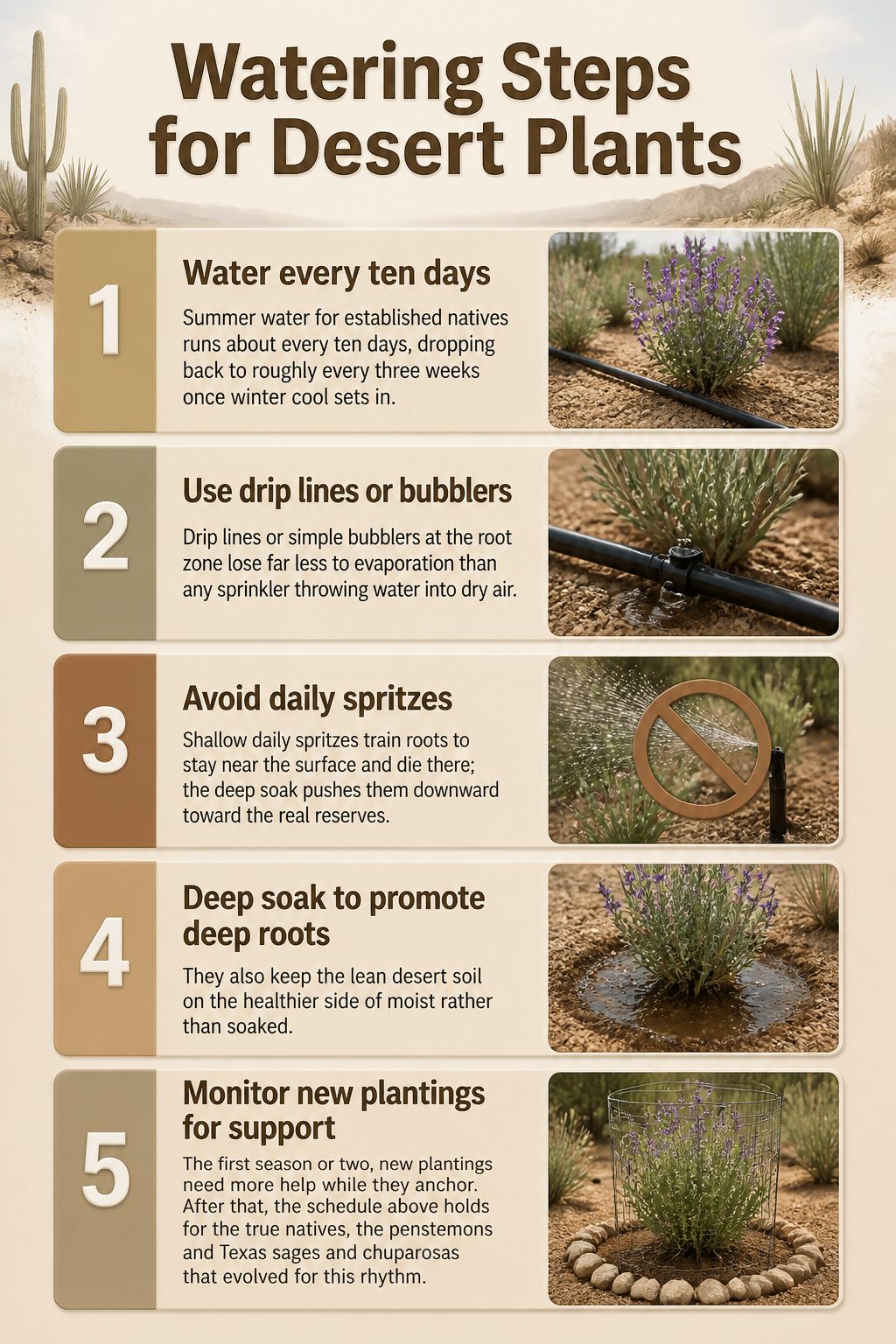
Summer water for established natives runs about every ten days, dropping back to roughly every three weeks once winter cool sets in. Shallow daily spritzes train roots to stay near the surface and die there; the deep soak pushes them downward toward the real reserves.
Drip lines or simple bubblers at the root zone lose far less to evaporation than any sprinkler throwing water into dry air. They also keep the lean desert soil on the healthier side of moist rather than soaked, which matters more than people expect. Saturated desert ground breeds root rot fast and washes out the spare nutrients that were there to begin with.
The first season or two, new plantings need more help while they anchor. After that, the schedule above holds for the true natives, the penstemons and Texas sages and chuparosas that evolved for this rhythm.
Hardscape Over Lawn
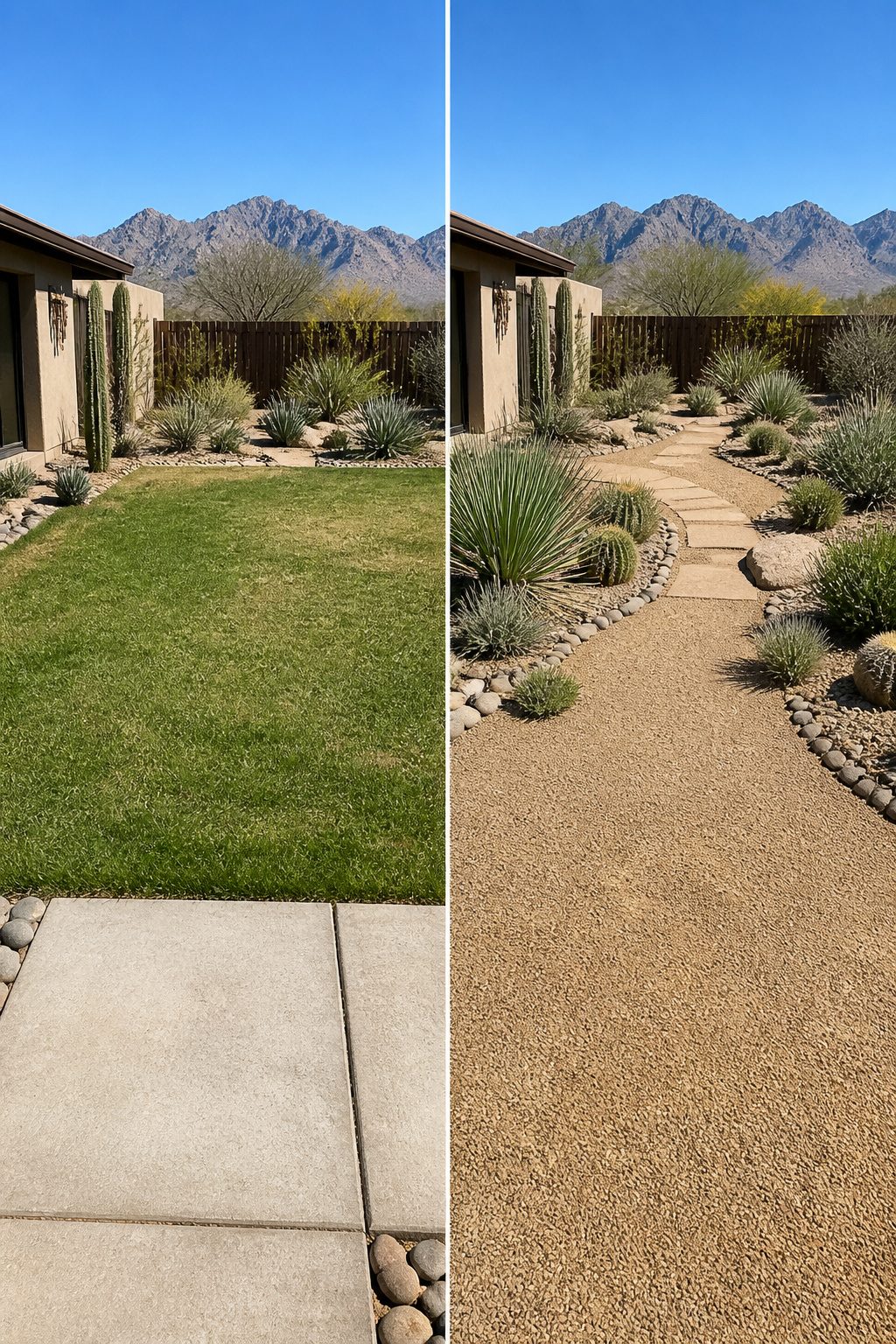
Gravel, decomposed granite, and crushed stone make more sense in the desert than grass ever did. I learned this the hard way after watching a Kentucky bluegrass lawn fry three Julys in a row. The switch to decomposed granite, or DG (particles 3/8 inch and smaller, available in varied colors), compacted into a flat patio surface, cut my weekend watering and mowing to nearly zero. For pathways, crushed gravel in 3/8 or 3/4 inch sizes holds underfoot better than loose shingle. River rock ranges from 1–3 inches up to 3–12 inches, and the larger rounds work well as dry streambed accents or around cactus bases where you want drainage and shadow. Beach pebbles, flat and rounded, run 1/2 to 3 inches but only come bagged; they cost more per square foot and suit a contained border better than a broad yard sweep. A square patio edged with charcoal gravel frames plantings the way a gallery wall frames artwork, and unlike mulch in wet climates, these mineral ground planes do not decompose, fade, or invite fungus. The maintenance drops to raking leaves and pulling the occasional weed that blows in.
Colorful Containers
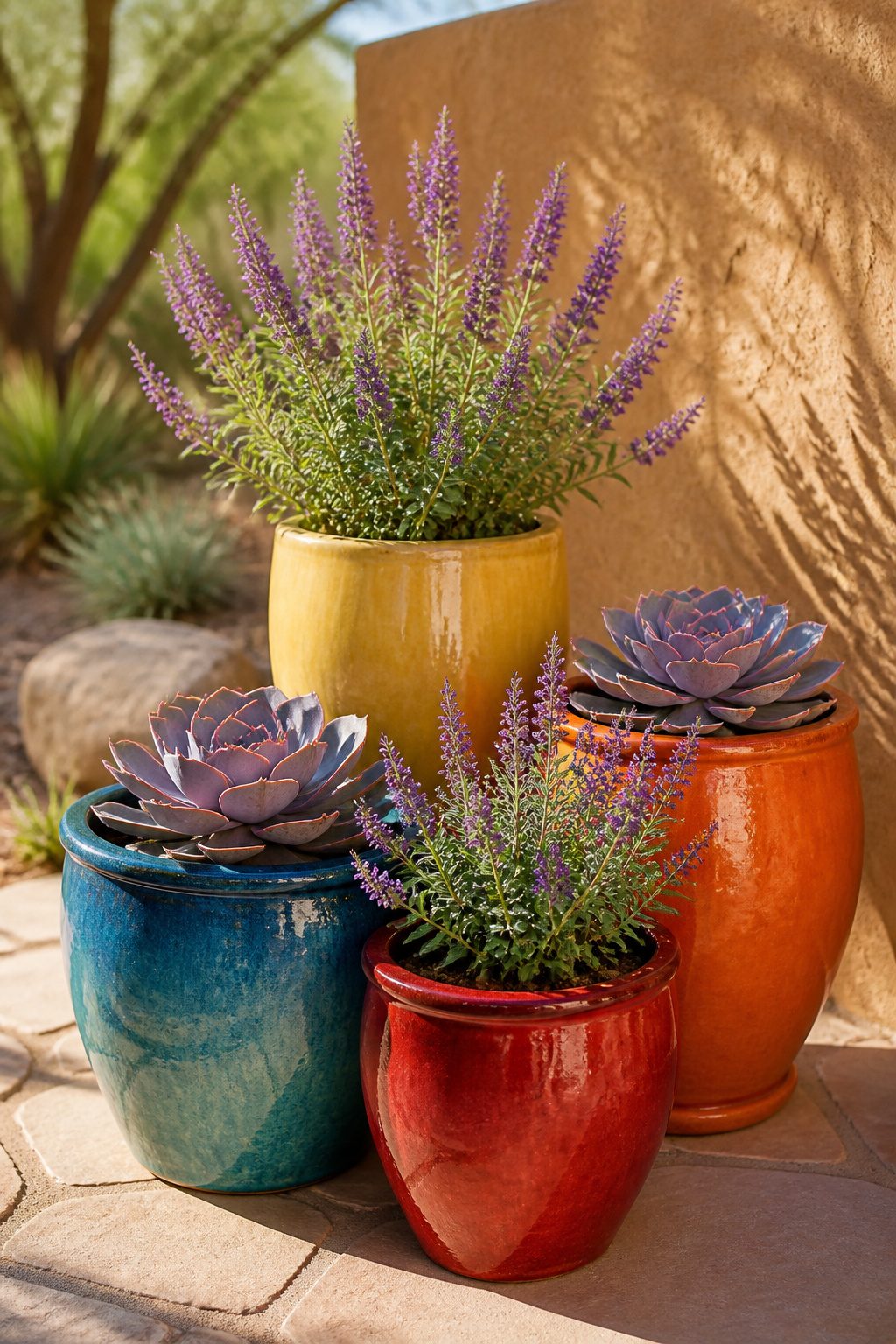
Bright pots buy you room to change your mind in a garden where the ground itself offers no mercy. I learned this the hard way after planting a Mexican bush sage straight into amended soil, watching it sulk for three weeks, then die the moment August hit. A glazed ceramic container on the patio, that same sage thrived two years running, and when it finally outgrew the pot I simply swapped in a smaller echeveria rather than digging another hole in baked clay.
The real payoff comes when you set that glazed pot against a wall you have already painted. The wall throws light back into the pot, the pot’s own color reflects onto the wall, and you get a volley of saturation that a single planting bed cannot match. Shift the pot two feet left and the whole scene changes. Move it to the back step for summer, the front courtyard for winter bloom, or group three at different heights when the composition goes flat. Nothing in that ground is giving you that freedom.
Modern Desert Style
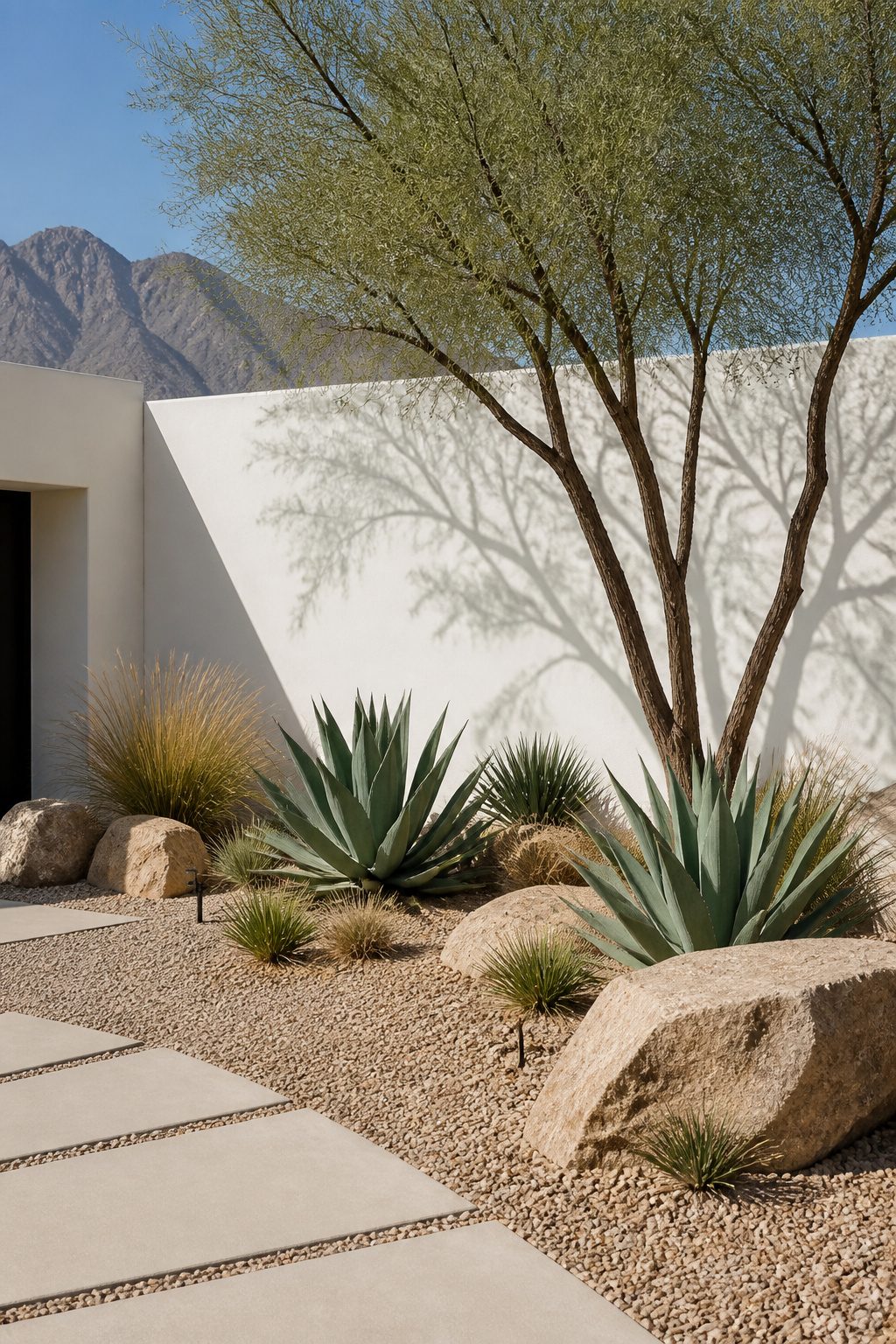
Clean lines strip the kitsch out of desert landscaping without stripping its bones. The combo that works is gravel ground plane, a single sculptural tree, and cactus grouped against a flat white wall. That wall matters more than people guess; it throws reflected light onto the plants and makes their shadows read as architecture.
I started by pulling out the painted pots and roadrunner figurines a previous owner left behind. What stayed was the gravel, a mature mesquite, and a cluster of agave that had been fighting for attention. The wall got painted flat white, not adobe, and suddenly those plants started to look intentional rather than accumulated.
Grouping plants by water need keeps the irrigation from getting fussy. Desert natives with fine leaf texture read as texture against gravel mulch; larger-leaved plants want organic mulch and more water, so they go elsewhere or they go out. Rounded stones in raked gravel can read Zen, but one bold cactus silhouette against that white wall reads modern desert specifically. The restraint is the point: one tree, not three; one wall, not a compound.
Frequently Asked Questions
What is desert landscaping?
Desert landscaping means using low-water-use and desert-friendly plants in your landscape. It pairs those plants with hardscape materials like gravel, stone, and painted walls rather than relying on thirsty lawns. The result is a garden built for arid conditions that still offers color, structure, and wildlife.
What are some drought-tolerant plants?
Drought-tolerant plants include cacti, succulents, and native shrubs. The article highlights totem pole cactus, golden barrel cactus, Parry’s agave, chuparosa, Texas sage, and desert willow as proven performers. Native flowering plants like penstemon and damianita also handle the Southwest’s dry air and alkaline soil without demanding constant water.
How do I create a desert landscape?
Evaluate your site, draw up a plan, and select appropriate plants and hardscape materials. Start with shade structure and reliable repetition of a few proven plants rather than scattering one of every species. Add gravel or decomposed granite ground cover, consider painted block walls for color, and place sculpture or salvage with scale and provenance in mind.
How often should I water desert plants?
Water deeply approximately every 10 days in summer and every 3 weeks in winter. Shallow daily spritzes train roots to stay near the surface and die; a deep soak pushes them downward toward real reserves. New plantings need more help their first season or two while roots anchor, then you can drop back to this schedule for true natives.
Can I include flowering plants in desert landscaping?
Yes, flowering plants like red yucca and autumn sage can provide seasonal color. The article also recommends chuparosa for its red tubular flowers through the hottest months, globe mallow for orange blooms, and desert willow for pink and lavender trumpet flowers that hummingbirds favor. Native flowering shrubs evolved for the region’s rhythm and need no pampering once established.