The cheapest small garden ideas run from free pallets and cracked wheelbarrows to a few dollars in terra-cotta pots, but the real split is effort: some need a drill and an afternoon, others need you to remember to water daily. The catch is that mobility and drainage matter more than the price tag, because a plant that cooks against a south wall or drowns in compacted soil costs the same to replace as it did to buy. I learned that the hard way the first summer I worked a 10-by-12 foot patio, buying three flats of annuals before I ever measured where the sun hit past noon.
1. Plan the Layout First
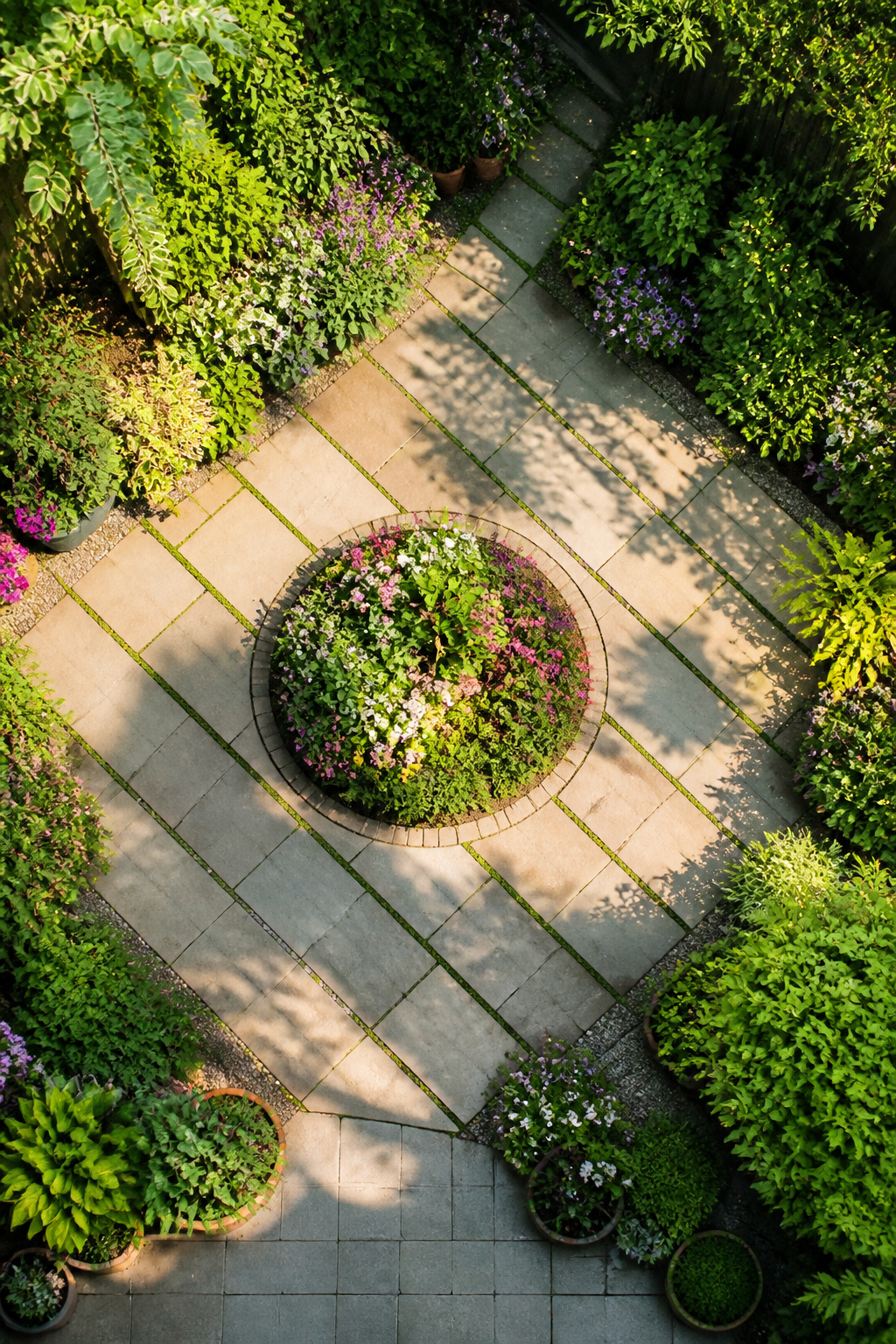
A small garden eats money fast if you let it. The first summer I worked a 10-by-12 foot patio, I bought three flats of annuals and a prefab raised bed before I ever measured where the sun hit past noon. Half those plants cooked against the south wall by July. Diagonal paving lines or a circular lawn shape trick the eye into traveling across the space instead of stopping at the boundary, which is how a 120 square foot plot starts to feel wider than it is. Circles break up the boxy geometry most small yards are born with, and the curve pulls attention away from the fence line. For very small gardens, the best layout is the one that picks a single focal point and builds paths that move toward it, not the scattering of features that reads as clutter. I draw the footprint now with a tape measure and a grease pencil on contractor paper, marking where shadow falls at 10 a.m., 2 p.m., and 5 p.m. before any plant goes in soil.
2. Raised Beds for Better Drainage
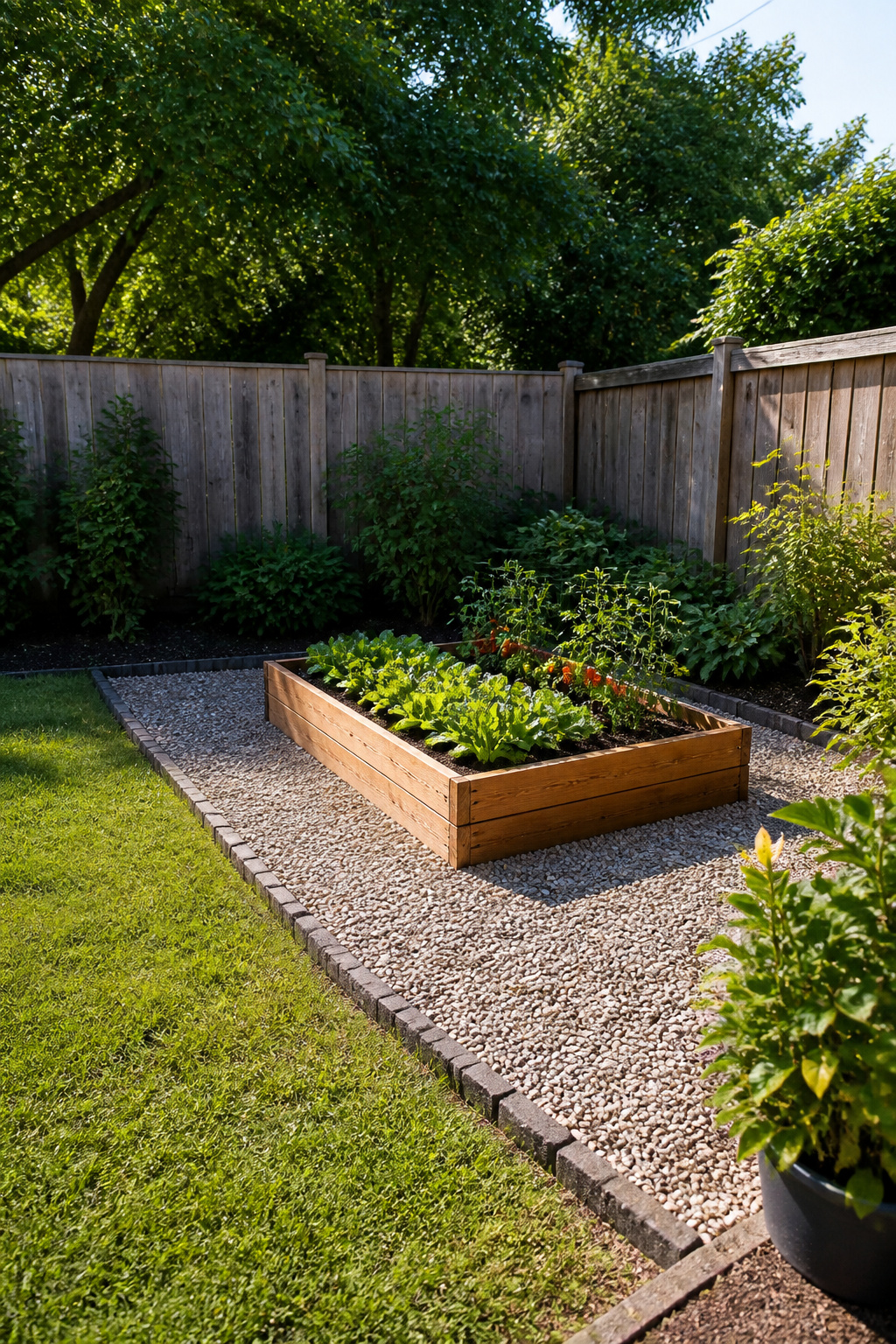
Raised beds solve the drainage problem that sinks most first-season gardens. In a small yard or on a patio, compacted soil or heavy clay traps water around roots and rots them before you know what went wrong. A raised frame lifts the planting zone above that mess and lets excess water run through instead of pooling.
The real advantage is control over what goes inside. You fill the bed with mix rather than fighting whatever the builder left behind. That is where square-foot gardening comes in: the same raised frame gets divided into a grid, and each square is planted at density matched to the crop. Sixteen radishes per square, one tomato per square. No wasted seed, no thinning drama, no guessing how far apart things go.
For a balcony or a narrow side yard, a small raised bed on legs or a simple framed box on the ground turns the worst soil into usable ground. The upfront cost is soil and lumber, but the saved plants usually cover it in one season.
3. Square-Foot Gardening

A raised bed divided into a grid turns one small patch into a surprisingly productive vegetable plot. Each square foot gets its own crop density based on plant size, so sixteen radish seeds fill the same space that holds a single tomato plant. That tight packing squeezes more harvest out of minimal ground and leaves almost no room for weeds to elbow in.
I started reading about this method after my second season of planting in rows and watching half my lettuce bolt before I could use it. The square-foot approach means you sow only what you will eat, and when a square finishes producing, you drop another crop straight in. Beetroot, rocket, spring onions, and chard all work well in that relay. No seed gets wasted on ground you will not tend, and the soil stays worked rather than sitting bare.
4. Container and Terra-Cotta Pots
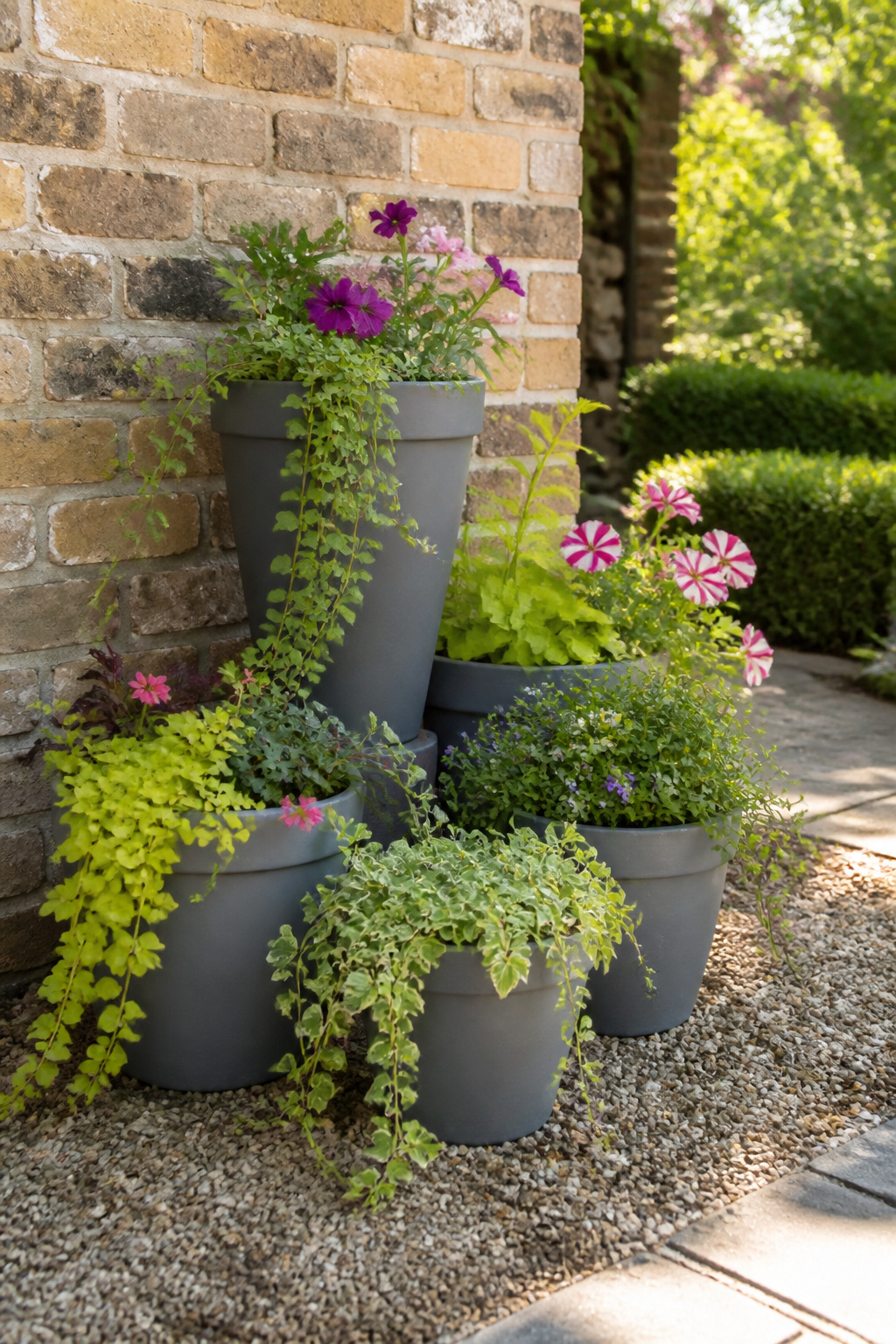
Terra-cotta pots remain the most forgiving place to start when space is tight and money is tighter. A standard six-inch pot runs a few dollars at any hardware store, and the clay breathes in a way plastic does not, which matters more than I expected when I overwatered my first batch of basil. The real advantage is mobility. A pot that sits in full sun in April might need shifting to partial shade by June, and on a rental balcony that shift can mean the difference between a plant that survives and one that does not.
One approach I have seen work well is to paint cheap terra-cotta in a single matte color, slate grey or charcoal, and group them at varying heights rather than lining them up like soldiers. The uniform color keeps the arrangement from looking cluttered, which a collection of small mismatched pots tends to do on a small patio. For planting, the classic thriller-filler-spiller formula still earns its keep: one tall grass or salvia in back, compact flowers around it, and something like lobelia or sweet potato vine to cascade over the rim. The whole display can be rearranged in ten minutes when company comes or when one plant fades and needs swapping out.
5. Vertical Gardening Techniques

Wall-mounted planters and hanging baskets let you grow upward when the ground is already spoken for. A simple trellis fixed to a fence or wall handles climbers like ivy, jasmine, or fast-growing nasturtium and scarlet runner bean that fill vertical space without demanding much care or material cost. Hanging planters at eye level work for trailing herbs, ferns in shaded spots, or shallow-rooted salad greens and spinach. For a bigger visual statement, small pots or even repurposed guttering lined up on a fence panel create a DIY living wall that adds greenery without sacrificing a single inch of floor space. The best vertical setups use what you already own: old ladders, pallet boards, or spare brackets keep the budget under control while the plants do the heavy lifting.
6. Arched Trellis for Climbing Vines
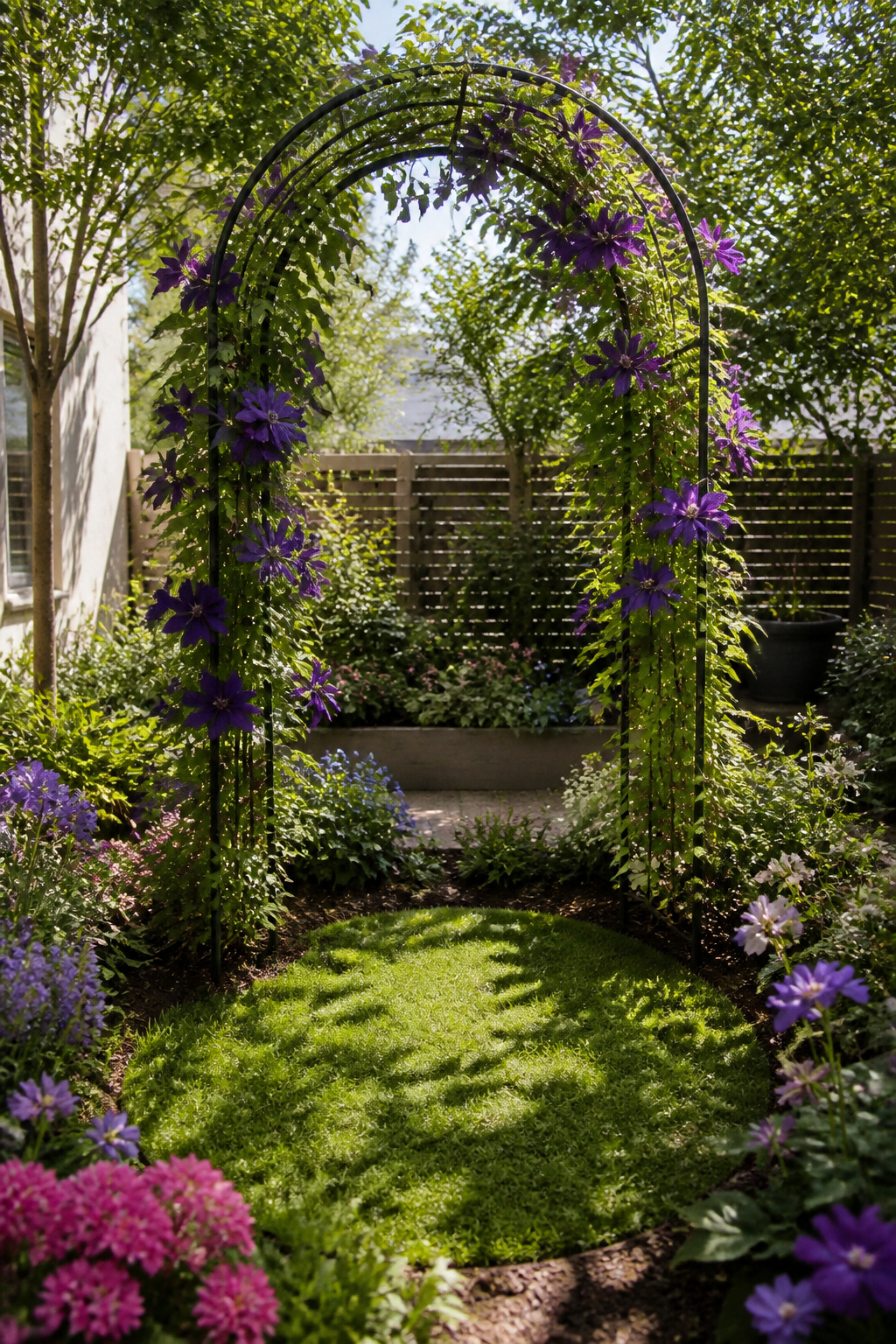
An arched trellis turns a narrow yard or balcony corner into something worth looking at. The curve draws the eye upward, and climbing vines fill the vertical space without eating the few square feet you actually have to stand on. I built mine from cattle panels bent into a tunnel, though a purchased metal arch works the same way. Either route, the thing that matters is giving plants something to grip and enough air moving through so stems do not mold against each other.
Clematis or jasmine will cover the structure fastest in sun; climbing hydrangea, ivy, or chocolate vine take the shade and north-facing spots where heat-loving plants sulk. Runner beans and French varieties like ‘Blauhilde’ or ‘Cobra’ climb just as happily if you want something to pick. The payoff is three things at once: privacy from neighbors, dappled shade underneath, and a focal point that costs less than a patio umbrella but lasts years longer.
7. Living Wall
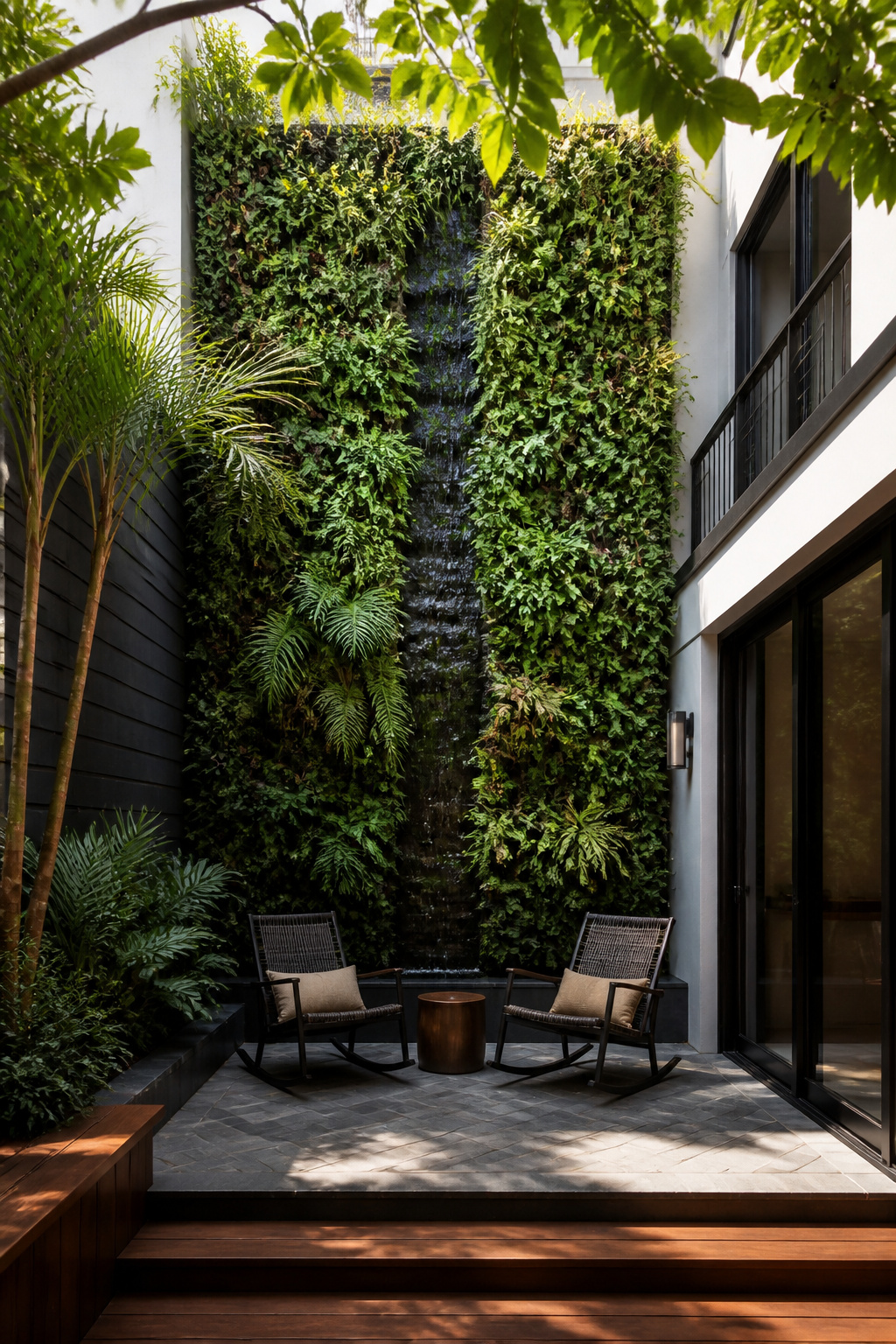
A living wall is the point where vertical gardening becomes architecture. Instead of a trellis or a stack of pots, you are building a system: a frame, a backing that holds moisture, a growing medium, and an irrigation path that water can travel without drowning the roots. The plants stay small, usually under six inches in mature height, and they root into the medium directly.
The frame can be steel, rot-resistant wood, or even a heavy plastic unit meant for this purpose. What separates a living wall from simpler setups is that the wall itself is the container, not a thing hung in front of one. You cut holes or pockets into the backing, slot in plants with their soil still on them, and the roots gradually bind to the medium behind. Water flows from the top and wicks downward; a catch tray at the base returns what drains through.
This costs more upfront than a pallet leaned against siding. A small four-by-two-foot wall runs roughly the same as three large ceramic planters and the soil to fill them. The tradeoff is visual density. Where a trellis gives you one plane of growth, a living wall gives you a surface that reads as solid green from across the yard.
The mistake most people make is choosing plants for color rather than root size. Sedums, small ferns, and creeping thyme work because their roots stay shallow and they tolerate intermittent moisture. A living wall packed with annuals looks full in May and threadbare by August when the root systems fight for the inch of soil they have.
8. Grow Vegetables Vertically

Peas, beans, tomatoes, and cucumbers all want the same thing: something to climb. Give them a trellis, a wigwam of bamboo canes, or even an old ladder braced against a wall, and they will trade their sprawling habit for a narrow footprint that leaves the rest of your bed free for lettuce or herbs. Runner beans and French beans like ‘Blauhilde’, ‘Algarve’, or ‘Cobra’ are the obvious choices; their tendrils wrap naturally around anything vertical. Tomatoes need tying in, and cucumbers do too, but both produce more cleanly up off the soil with less rot and slug damage.
The space saved is the real payoff. A tomato that sprawls might swallow three square feet of soil. Trained upward, the same plant needs perhaps six inches at the base. That math is what makes vertical growing non-negotiable in a small plot. Scarlet runner beans grow fast enough to cover a support by midsummer and give you something worth looking at while you wait for the pods. If you have a fence panel facing south, screw on a few lengths of guttering or small pots for a living wall at eye level: the same wall now grows your crop without stealing a centimeter of ground.
9. Trained Fruit Trees
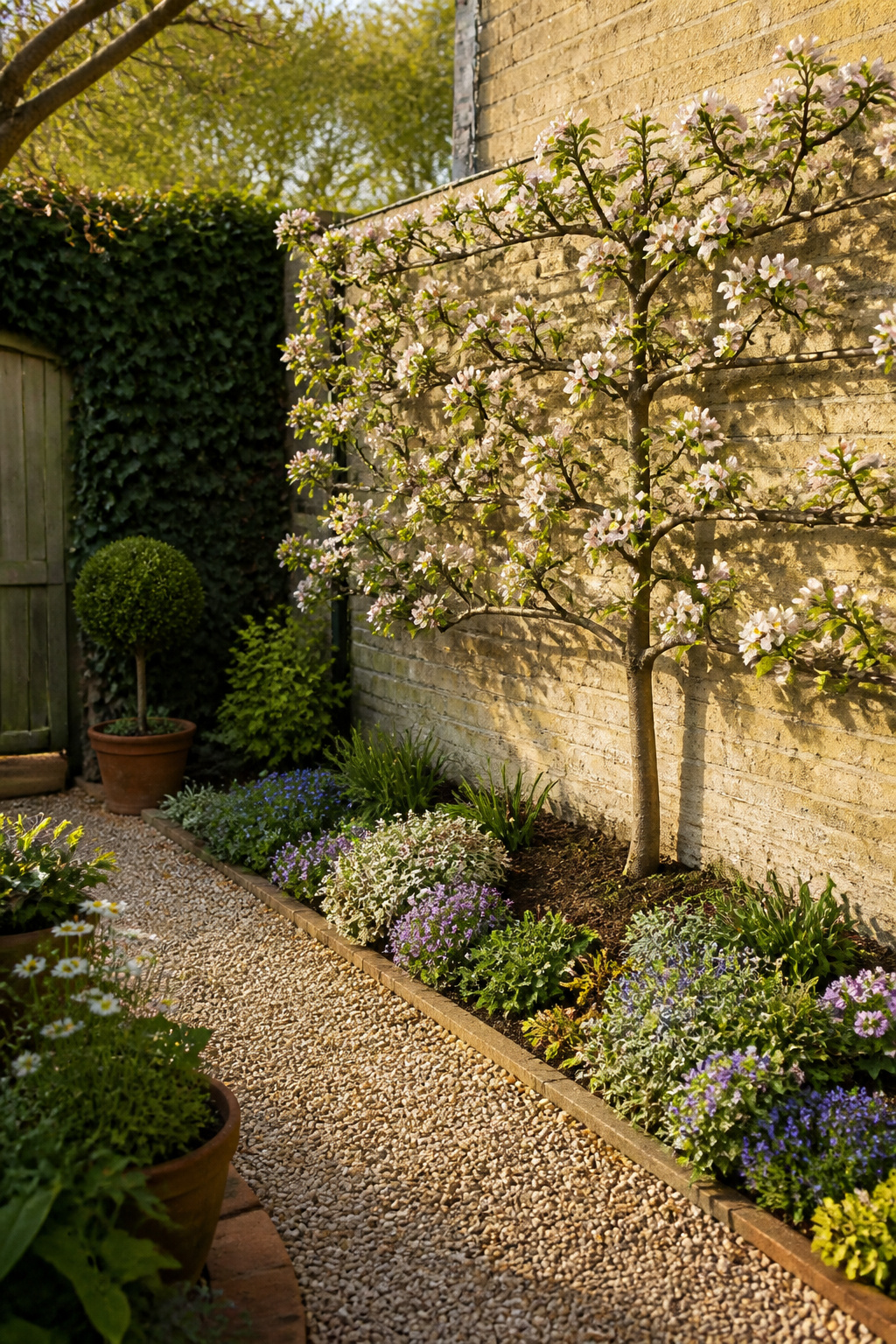
Espalier was the only way I was going to get apples onto a balcony that measured six feet across. The technique flattens a tree into a two-dimensional plane, training limbs along horizontal wires against a wall or fence so the canopy stays inches deep instead of feet wide. Dwarf rootstock makes it possible in the first place. For apples, M27 keeps the tree around 1.5 meters, while MM106 pushes to 3–4 meters; the smaller stock is what you want when floor space is measured in pots, not plots.
Fan shapes work for stone fruit, cordons squeeze the footprint even narrower, and stepovers edge beds at knee height. All of them share the same trick: sunlight hits a flat surface more completely than it ever reaches inside a globe-shaped canopy, so a trained tree on a warm wall ripens fruit a standard tree would shade into sourness. Pruning happens in late summer, not spring, because the cuts heal faster and the shape holds until dormancy. I have killed a pear by pruning in March, watching sap bleed from stubs that never sealed; the tree leafed out weakly and was gone by autumn.
10. Pallet Garden
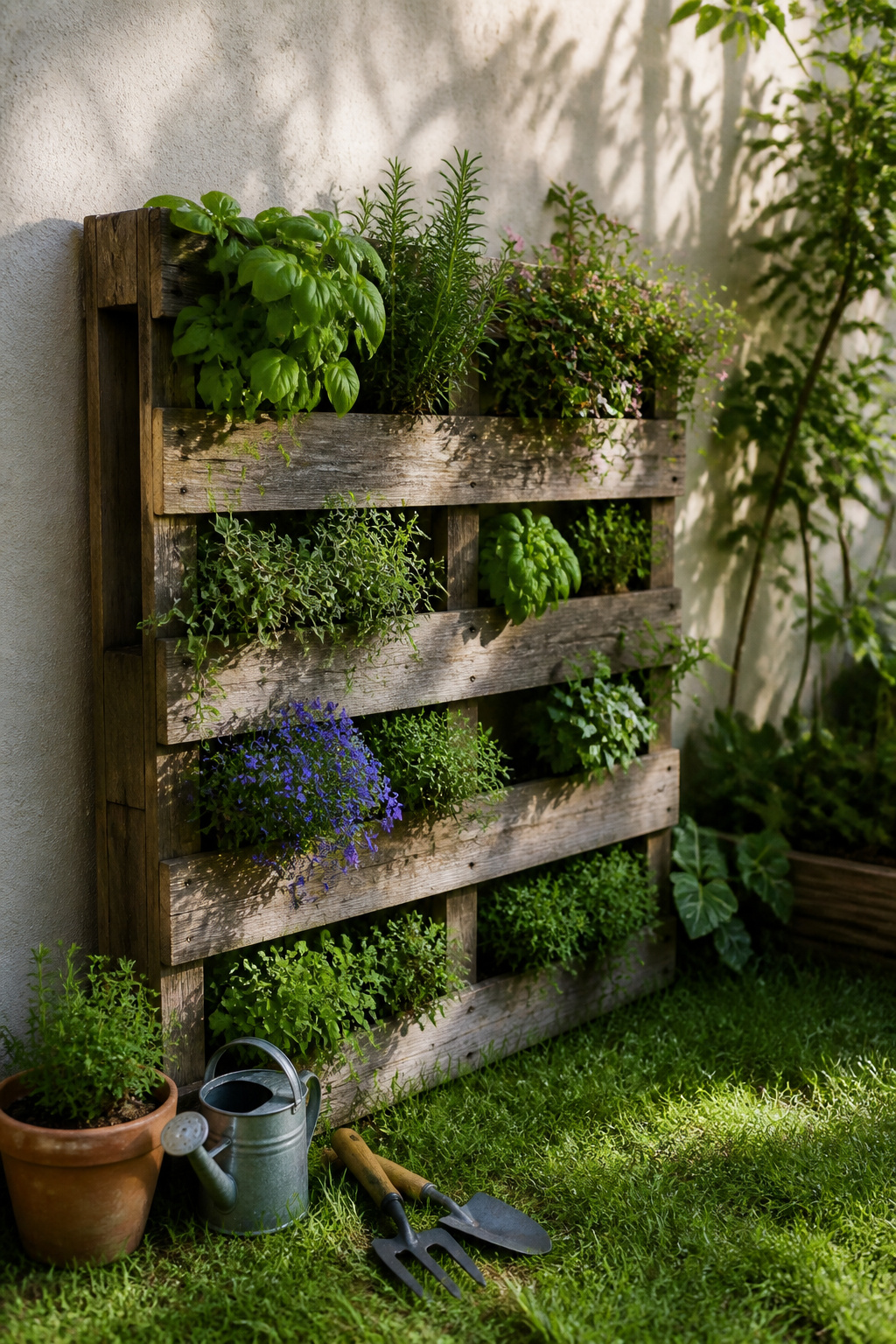
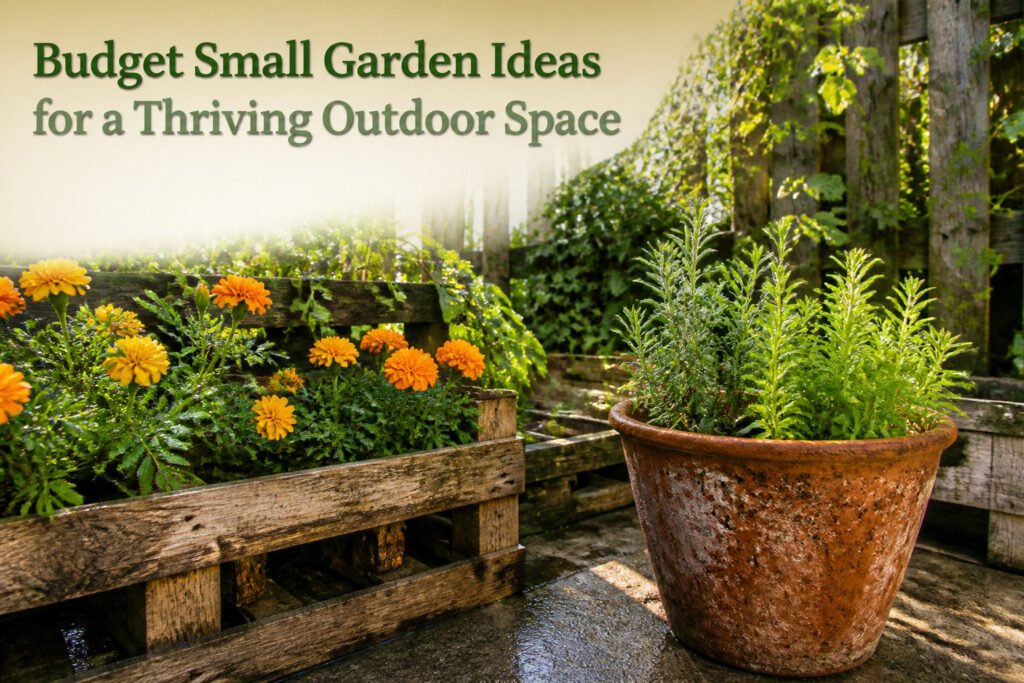
A wooden shipping pallet costs nothing if you ask around behind grocery stores or warehouses, and it fills a narrow balcony wall that otherwise grows nothing. Stand it vertically or lay it flat; either way, sand every surface that faces outward until splinters won’t catch on sleeves or hose. The heat-treated ones, stamped HT on the inner block, are the only pallets safe for growing food near. Chemical-treated pallets marked MB leach into soil and herbs.
For a vertical planter, staple landscape fabric across the back and along each open slat to hold soil. Pack it with potting mix and plant between the slats: trailing nasturtium or scarlet runner beans climb naturally and cover the raw wood fast. Horizontal use is simpler. Fill the pallet’s face with clay pots wired or cabled through the slats, spaced so mature herbs don’t crowd. Rosemary and basil sit at arm’s reach this way, living kitchen storage that costs under the price of one store-bought planter box.
11. Wheelbarrow Garden

An old wheelbarrow with a cracked bed or rusted handles still has one job left in it. Drill a few holes through the bottom for drainage, fill it with potting mix, and it becomes a mobile planter you can roll where the sun is. That mobility matters more in a small space than people expect. A corner that gets six hours of light in June might drop to three by August once a neighbor’s tree leafs out, or a sudden cold snap can threaten everything you have in bloom. With the wheelbarrow, you pivot the whole planting to the other side of the patio instead of starting over.
The rusted look works, though a coat of paint ties it to the rest of the garden if you want that. I have seen them planted with trailing nasturtiums that spill over the sides, or with a single determinate tomato that would otherwise take up a whole bed. The wheelbarrow limits root run, so it suits plants that do not mind staying compact or that you plan to replace each season. Keep an eye on how fast it dries out. Elevation and metal sides mean it needs water more often than a ground bed, sometimes daily in July. The tradeoff is worth it for the flexibility, but only if you remember to check.
12. Bird Bath Succulent Garden

A cracked or leaky bird bath still has a job left in it. The shallow basin, built to hold only an inch or two of water, happens to match the root depth most succulents actually use. I flipped one last spring that had sat empty for two years, drilled three extra holes in the base for insurance, and filled it with gritty cactus mix rather than potting soil. The hens-and-chicks and stonecrop went in with barely any soil between them, just enough to anchor the roots, and the gravel top dressing I pressed around each rosette does the real work of holding moisture near the base without letting the crown stay wet.
The height puts the planting at knee to waist level, which reads as a deliberate design move even though the piece cost nothing. Succulents grown from cuttings of mature plants, as many of these spreaders are, make this one of the cheapest ways to fill a focal point. Dark gravel underneath would push the color further; I used what I had, light tan, and the effect is quieter but still reads from the path. The only real limit is winter hardiness. In my zone the bird bath itself lifts the roots above the coldest ground layer, which helps, but a true tender agave still needs bringing in or treating as annual.
13. Fairy Garden

A fairy garden turns the problem of a tiny space into its own reward. The whole scene sits in a single container or a corner of bed no larger than a boot tray, which means a broken pot or a cracked saucer is enough ground to start on. Scale does the work. A three-inch sedum becomes a shade tree, a shard of slate turns into a patio, and a miniature birdhouse on a twig reads as architecture. The playful element sneaks in through that shift in proportion, not through bright colors or novelty items. Rustic stones laid as a path, a few tiny accessories, and the eye invents a world.
Kids make this project faster because they already treat small things as real. My own patience ran out before theirs did; the moss I pressed down as lawn lifted at the edges by week three, and the birdhouse bleached to gray by August. The sedum and the stones stayed. A fairy garden costs little because the plants are ground-cover scraps and the structure is what you find. It works where full-sized plantings would crowd each other into leggy competition, and it asks only that you keep the soil damp enough for the smallest roots.
14. Rock Garden

A rock garden turns the slope you hate into the feature that saves water and money. Large stones anchor the grade, slow runoff, and cost little if you pull them from a local quarry or a neighbor’s excavation. Between them, gaps fill with sedum, yarrow, or creeping thyme, all of which tolerate the poor soil and sharp drainage that kill fussier plants.
Gravel carries the same logic to flat ground. It reads as open space, so a small yard feels larger than it would under lawn, and every plant you do add stands out against the stone. Two 850 kg bulk bags of 20 mm chippings covered one blogger’s entire plot at £91 each; the membrane underneath ran cheap and stopped weeds for years. In dry zones, the combination of rock, gravel, and drought-tolerant alpines cuts watering to nearly nothing. The look is spare, but that is the point: fewer plants, each one visible, none of them struggling.
15. Zen Garden

A four-by-six-foot corner is enough for a working zen garden, the kind called karesansui in its dry form. Flat stones set as pathways keep your feet out of the gravel, and the gravel itself, small enough to rake, becomes the practice: drawing patterns with a simple rake as a kind of active meditation. Large stones placed deliberately give the eye somewhere to rest, and a little moss in shaded pockets softens the edges without adding work.
Weed suppression and drainage both come free with the gravel-and-sand ground cover. A membrane underneath, held still by the weight of the material above it, keeps maintenance to almost nothing. No watering schedule, no deadheading, no succession planting. The space asks only that you rake it, and the raking is the point.
In a season or two of gardening, most of us accumulate half-dead spots where nothing thrives. A trampoline scar, a corner the hose never reaches. That failure becomes the right place for this. The gravel brightens it instantly, and the sitting stone you place there turns a problem area into the part of the yard you actually use.
16. Potager Bed

A potager bed treats the kitchen garden as a flower border, with vegetables, herbs, and annual flowers woven into repeating geometric patterns. The French style works especially well when space is tight because one bed delivers both dinner and curb appeal.
Most vegetables and fruit need about six hours of direct sun to produce well, so a south- or west-facing spot is the practical starting point. Without that light, you are tending an ornamental bed, not a productive one, and the design falls apart.
I have seen potagers laid out in simple four-square divisions and in more elaborate diamond patterns edged with dwarf boxwood or lavender. The structure matters more than the complexity. Chard with ruby stems reads as foliage color. Nasturtiums trail over the edge and end up in salads. Purple basil fills a role that coleus would play elsewhere. The eye registers a composed border; the cook registers ingredients within arm’s reach.
The mistake is planting for harvest first and trusting beauty to follow. It rarely does. Start with the pattern, slot crops into their color and height roles, and accept that some edibles will underperform because the design asked them to. A potager is a compromise by definition, but the compromise is the point.
17. Low-Maintenance and Native Plants

The first two seasons I gardened, I spent more time replacing dead plants than enjoying live ones. Most of those losses came from treating every plant tag as a suggestion rather than a hard limit. A native perennial that actually belongs in your zone needs no coddling. It wants the rainfall you get, shrugs off the heat you have, and comes back on its own each spring.
Perennials regrow and rebloom every year, which matters when your annual plant budget sits around $500–800. One well-chosen native clump outlasts three rounds of annuals that fried in July or drowned in a wet spring. The replacement cost drops to nearly zero after year one.
Sedum, yarrow, and thyme handle lean soil and skip days you forget to water. If your space has a slope or a corner where nothing else holds, those drought-tolerant choices anchor the ground without the runoff problems bare soil creates. Rock gardens work the same way, and large rocks from local quarries often cost little or nothing while doing the structural work of holding a grade.
Gravel gardens replace lawn in tight quarters, which helps a small plot read larger than it is. The gravel itself is a one-time cost, and the gaps between stones let you tuck in low-care plants where grass would demand weekly mowing and seasonal reseeding. I still miscalculate sometimes, but the mistakes I make with natives tend to be slow ones I can correct, not sudden collapses that leave a hole for the rest of the season.
18. Pollinator-Friendly Plants
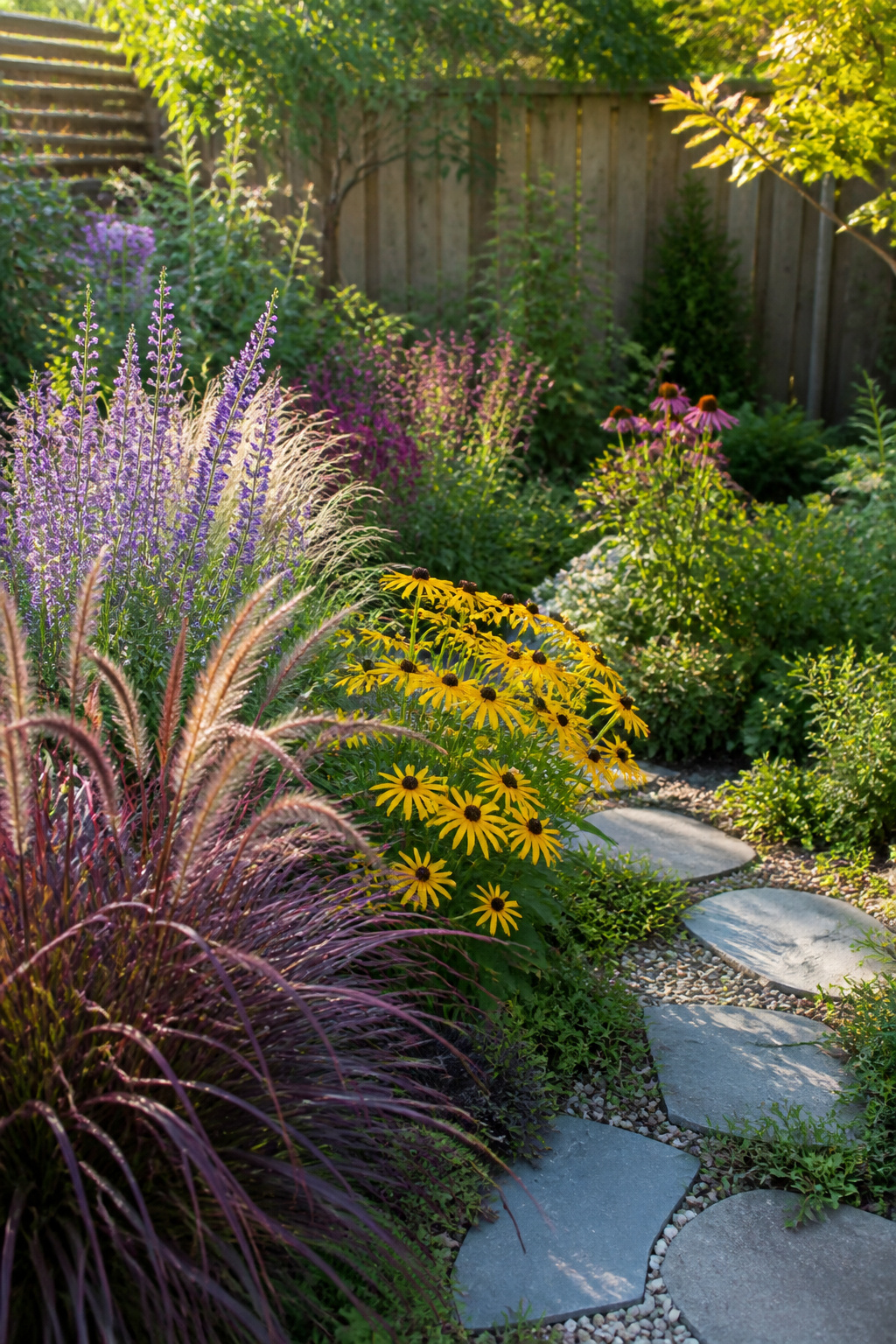
Ornamental grasses and flowering perennials pull more weight in a small garden than shrubs that bloom for three weeks and then sit there green. I learned this after planting a border that looked fine in May and dead by August. Repeat-flowering roses like Rosa ‘Lady of Shalott’ carry color from June through October, and perennials such as Erigeron karvinskianus or Erysimum ‘Bowles’s Mauve’ keep the show running without replanting. Native perennials suit this even better: they return each year, need less water and fertilizer, and handle drought without turning crispy. A limited palette helps too. Repeating the same four or five plants, maybe purple moor grass threaded with Salvia uglinosa, reads as intentional design rather than a crowded collection. The pollinators do not mind the repetition. Bees and butterflies want quantity and sequence, one nectar source replacing another as the season turns. In my own small yard, the mistake was treating every plant as a solo act. The fix was choosing long-season natives and planting them in drifts, even if the drift was only three plants wide.
19. Limit the Planting Palette
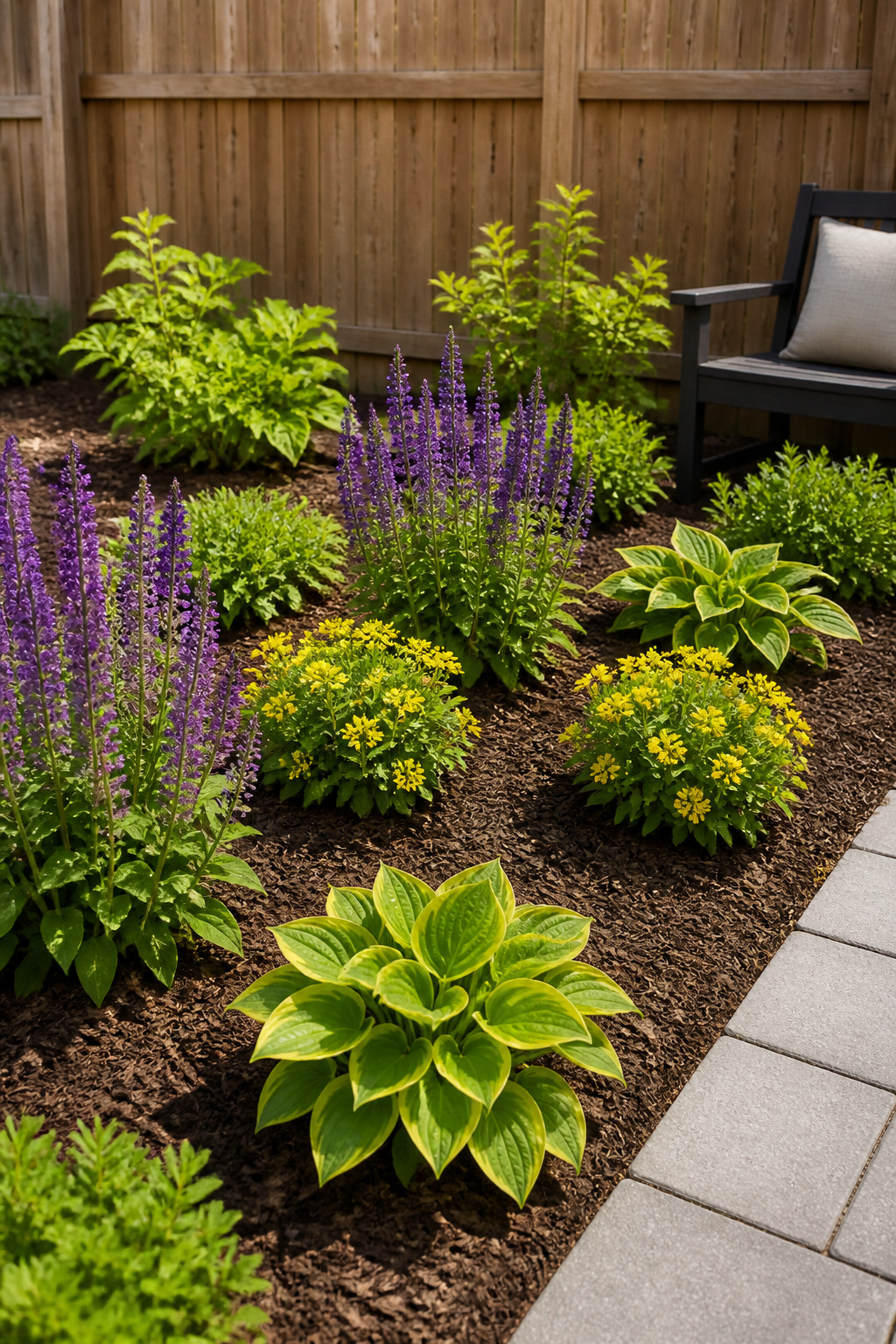
A small garden can start to look like a clearance rack fast: one of everything, nothing talking to anything else. Repeating a limited selection of plants is what makes the space read as designed rather than accidental. Three or four varieties, cycled through the bed or container, give the eye somewhere to rest.
The alternative is the bitty look, where each plant competes for attention and none of them win. I made this mistake early, buying singles on impulse at the nursery and arranging them like a collection of souvenirs. The result was restless, crowded, and somehow emptier than the actual square footage.
Color works the same way. A narrow range, maybe a single flower hue against green, builds cohesion without asking for more space. The plants do not need to be rare or expensive to pull this off. Common varieties repeated deliberately look intentional; unusual ones planted once each look like afterthoughts.
20. Light Colors for Landscaping

Pale gravel or light grey paving bounces light around a small garden in a way dark materials never manage. I noticed this first on a north-facing patio where the previous owner had laid charcoal slabs; swapping them for a warm limestone mix lifted the whole space even on overcast afternoons. Paint your boundaries white or soft grey and the effect doubles, especially if your garden sits on the shady side. The look reads modern without trying hard: clean planes, nothing competing with the planting. White paint on fences costs little more than the darker shades, and pale gravel is often the cheaper option at the yard because it is what quarries produce in volume. The one limit is upkeep. Light surfaces show every leaf stain and algae patch, so budget for a stiff brush and an afternoon twice a year, or the airy feeling turns grubby fast.
21. Gravel Instead of Paving

Hard paving for a sitting area or path eats budget fast and turns rainfall into runoff that puddles against your house. Gravel costs less, drains on its own, and reads as a deliberate surface rather than a cheap fallback. I laid it in my own side yard after watching a summer storm sheet across my neighbor’s concrete patio and pool against her foundation wall. The water found its way through the chippings and disappeared.
For scale, Cotswold Chippings 20mm runs about £182 for two 850kg bags. Converted, that lands near $230 for roughly 3,700 pounds of stone, enough to cover a modest patio depth at roughly a third the installed cost of concrete pavers. Angular limestone or slate chippings carry better underfoot than rounded pebbles, which shift and roll. Stepping stones set 60 cm apart in a gravel bed give you a solid path without needing a full paved surface, and steel or recycled-plastic edging keeps the stone from migrating into your planting beds.
22. Mulch Around Trees and Beds
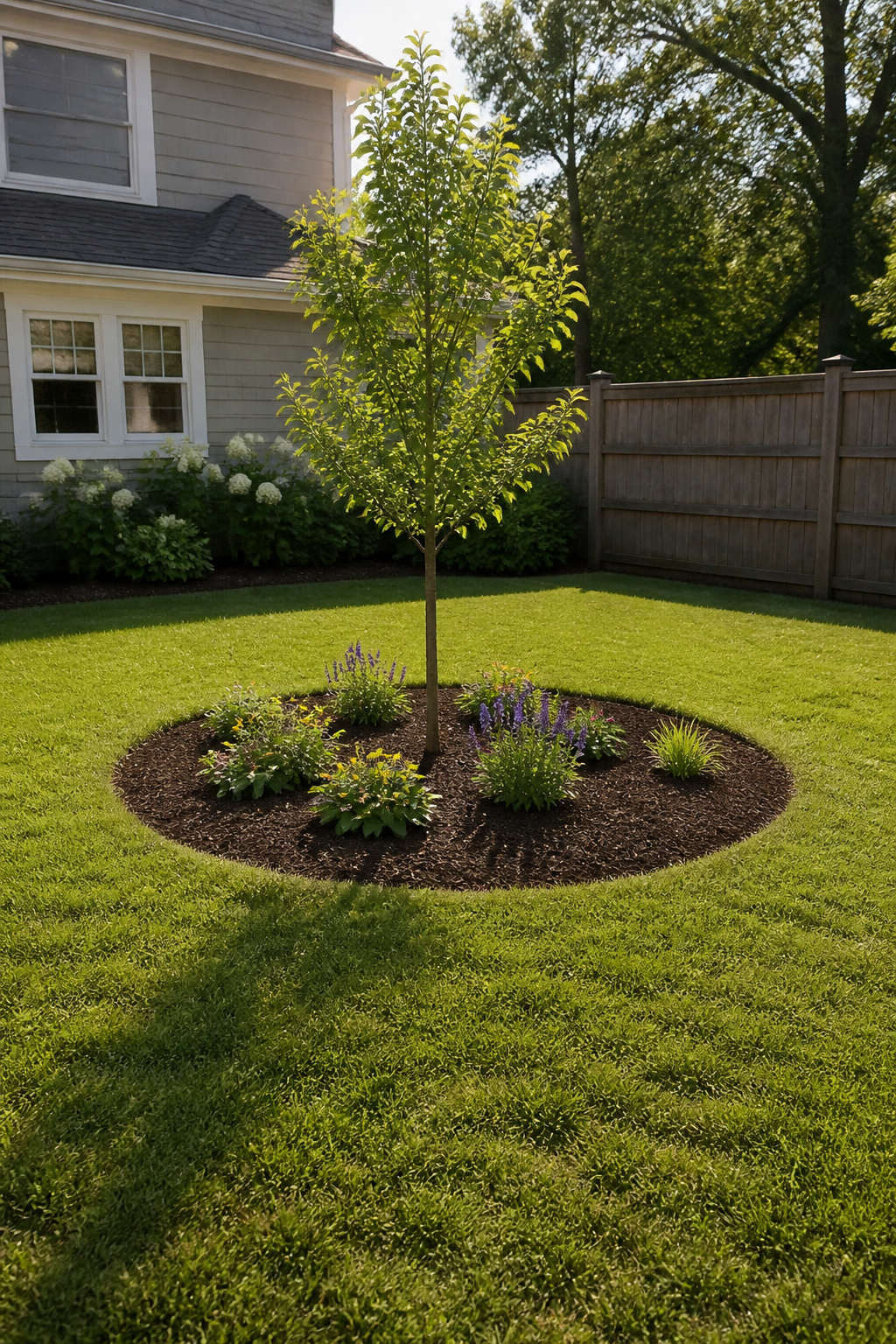
Organic mulch does more than tidy up a bed. Wood chips or bark from a local supplier lock moisture into the soil, suppress weeds before they seed, and break down slowly to feed the ground underneath. Spread it two to three inches thick, but keep it a few inches back from tree trunks and plant stems. Piled too close, it traps excess moisture that rots stems and invites pests to the base.
The cost beats most ground covers by a wide margin. A bagged alternative or rubber product runs higher, and recycled rubber, while it lasts longer, does nothing to improve soil. For the tightest budget, tree trimmers in some areas deliver chipped material free, and city programs exist in certain regions. Shredded fall leaves, raked from your own yard, cost nothing at all and can be worked straight into beds or layered over them before winter.
23. Outdoor Mirrors
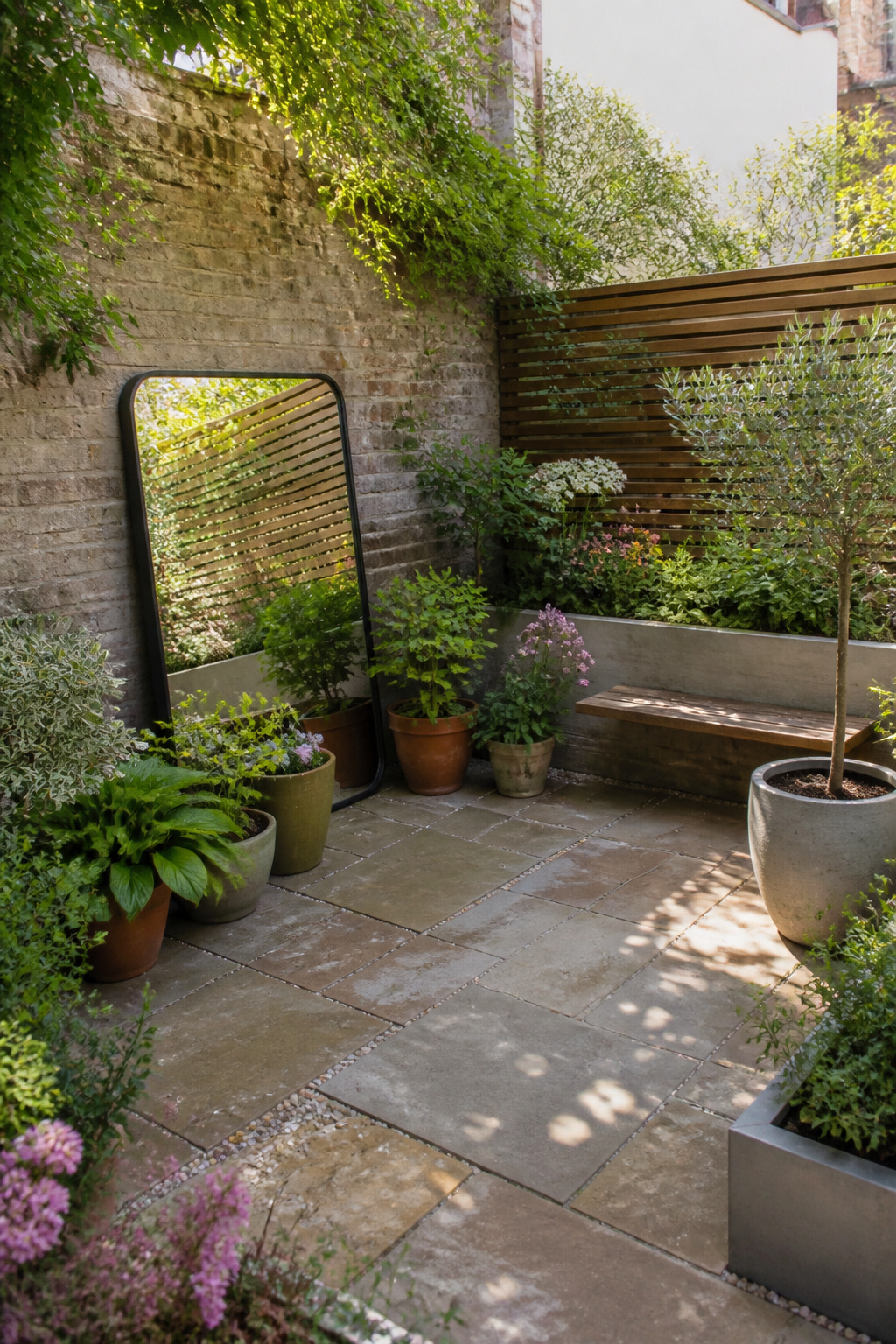
A weather-resistant mirror hung on a fence or the wall of a narrow courtyard catches whatever light your small garden gets and throws it back into the darkest corner. The reflected greenery doubles what your eye reads as garden, so a six-foot strip of paving reads like a twelve-foot room with windows on both ends. Acrylic or metal-backed glass survives temperature swings and the odd ball from a neighbor’s yard; standard wall mirrors craze and flake within a season.
Placement matters more than size. Angle the mirror so it catches sky, not direct sun, or you will blind yourself at breakfast and cook anything in its path. The lower edge should sit a few inches above the soil line, tilted back slightly, so the reflection shows plants rather than your own feet.
Birds need consideration too. A mirror facing open sky can read as rival territory to a territorial male in spring, and collisions happen when glass reflects branches birds think they can land on. A lattice frame or a few vertical bamboo strips in front of the surface breaks the illusion without blocking the light you wanted. I have seen a robin spend a week attacking its own reflection before the gardener wised up and moved the panel to a wall that faces planting, not air. A mirror that faces greenery instead of sky solves both problems: depth for you, safety for the birds, and no angry dawn chorus hammering glass at six in the morning.
24. Small Bench
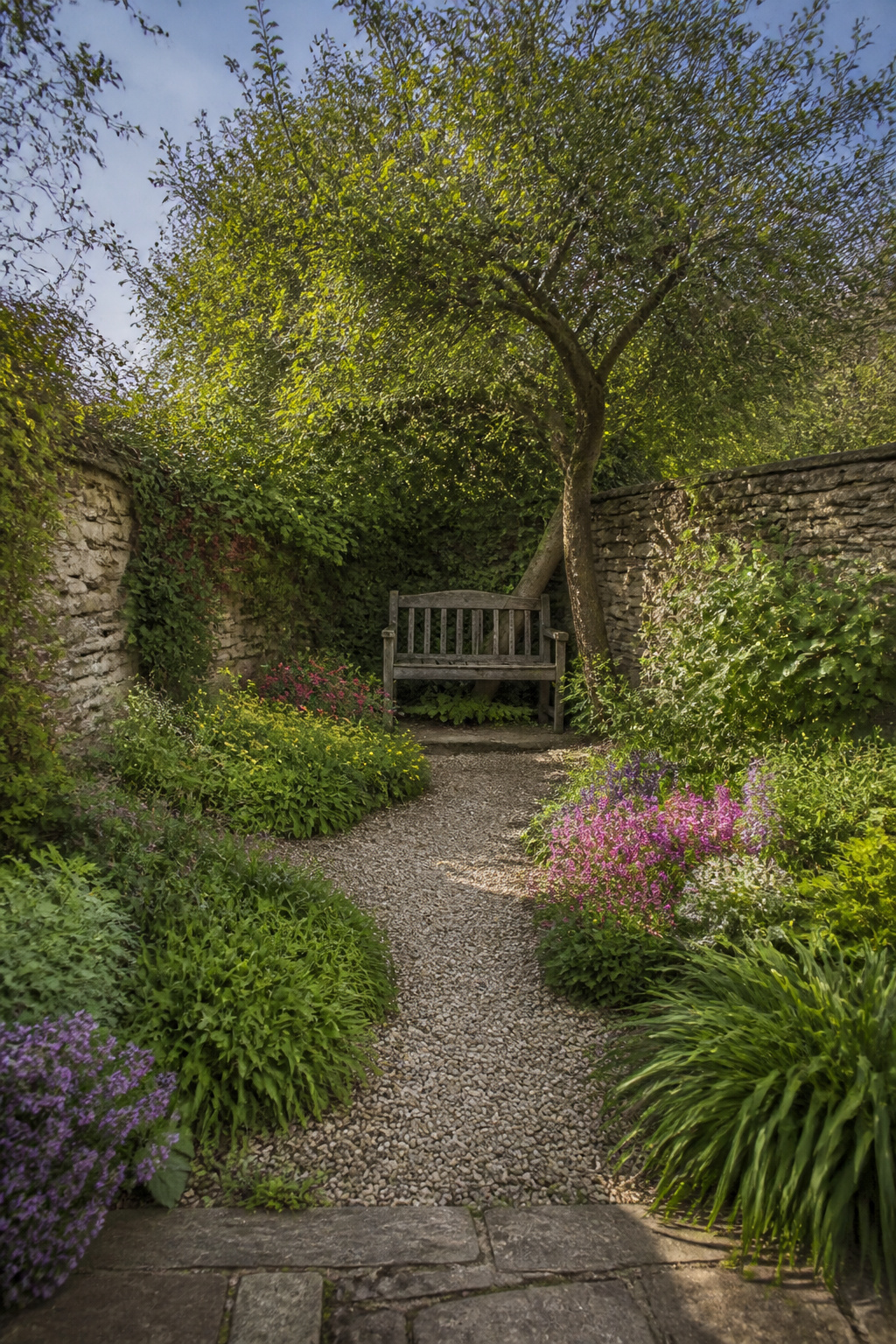
A bench turns a planted strip into a place someone actually stops. I learned the proportion lesson the hard way after hauling home a 5-foot slatted seat that blocked half my path and made the whole bed feel like a corridor. For a space under 10 feet wide, keep the bench under 4 feet long and 18 inches deep. Anything wider reads as a barrier; anything deeper and your knees hit the planting behind it.
Placement matters more than style. Set it where morning light falls, not where you think it looks balanced. I moved mine twice before finding the spot where I’d actually sit with coffee, which turned out to be against the fence facing the house, not the house facing the fence. Compact two-seat designs from hardware-store house brands run about $80–120 and hold up fine if you hit the legs with leftover deck stain each spring. Skip cushions unless you enjoy storing mildew.
25. Bistro Table for Two

A foldable bistro set turns the smallest patio or balcony corner into a place to eat outside without claiming permanent ground. The table and two chairs stay light enough to move when you need that spot for tomato cages or a party, and they fold flat against a wall by November. I have watched friends buy heavy dining sets for tiny spaces and then spend three seasons stepping around the legs; the 24-inch round tables meant for café sidewalks solve that by simply being less there. Metal mesh or painted steel lasts longer than the wood look-alikes I have seen soften and wobble after one wet winter, though the metal does need a cushion if you sit longer than coffee. The real savings is in not building anything: no deck expansion, no poured pad, just level ground and the willingness to pull chairs out when dinner calls and stack them after.
26. Upcycled Furniture

An old wooden chair with the seat rotted out becomes a plant stand the minute you set a pot where the cushion used to be. The trick is stopping the rest of the piece from rotting too. Sand any flaking finish down to bare wood, especially on legs and joints where water pools, then brush on two coats of exterior paint. Comparable exterior paint runs about $14 per liter, and one liter usually covers a small table or two chairs with a coat to spare.
For seating, heat-treated pallets stamped "HT" are the safer pick over chemically treated ones. Stack two for a low table, or add casters later if you want it mobile. I have seen pallet tops tiled over with cheap square pavers glued down so nothing slips through the slats, though gorilla glue and gravity do most of the work. An old metal bistro set paints up faster than wood; all one color, black or white, reads as intentional rather than rescued.
Concrete blocks work too, stacked for side tables or a bench base. They cost next to nothing, drain freely, and move when your layout changes. The limit is comfort: without a cushion, you will not sit there long.
27. String Lights
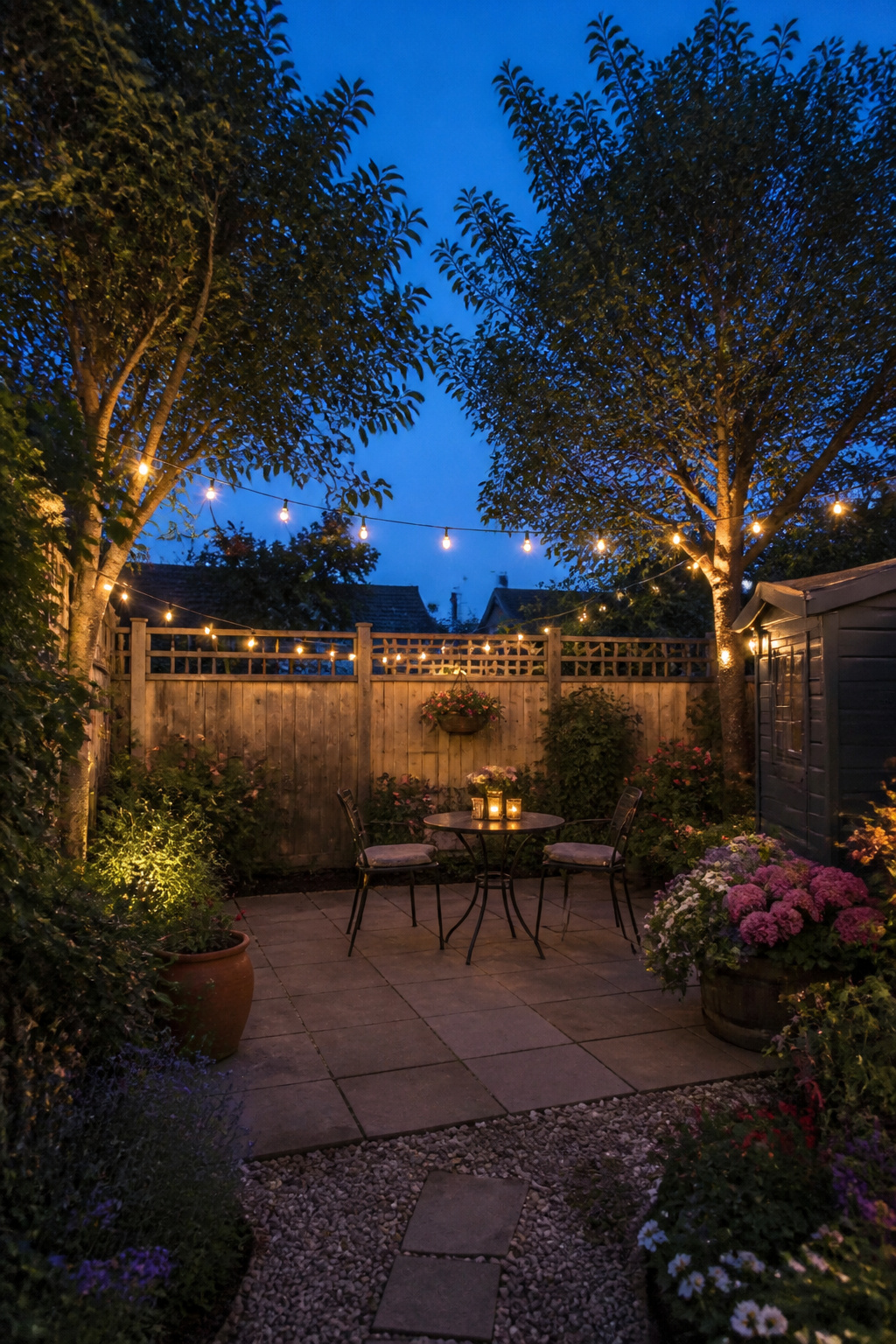
Evening light changes what a small garden is good for. The same patio that felt cramped at noon opens up after dark, and solar festoon lights in the $22–$55 range are the cheapest way to push that opening later into the night. I look for warm white LEDs at 2700K; the cooler tones read as blue once your eyes adjust, and blue light after dusk is harsher on moths and the bats that hunt them.
Solar strings need no outlet and no electrician, which matters when your only exterior plug is behind the grill. The tradeoff is dimness on cloudy weeks and a battery that weakens after two or three seasons. I hang mine with enough slack that wind does not snap the filament, and I take them down before hard frost because the cheap ones are not built for freeze-thaw. Waterproofing is the spec to check; the box should say IP65 or better, not just "water resistant," or one May thunderstorm ends the whole strand.
If your space is a balcony with no overhead anchor, a galvanized steel pole set in a bucket of concrete gives you two corners of a triangle. The third hooks to the railing. It is ugly until the lights are on, and then nobody looks at the pole.
28. Solar Lighting
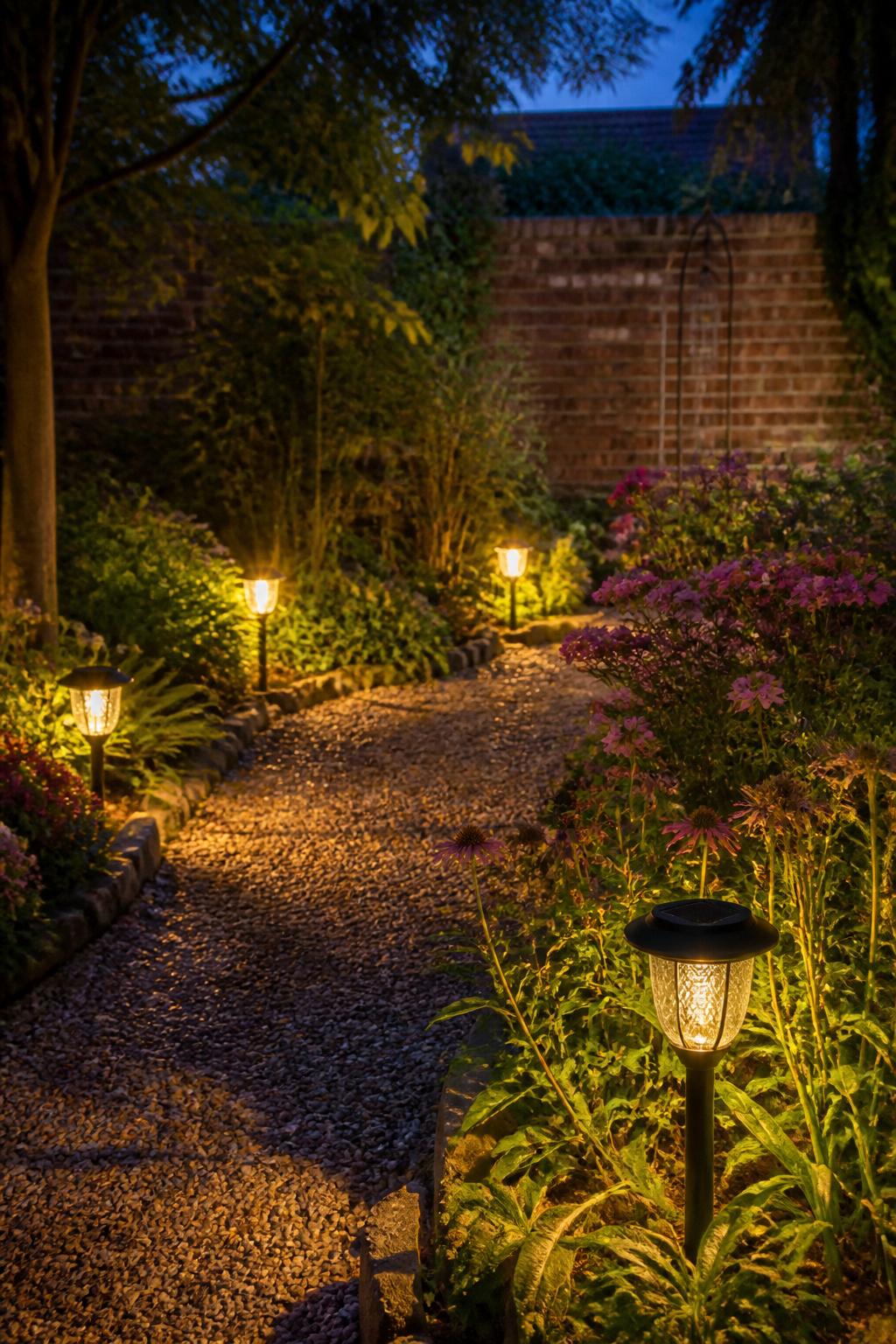
Solar-powered fixtures are the easiest way to light a small garden after dark without touching your house wiring. I started with path lights that stake straight into the soil along my walkway, and the only planning they needed was checking which spots still caught afternoon sun after the maple leafed out. Place lights where they will receive direct sun for at least six hours, or the battery will not charge enough to last through evening.
Spotlights work the same way. The ones I bought came with a ground spike and a small solar panel on top, so I angled one up at a climbing hydrangea on the fence. Warm white LEDs, around 2700K, give a softer glow than cool blue and are less disruptive to moths and other night visitors. A few sources mention yellow-toned light specifically for wildlife, and that tracks with what I have noticed: fewer insects battering themselves against the fixture when I skip the bright white option.
Operating cost is essentially zero after the purchase. No extension cords, no timer, no spike in the electric bill. The fixtures I have run on small rechargeable batteries that the sun replaces daily, and after two seasons the only maintenance has been wiping pollen off the panels in spring. For a garden on a $500–800 yearly budget, that leaves room for plants instead of utility costs.
29. DIY Water Feature
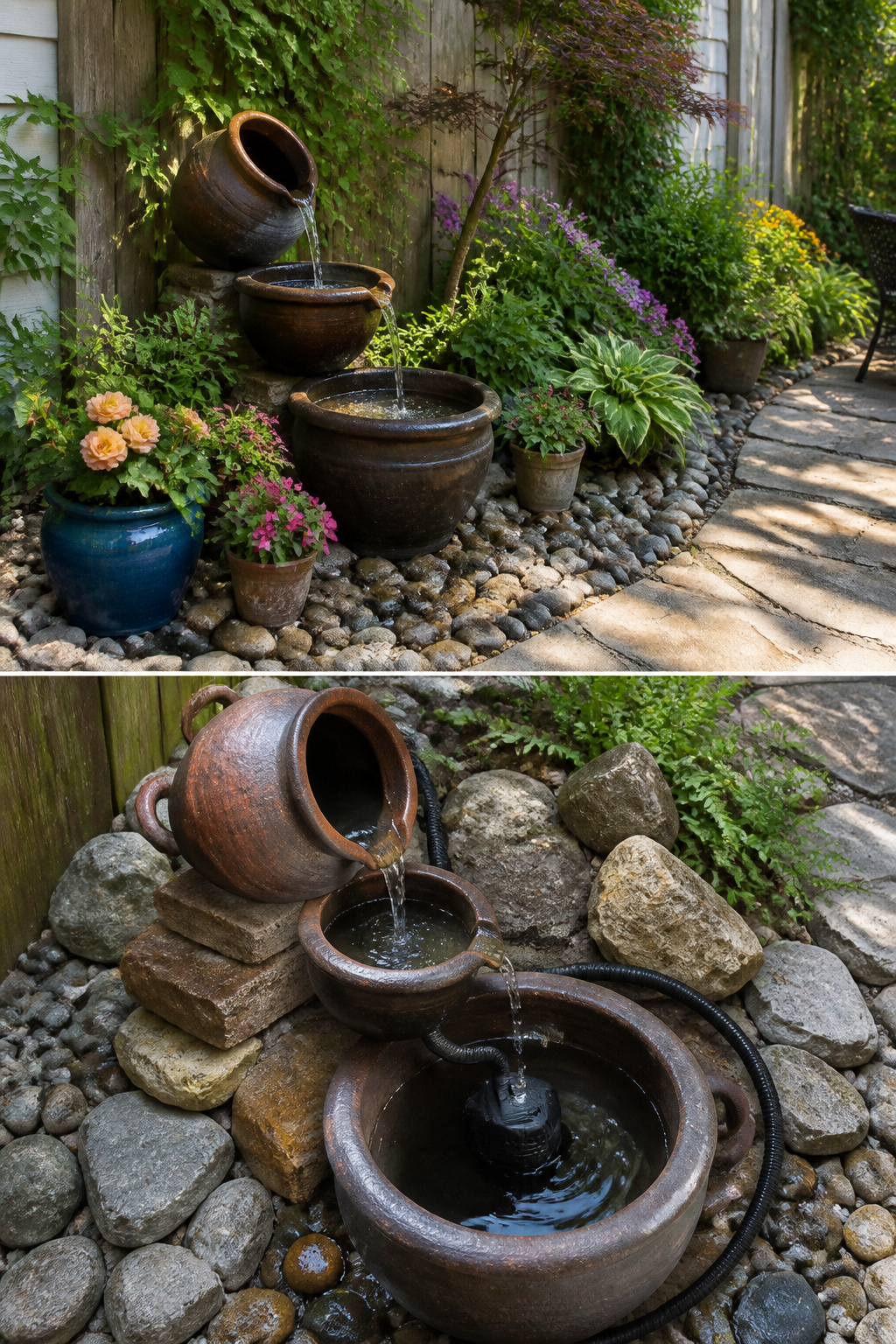
A water pump, tubing, a drill, glue, and sealant are all it takes to build a small fountain or bubbler that sounds like something twice its size. Ceramic pots filled with pebbles work well as the vessel, and stacking multiple tiers creates a gentle waterfall effect without the footprint of a full pond. The pump recirculates the same water, so the running cost stays low.
Even a single pot with water bubbling over stones adds atmosphere to a balcony or patio corner. The sound masks traffic noise and draws birds, which is worth more in a small space than the feature itself. A 30-dollar pump kit and a terracotta pot you already own gets you most of the way there. Sealant matters more than the pot’s looks; a slow leak will empty the reservoir onto your deck before you notice it. Test the assembly for an afternoon before you settle on placement.
30. Small Pond

A preformed pond shell drops into a dug hole faster than a flexible liner, but the rigid shape limits where it fits. Flexible liner gives you the edge in an awkward corner, though you will spend longer getting the folds flat and the edges hidden. Either way, depth in a small garden should stay shallow enough that a toddler could stand up if they stepped in, which also keeps your water volume low and your liner cost down. I have seen neighbors skip the safety shelf, the shallow ledge just below the waterline, and regret it when raccoons knocked pots in and could not climb back out. A shelf gives you a place for potted marginals without drowning them, and it gives wildlife an exit.
Maintenance stays manageable if you size the pump to the actual water volume, not the next size up the hardware store stocks. Too much flow in too little water stirs sediment constantly, and the filter clogs faster than you clean it. In my first attempt, I ran the pump eight hours a day through a Texas summer; the electric bill taught me that four hours, split morning and evening, kept the water clear enough for the price I wanted to pay. Algae still comes. A bundle of barley straw, weighted and left in the deepest part, works slower than chemicals but does not kill the tadpoles you will probably want once the pond is in.
31. Fire Pit
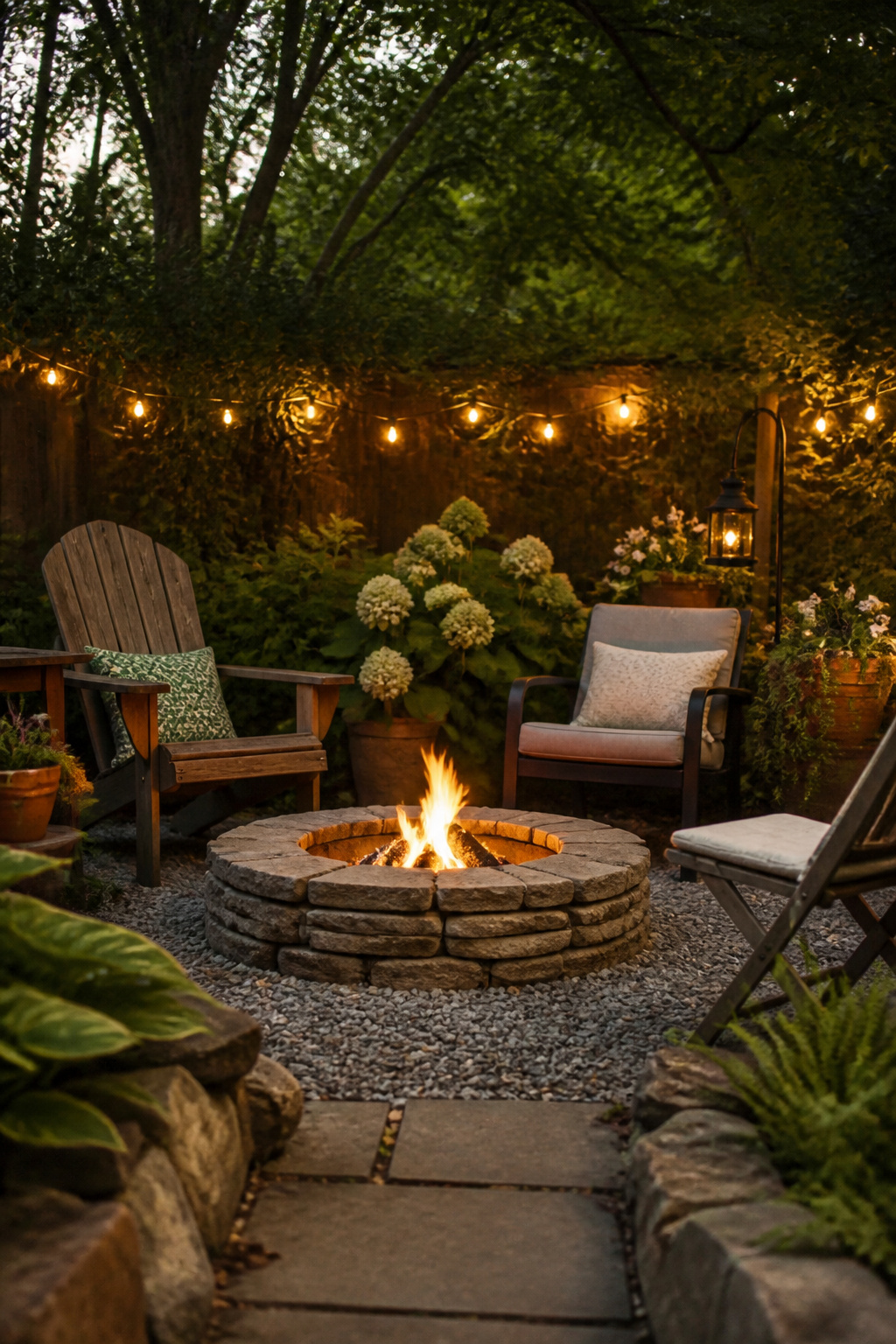
A fire pit turns the smallest yard into a place people linger. I built mine from cinder blocks and pavers stacked in a rough circle, though natural rock works if you have the patience to fit uneven pieces. The barrier needs to sit at least 10 feet from any structure, fence, or overhanging branch, and more clearance is safer if your space allows. Local fire codes vary, so a quick call to the city or a check of the municipal website saves the awkward conversation with a neighbor or a fine.
Fuel shapes the experience more than the ring itself. Wood gives heat and that campfire smell, but stored logs eat space a small garden does not have. Propane bowls stay clean and start instantly, yet the tank hides somewhere and replacement costs add up. I went with wood because a face cord tucks against the garage and lasts the season, but a balcony or tight patio almost demands propane.
The seating circle matters as much as the flame. Camp chairs work, but they read temporary. I found two weathered metal chairs at a garage sale and added a small concrete side table for mugs and skewers. The whole setup cost under $80, not counting the wood.
32. Plant Markers

Painted stones work better than you might expect for marking vegetables and herbs in a small garden. A flat river stone, a coat of exterior paint, and a fine brush give you a label that sits at soil level and does not snag hoses or knees. Wooden spoons from the thrift store do the same job with less artistry; the handle stakes into the ground and the bowl faces you like a tiny sign. Both materials rot or fade eventually, which is the point in a garden you replant every season.
Metal tags cost more upfront but survive years of rain and sun. Aluminum flashing cut with tin snips, or the tags that come with nursery plants, washed and reused, keep their lettering where wood swells and paint flakes. The real advantage of any marker system is the record it keeps. In a four-by-eight bed or a cluster of pots, the label you write in May is the memory you do not have in August, when basil and young peppers look identical from two feet away and you are deciding what to thin, what to feed, and what has already failed without admitting it.
33. Sun Catcher
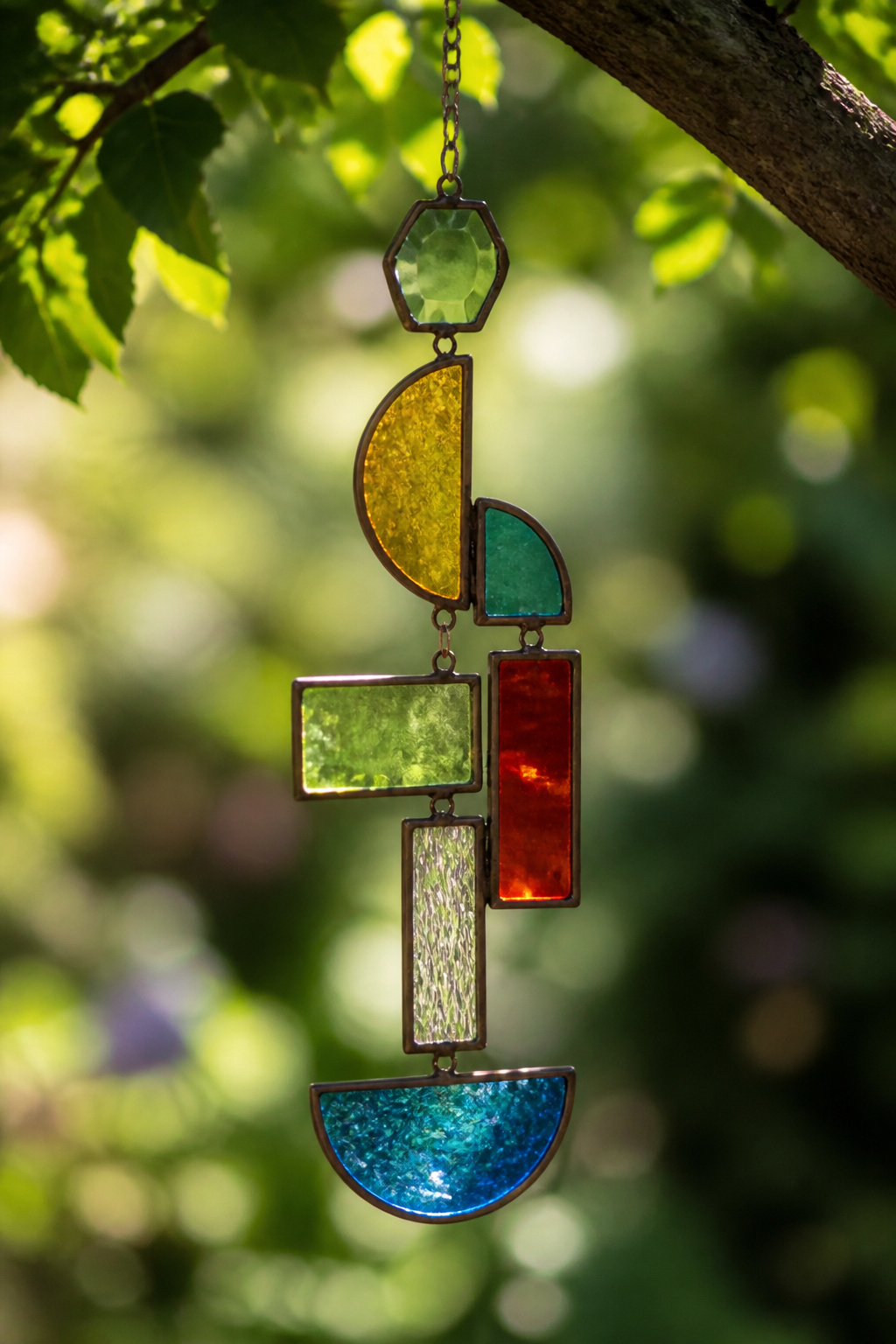
A sun catcher hung where morning light first hits turns a small garden into something that moves. I make mine from brass wire, glass beads scored at thrift stores, and whatever turns up: old keys, shell fragments, a chipped marble. The wire frame takes shape around a loop of picture-hanging cord, nothing fancier than a few intersecting circles that let the pieces dangle at staggered lengths. Morning placement matters more than the design itself; east-facing hooks catch the low, gold light that throws long, shifting patterns across a patio or balcony rail. Afternoon sun from the west works too, but the effect flattens, more glare than geometry. The beads need to be close enough to clink occasionally, far enough apart that each one spins independently. My first attempt crowded everything into a tight spiral, and the pieces tangled by June into a dull knot. Now I leave three or four inches between each drop, and the wire gets a quick coat of clear nail polish where the cord rubs, which keeps the tarnish from bleeding onto the hanger.
34. Zoned Spaces for Multiple Uses
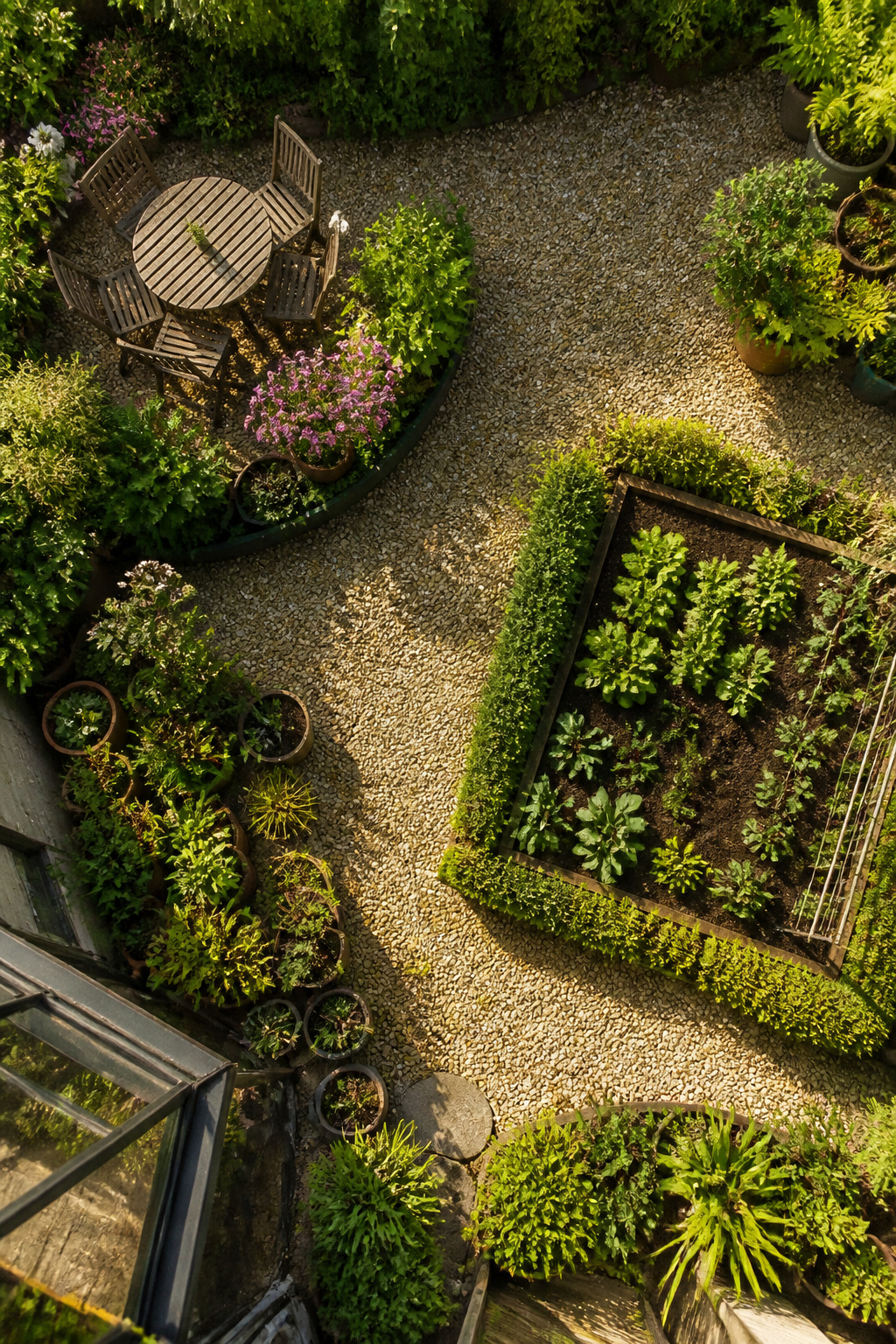
A small garden feels larger when you cannot see the whole thing at once. Dividing the space into distinct zones for sitting, growing, and storing gives each area a clear purpose, and that sense of order keeps the yard from feeling cramped.
You do not need walls to mark the change. A weatherproof polypropylene rug under a bistro set creates a living-room area on a patio or deck. Switching from paving to gravel, held in place with steel or recycled-plastic edging, signals a shift into a growing zone. Even a single step or a low raised bed separates spaces without blocking sightlines, so the garden keeps its open feel while each zone earns its keep.
Gravel is the cheapest way to define these spaces and improve drainage at the same time. A bulk bag of Cotswold chippings runs about £91 for 850 kg, and a membrane underneath stops weeds from pushing through. Two bags covered the ground in one project I read about, though your own space will vary. The result reads as intentional, not improvised, and that is what makes a small garden feel like enough.
Specific Plants That Thrive Small
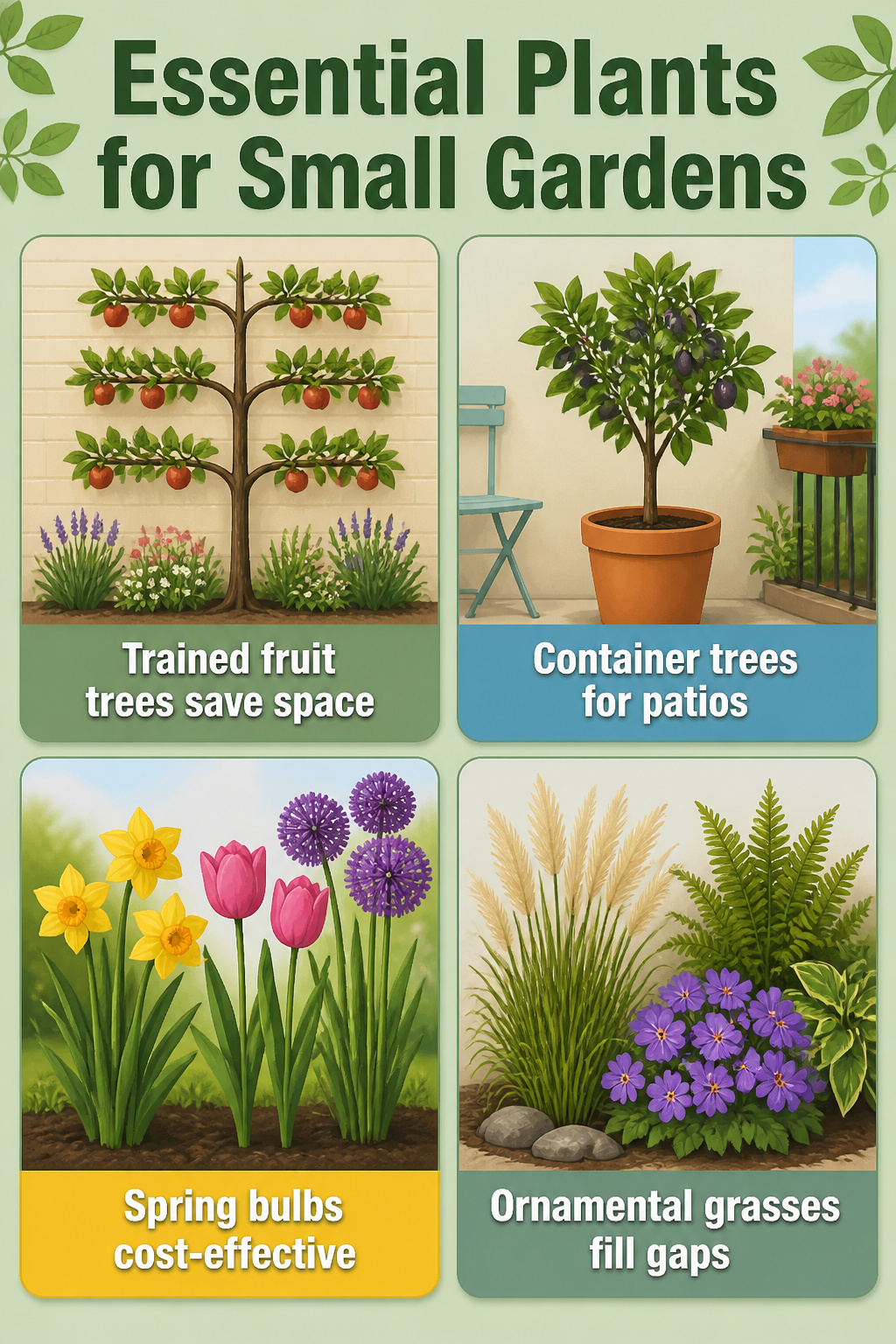
Specific plants make or break a small garden, and the right ones earn their square footage year after year.
- Trained fruit trees fit walls and fences where standard trees would crowd everything out. Espaliers and fans run flat against vertical space; stepovers edge vegetable beds without stealing room from them. Cordon apples stay so narrow horizontally that several varieties fit where one ordinary tree would sulk. All want sun and regular pruning, but little else.
- Container fruit trees suit patios and balconies with no ground to plant in. Self-fertile varieties like Cherry ‘Stella’, Apple ‘Fiesta’, and Plum ‘Opal’ fruit without a pollination partner, and a sunny spot with consistent feeding and watering yields a harvest in a few years. More work than in-ground trees, but the only option when pavement is what you have.
- Spring bulbs planted in autumn cost little and return before anything else wakes. Daffodils, tulips, and alliums store their own energy underground, so they do not demand the space or soil depth of permanent plantings. Alliums in particular carry that globe-shaped flower head high on a slim stalk, vertical presence without width.
- Ornamental grasses like feather reed grass move with wind and fill narrow gaps where shrubs would overgrow. Hardy geraniums spread low, resist slugs, and cover ground cheaply. Ferns handle shade where the sun-loving choices fail. These are the perennials that come back without repurchasing, and native ones to your zone need less water and fertilizer than anything forced to adapt.
Seasonal Timing for Planting

Timing determines whether a small garden budget stretches or shrinks. Autumn planting of spring bulbs and hardy perennials uses the season’s still-warm soil to establish root systems before winter dormancy, which means stronger growth and earlier blooms the following year without replacing failed plants.
The hardiness zone system matters here more than calendar dates. A gardener in zone 6 might plant tulips and daffodils through late October, while zone 8 planting finishes weeks earlier. Hardy perennials set in autumn, like the native varieties suited to local conditions, develop enough resilience to survive difficult conditions such as drought with less water and fertilizer than spring-planted counterparts. That resilience translates directly into fewer replacements and lower yearly costs.
Spring planting works for frost-sensitive annuals and tender vegetables, but the same bulbs cost the same money either season. The difference is survival rate. Autumn-planted stock simply has more time to settle where it will live, rather than where it was grown in a nursery pot. For the gardener working within that $500–800 annual range, the wrong season turns a one-time purchase into a recurring expense.
Upcycling and DIY Basics

- Pallets stamped "HT" for heat-treated are the only ones to bring home; "MB" means methyl bromide, and that wood belongs at the curb. A pry bar and a claw hammer lift the slats without splitting them if you work the nails from both sides. Sand to 80-grit, then prime. Exterior paint on pallet wood needs that primer coat or it flakes by August.
- Old metal bistro sets take exterior metal paint in a single color, all black or all white, and the uniformity does more for the look than the paint itself. Wire-brush rust first; the paint sticks or it does not, and there is no middle ground.
- For a DIY fountain, a ceramic drill bit and masonry sealant matter more than the pot’s looks. Drill the drainage hole larger, run tubing through, and seal around it with aquarium-grade silicone. The pump sits hidden in the base pot; stack a second tier if the weight feels stable. Test the seal with water for an hour before you add pebbles. A small pond uses the same pump logic, just buried in a liner with rocks for cover.
- Tools: pry bar, claw hammer, 80-grit sandpaper, drill with ceramic and wood bits, wire brush, masonry sealant, aquarium silicone, and a basic pump with tubing. Most of it lives in a standard toolbox already.
Minimalism for Modern Looks

Light colors do more than brighten a corner; they stretch it. In my own reading, pale gravel or whitewashed boundaries bounce daylight back into shadowed patios and make the footprint read larger than the tape measure says. Cotswold chippings, laid over a weed membrane, run about £91 for an 850 kg bulk bag, and that single material can carry the whole ground plane.
Clean lines come from restraint, not purchase. Limiting yourself to one or two hardscape materials, painted in a single tone, does more for a modern feel than scattered accents. Painted pots in one color, one gravel size, one fence stain: the repetition reads as intention.
Upcycling fits this discipline well. Old furniture painted in a modern tone, architectural grasses in salvaged containers, a decluttered layout with clear borders. The mistake is treating "budget" as permission to collect mismatched freebies. A modern small garden needs editing, not accumulation. Two materials, one light value, and everything else leaves the space.
What to Avoid in Small Gardens
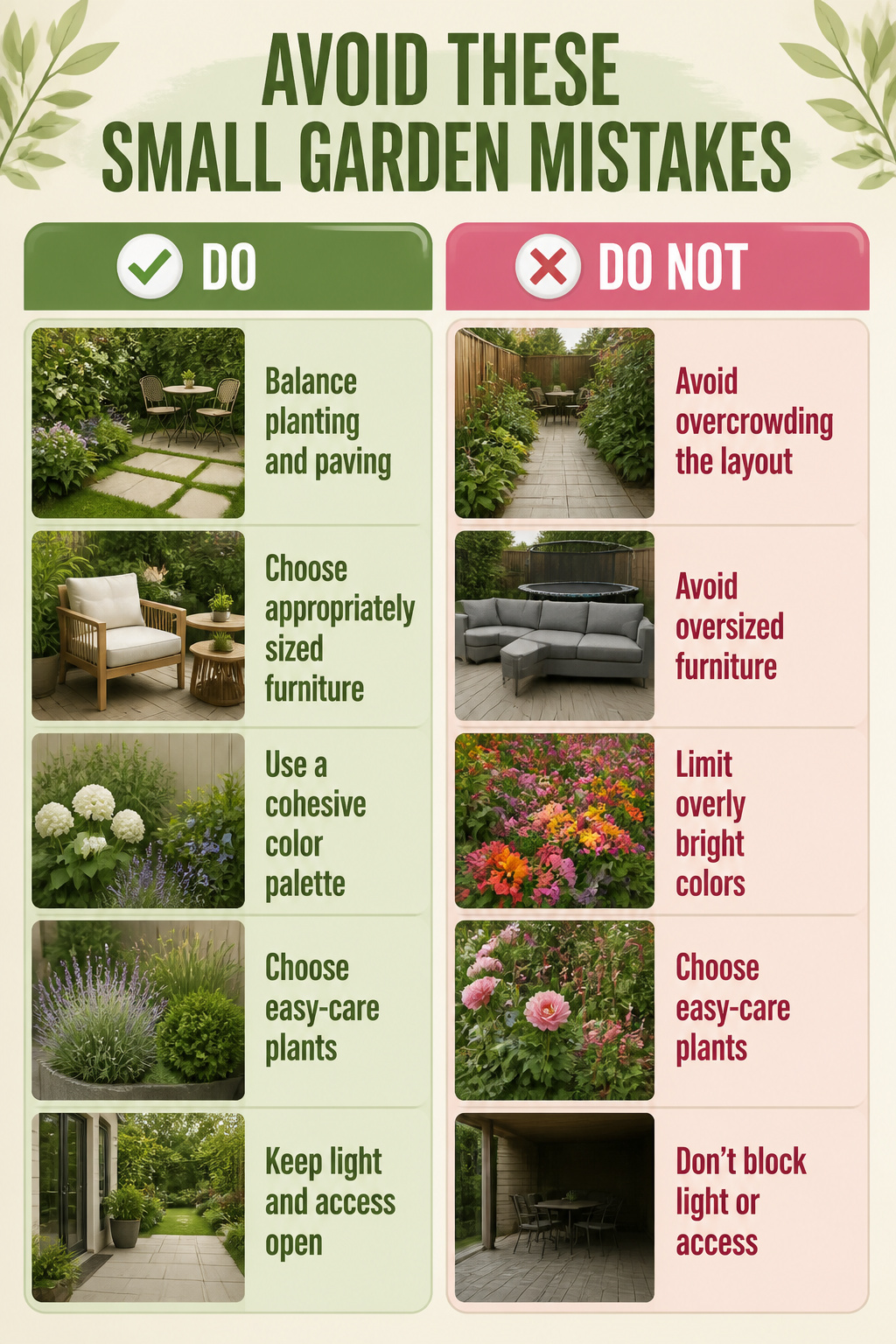
A small garden collapses under its own weight faster than you’d think. Here is what to cut before you spend.
- Overcrowding the layout. Planting and hardscaping need to stay in balance. A patio or deck that creeps past half the space starts to feel pinched and hard to use. The ratio that reads right is about 50 percent planting and furniture to 50 percent paving or decking.
- Oversized furniture. A trampoline or bulky sectional hogs the last patch of afternoon sun and leaves you camped in its shadow. Measure the footprint before you buy, and picture where the light actually falls at 1 pm.
- Competing colors. Too many bright tones in a tight space fight for attention and tire the eye. Two or three restrained colors carry farther.
- High-maintenance plants for beginners. If you are only a season or two in, a plant that wants staking, deadheading, and precise watering will turn into a guilt trip by July.
- Features that block light or access. That stylish stenciled deck by the kitchen extension looks good in photos, but if it sits in full shade by midday and feels detached from the garden, you will not sit there.
Frequently Asked Questions
How do I make my small garden look modern on a tight budget?
Use light-colored paving or gravel to bounce light around and make the space feel larger. Paint boundaries in a light shade if your outdoor space is shady. Pair this with upcycled materials like pallets or old wheelbarrows painted in a single matte color, and group containers at varying heights rather than lining them up.
What is the best layout for a very small garden?
Diagonal paving lines or a circular lawn shape trick the eye into traveling across the space instead of stopping at the boundary. Circles break up boxy yard geometry and pull attention away from fence lines. Pick one focal point and build paths that move toward it rather than scattering features.
What can I plant in autumn in Europe?
Autumn is ideal for planting spring-flowering bulbs like daffodils, tulips, and alliums, which are budget-friendly. Hardy perennials and evergreen shrubs also establish well while soil stays warm, giving them a head start before winter sets in.