These mudroom ideas run from a wall-mounted hook strip you install in an afternoon to a pet washing station that needs a plumber and a tiled basin.
The right choice depends on whether your entry is a narrow hallway that barely fits a bench or a full room with wall space to spare.
A single LED strip underneath open shoe cubbies can be enough to keep winter mornings functional, while a barn door only works if you have clear wall beside the opening equal to the door’s full width.
1. Shoe Cubbies
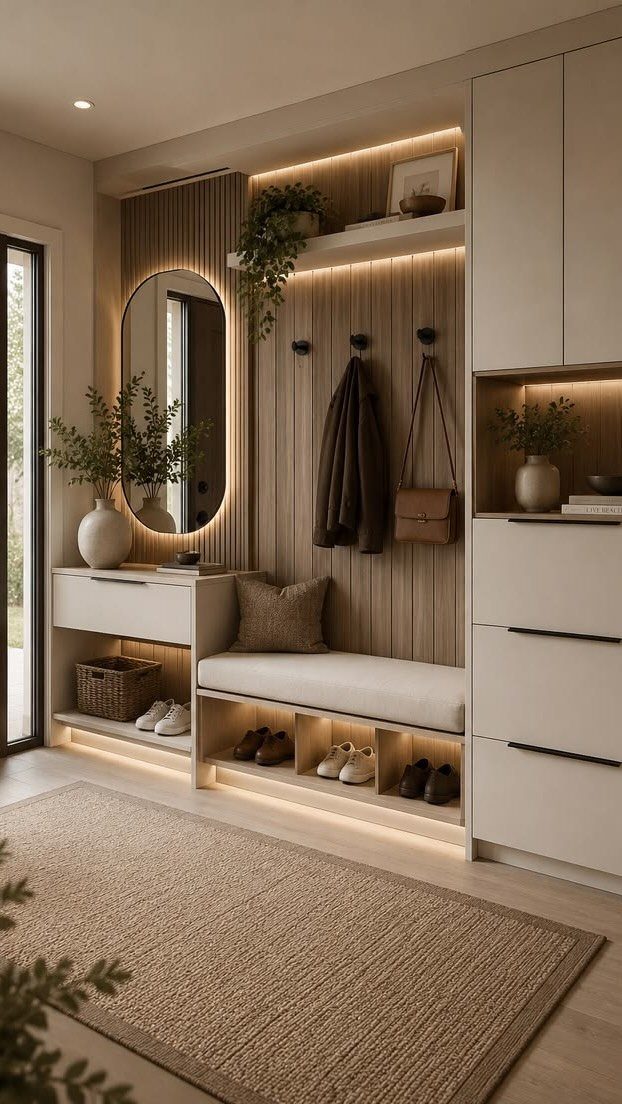
Shoe cubbies work best when they sit open at the base of a bench, low enough that kids and adults alike can kick shoes straight in without bending.
LED lighting underneath helps on dark winter mornings when you’re fishing for boots.
I keep mine open after watching friends fight with pull-out drawers that jam or get left half-open. A hidden upper shelf set back a few inches handles the second-tier stuff: tall boots, the pair you wear twice a month.
Leave the daily rotation where you can see it, or it ends up on the floor anyway.
This setup suits families who come in with dirty shoes and no patience. Dust is the downside; vacuum the cubbies monthly or line them with a thin mat you can shake out.
2. Hooks, Drawers, Shelves, and Baskets
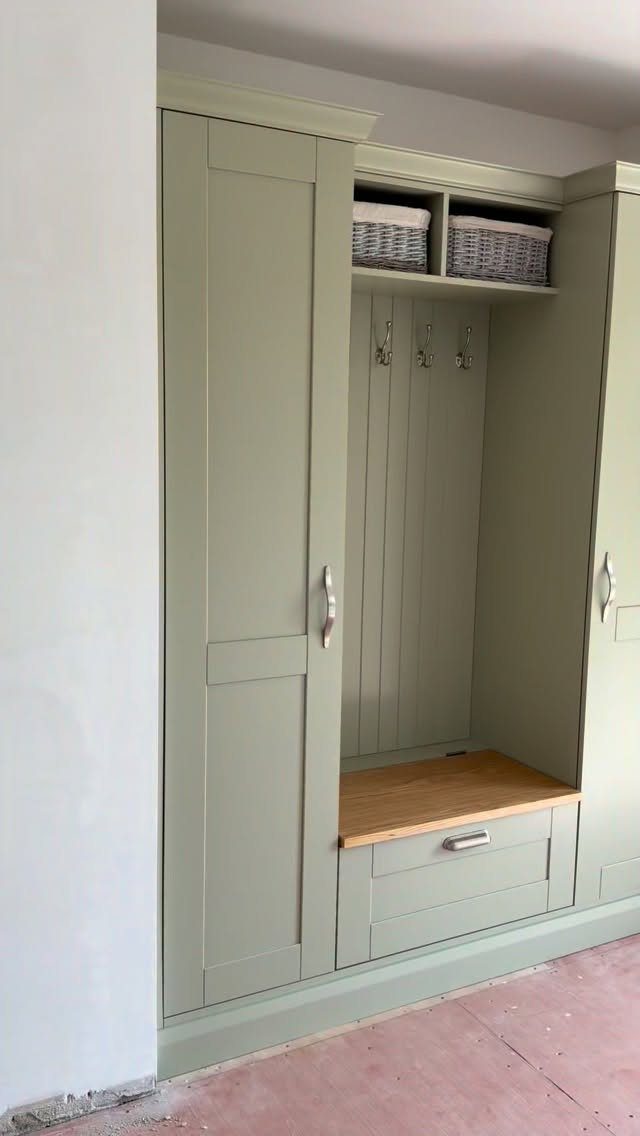
A mudroom that actually functions mixes storage types because no single one handles everything.
Hooks for coats you grab daily, drawers for the gloves and lip gloss you don’t want to display, shelves for baskets that corral hats and scarves, and those baskets themselves for the stuff that has no fixed category.
The choice depends on who uses the space and when. A household where everyone leaves at the same hour needs more hooks and fewer drawers; one with staggered schedules can share fewer hooks if drawers hold the backup layers.
I like a bench with a shallow drawer directly beneath the seat for the things you handle last: keys, the dog’s leash, the mask you keep forgetting.
Wall space above the bench is often wasted. Floating shelves there hold what hooks would drop: sunglasses, a small dish for change, the hat you wear on weekends.
Check your own morning routine before deciding the mix; most people overestimate hooks and underestimate flat surfaces.
“Determine the three most important uses for the space and let those drive floor plan and storage decisions,” English suggests. Britt shares some additional mudroom ideas.
3. Built-in Lockers
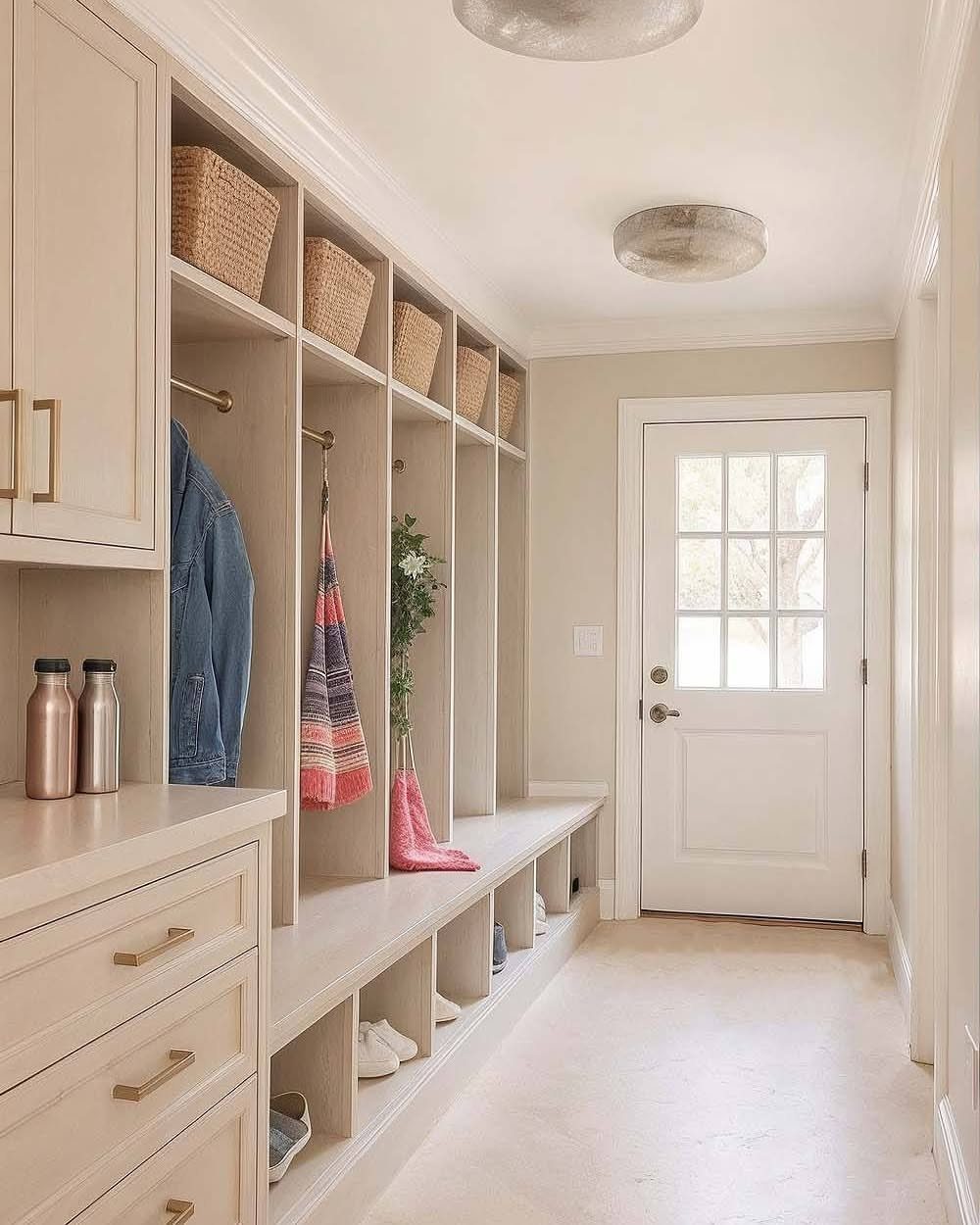
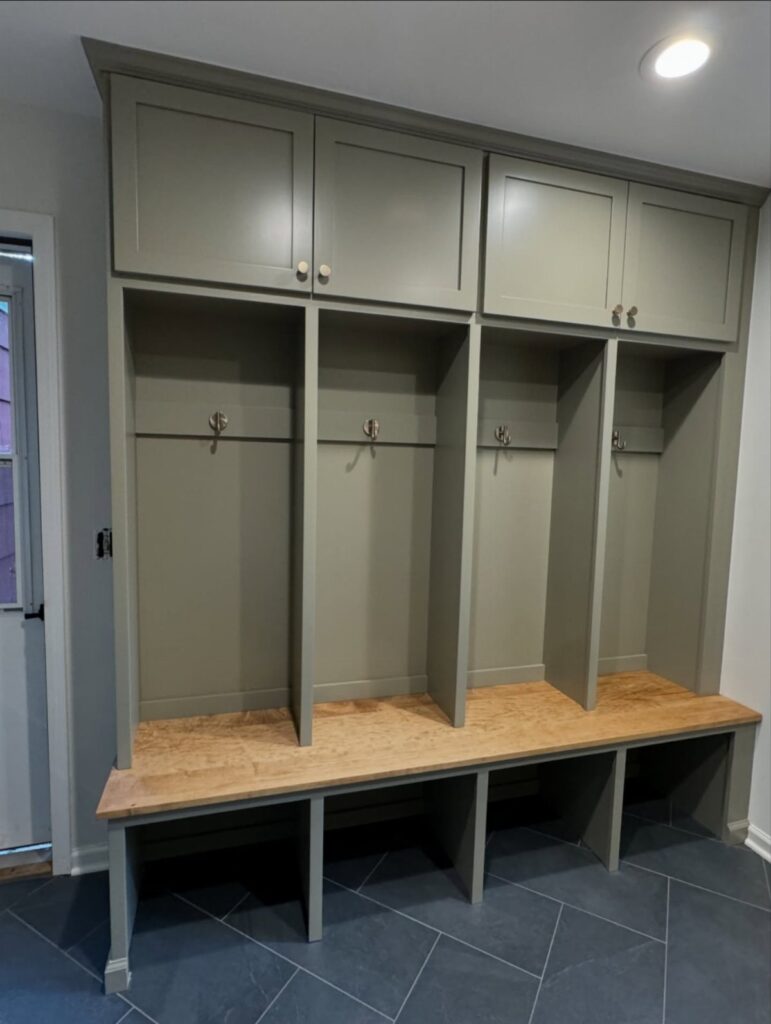
Built-in lockers give each person a vertical column of their own, which matters more than you’d think until you’ve watched two kids fight over the same hook.
Open cubbies above and shoe storage below, with a bench running the length; the baskets on top handle overflow for seasonal gear.
I went back and forth on closed versus open for the coat area. Closed doors hide mess but add a step, and that step costs you on rushed mornings.
Open lockers stay neater than expected if each person has enough width for their gear, a bit more for adults with bulky coats.
The shoe cubbies below work best open for the same reason: if pulling out a drawer is required, the shoes land on the floor.
This idea suits families of three or more where gear multiplies fast. Lockers need a hallway wide enough to avoid a tunnel feeling.
4. Bold Wallpaper Accent Wall
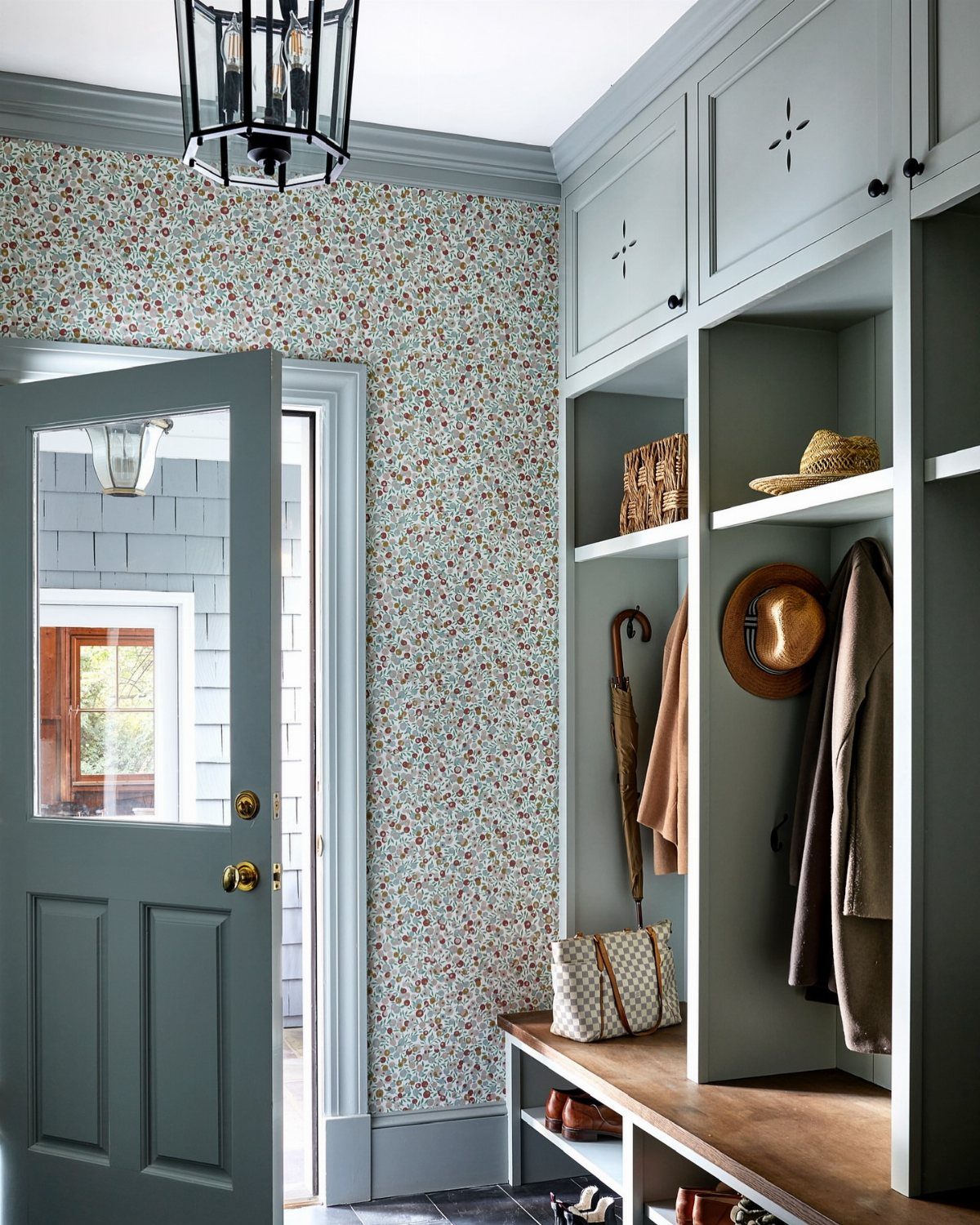
Wallpaper in a mudroom sounds risky until you pick the right kind.
The floral pattern sits above the bench line, where scuffs and splashes rarely reach, and the paper itself is vinyl or coated, meant to wipe clean with a damp cloth.
I would not paper below bench height or behind the door swing. The upper wall is where the pattern lives, where you actually see it while sitting to tie shoes or hanging a coat.
Choose a small-scale print; large geometrics or oversized florals fight the vertical lines of lockers and hooks. The blue-gray works because it picks up the cabinetry color rather than competing.
This suits renters or commitment-shy homeowners because modern peelable papers come down clean. The limit is light: a windowless mudroom needs a pattern with enough contrast to read under a single fixture, or it goes muddy and sad.
5. Benches or Ottomans with Built-in Storage
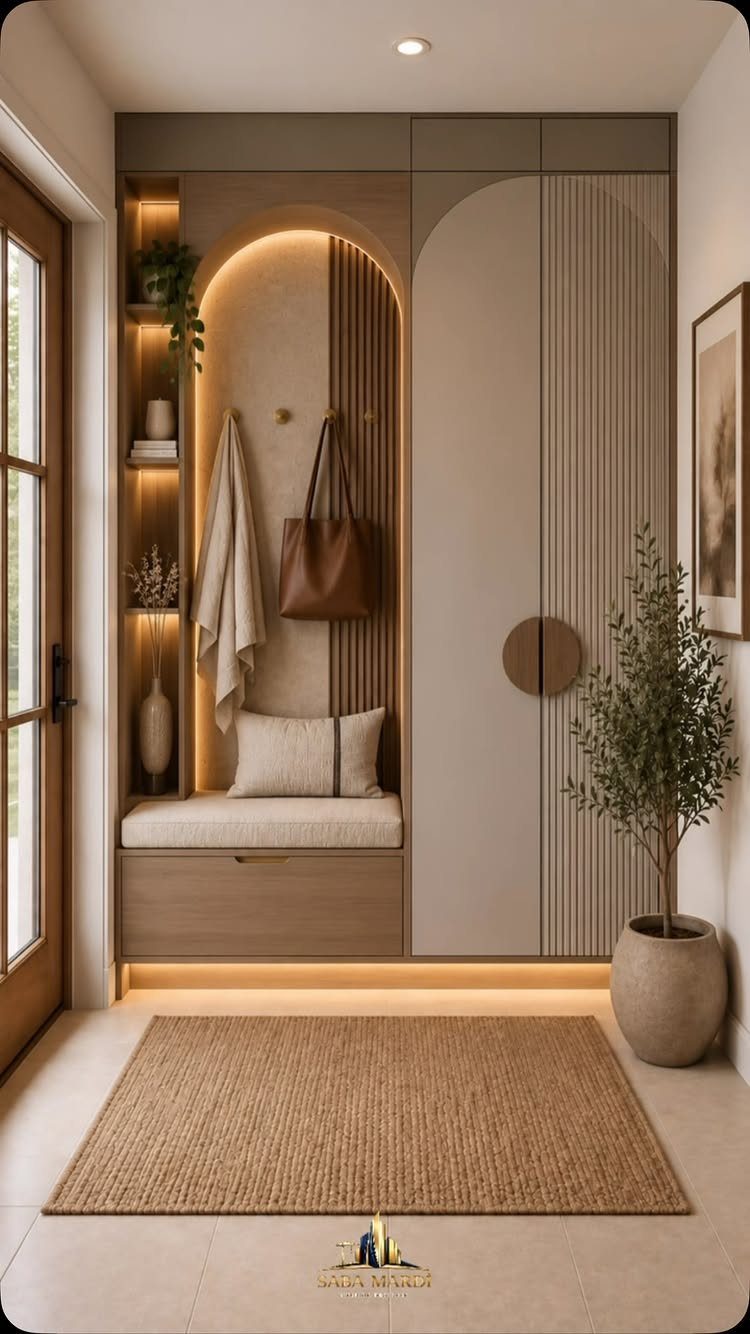
A bench with storage underneath is the single piece that turns a wall of hooks into a usable mudroom.
The arched cushion sits over a drawer deep enough for shoes or seasonal gear, and that combination means you can sit, store, and sort in one spot.
I prefer drawers to lift-top benches for daily use. A lift-top forces you to clear the cushion every time; a drawer pulls out while someone sits.
The drawer depth matters more than width; deep enough front to back handles boots, shallow leaves you with sneakers only. Underneath, baskets on a shelf are the cheaper alternative if you’re building from scratch and want to save on hardware.
This idea works anywhere you have enough wall width. The tradeoff is that built-in benches stay with the house; a storage ottoman you can move, but it rarely fits as precisely or holds as much.
6. Custom Cabinetry and Shelving
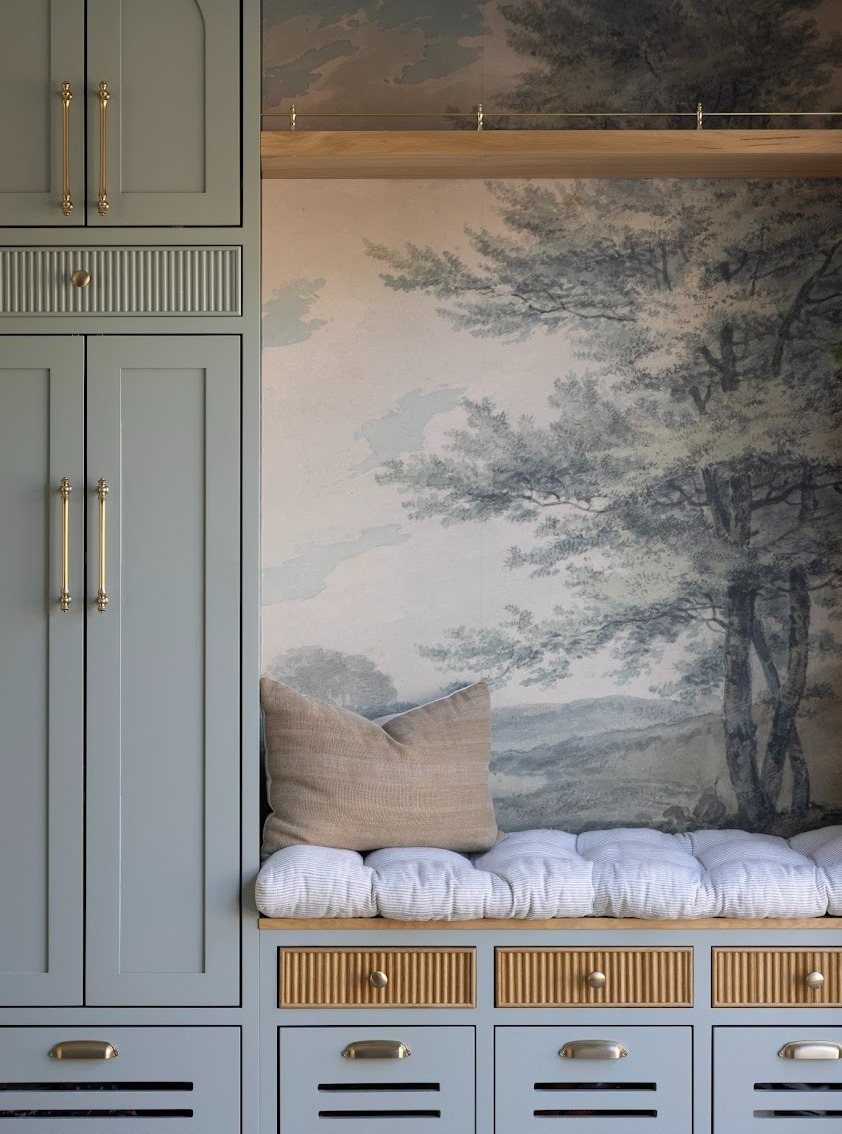
Custom cabinetry makes sense when the alternative is fighting a prefab unit into an awkward space.
Sage green built-ins with fluted drawer fronts and a scenic paper backing the upper shelf tell you this room was measured before anything was ordered.
I would start with the bench height for most adults and build outward. The tall cabinets handle the vacuum, the bulk paper towel stash, the things that have no other closet.
Drawers with dividers, clear acrylic or wood, keep small items from becoming a jumble; I sort mine by season, not by person, because gloves migrate.
The cost runs higher than freestanding, but the gain is in corners and ceiling lines that would otherwise stay dead.
Check your ceiling height before committing to overhead cabinets; in a low room they can feel looming, and in a taller room they look proportional.
7. Overhead Cabinets
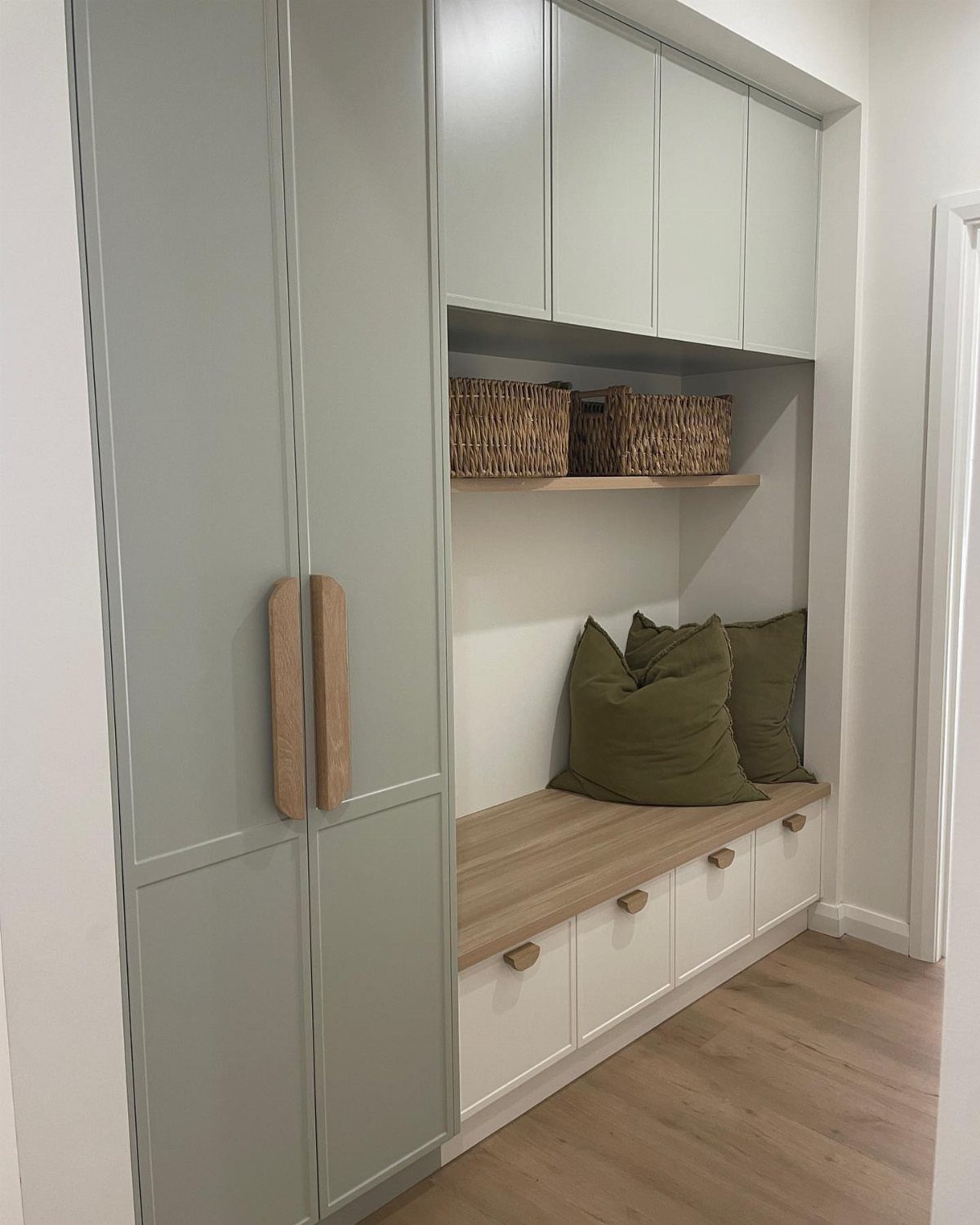
Overhead cabinets draw the eye upward and turn the gap above a shelf or bench into storage you do not trip over.
I would mount them at least a foot above the tallest family member’s reach, with the bottom edge clearing any baskets or display objects on the open shelf below. Pale green or light grey paint keeps the mass from looming.
Reach is the catch: you need a step stool for anything above the first shelf, so reserve that space for seasonal items, extra boots, or bulk paper goods.
Low ceilings call for a different move: skip the crown and run the cabinets straight to the top to exaggerate the height.
8. Bench and a Few Hooks
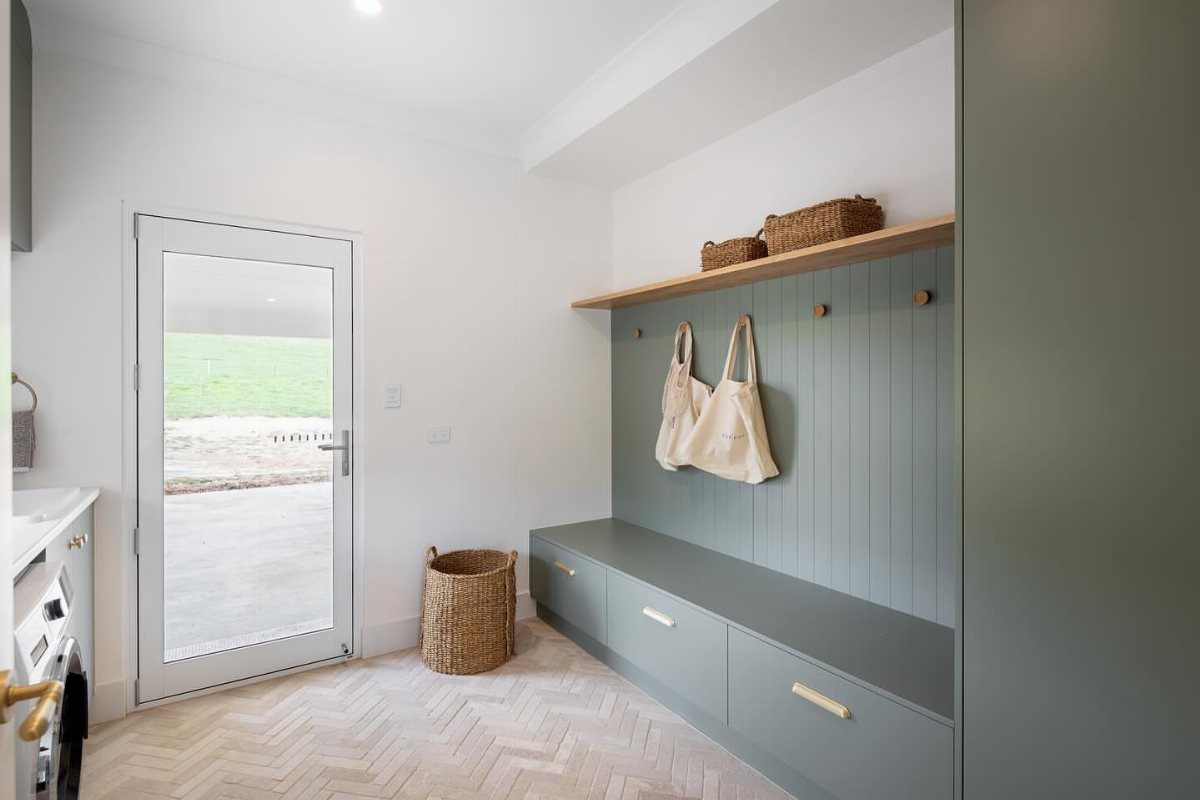
A bench and a few hooks is the whole mudroom for anyone working with a narrow hallway or a wall that is not deep enough for built-ins.
I have seen this calm a busy entry simply by refusing to overfill it. A bench and a handful of hooks is enough; the rest is clutter waiting to happen.
Storage baskets slide underneath if the bench is open; drawers add cost but hide the mess of mittens and sunscreen. The version in grey with wooden pegs reads modern; green with a cushion leans cottage.
Either way, the discipline is in stopping before you add the shelf, the cabinet, the mail slot. What you save in carpentry you gain in floor space and peace.
9. Bold Pendants or Unique Sconces
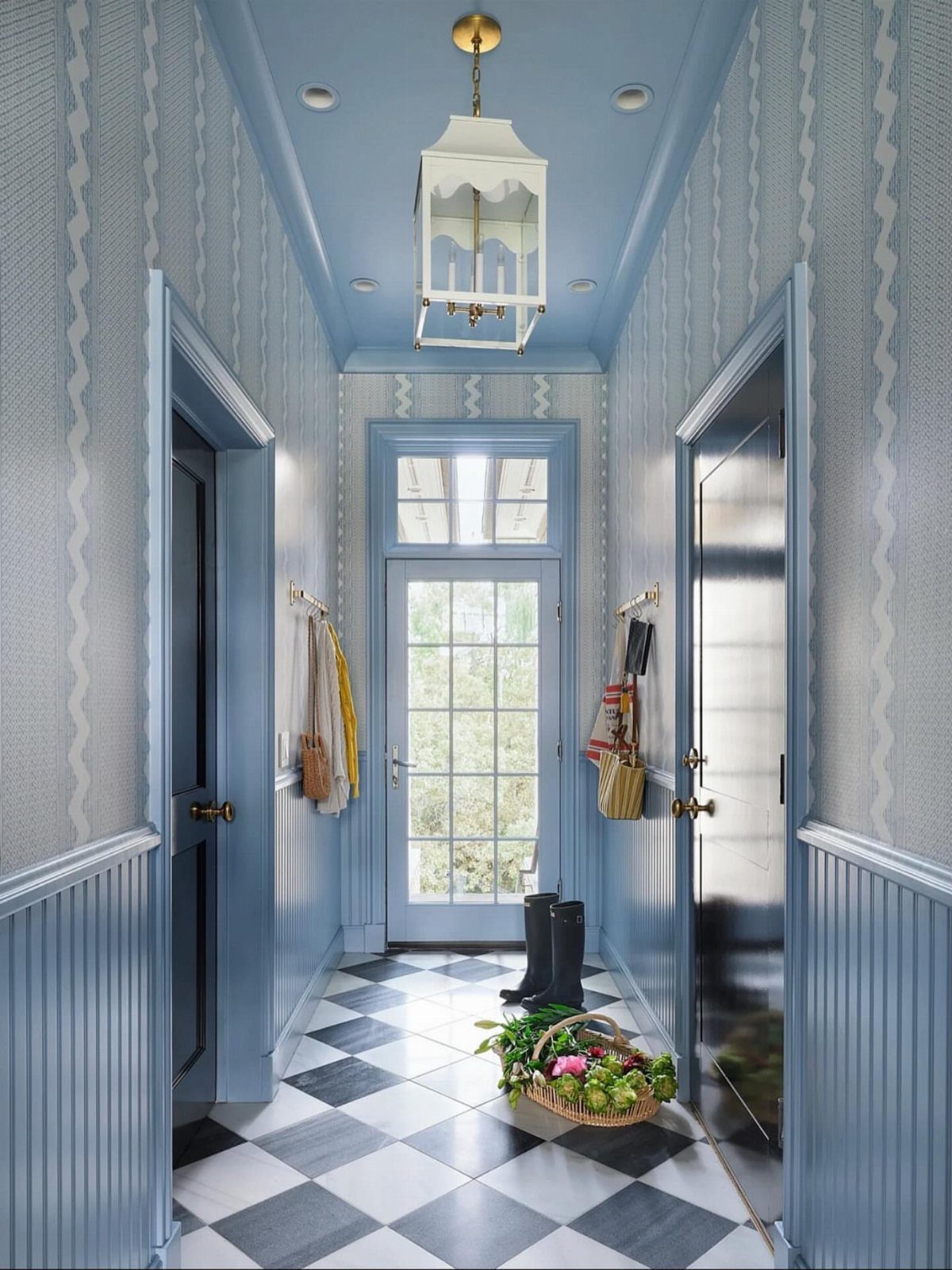
A single bold pendant or a pair of sconces does what a window cannot always manage: it makes a small mudroom feel intentional rather than leftover.
I would hang a lantern-style pendant dead center if the space is a passageway, or flank a mirror with sconces if there is a wall to face.
The wattage matters less than the scale; a too-small fixture gets lost above boots and coats. When wallpaper and tile already compete, a plain white lantern gives the eye a place to rest.
In a plainer room, a black or brass fixture becomes the personality.
10. Sliding Barn Door
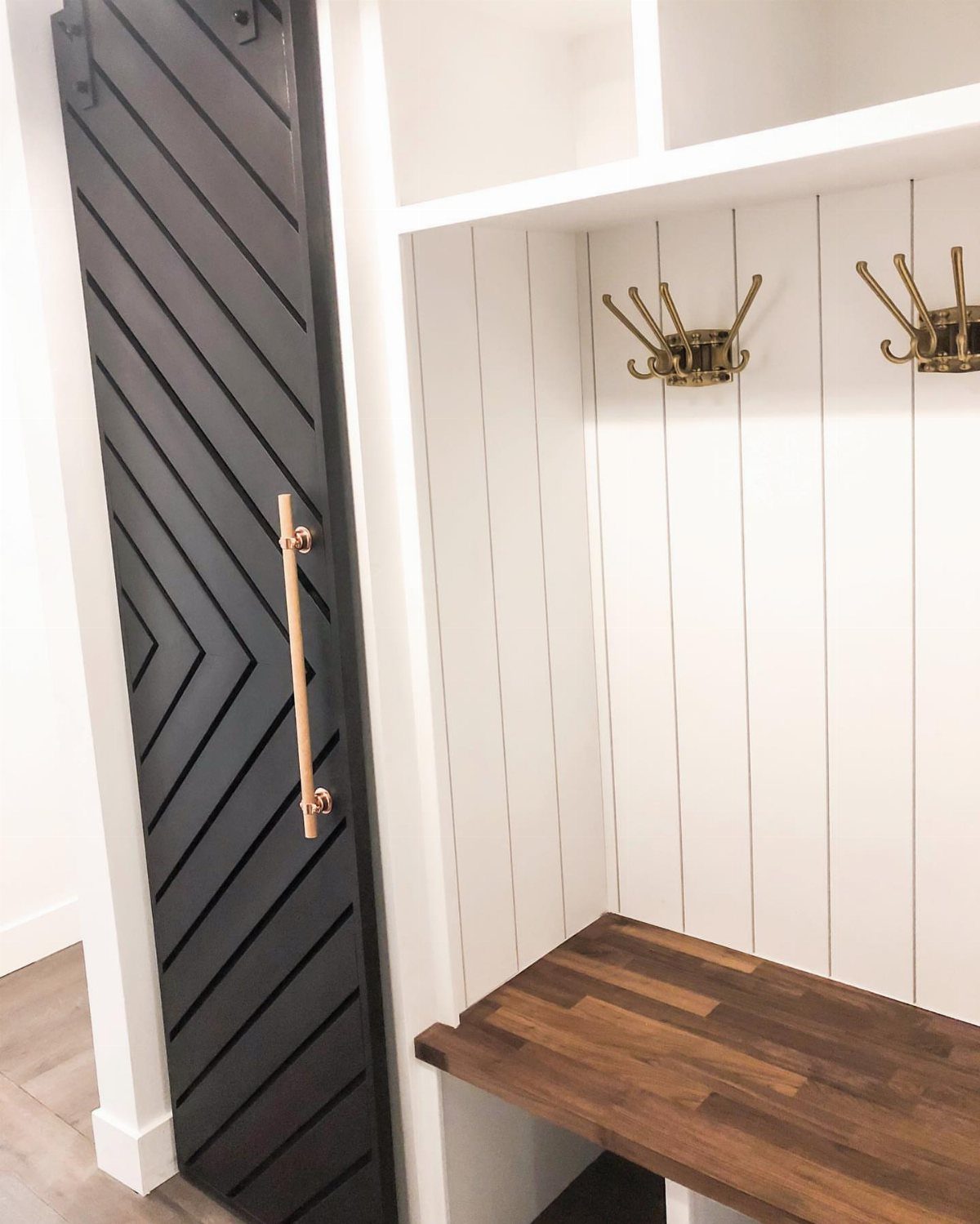
A sliding barn door buys back the swing space a standard door wastes in a tight entry. The chevron pattern in grey and wood adds texture without demanding a whole rustic scheme; brass hardware warms it up.
I would check the wall length first: you need at least as much clear wall beside the opening as the door is wide, or the track will block a hook or cabinet.
A soft-close mechanism is worth the extra cost to keep the slam out of a high-traffic morning. If the mudroom opens directly to living space, the door also hides the chaos of backpacks and wet shoes from guests.
11. Tile or Vinyl Flooring
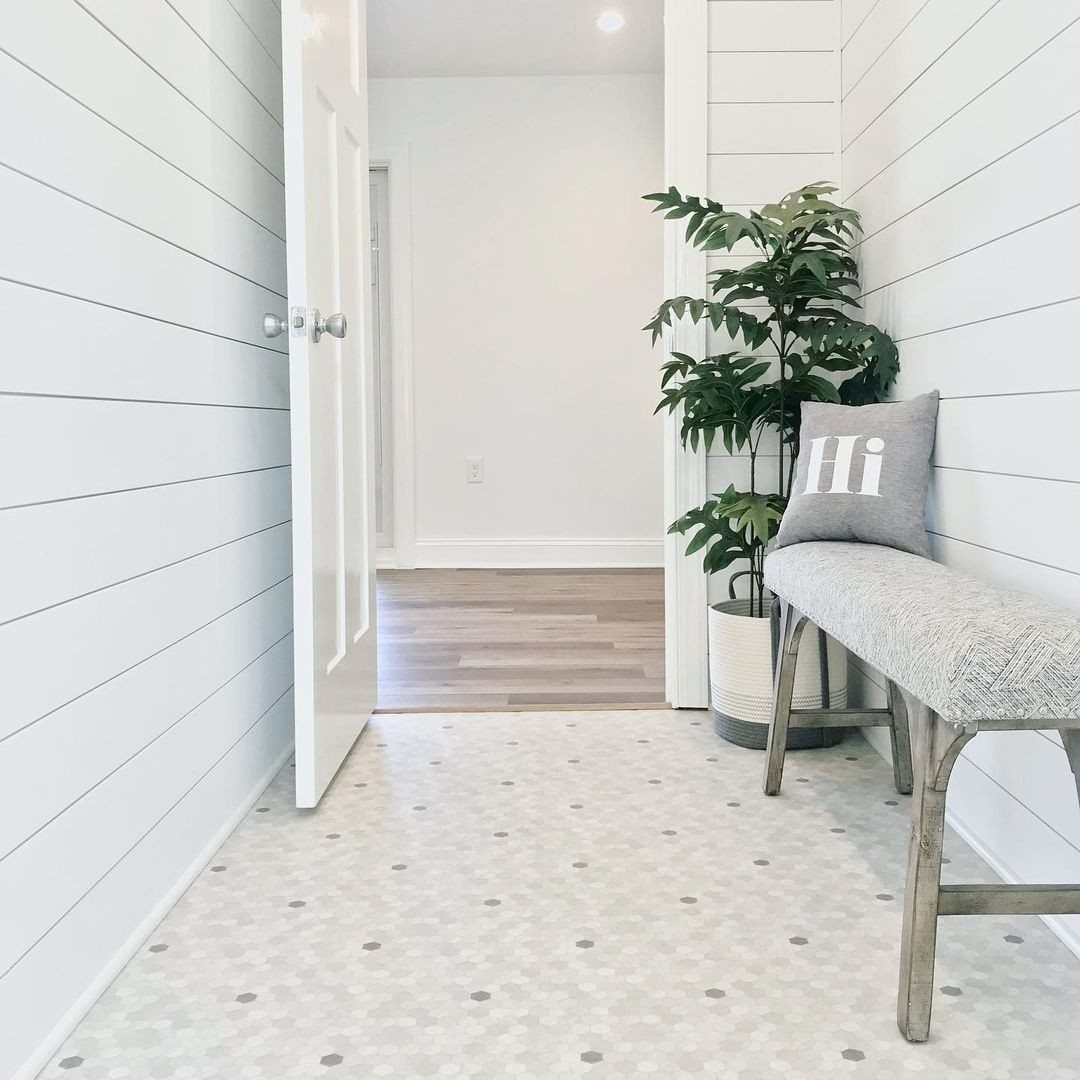
Tile or vinyl in a mudroom is not about looks first; it is about surviving grit, salt, and the dog’s paws without your intervention.
Patterned hexagon or penny tile hides the dirt that shows instantly on plain concrete or pale wood.
I would lay the tile through the whole entry, not stop at a threshold, so the transition does not become a dam for water.
Vinyl plank is cheaper and warmer underfoot in winter, but check the wear-layer thickness: the thicker the better for this traffic. The real test is the grout.
Darker grout, or epoxy, or you will be on your knees every spring.
12. Jute Rug
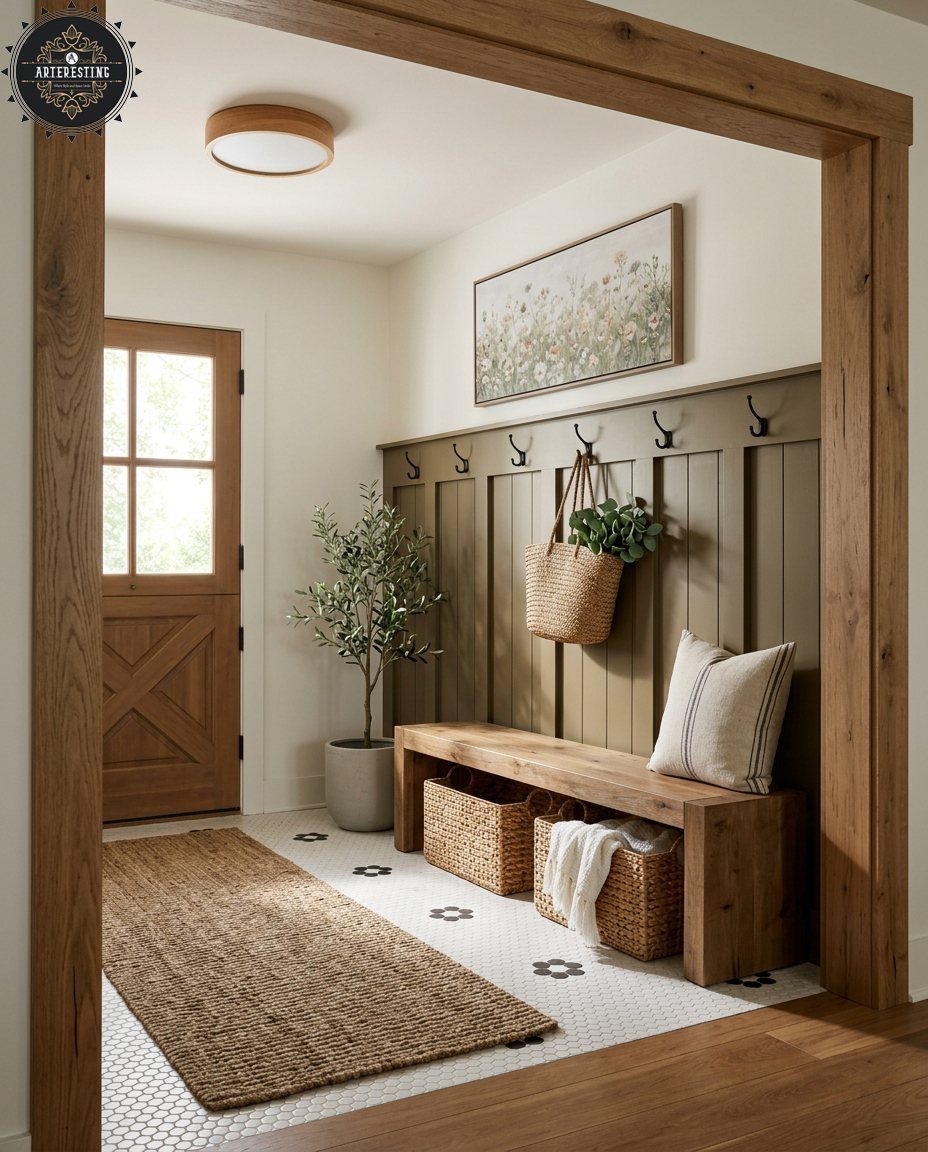
A jute rug on top of hard flooring is the compromise between warmth and washability. Shake it out weekly, beat it monthly, replace it every few years when the fibers break down.
I would layer it over tile or vinyl, never directly over wood, because trapped moisture warps boards.
Jute fits a natural palette without demanding one; a pink or patterned rug on top of jute, as some designers do, is another route if your taste runs brighter.
The limit is comfort: jute is scratchy, so a bench with a cushion is almost mandatory.
13. Utilize Shiplap
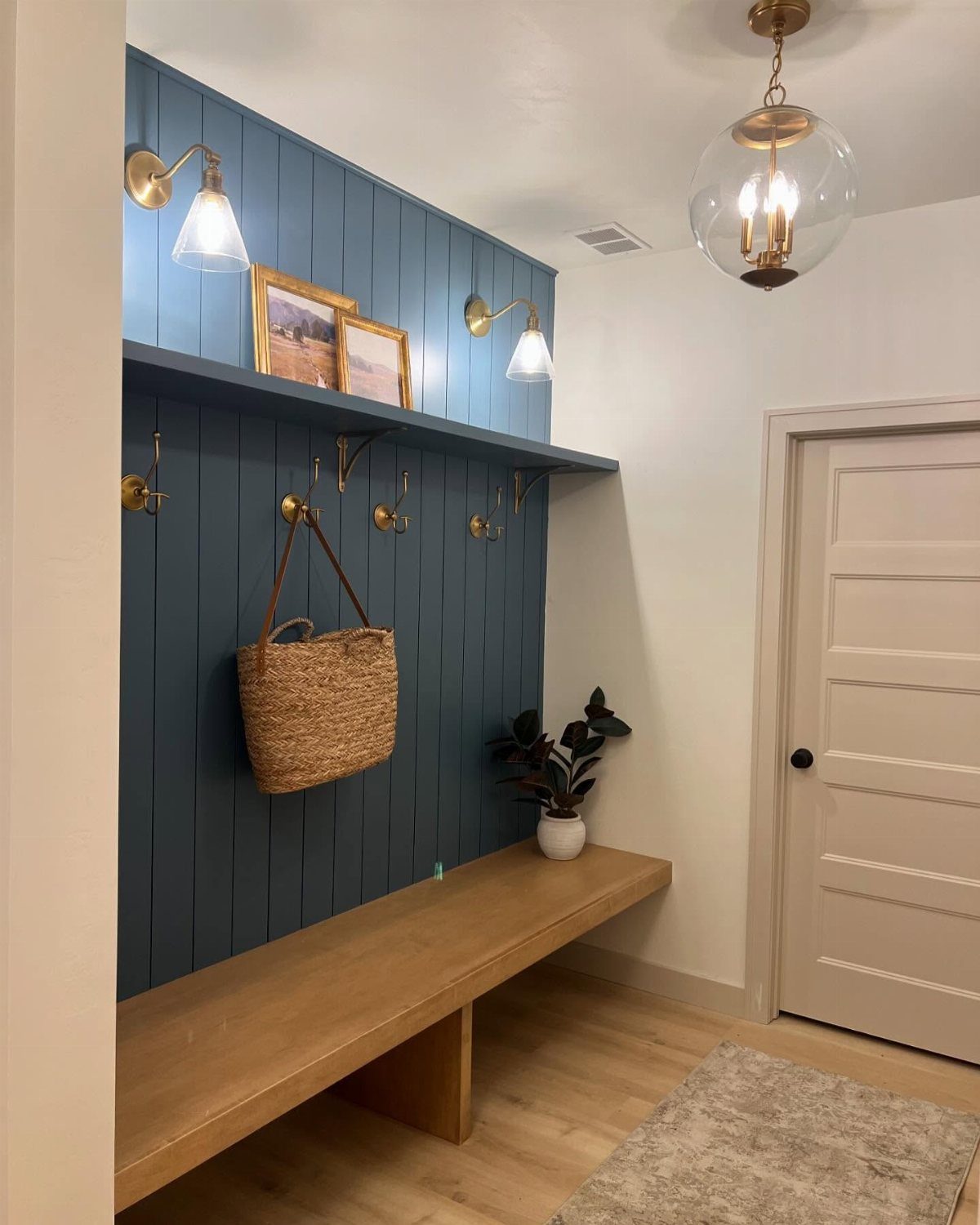
Vertical shiplap draws the eye up in a small mudroom, which is half the battle in a space that collects clutter.
Shiplap in blue with brass hardware reads crisp and coastal; white or natural stain work the same way if your light is dimmer.
Amy Storm chose shiplap for a couple who needed the room to take a beating, and that is the real case for it: the boards hide scuffs better than flat drywall and wipe down faster than textured paint.
Oak bench and drawer fronts underneath hold up to wet boots and heavy bags.
If your entry is narrow, run the boards vertically; horizontal lines widen a tight space but can feel busy when you are already facing coats, shoes, and bags.
Check your wall first: shiplap adds about three quarters of an inch, which matters if hooks or cabinets need to sit flush.
14. Bold Hue
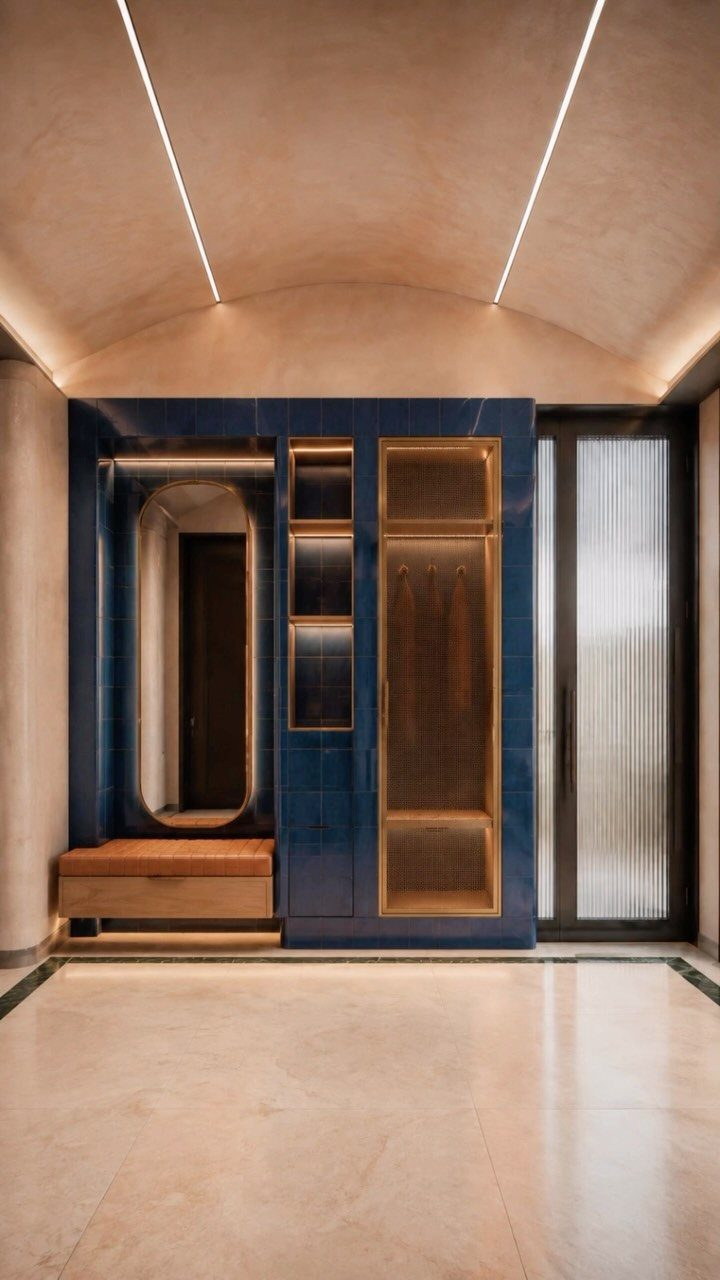
A single strong color turns a mudroom from afterthought to arrival.
Jennifer Hunter used Benjamin Moore Dark Harbor in a city apartment where the entry had to do real work; the depth of the color hides the wear that shows first on pale walls.
The photo pairs that saturation with brass mesh cabinet fronts, which keep the darkness from feeling heavy.
Small spaces can handle bold color better than you would expect because you pass through, you do not linger.
The risk is the shade against your floors: that blue sits on marble, but against wood or tile with warm undertones, the same color can turn muddy. Test a patch at the hour you actually come home, not at noon.
15. Wall-mounted Coat Hooks
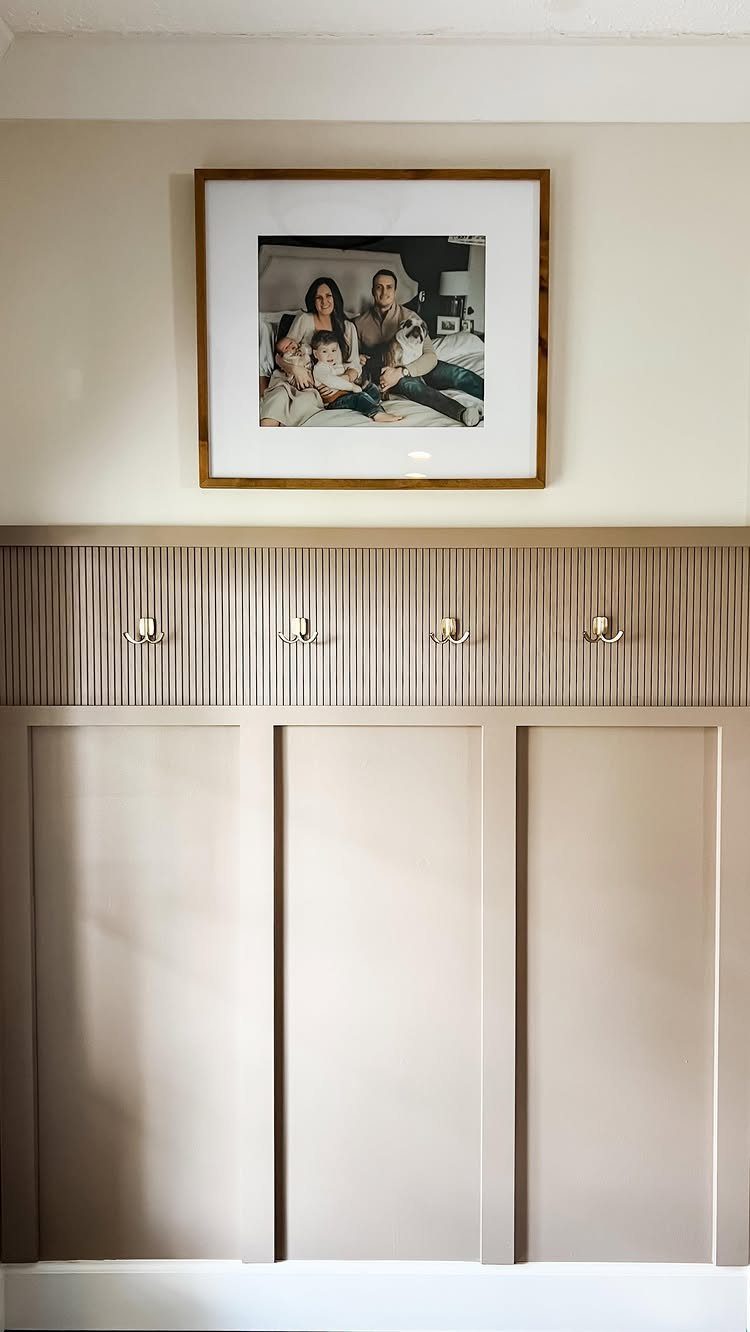
Wall-mounted hooks keep floors clear in an entry the size of a closet.
Four hooks on a fluted strip above wainscoting is one way to give them visual weight; a plain painted wall works if the hooks themselves have some heft.
Stagger heights if children use the space, or run one row at adult shoulder height for coats and a lower row for bags.
Check the backing behind your wall before you buy hardware; drywall anchors hold light jackets, but a loaded winter coat needs a stud or a toggle bolt rated for heavy weight.
16. Mudroom Island
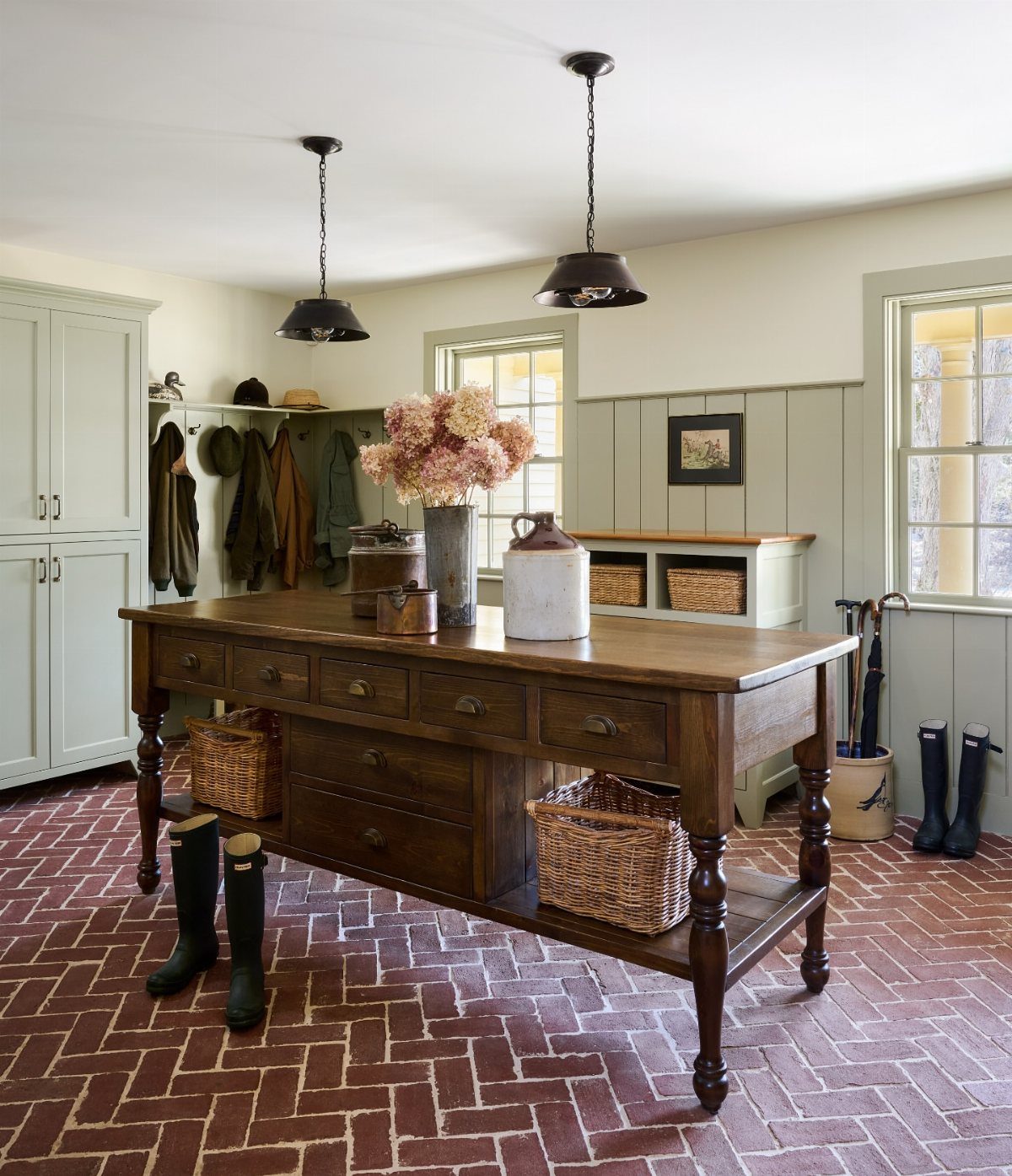
A mudroom island is a luxury that only makes sense when the room is already large enough that you are not fighting for wall space.
A wooden worktable with drawers and open shelving for baskets, set on herringbone brick, functions as a folding station, a sorting surface, and a place to drop groceries before they reach the kitchen.
An island blocks the middle of the room, so you give up the straight shot through. An island needs clear space on every side or the room becomes an obstacle course once more than one person is in it.
If your mudroom serves as the main route to the garage or the backyard, measure traffic first. A peninsula against one wall gives most of the function without splitting the floor plan.
17. Chalkboard or Whiteboard
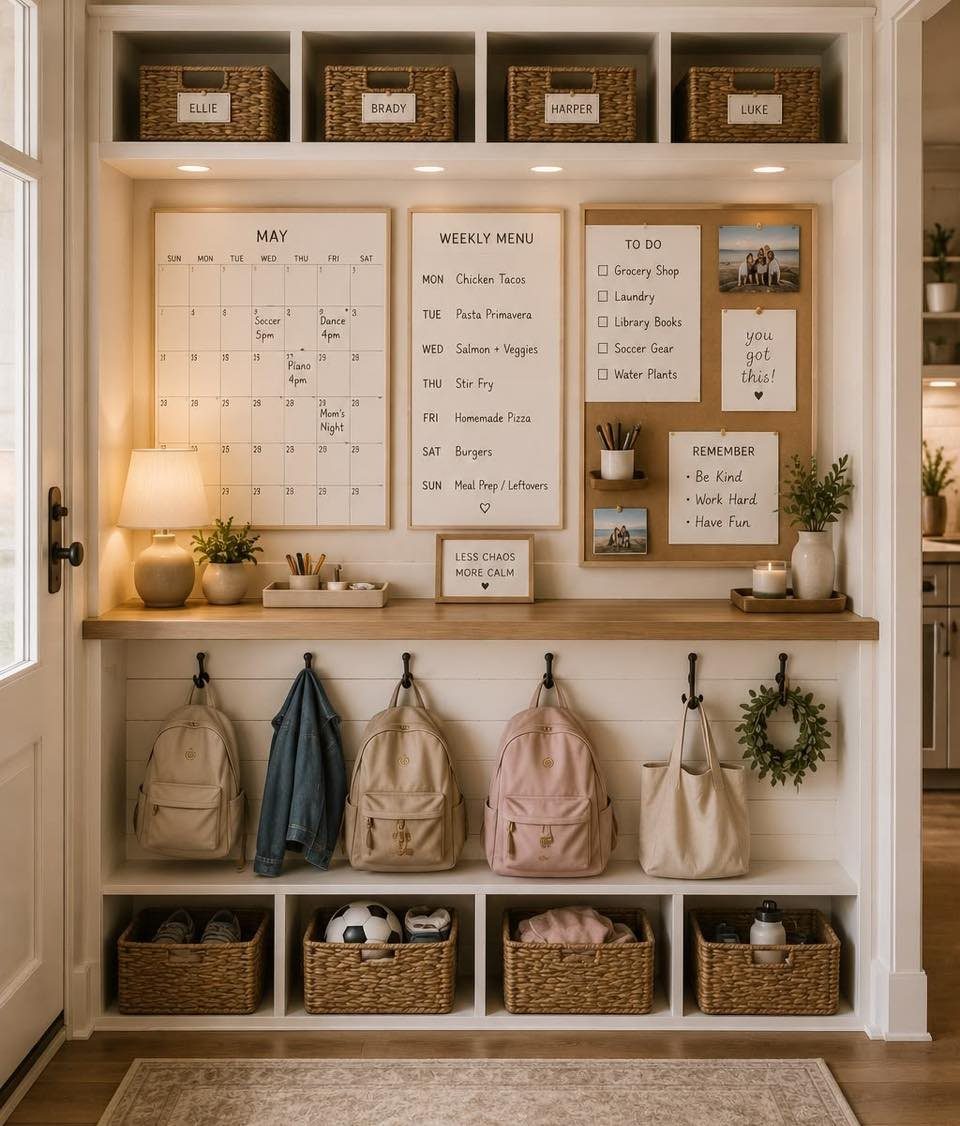
A whiteboard or chalkboard turns the mudroom wall into the family command center.
Framed boards for a monthly calendar and weekly menu, hung at eye level above cubbies; the cork strip alongside holds tickets and permission slips that would otherwise vanish into pockets.
The real question is who updates it. A menu board only works if one person owns the meal plan; a calendar needs someone to erase and rewrite.
Start with one board, not three, and add only if the habit sticks. Dry-erase markers stain painted surfaces, so framed glass or actual board material beats wall paint with a glossy finish.
18. Repurposed Furniture
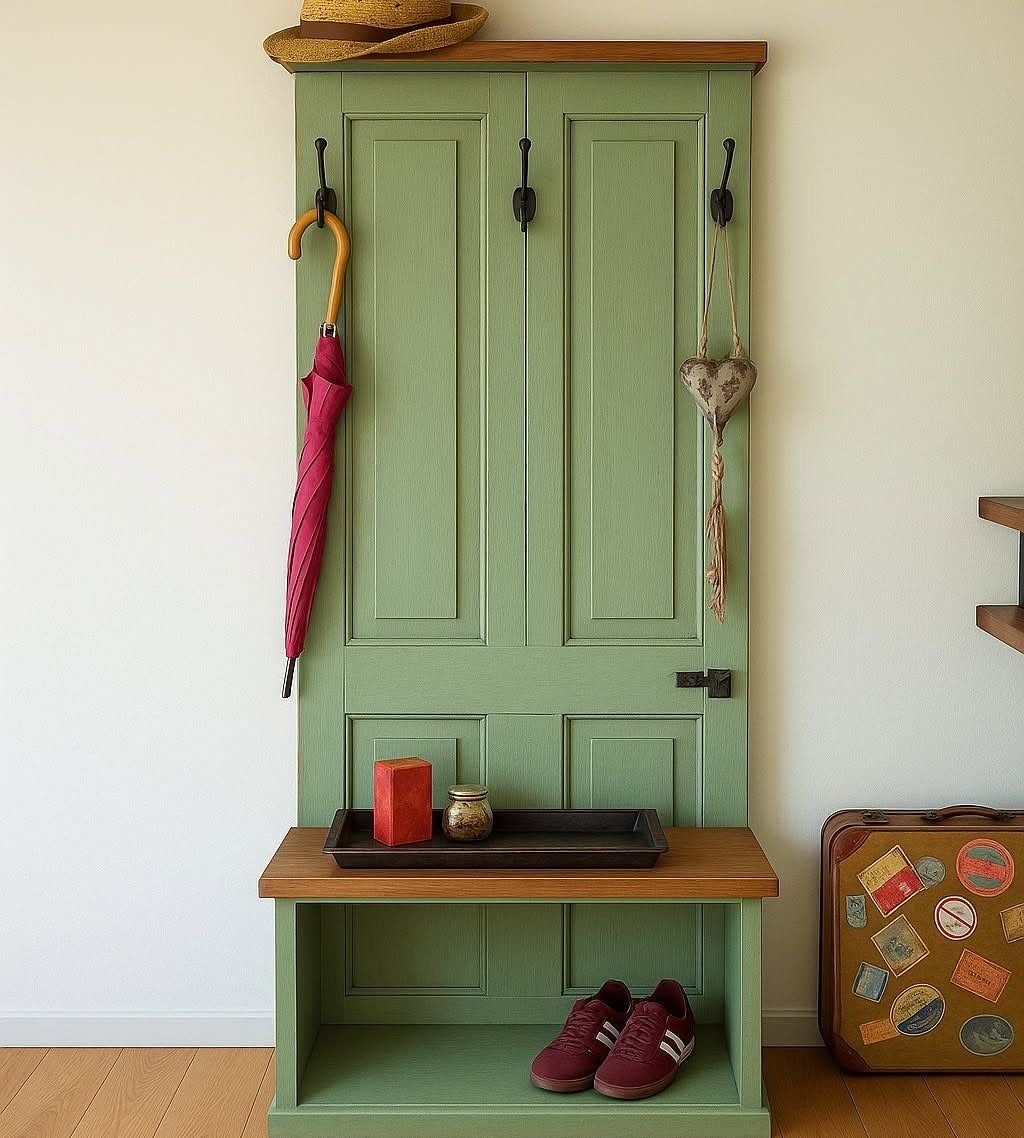
An old door, a discarded cabinet, a table from a relative’s attic: mudrooms are forgiving enough to take castoffs and make them central.
A hall tree built from a paneled door, painted green, with hooks added and a shelf below for shoes. The finish is what unifies it; the same piece in raw wood would read as unfinished, not intentional.
Check the height before you commit. A repurposed cabinet that hits below knee height works as a bench with storage; one that is tall wants to stand against a wall with hooks above it.
Weight matters too: a solid wood door is heavy, and wall mounting needs real support. The best finds already have some damage, scuffs and dents that read as history in a room meant for dirty boots.
19. Pet Station
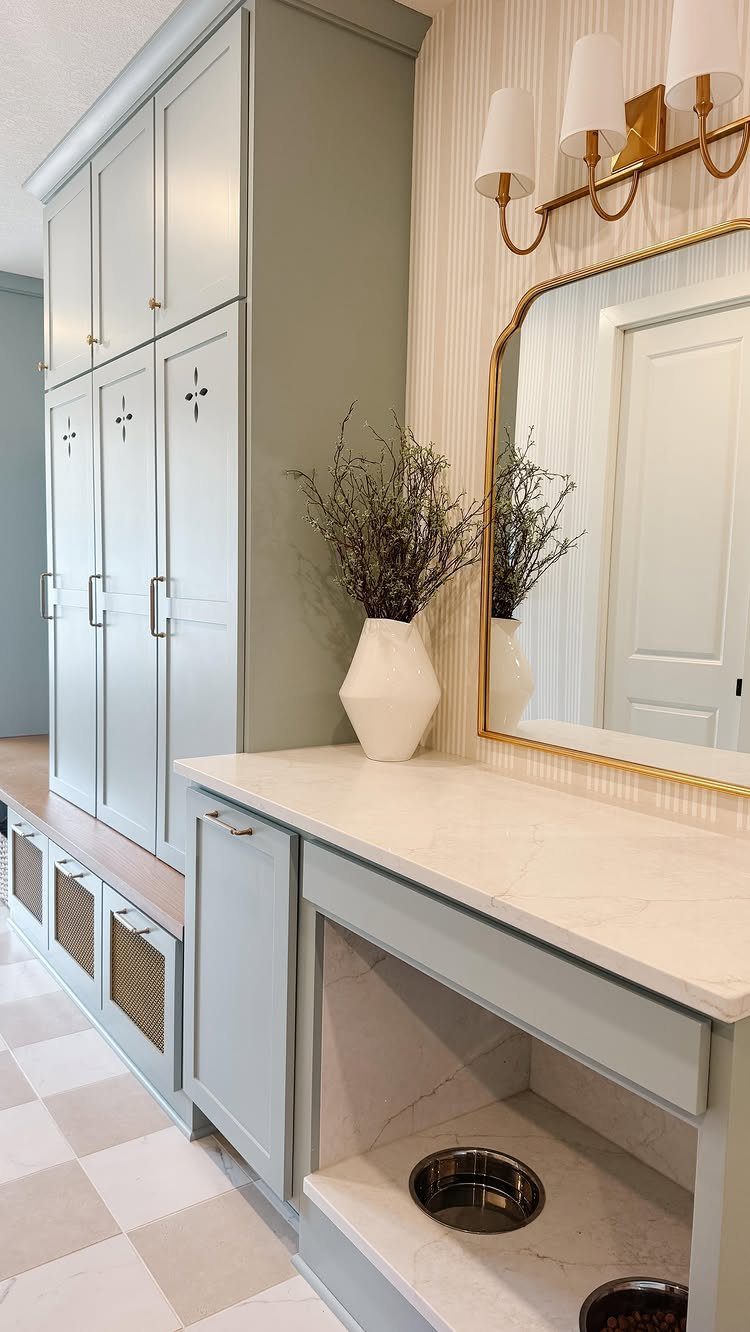
A pet station turns the mudroom into the drop zone for leashes, toys, and the wet-paw routine. A cabinet niche or a single lower shelf is enough for a small space.
Bowls set in a built-in recess under the bench keep kibble off the floor and out of the traffic lane.
Hooks at dog-height hold leashes without tangling, and a lidded bin corrals tennis balls and chew toys before they migrate into the living room.
The stone mat underneath the bowls dries paws and catches splashes; swap it weekly or keep a second on hand.
I’d put this near the door you actually use for walks, not the pretty front entry, since the point is function at the moment you come in sopping.
20. Pet Washing Station
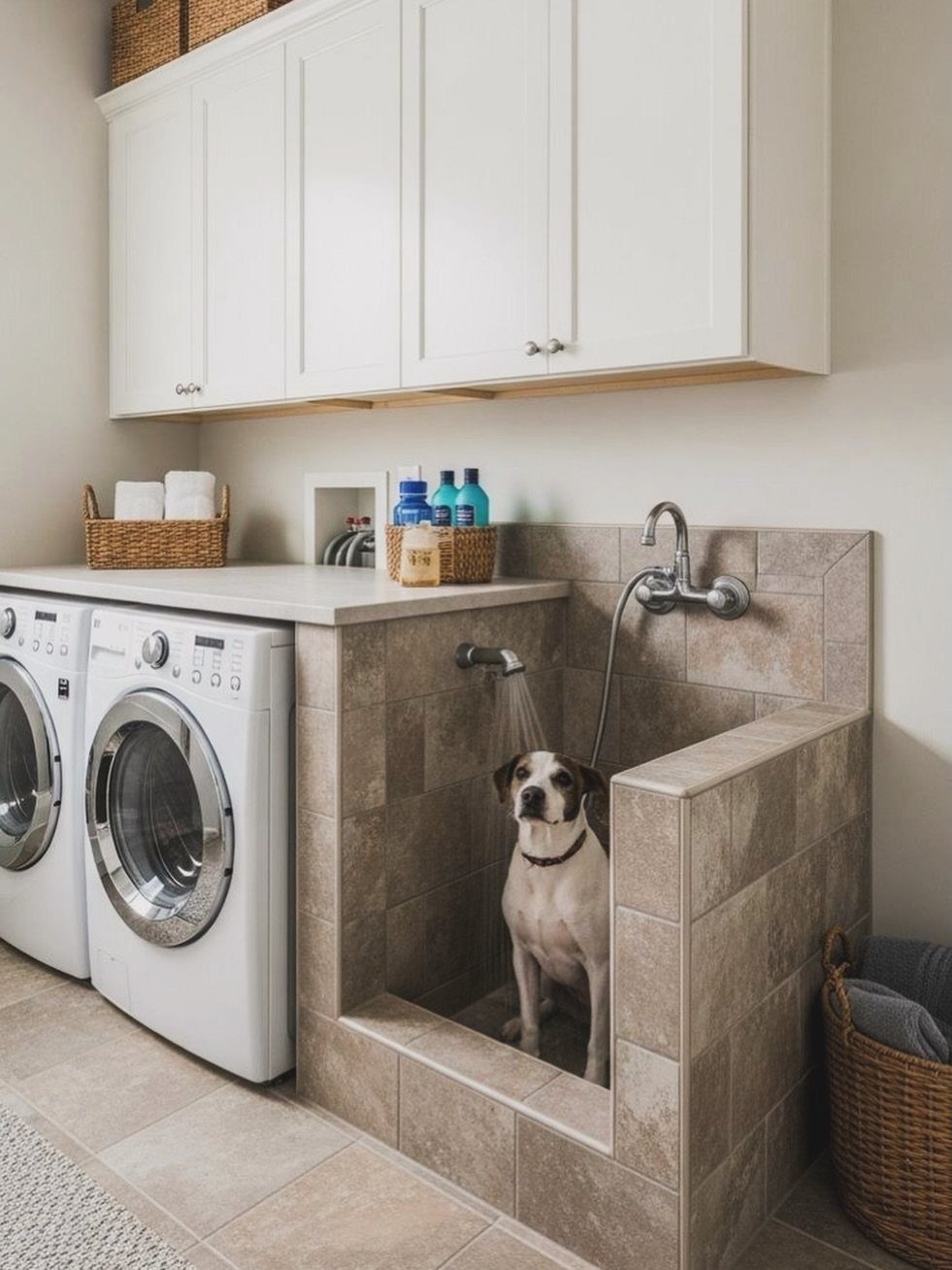
A washing station saves the bathtub from claw marks and your back from bending over a garden hose.
A tiled basin at knee height with a handheld shower head, set beside the laundry machines where the plumbing already runs, cuts the install cost because the drain line and supply are within the wall.
Most dogs fit a standard step-in basin, though a Great Dane needs the floor-level version with a ramp. The tiled surround hoses down clean, and a detachable shower head reaches every muddy undercarriage.
This trades square footage you might have used for storage, so it suits households with more than one shedding pet or acreage that delivers serious dirt.
If your dog fits in the kitchen sink, skip it and buy a better doormat instead.
Decluttering Tips
A mudroom only works if you edit it before it edits you. I pull out-of-season gear twice a year, in late March and again in October.
Winter coats go to a hall closet upstairs; summer hats and sunscreen take their place. The swap takes an hour and saves me months of fighting past puffy jackets to find a light sweater.
The real enemy is the bag of bags. One canvas tote is enough for groceries; the rest can go to donation.
Same with single mittens, boots the kids outgrew, the umbrella that broke last spring. If I have not touched it in a season, it leaves.
The floor stays clear enough to sweep, and I can actually see what I own.
Design Aesthetics
A mudroom can handle more personality than most people give it credit for. I would hang one piece of art above the bench, something with green or sky in it, since this room sits between outside and in.
Family photos work too, though I prefer them in the hall where they do not compete with wet gear.
Color is the cheaper route. A painted bench in deep blue or sage, brass hooks against it, and the room feels chosen rather than inherited.
Patterned or textured flooring adds the same effect without demanding a decision every morning. The eye reads it as intentional, and the dirt hides in plain sight.
Functional Design
Symmetry sounds rigid until you watch two kids try to leave at the same moment. Each person needs their own column: hook, cubby, drawer, done.
I would build in a little extra height for adults and a lower row children can reach by second grade. The backup gear, the off-season stuff, goes above or behind where only you can get it.
The morning routine should shape the layout, not the other way around. If everyone exits together, hooks multiply.
Value Addition
Buyers notice a mudroom that already works. I would not build one from scratch unless I planned to stay put; the return takes time.
If a full build is too much, a corner with board and batten and decent hooks still registers. Keep cosmetic work under $15,000 if you might move soon; buyers notice the difference when they step inside.
A family can picture their own coats on those hooks, their own chaos contained. That visualization is what sells a house.
Frequently Asked Questions
What are the latest mudroom trends?
Bold colors like deep blue and sage green, multifunctional built-ins with benches and drawers, and personalized storage that mixes open and closed elements.
Peelable wallpaper and brass hardware are showing up more, and designers are using vertical shiplap and patterned tile to add character without cluttering small spaces.
Do mudrooms add value to a home?
Yes, most homebuyers want practical organization already in place. If you plan to sell within three years, cap cosmetic spending at $15,000; you may not recover a bigger investment.
Even a modest mudroom with hooks, a bench, and a basket system helps buyers picture easier daily living.
What is the ideal layout for a mudroom?
A bench you can sit on, shoe storage below or beside it, hooks within arm’s reach for coats and bags, and some closed storage for the stuff you do not want to look at.
The exact mix depends on who uses the space and when: families leaving all at once need more hooks, while staggered schedules can share fewer if drawers hold backup layers.