
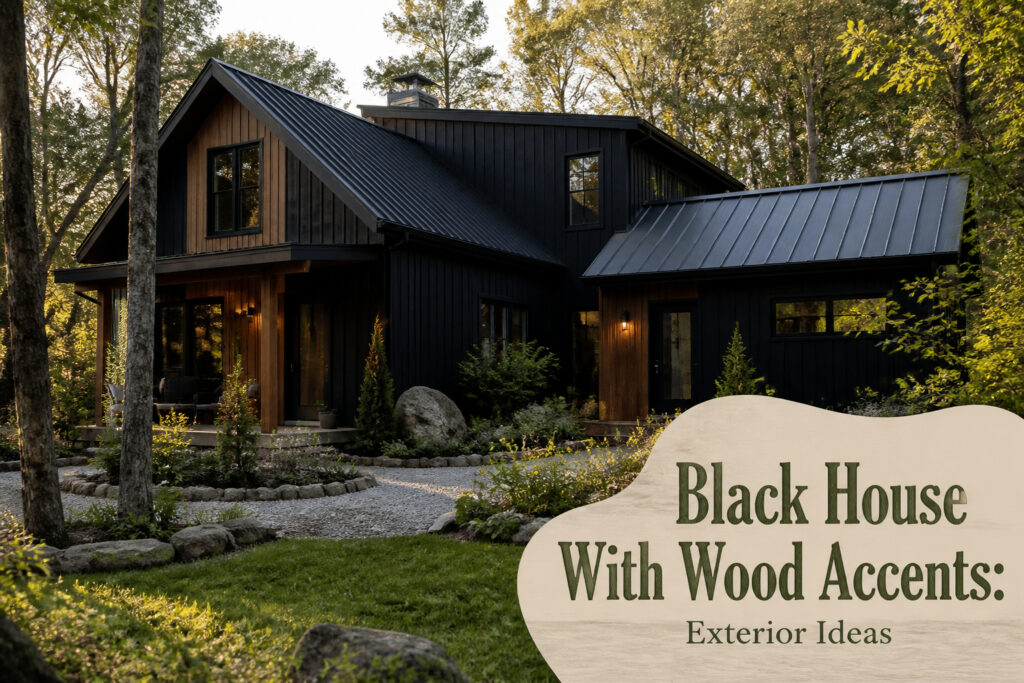
The right black house with wood accents depends on how much contrast you want the grain to carry, not just which species you choose. Cedar shouts with warm honey and red undertones; thermally modified ash whispers in grey-brown texture alone. That choice between pop and quiet is what separates a facade that reads staged from one that reads settled.
1. Cedar Front Door
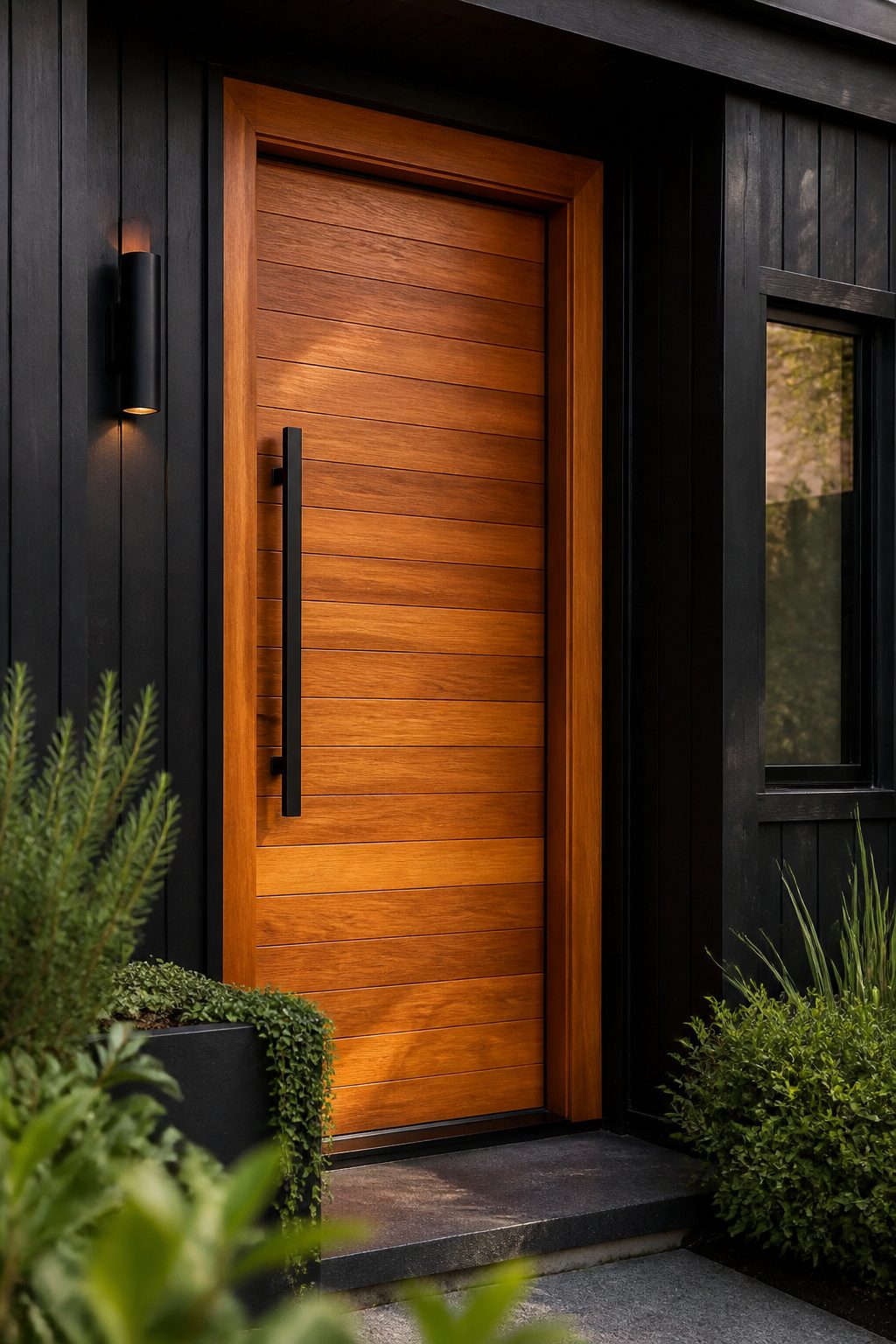
A cedar front door sits at eye level on a black house, and that placement matters more than the wood itself. The warm red and honey undertones hit the visitor first, before the siding has time to read as modern or severe. I have seen the same door look almost orange at golden hour and settle to a quiet honey by noon; either way, it earns its place against the dark field.
Seal it to keep the color, or let it weather to silver. Both choices work, though the sealed route preserves what most people install it for. The grain stays visible either way, and that texture is what keeps a black exterior from reading flat from the street. Cedar softens the boldness of dark siding specifically because it carries those undertones; cooler woods can look like an afterthought.
For stain, a natural cedar tone left matte keeps the contrast warm rather than flashy. High gloss fights the natural grain and competes with the black.
2. Wood Soffit
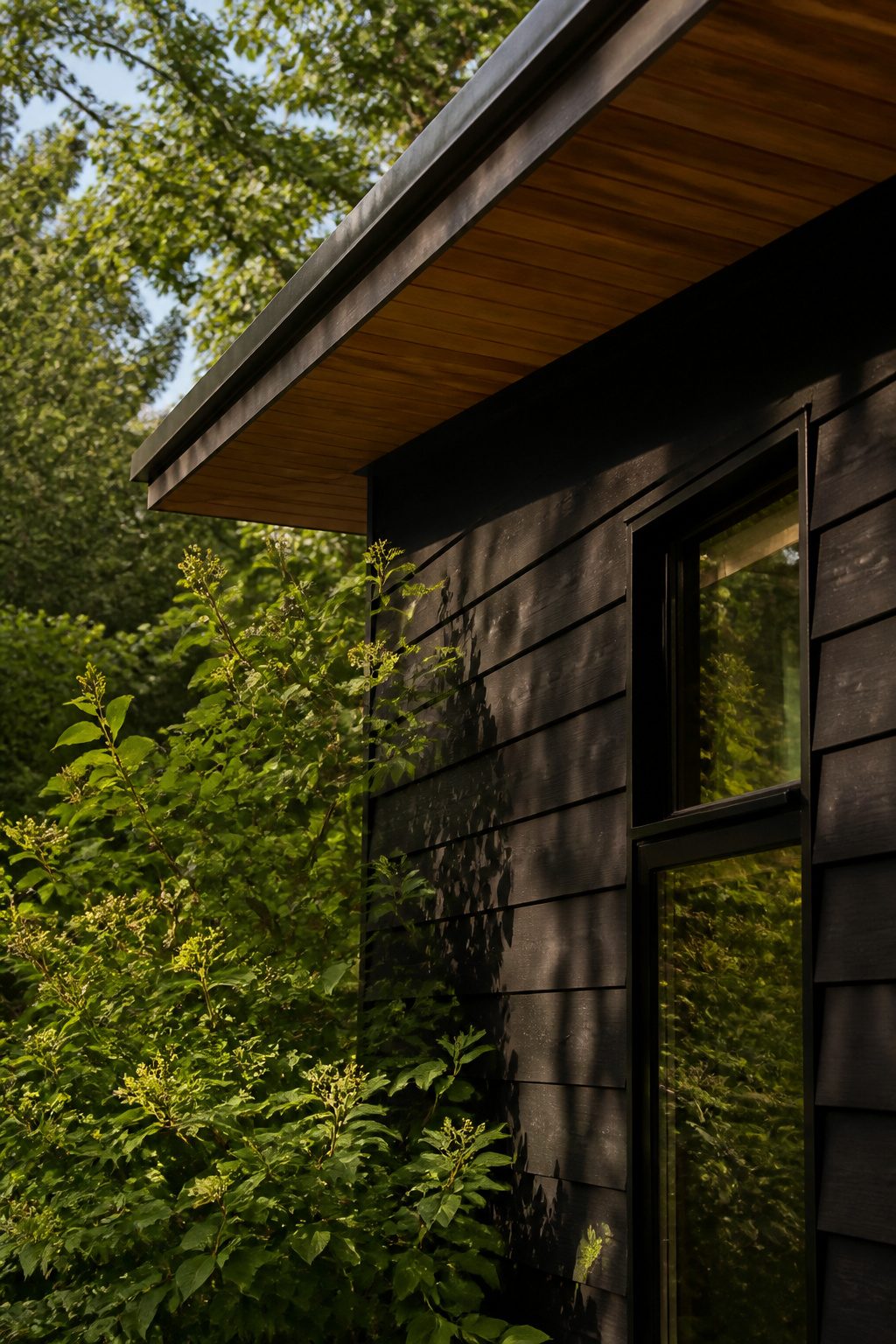
Running wood along the soffit adds warmth overhead where black siding can feel heavy. That horizontal strip sits in shadow much of the day, but catch it from the driveway at the right hour and the grain seems to glow against the dark wall below. Cedar lands here more naturally than other species. The wood stays protected from direct rain under the overhang, and cedar’s own resistance to moisture buys you time even if the gutters ever clog or back-splash. What I notice scanning the houses that pull this off is how the eye travels upward. The roofline softens from a hard cap into something that hovers. Without that lift, a black facade can read as a solid slab. With it, the house gets a forehead. You don’t need much; a six- to eight-inch exposed face does the work. The trick is staining rather than painting it. Paint fills the grain and kills the contrast you’re after. A translucent cedar stain in something warm, not orange, not gray, lets the knots and runnels show through. That lived-in quality keeps black from looking like a stage set.
3. Board and Batten With Cedar Garage Door
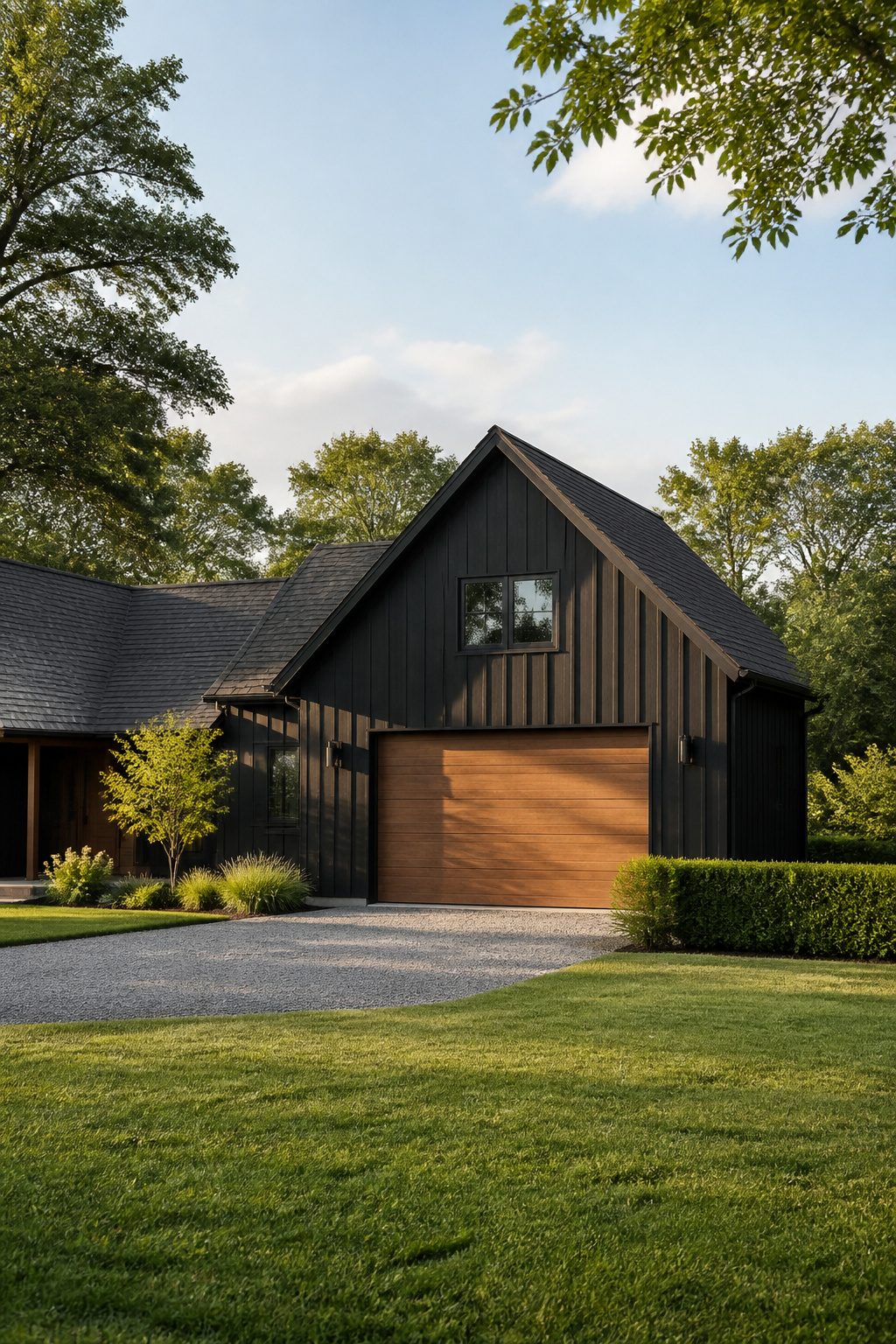
A garage door covers more facade area than most people account for when planning an exterior. On a black house with wood accents, a cedar-stained door against black board-and-batten siding anchors the lower half of the facade with warmth where it matters most.
Cedar carries warm red and honey undertones that soften black’s boldness without weakening it. The vertical lines of board-and-batten siding run one way; the horizontal grain of a cedar garage door cuts across them. That crossing creates a visual rhythm that keeps the eye moving instead of locking onto one flat plane.
This pairing works best on Craftsman and modern farmhouse exteriors, where the mix of rustic and clean already has a foothold. The cedar can be left natural to weather silver-gray over time, or sealed early to keep those honey tones intact. Sealed reads more modern; weathered leans more country. Both are valid, but the choice should match what the rest of the house is doing, not fight it.
Restraint matters here. One strong cedar door against black siding often outperforms spreading the wood around in thin strips. The garage door is already large; let it carry the load.
4. Wood Porch Ceiling
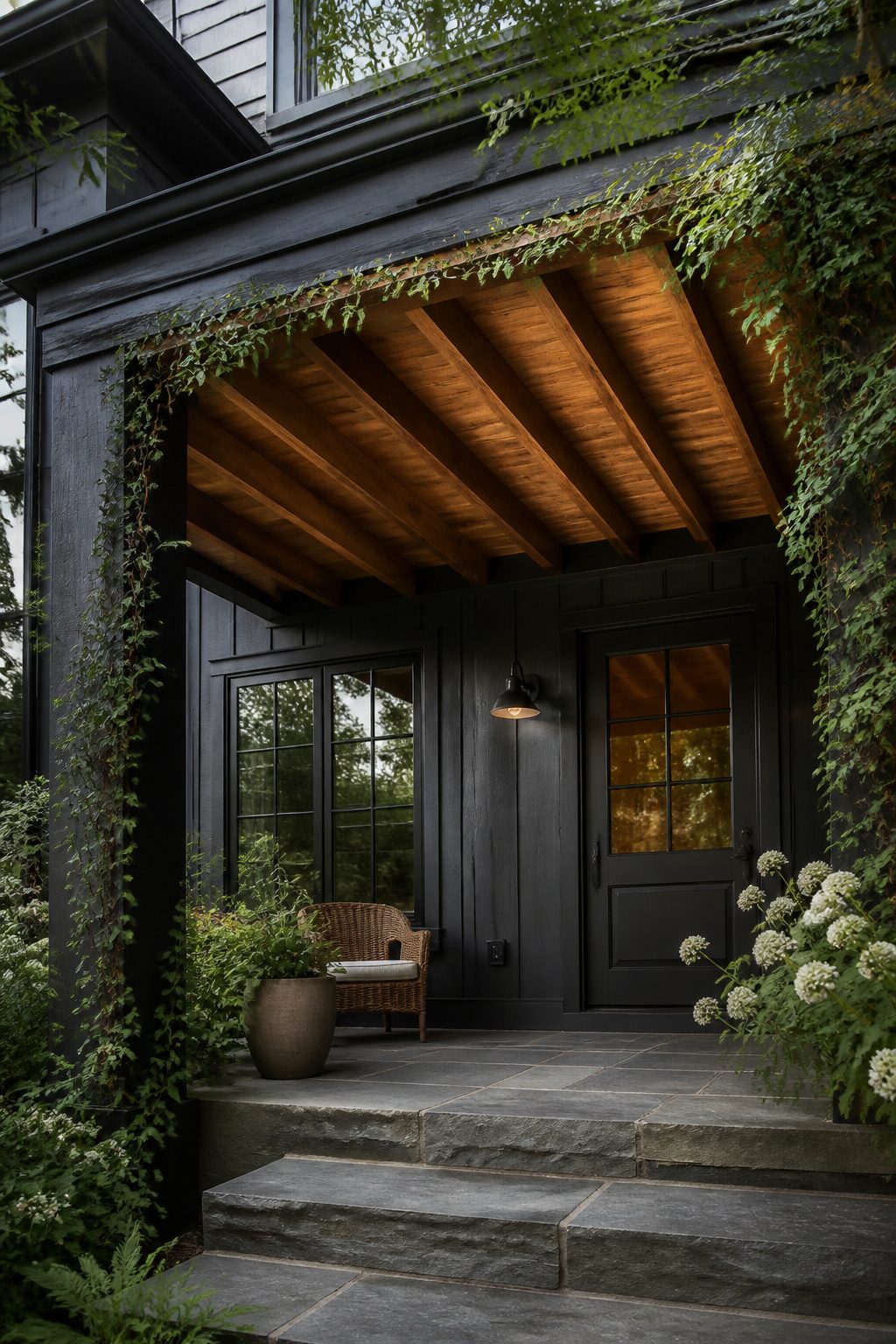
The ceiling a visitor sees first on a black house with wood accents is not a front door or a column, but the porch ceiling overhead. Cedar and pine are the usual choices up there, and the decision to stain or leave them bare shapes how the entrance reads for years. A natural cedar starts with warm red and honey tones that bounce light down onto the porch floor, then grays out to a muted silver if you let weather do its work. Pine goes lighter from the start and grays faster, which some homeowners prefer for a quicker shift in character.
Painted blue porch ceilings have their fans, but a natural wood ceiling overhead does something painted surfaces never achieve. The warmth lands where standing guests actually feel it, not where passing drivers glance. Seal the cedar if you want to keep that honey color for the first few seasons; skip the sealer and the graying begins by year two. Either way, the wood breaks up the black expanse above eye level before the door ever opens.
5. Farmhouse With Cedar Porch Columns
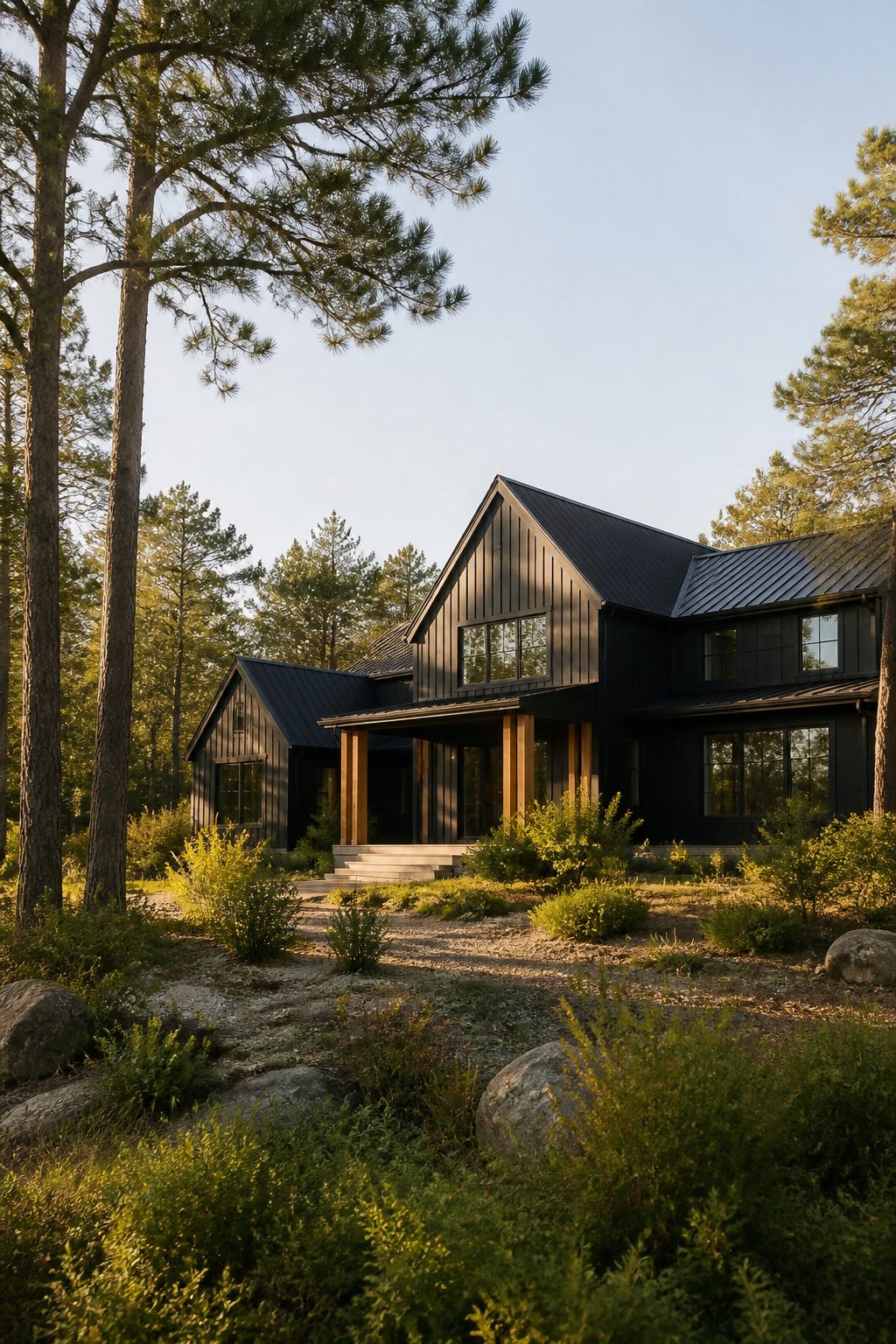
Cedar porch columns on a black farmhouse carry a weight that painted columns never quite match. The grain runs vertical, drawing the eye up, and the honey and red undertones in the cedar soften the matte black siding without dimming it. What started as traditional farmhouse architecture has shifted sharper and cleaner in recent years, but the wood keeps it from reading too cold.
The pairing works because the columns break large wall planes into human-scale intervals. Black absorbs light; cedar returns it. Leave the wood natural and it silvers over time, or seal it to hold that warmth against the black paint year after year.
Matte black paint against sealed cedar is the combination that reads freshest now, not because it is new but because it is spare. No ornate trim competes. The materials themselves do the work.
6. Vertical Wood Cladding Panel
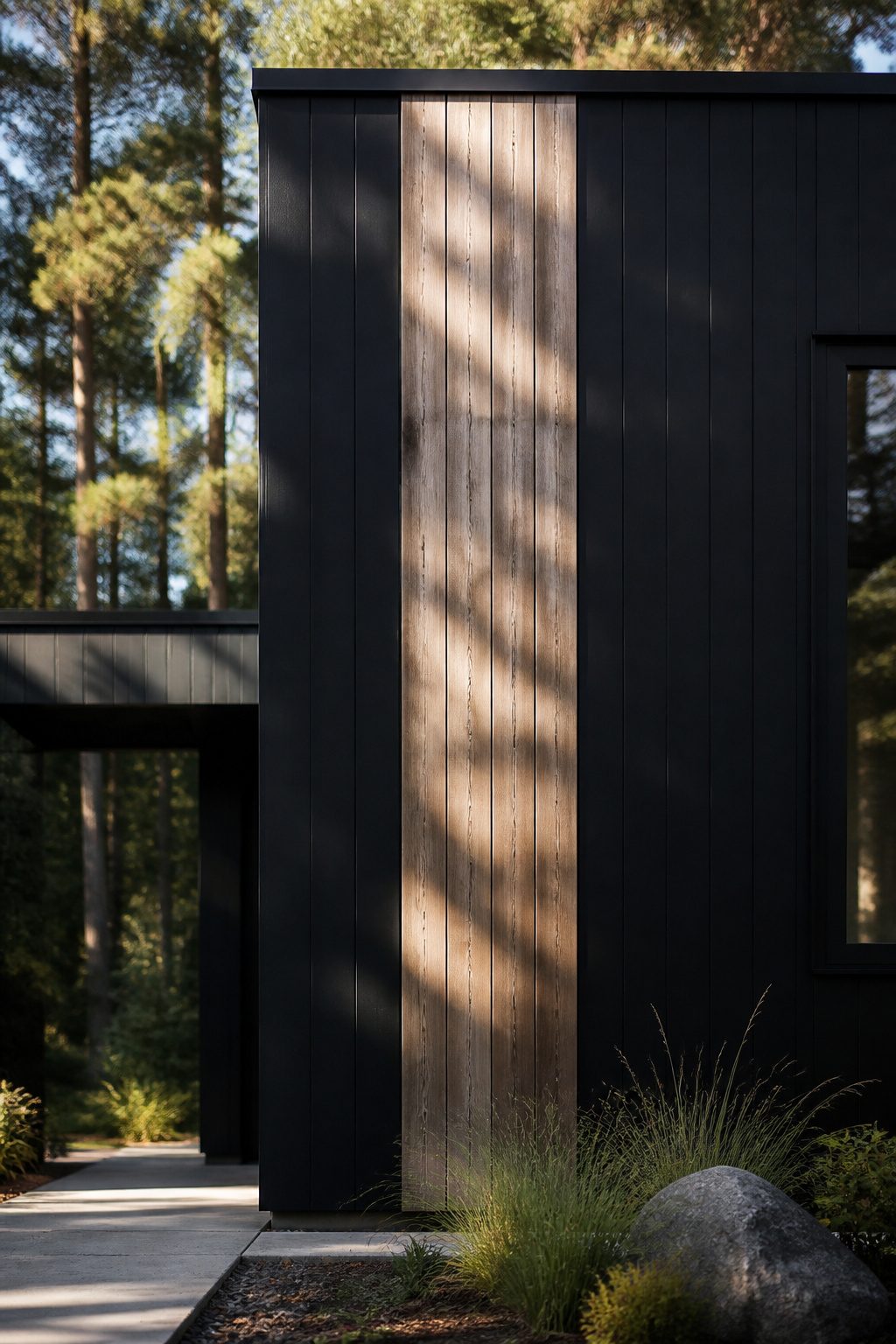
A single vertical wood panel can do the work of a front door or a full accent wall without either one. On a black facade, that one panel marks an entry, a window bay, or a chimney volume so the eye knows where to land.
Thermally modified wood works well here because dimensional stability matters more when the accent is narrow. A strip that warps or cups becomes obvious fast, and the heating process gives you the smooth grey-brown tone that sits close to black paint in value while reading completely different in texture. The contrast stays quiet, not loud.
Two ways to play this: let the panel match the surrounding black in depth so the texture alone carries it, or go slightly lighter and let the tone shift register as a shadow line. The texture match wins if the rest of the facade is already busy with windows or trim.
7. Stained Wood Window Trim
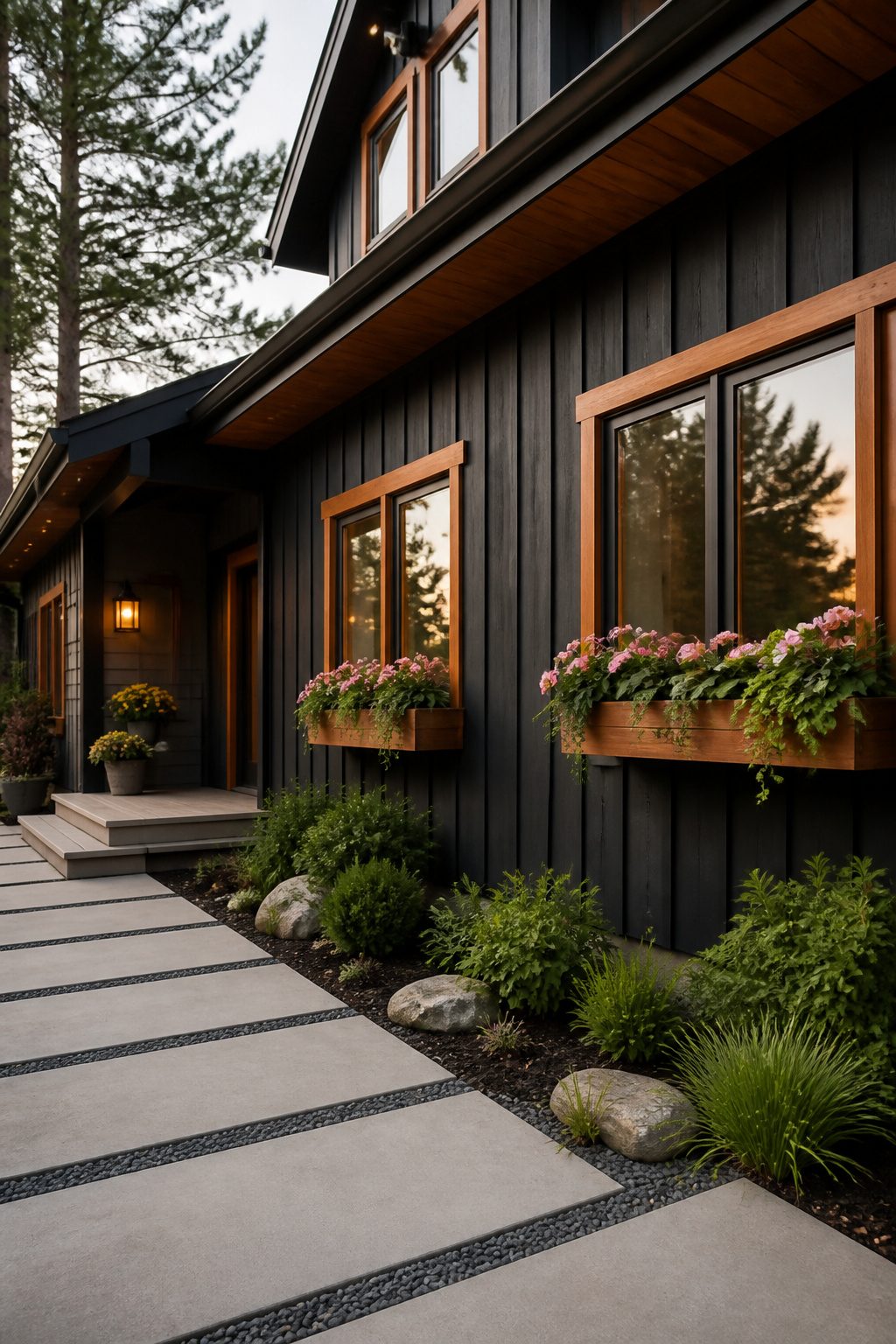
Stained wood window trim against black siding frames each opening like artwork, but only if the stain color hits the right note. Warm mid-tones do the heavy lifting here: natural cedar sealed but not darkened, warm honey, or a medium brown carrying subtle red undertones. Those undertones soften the black rather than competing with it, which is the balance that keeps the exterior from reading too stark.
I spent time looking at Sherwin-Williams Iron Ore (SW 7069) on sample boards paired with different stains, and the combination works because Iron Ore is a true off-black, neutral enough that cedar’s honey warmth registers as deliberate contrast rather than accidental clashing. Too cool a stain, or one polished to high gloss, turns the window into a graphic stripe; a matte, muted finish lets the wood grain do the talking. Cedar tends to be the starting point for this detail because its natural color already sits in that warm mid-tone range, though oak with a natural stain can accomplish something similar if you want a tighter, less rustic grain.
From twenty feet away the effect reads as subtle depth; up close it’s unmistakably tactile.
8. Wood Shutters
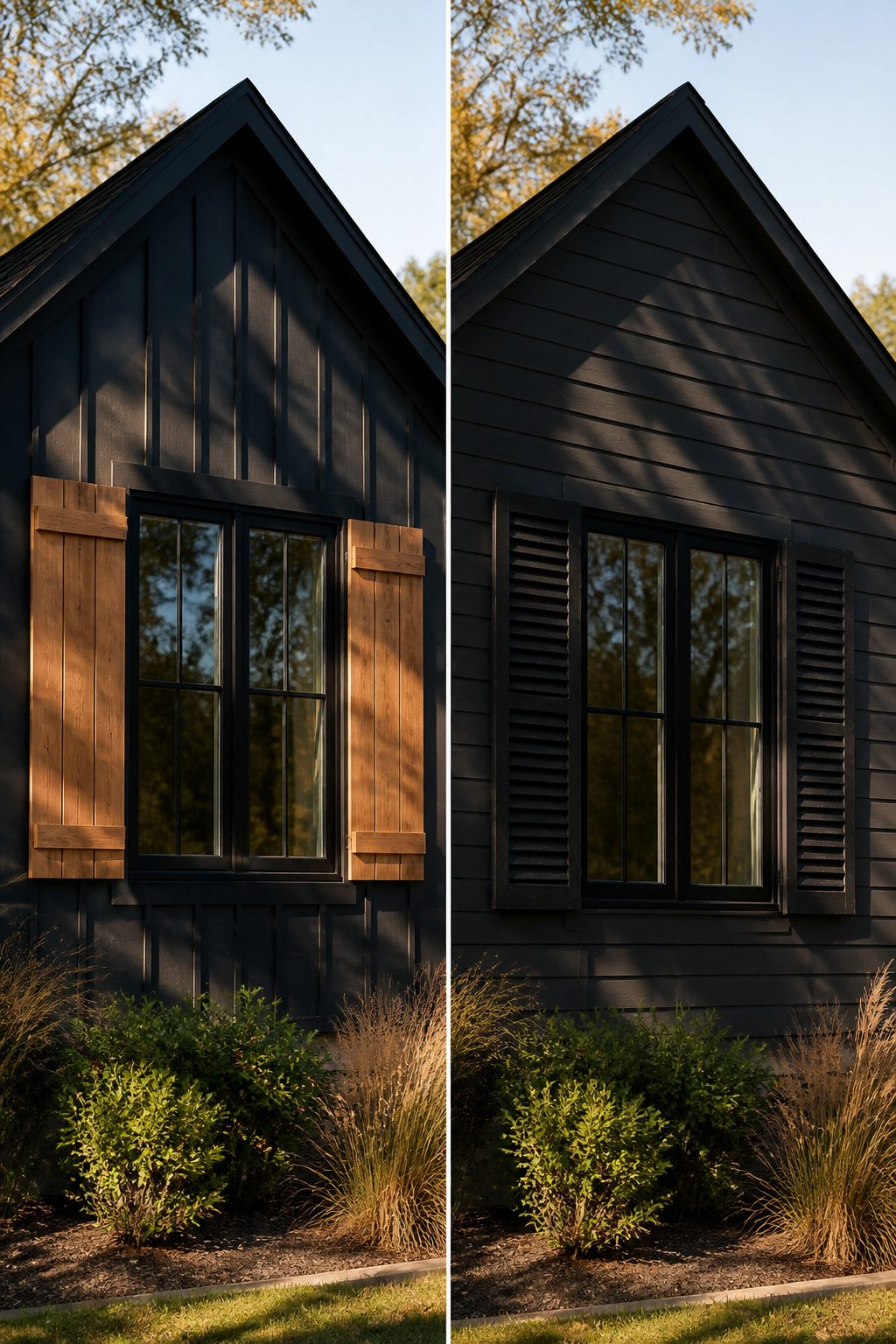
Flat black walls swallow light, and without something to break them up the whole facade can look like a billboard rather than a house. Wood shutters add depth and shadow in a way painted ones simply do not; the grain catches sun at different angles through the day, so the wall changes as you move past it.
Cedar holds up well against weather but needs a fresh coat of stain or sealer every few years. Skip that maintenance and the color drifts to silvery gray, which some people want and most do not. The style matters as much as the wood: louvered shutters suit traditional houses, board shutters read farmhouse, flat panel works for modern lines. A louvered shutter on a clean contemporary box looks like a costume piece, and a flat slab on a colonial reads unfinished. Match the shutter to the architecture before you match the stain to the door.
9. Ranch House With Wood Accents and Copper Gutters
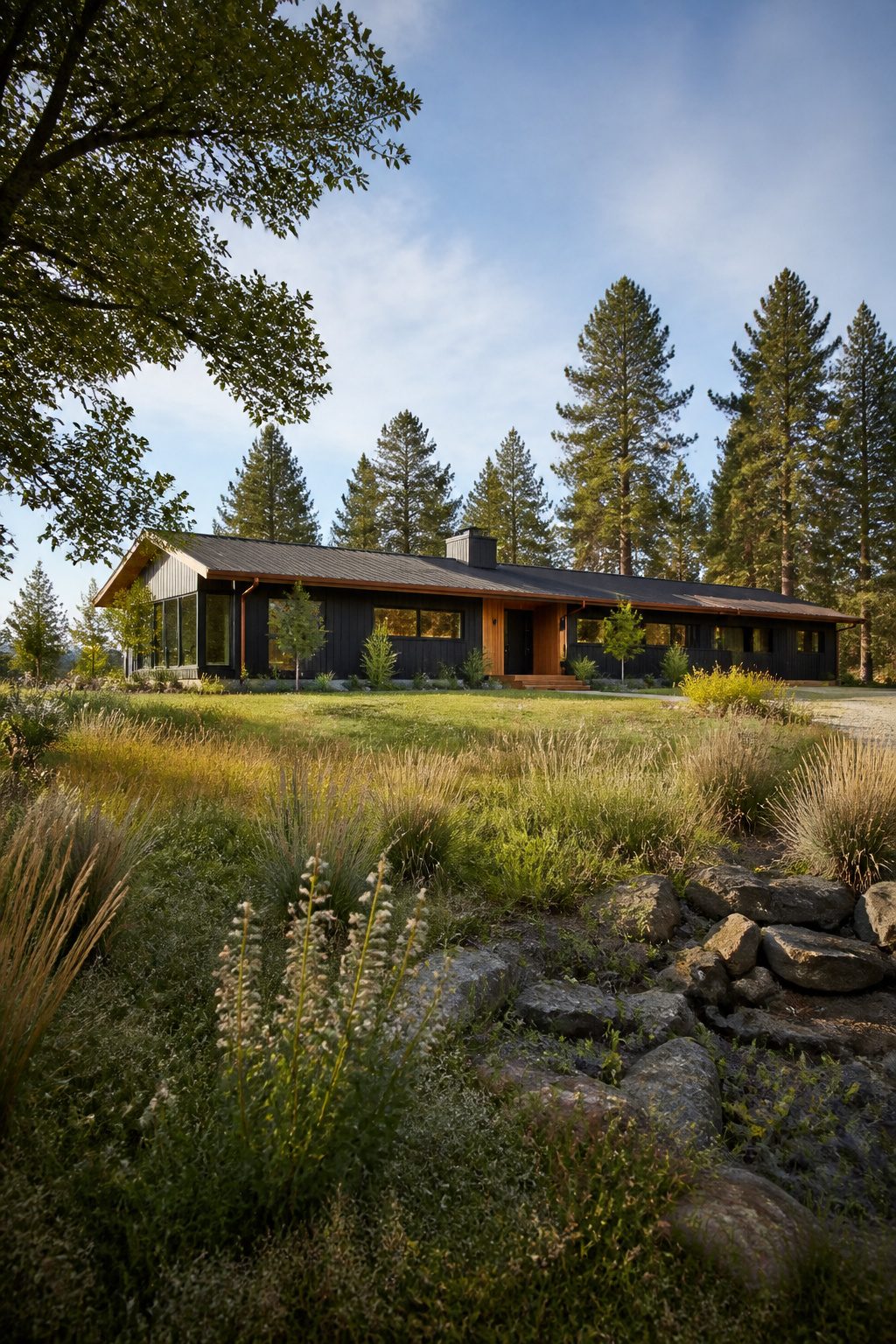
The long horizontal lines of a ranch house carry wood accents and copper gutters better than vertical styles do. That low, stretched silhouette gives timber trim somewhere to travel, and copper gutters pick up the same rhythm along the roofline.
New copper starts bright and warm against black siding, almost too warm if every accent is doing the same thing. Leave it alone for a few seasons and it shifts toward a muted verdigris, a green that settles the conversation between the black paint and the wood. Both stages work; the aged stage reads as lived-in rather than staged.
For a ranch specifically, put the wood in trims, the front door, railings, or shutters. Without that break, black goes flat across all that horizontal surface. The copper gutters keep the metallic note from feeling like hardware tacked on; they belong to the same material family as the timber, just on a different timeline.
10. Ranch House With Natural Wood Deck
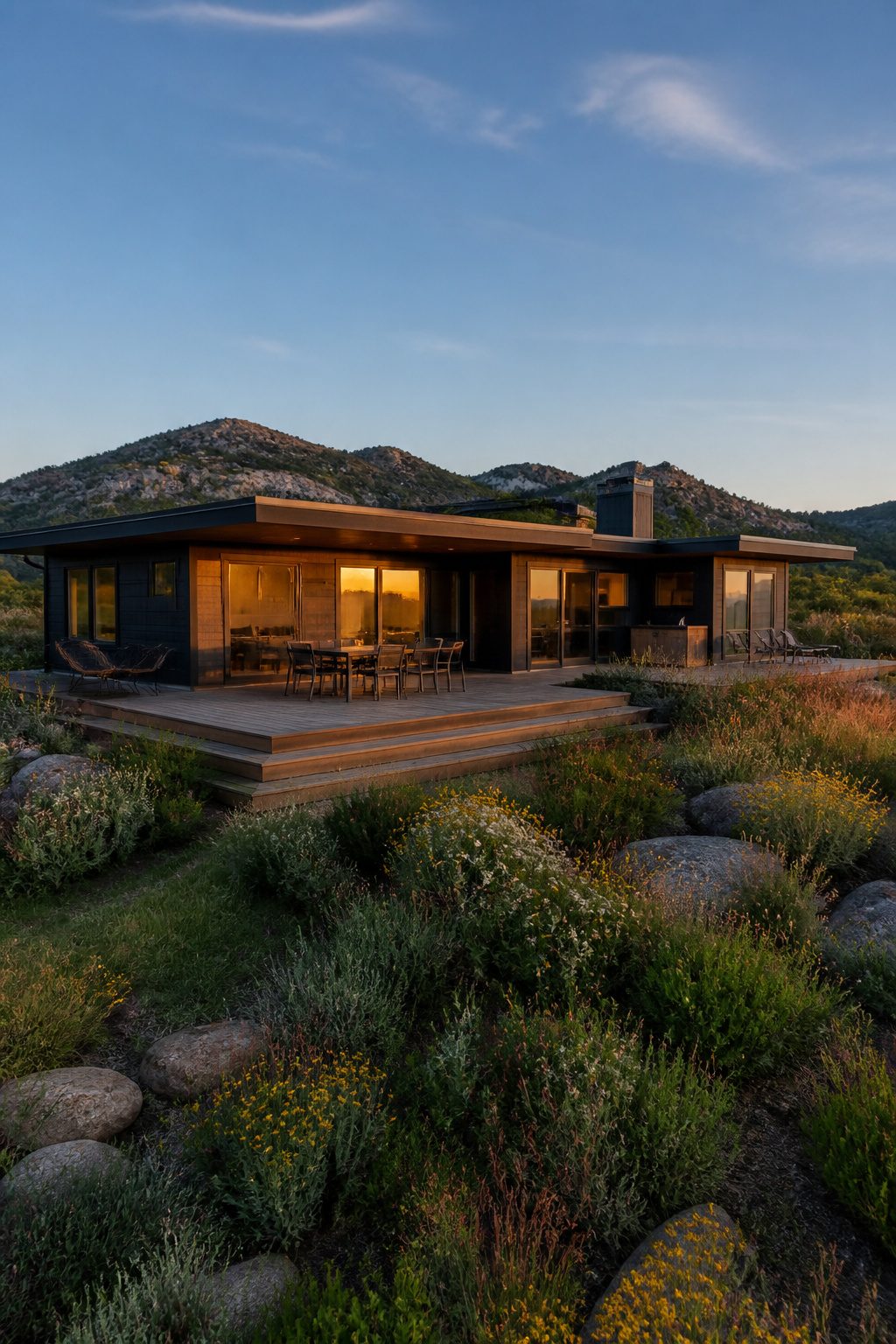
A ranch house already hugs the ground plane, so the deck that extends from it can finish that story instead of starting a new one. The low horizontal profile of the house and the wide timber deck read as a single gesture, both emphasizing the landscape rather than rising above it. Black metal railings alongside the natural timber keep the palette coherent without introducing a third material that would break the quiet line.
Ipe is denser and more durable than cedar for this application if the budget allows. Its deep brown against near-black siding reads architectural and restrained rather than warm and rustic. Working through a dozen of these builds, what convinced me was watching how the subtler contrast held up across seasons; cedar tends to shift and silver faster, which can turn the intentional pairing into something that looks accidental.
11. Ipe Wood Deck
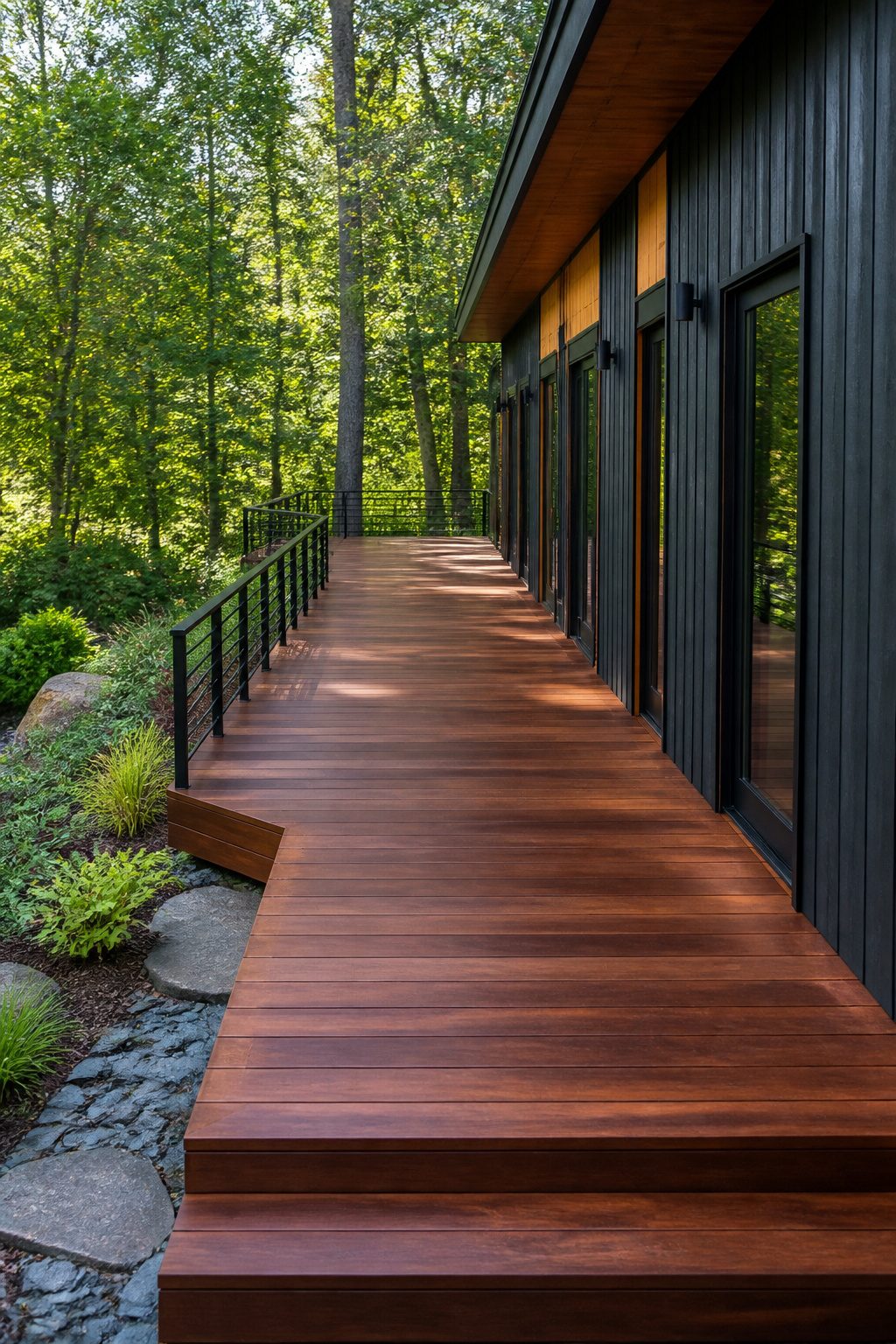
Ipe carries a density that cedar simply does not match, and against black siding that extra weight becomes a visual asset. The tropical hardwood reads as deep brown rather than warm honey, so the pairing stays sophisticated rather than rustic. Sources describe the effect as architectural, a quiet contrast that lets the house read as one intentional plane.
The lifespan runs about 50 years, which matters on a deck you are building to stay. That hardness comes back at you during installation though. Standard fasteners will not seat properly; you need the specific screws and bits rated for ipe’s density, or you will snap drill bits and strip heads. The material costs more than cedar up front, and the fasteners add to that. Whether the math works depends on how many years you plan to own the house, not on any abstract promise of permanence.
12. Wood Front Gate
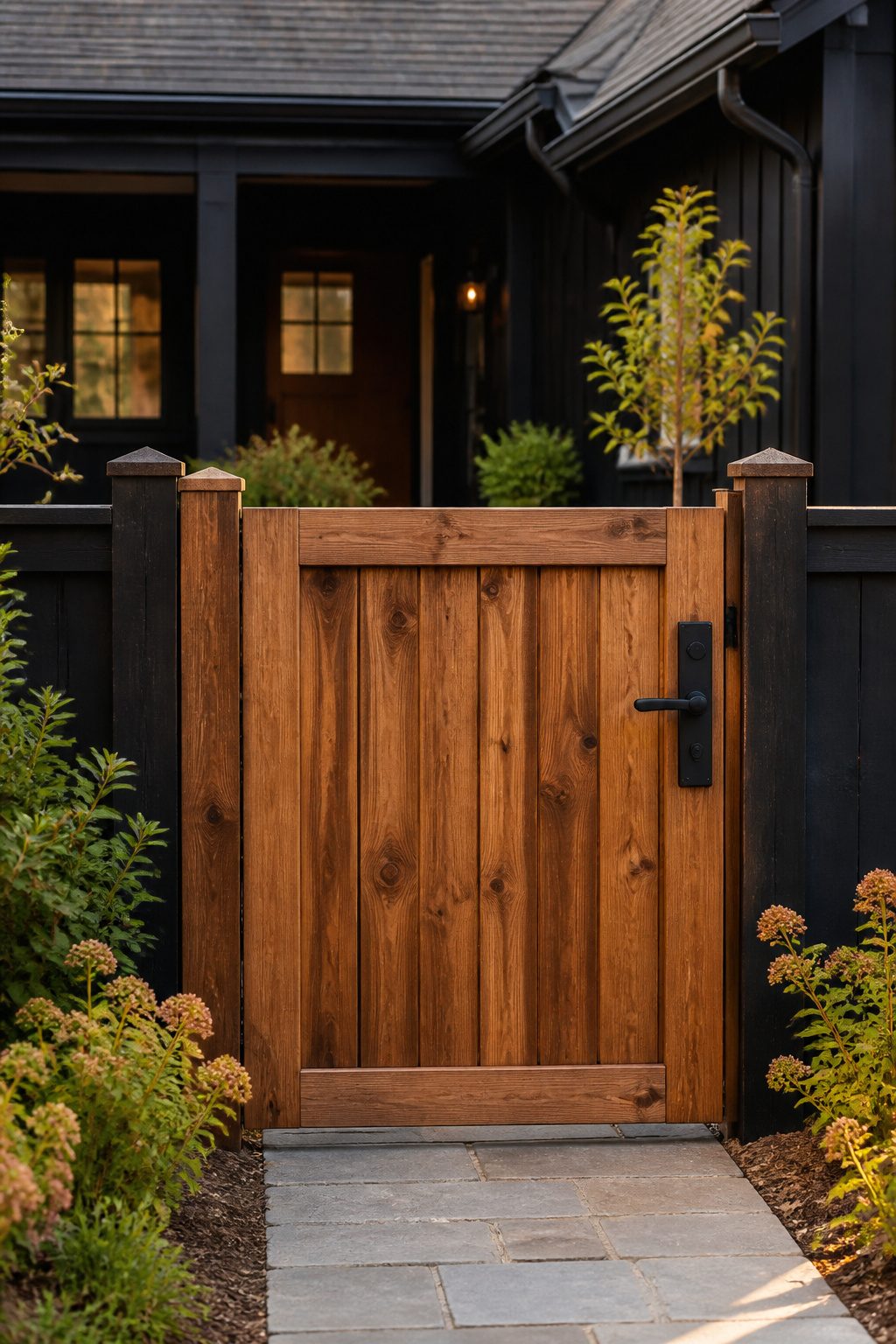
A wood front gate lets you test the pairing before you commit. On a black house with wood accents, it sits at the sight line from the street but costs far less than a door replacement or siding work. Cedar reads as intentional against the dark paint. Seal it to keep the warm tone, or let it silver and weather in. Either way, the grain earns its place before visitors reach the porch.
Placement matters more than size. Even a small gate can echo larger wood details, or stand alone as the single warm note. Restrain yourself to one wood type here, because a clash at the entry gate is a mistake you walk through every day. If the house already carries cedar on the porch columns or a front door, match it. If the black exterior is bare, the gate becomes your first move and your proof of concept.
13. Wood Accents and Stone Base
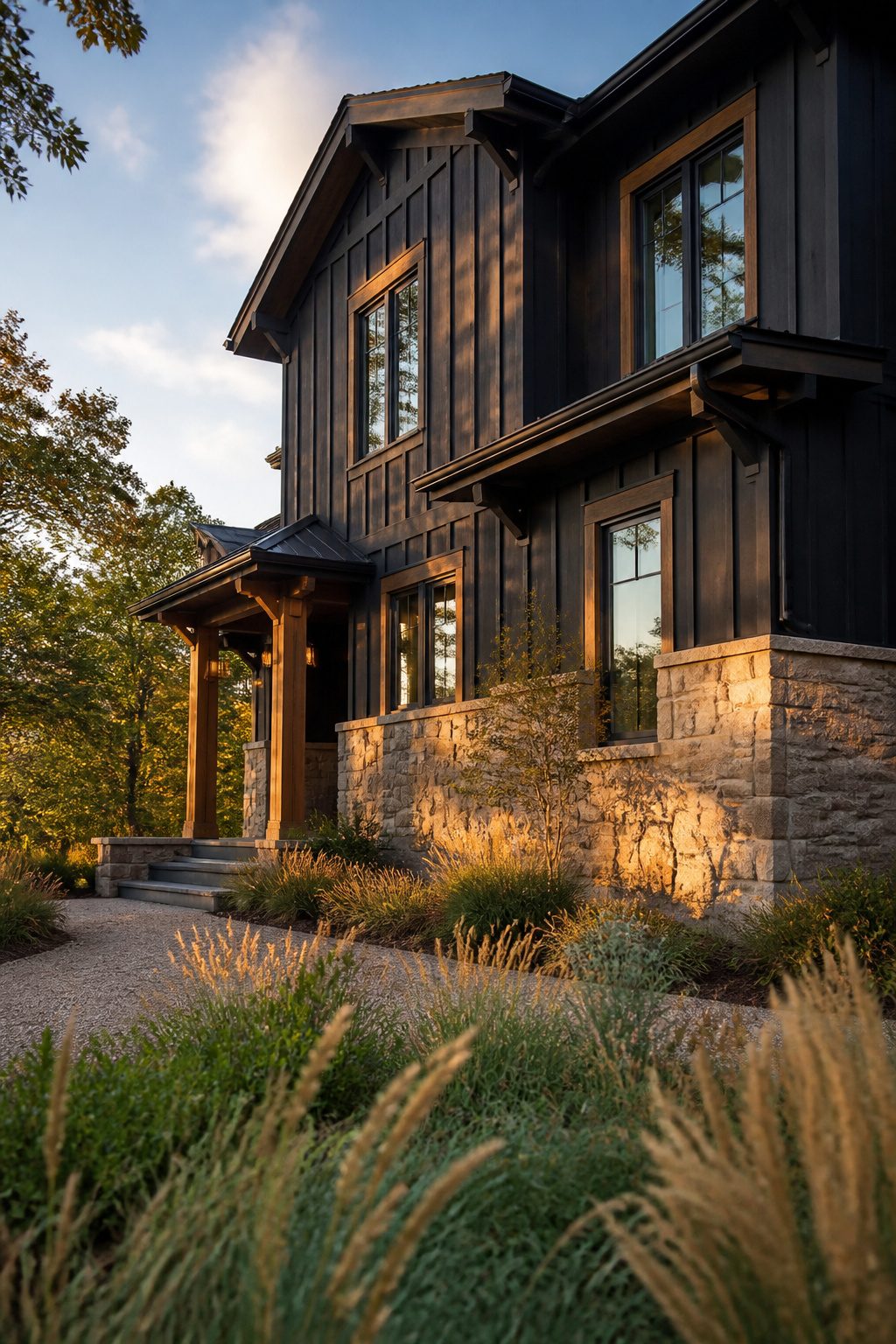
Stone at the base of a black house does something siding wood alone cannot manage: it gives the whole structure weight where it meets the ground. Warm fieldstone makes the dark upper walls feel settled into the site rather than perched on it. Timber trim then bridges the two, so stone, wood, and black siding read as three materials in tonal harmony rather than two accents competing for attention.
This three-material palette works best on styles that already expect natural textures. Craftsman builds lean into it naturally; mountain modern uses the stone to echo actual terrain; rustic contemporary gets the warmth it needs without softening the edge. The risk is overuse. Let one material dominate in surface area and the other two stay in supporting roles. When the proportions balance instead, the eye keeps moving and nothing quite resolves, which on a facade reads as busy rather than rich.
14. Thermally Modified Wood Cladding
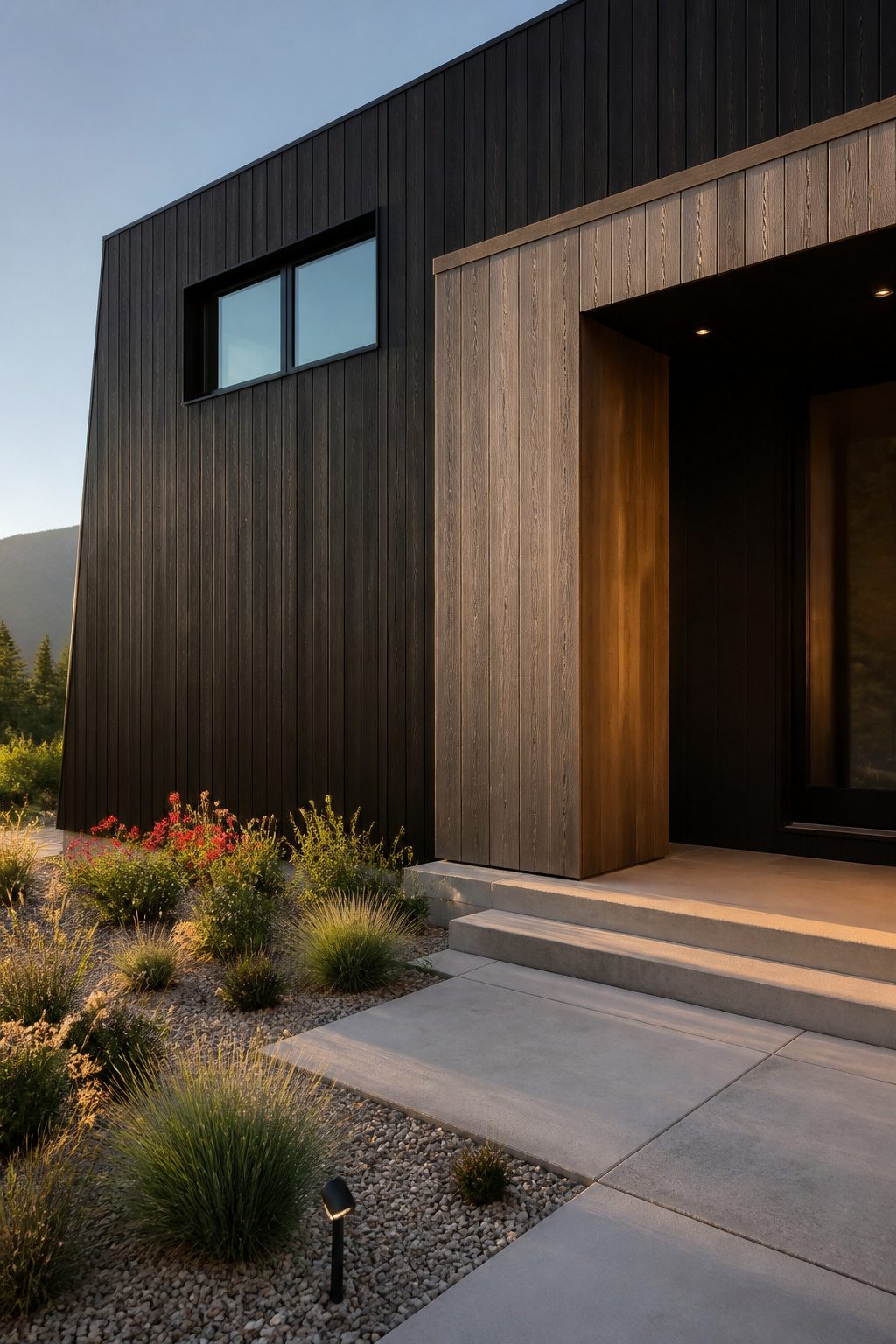
Thermally modified wood cladding sits almost in the same tonal range as black paint, warm where paint is flat, textured where siding reads as uniform. The heat process darkens the wood slightly and removes resins that would otherwise absorb moisture, so boards resist rot without chemical preservatives. In climates where untreated cedar turns grey and checks within two or three seasons, modified stock stays stable enough to skip the annual sanding and re-oil.
The look runs Scandinavian, smooth, even, deliberately quiet. Grey-brown ash or pine against charcoal fiber-cement feels like one dark mass with internal variation rather than a high-contrast pairing. Cedar against black siding does the opposite, shouting honey and rust. Two valid directions, but the choice is about how much the wood is meant to compete. I would use thermally modified material where the architecture already has enough drama and the wood’s job is simply to soften the edge.
15. Cedar Accents and Metal Roof
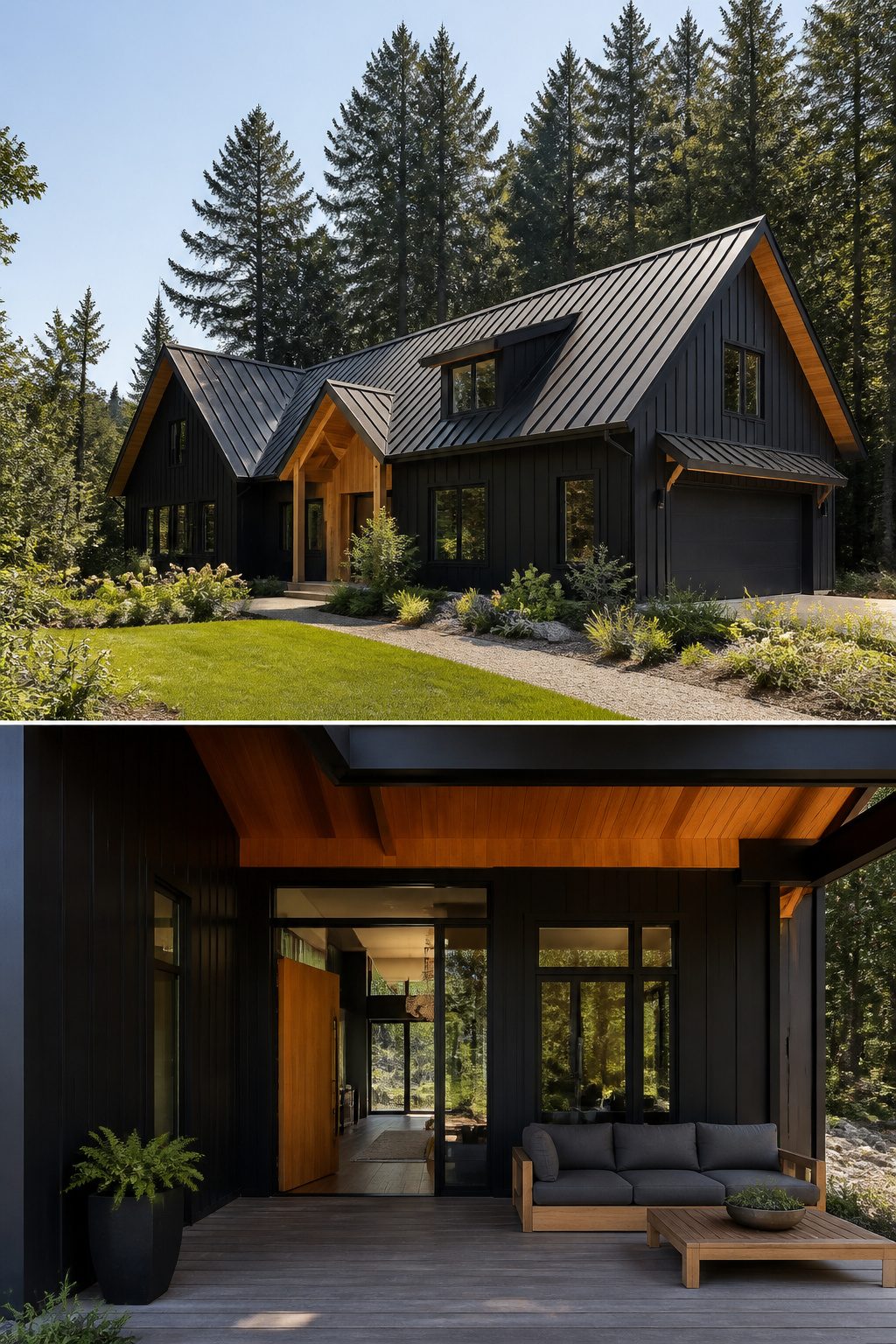
A standing-seam metal roof alongside cedar accents on a black house creates an exterior where the wood becomes the only source of warmth in an otherwise fully unified dark composition. The effect stays precise and deliberate, not accidental.
Cedar carries warm red and honey undertones that soften black’s boldness and add instant warmth. Metal introduces a third texture and reflects light differently across the day, so the façade changes from morning to evening without changing anything at all.
I would put cedar where it gets seen up close: soffits, porch ceilings, vertical accent panels, the front door itself. Left natural, cedar weathers to a silvery gray. Sealed, it keeps that warm tone the first season. Two paths, one early choice.
Standing seam dominates residential metal roofing for the same reason it looks good on modern-rustic builds. The ribs run clean and vertical, catching light along their edges, and the concealed fasteners keep the face unbroken. The pairing reads as contemporary without trying too hard for it.
16. Light Oak Trim and White Windows
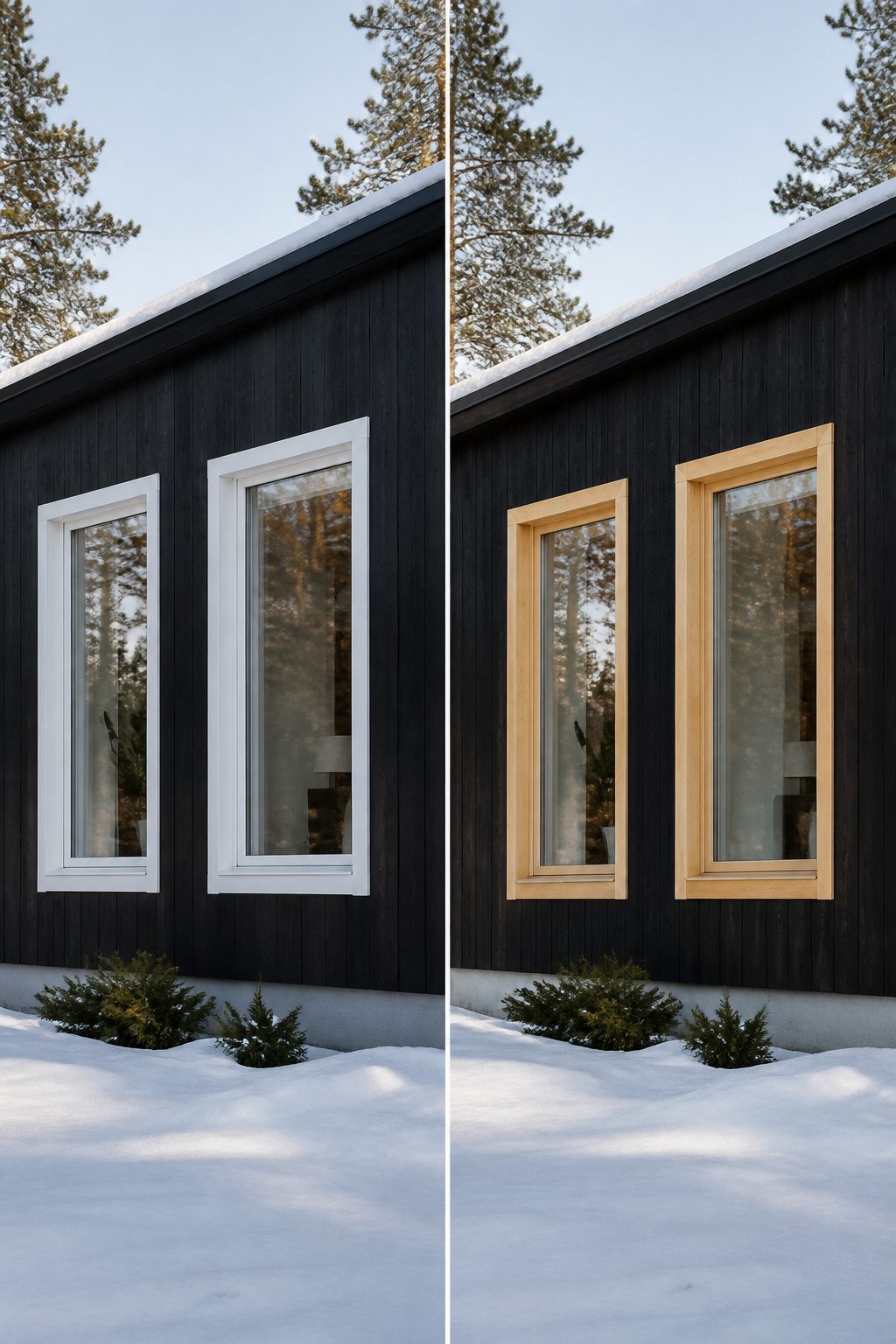
Light oak trim with white windows against black siding reads cooler and more graphic than cedar pairings, leaning Scandinavian rather than farmhouse. The white windows advance and draw the eye to the glass, where oak alone would soften the edge too much. That crisp definition matters on a dark envelope, especially in winter landscapes where the contrast against snow is the whole point. I find this combination works best when the trim is genuinely light, a raw or barely-oiled oak that hasn’t ambered. Once it yellows, the crispness fades and the palette drifts toward a warmer feel that competes with the white rather than framing it. If you’re after the minimal but warm Scandinavian note, keep the wood pale and the windows matte, not glossy.
17. Walnut Garage and Cedar Door
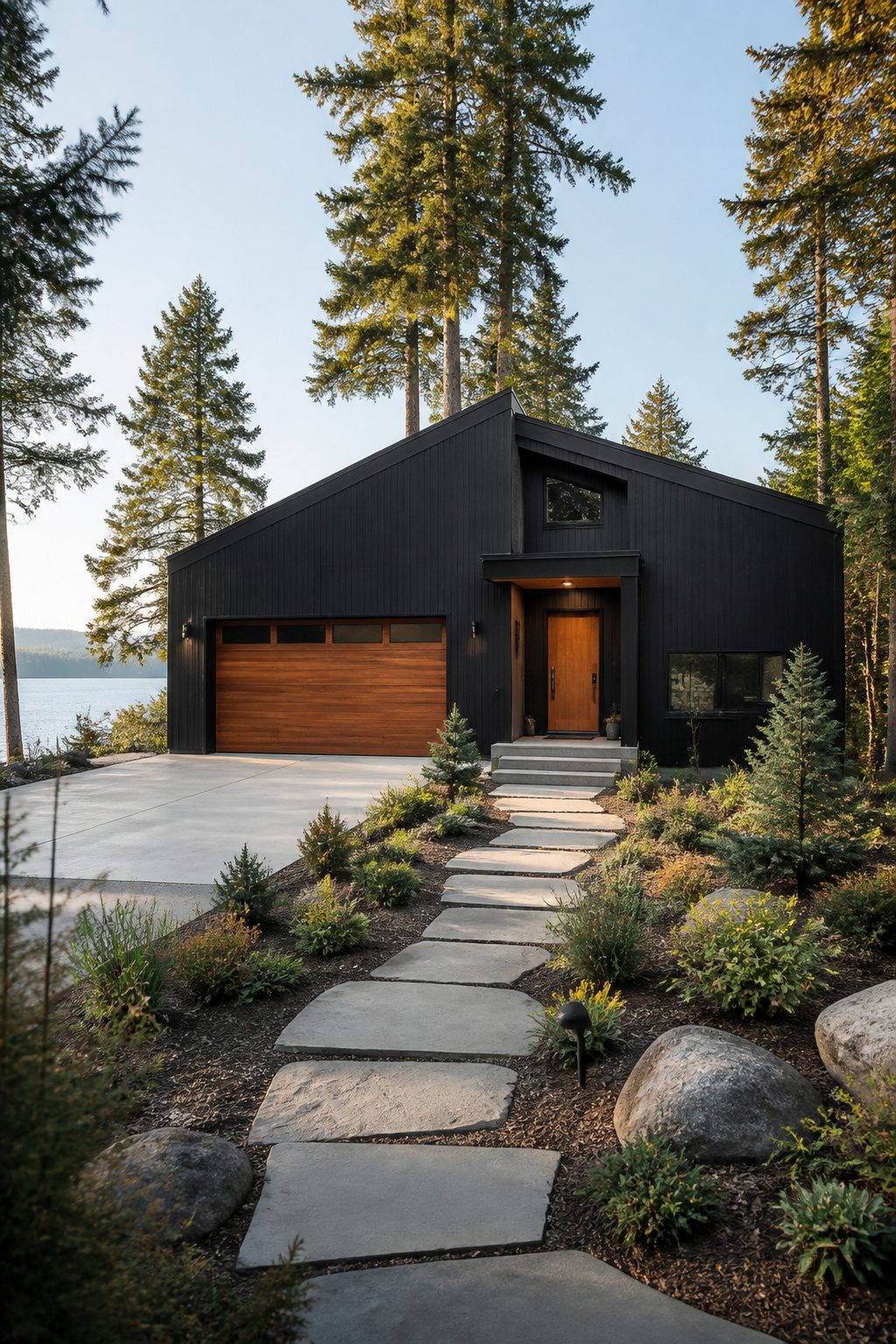
A walnut garage door paired with a cedar entry door on the same black facade creates a two-tone wood scheme that reads as intentional rather than accidental. The grain structures differ enough, walnut running tight and straight against cedar’s more pronounced figuring, that the eye registers them separately even from the curb.
Using two species means neither competes with itself, a risk I watch for on smaller houses where a single wood tone can flatten into one repeating stripe across the front elevation. The walnut carries more visual weight because its base color sits deeper; placing it on the larger garage surface and the lighter cedar at the human-scaled entry balances that weight toward the door people actually use.
The cost in confidence is real. Neighbors with safer schemes will notice first, and not always kindly. Maintenance timing splits too: cedar left natural weathers to silver-gray while walnut stain fades toward umber, so the contrast between them shifts through the years rather than holding static. Sealing the cedar preserves its warm red undertones against the black siding, but demands a schedule the natural-weathering homeowner avoids.
For anyone spending $500–$800 annually on exterior upkeep across a whole property, the split-wood approach claims more of that budget than single-species simplicity. The return is depth no single wood provides, a facade that reads closer to custom than kit-built, and that distinction tends to sell itself at resale.
Why Black and Wood Work Together
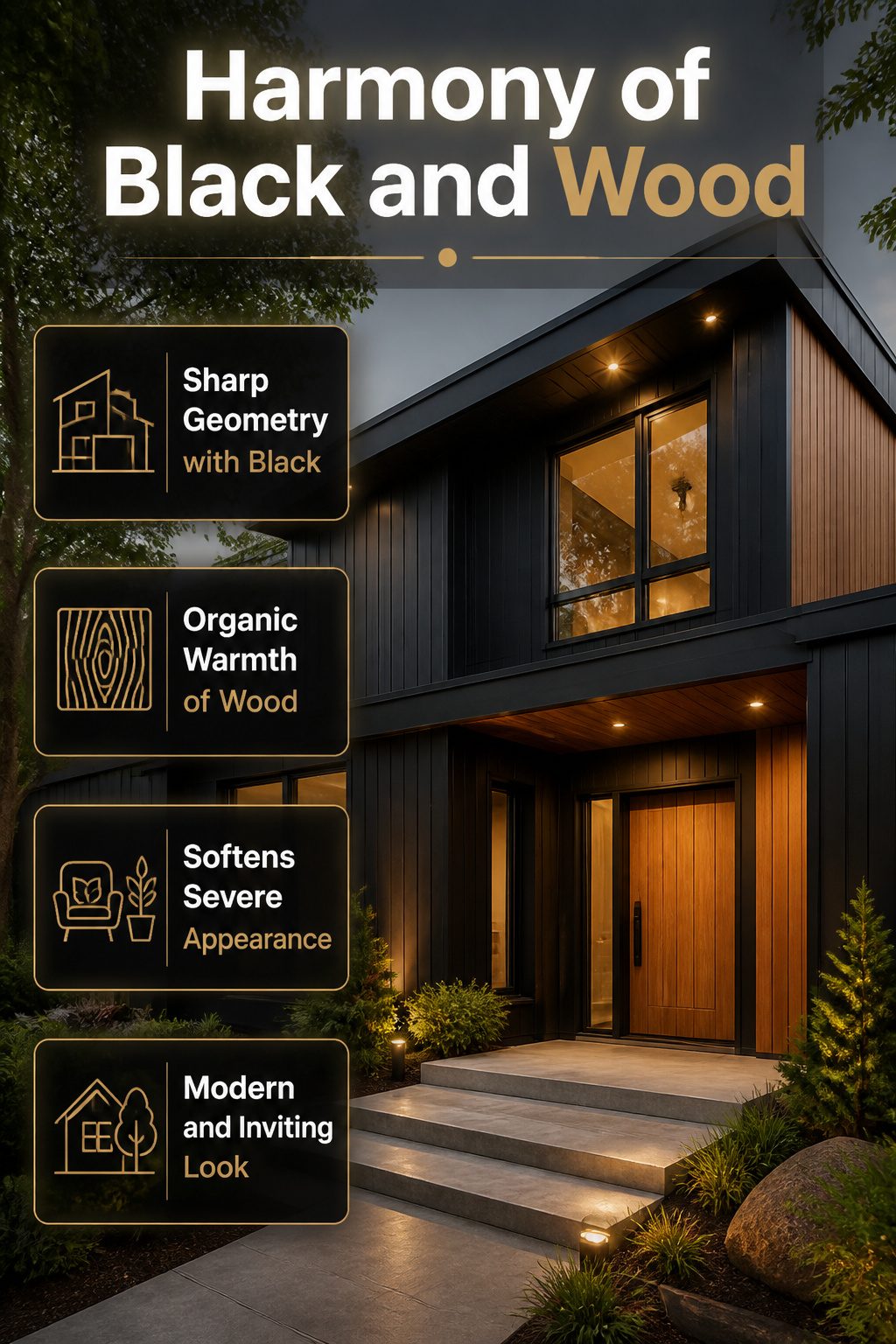
Black does something specific to a building it does not do in a room. Outdoors, a dark facade sinks back visually while the edges stay sharp, so the geometry reads more cleanly than it would in sage or cream. Windows, trim lines, and any overhang become definite. That depth is the first half of the pairing.
Wood supplies the second half. Cedar or a similarly rich, organic tone pops against that dark ground the way a door painted red never quite does on white clapboard. The eye travels straight to the grain, whether it is a front door, a soffit run, or a vertical accent panel.
The risk with black alone is severity. I have seen houses that looked like rendered models, correct and uninhabited. Warm wood breaks that without breaking the contrast. High difference stays, but the harshness goes. The result reads modern and inviting at once, layered rather than stark.
Wood Types Compared
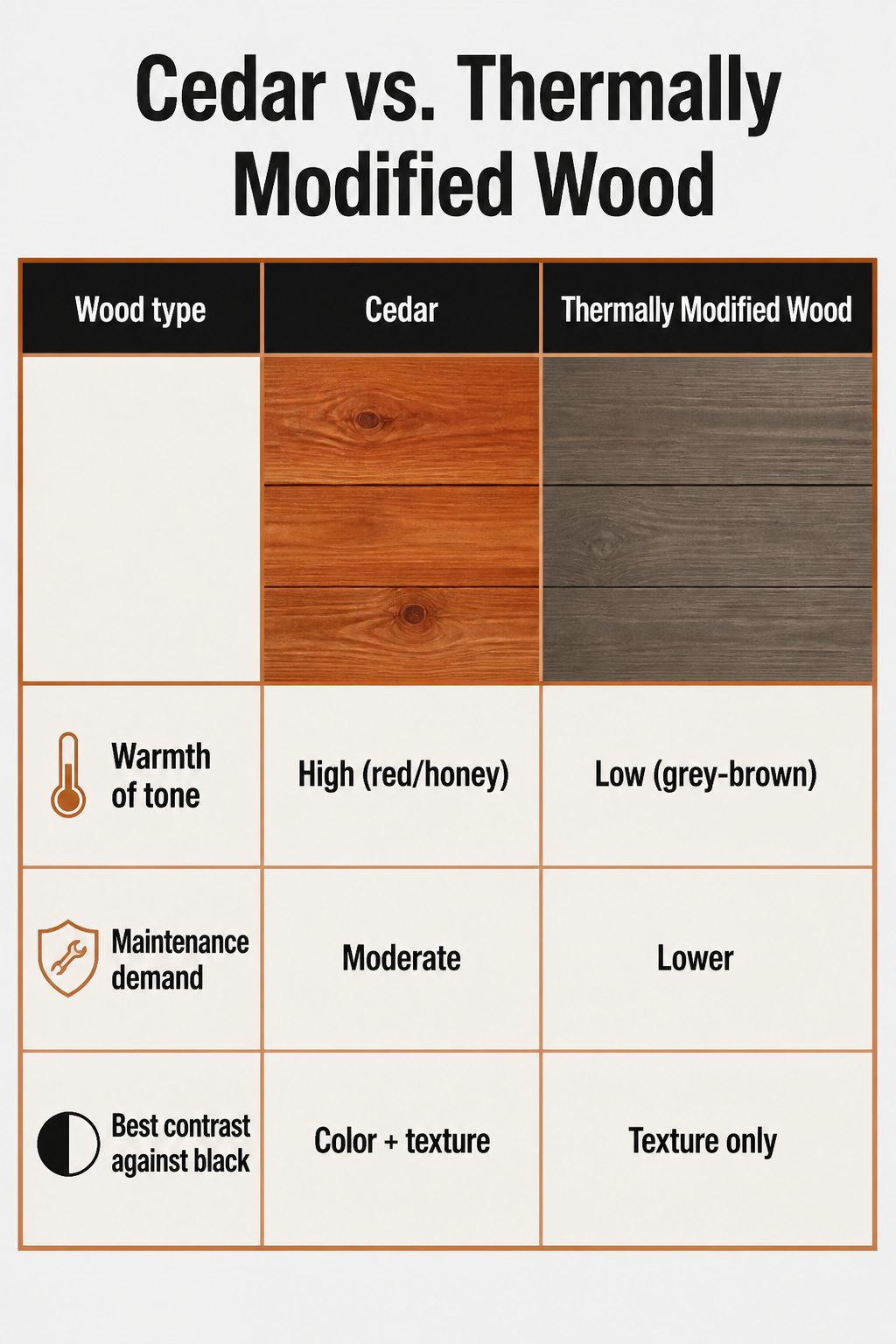
Cedar tends to win out for warm red and honey undertones that read richer against black siding than anything else on the market right now. Thermally modified wood takes a different route: it carries a smooth grey-brown tone, close in value to black paint but completely different in texture, for people who want the contrast to come from surface rather than color. Pine or fir with a light stain reads more contemporary, with fewer red undertones, though softer woods demand more upkeep over time in harsh climates. Ipe sits in between on warmth but adds density that shows in the grain.
| Wood type | Warmth of tone | Maintenance demand | Best contrast against black |
|---|---|---|---|
| Cedar | High (red/honey) | Moderate | Color + texture |
| Pine/Fir | Low (neutral, light stain) | Higher, especially harsh climates | Subtle, contemporary |
| Ipe | Medium | Lower | Grain density |
| Thermally modified wood | Low (grey-brown) | Lower | Texture only |
The choice I keep coming back to: whether you want the wood to pop or to whisper. Cedar pops. Thermally modified wood whispers.
Energy Efficiency of Black Exteriors
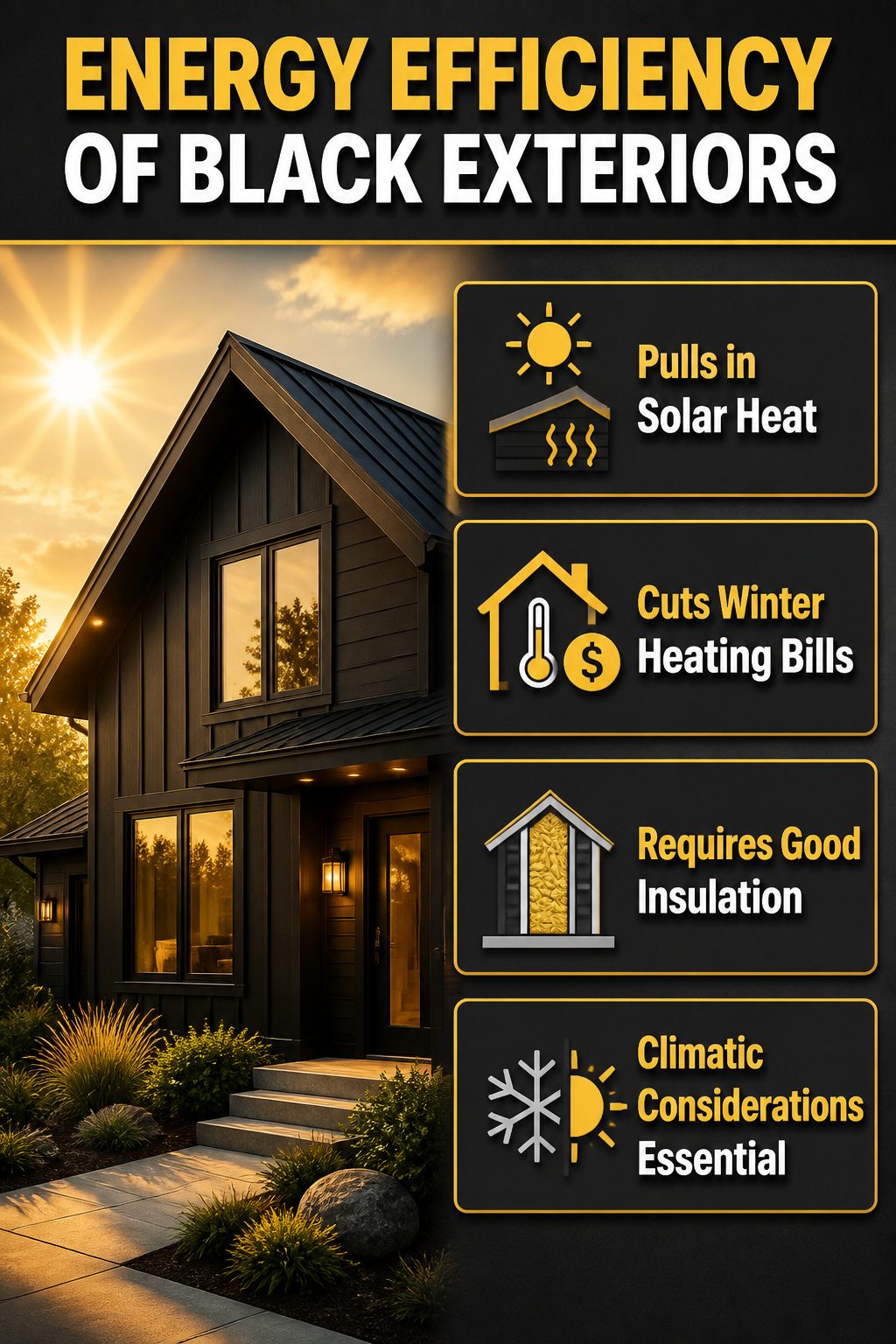
Dark siding pulls in solar heat, which cuts heating bills during a cold-climate winter. That same absorption turns against you in summer without proper insulation and roof overhangs to block it. Black paint also shows every surface flaw, so quality prep matters more than with lighter colors. The energy equation flips by zone: a real asset up north, a liability down south unless you build in shade.
Metal Details That Complement
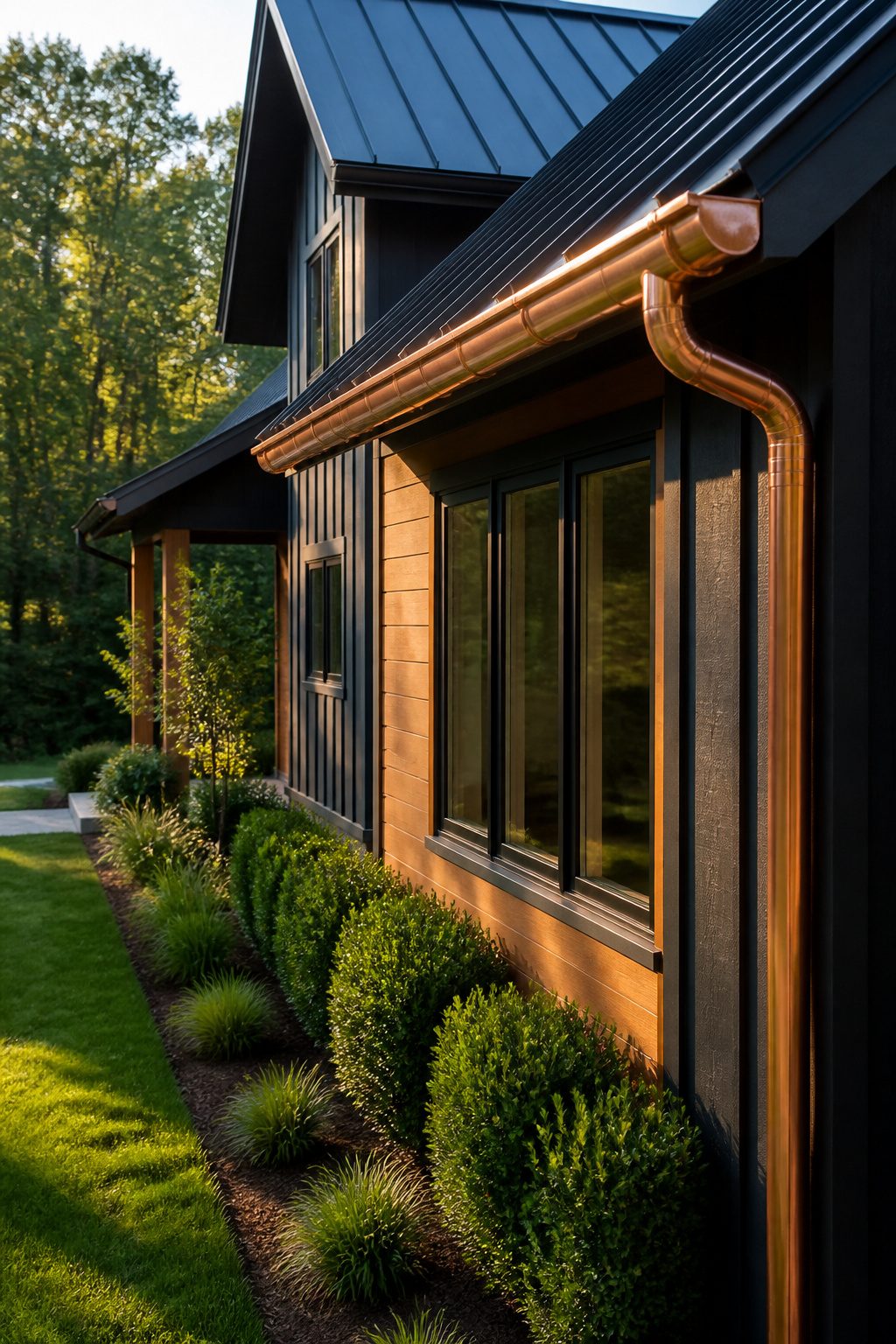
Copper gutters sit somewhere between wood trim and the black siding itself, catching light that would otherwise disappear into the dark field. New copper reads bright and warm against black; aged copper softens into verdigris that gains character year by year. Either stage works with cedar or timber details without introducing another paint color.
A standing-seam metal roof takes the same approach in larger strokes. Used alongside cedar accents, it leaves wood as the only warmth in an otherwise fully unified dark composition. The effect is precise, almost deliberate in its restraint.
Steel awnings or overhangs add the same contemporary note on a smaller scale. Where copper ties back to wood’s warmth, steel or black-finished metal keeps the cooler side of the palette alive. The fourth material matters more than people expect: two warm elements against black can read as accident; three materials read as intention. Copper gutters lean warm and timeless. A steel awning leans crisp and modern. Choose based on which direction the rest of the house is already headed.
Frequently Asked Questions
Is cedar the best wood for a black house?
Cedar is the most popular choice because its red and honey undertones soften black’s boldness without weakening it. The grain stays visible whether sealed or weathered, and that texture keeps a black exterior from reading flat. Pine, fir, ipe, and thermally modified wood all work too, but cedar’s warmth is the benchmark most people start from.
What stain color works best with black siding?
Warm mid-tones pair best: natural cedar left matte, warm honey, or medium brown carrying subtle red undertones. A matte finish lets the grain do the work; high gloss fights the natural texture and competes with the black. Sherwin-Williams Iron Ore, a true off-black, pairs particularly well because its neutrality lets cedar’s warmth read as deliberate rather than clashing.
Is painting a house black a practical decision?
Yes, with climate in mind. Dark siding absorbs solar heat, which cuts winter heating bills in cold zones but works against you in summer without proper insulation and roof overhangs. Black also shows every surface flaw, so prep quality matters more than with lighter colors. Up north it is a real asset; down south it becomes a liability unless you build in shade.