
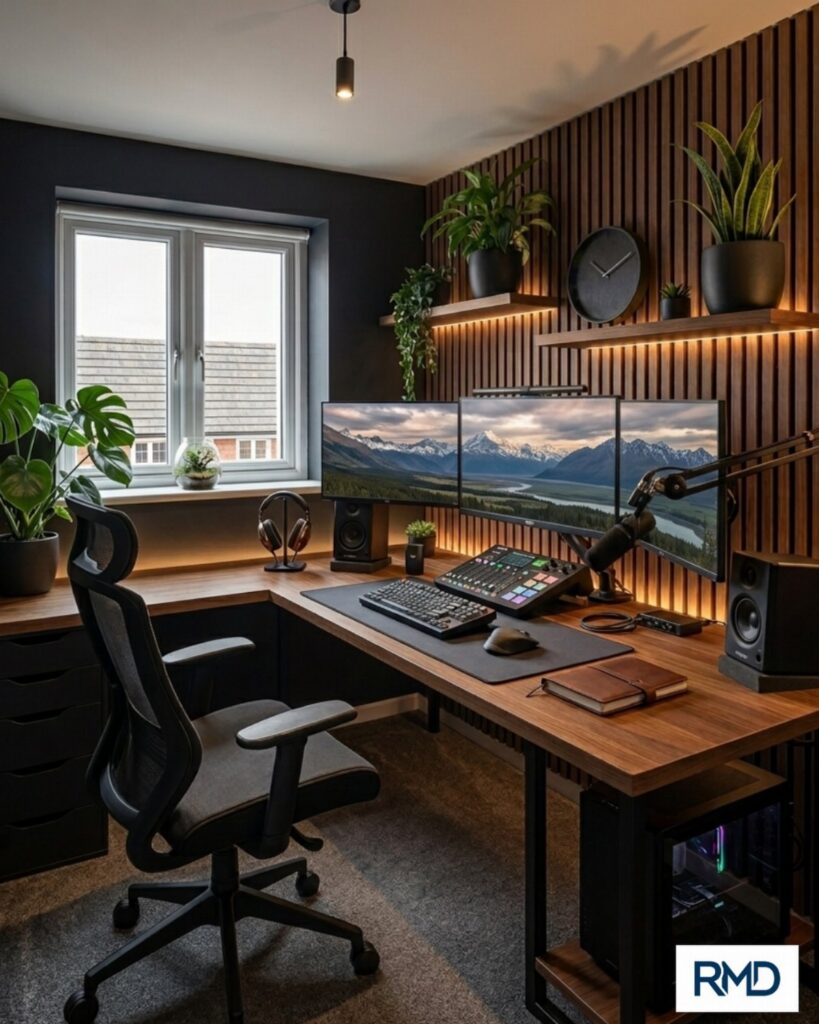
These home office ideas run from a candle on a kitchen table to a full masonry fireplace install that costs months and dust.
What decides which one belongs to you is whether your workspace is a dedicated room with a door or a corner borrowed from sleep or traffic.
A furring strip slat wall catches light differently as afternoon moves; that detail only matters if you have a wall that belongs to work alone.
1. Include Plants
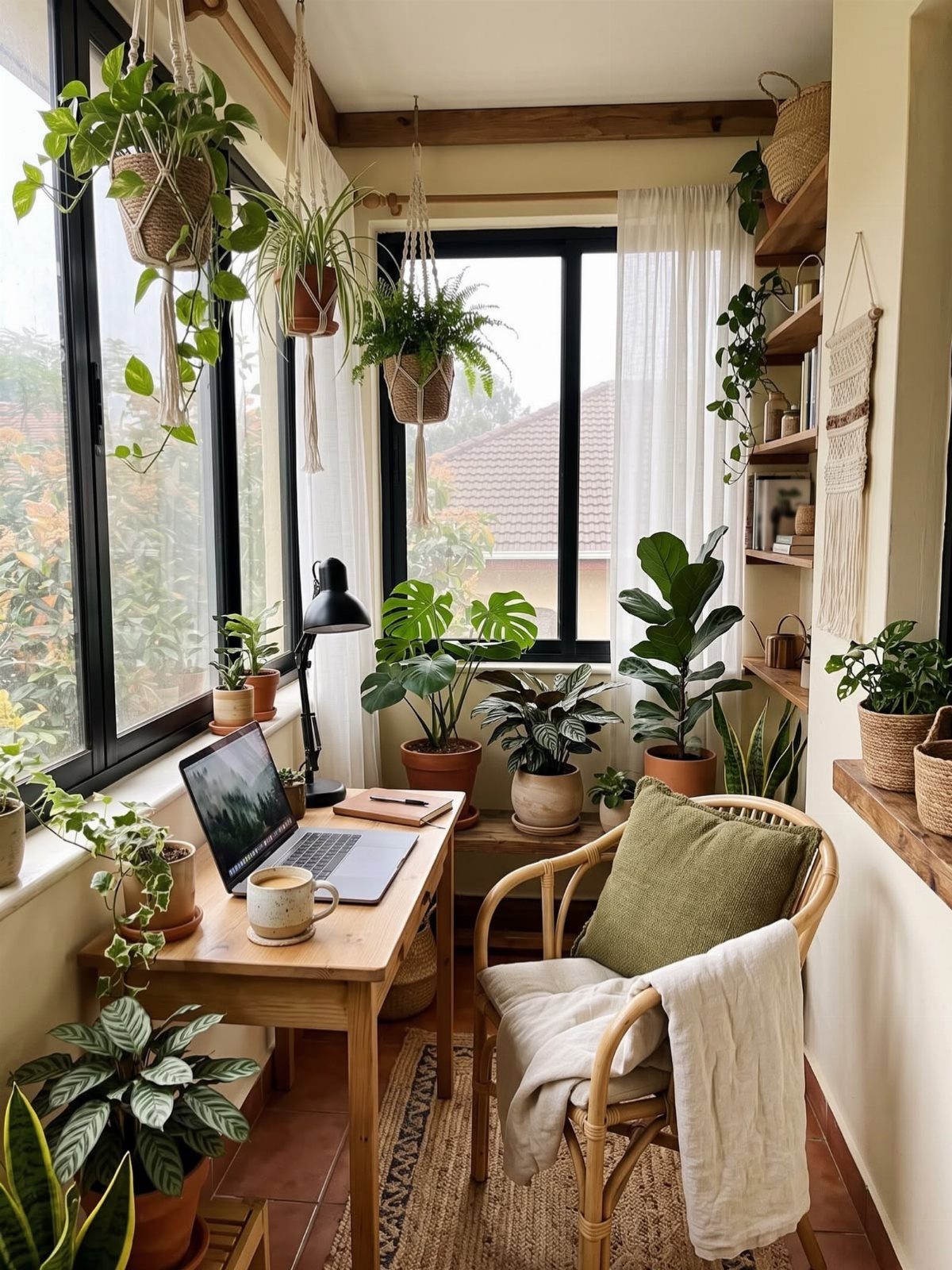
Low-light survivors like peace lilies and dragon trees filter the air without demanding a south-facing window, which matters when your office is a balcony nook or a corner the sun barely touches.
I keep one near my monitor to break up the wall; the green acts like a visual exhale during long calls. Bromeliads and Chinese evergreen work too if you tend to forget watering.
No natural light at all? A realistic artificial plant still softens the edges, though it won’t oxygenate the room.
This suits renters and small-space workers who need the outdoors to feel closer than it is.
2. Ergonomic Furniture
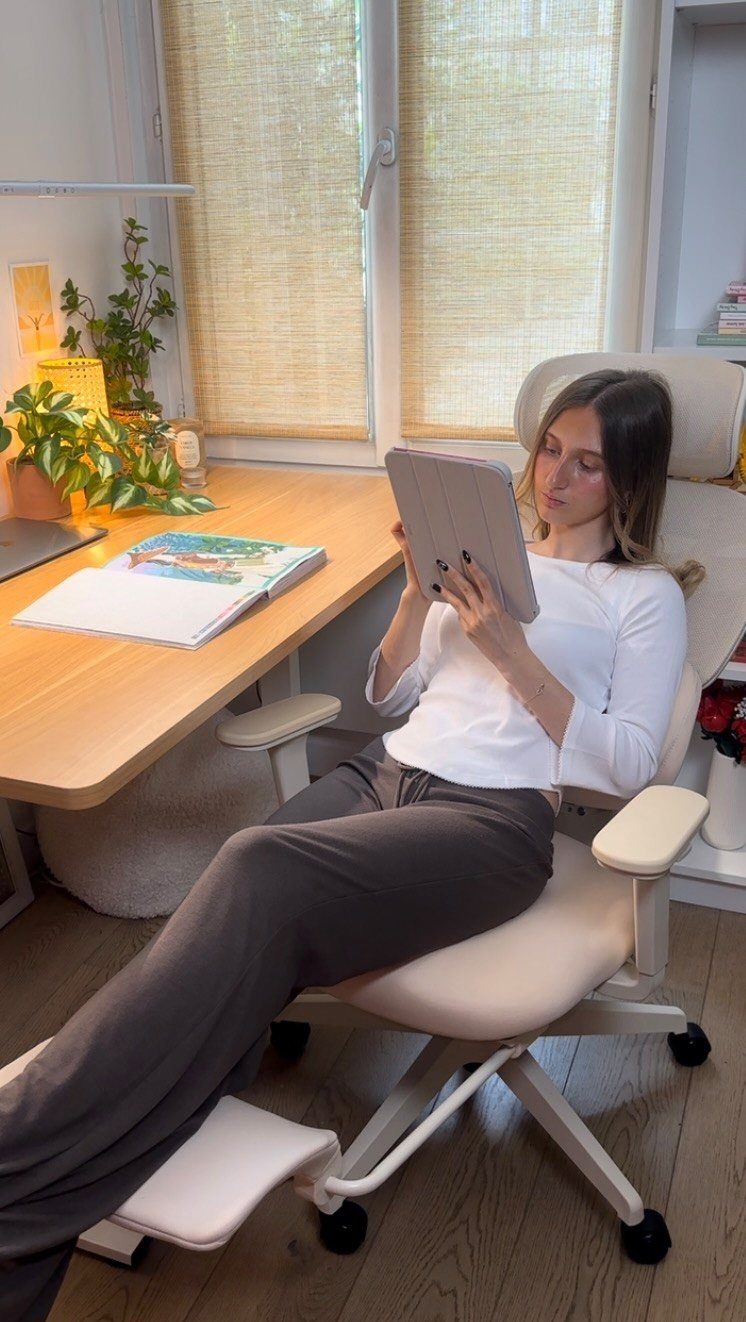
Your body will tell you the furniture is wrong long before your budget recovers. A workstation needs roughly 60 inches of width and 84 inches of depth to fit a monitor, laptop, notes, and coffee without your shoulders creeping toward your ears.
Standing desks and laptop stands help, but the chair does the heavy lifting; an adjustable seat with a footrest keeps hips level and wrists neutral through afternoon slump.
Mid-Century lines or Art-Deco curves can still read as personal, not corporate, if you pick one silhouette and build around it. This setup does need more floor space than a folding table tucked in a closet.
Skip it if your office is temporary; invest if you sit there most of the workday.
3. Use a Sleek Desk
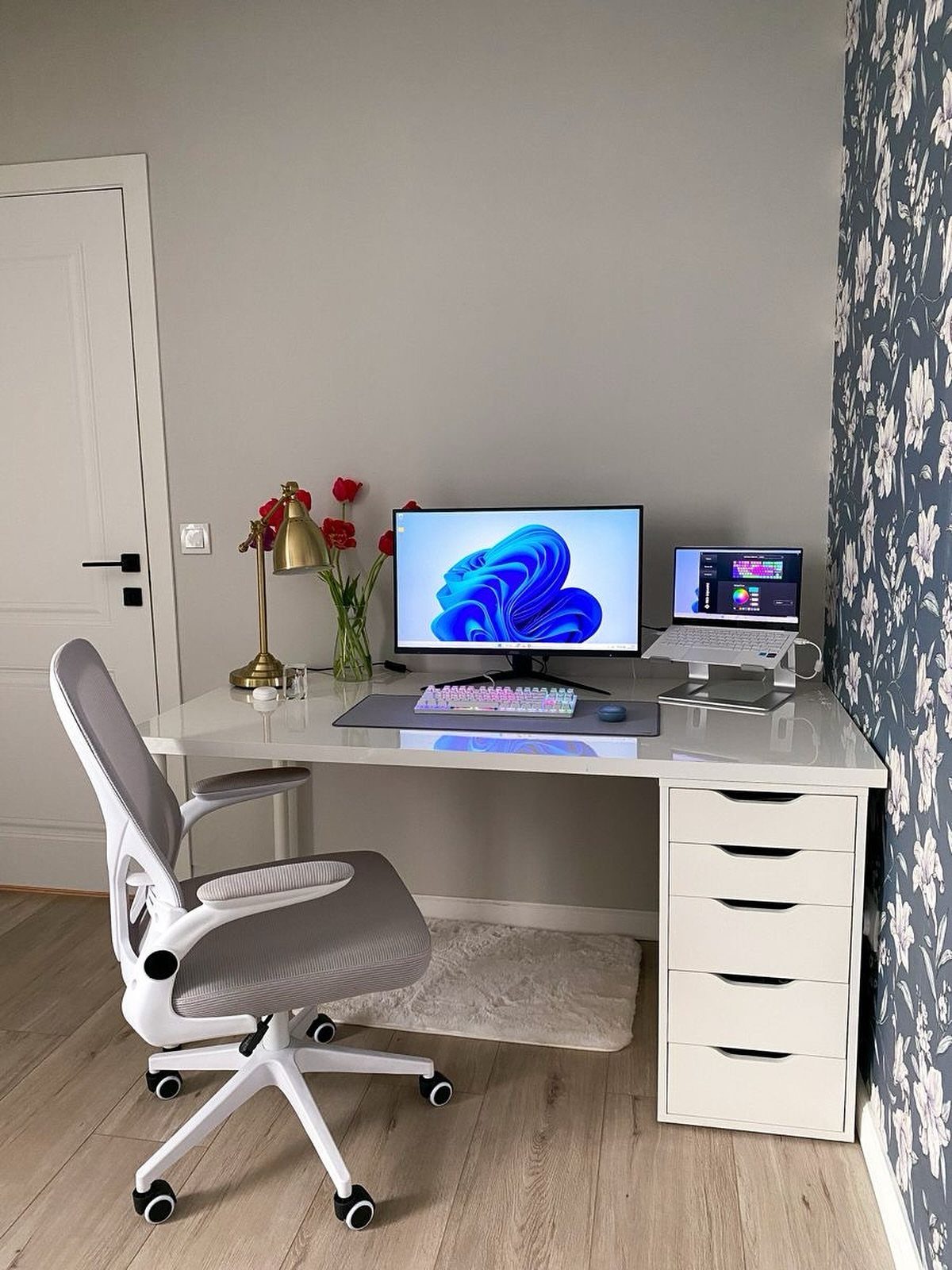
The desk sets the tone for every hour you spend facing it.
A glossy white surface with clean drawers reads lighter than a bulky executive slab, which helps when the room doubles as a bedroom or the desk backs to a floral accent wall that already carries visual weight.
The Finley Desk balances negative space against usable surface; that fluid form works in entryways too if your office later becomes something else.
Before ordering, measure your corner twice: an L-shape eats wall space but gains spread for dual monitors, while a straight desk keeps traffic paths open.
I’d pick the simpler silhouette for a small nook and save the statement piece for a dedicated room.
4. Choose a Comfy Chair
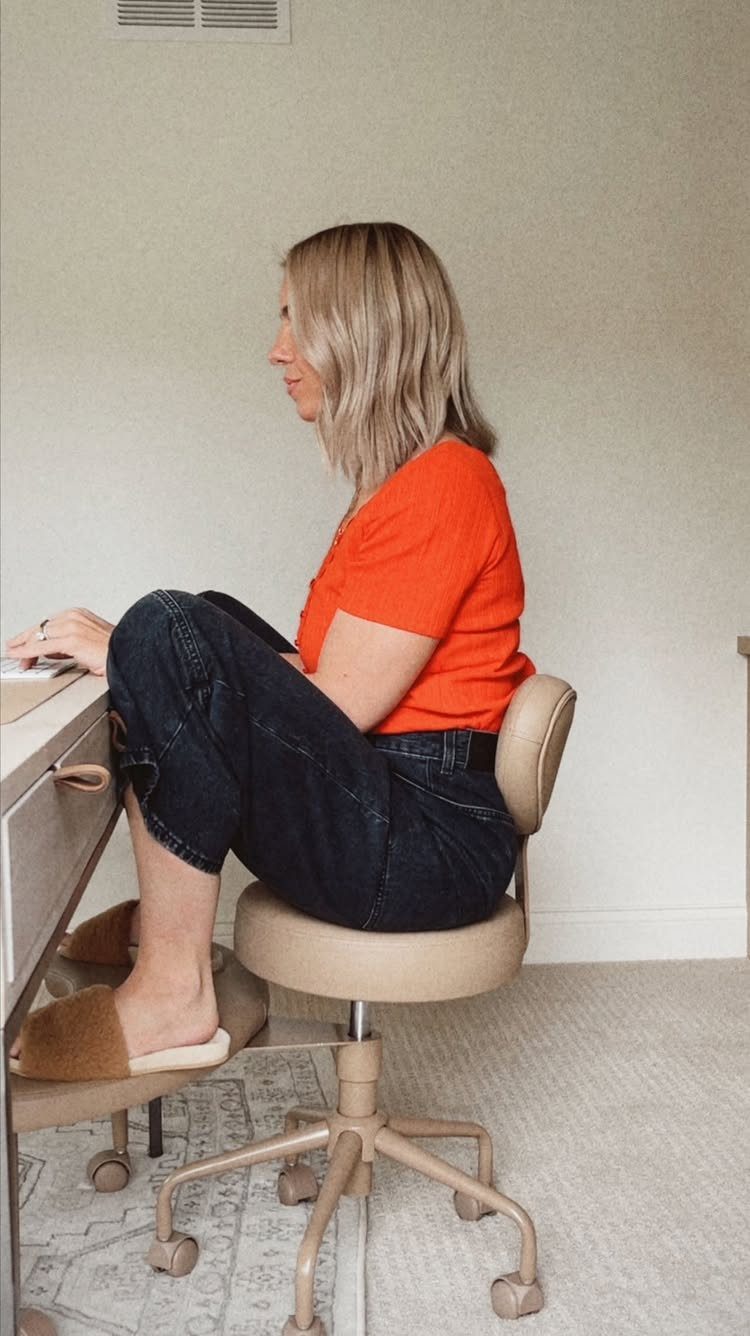
The Prelude Chair was built for small footprints, which is why it appears in home offices that can’t spare the square footage of a lounger. A swivel base lets you pivot between desk and door without scraping walls.
A neutral fabric reads clean against patterned rugs, though your own choice should match how much coffee you spill.
One maker tags friends who’d relate; the joke lands because cross-legged sitting at a desk is a universal impulse this chair actually accommodates.
It costs more than a dining chair dragged from the kitchen, but less than medical bills from a year of bad lumbar support. Best for workers who treat sitting like a sport.
5. Hang Artwork
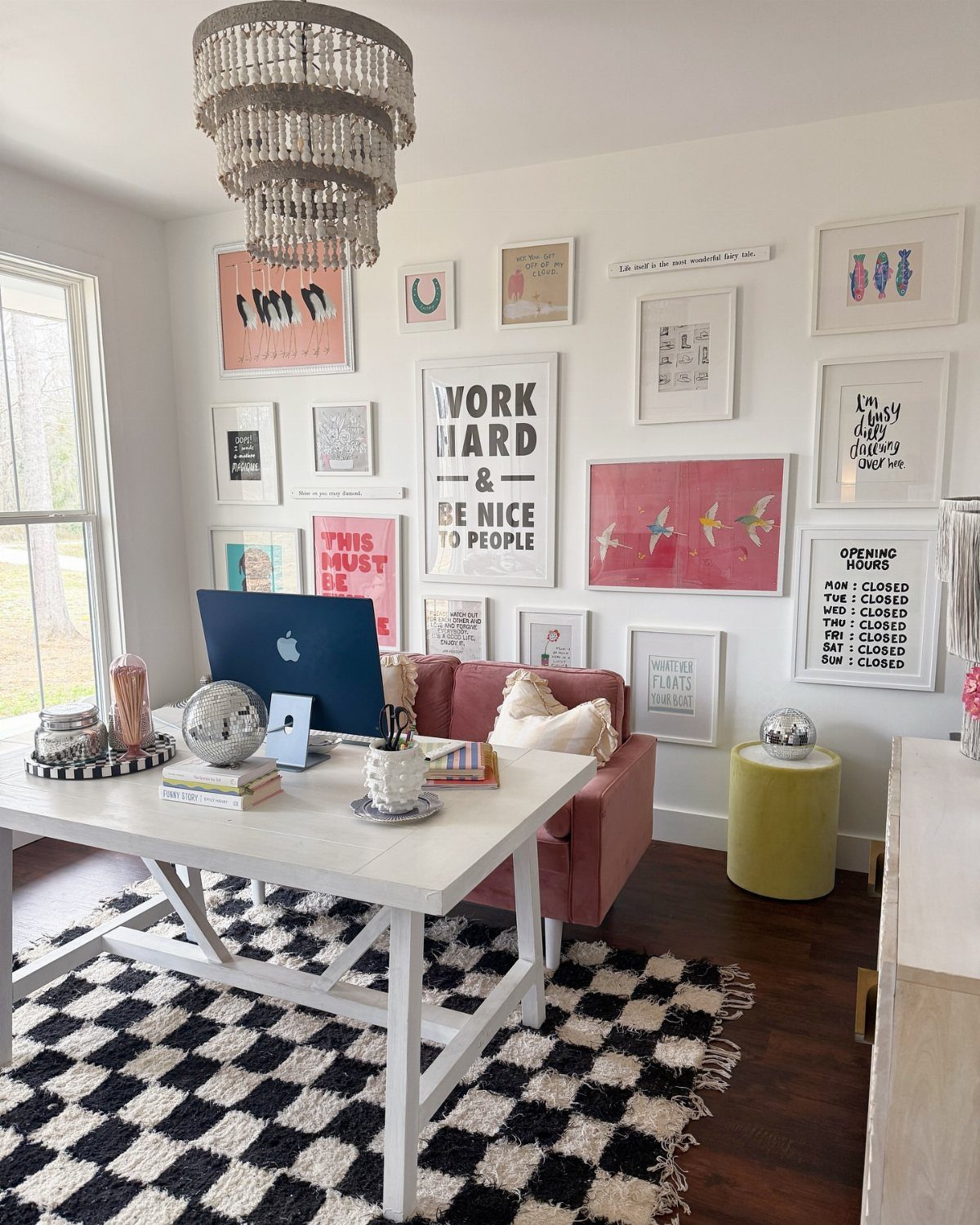
A gallery wall turns blank drywall into something that pulls you through the door on slow mornings.
A mix of typography and image in matching frames keeps a small office from feeling cluttered; a single large piece works better if your wall space is narrow.
I hung a "WORK HARD & BE NICE TO PEOPLE" print above my own desk during a brutal project year, and the joke wore thin by month three.
Now I rotate: energizing colors for winter, calmed-down tones when deadlines stack in summer. The cost stays low if you frame calendar pages or your own photography.
This idea fails in shared spaces where your taste isn’t the only vote; thrives for solo workers who need the room to feel inhabited.
6. Candles or Diffusers
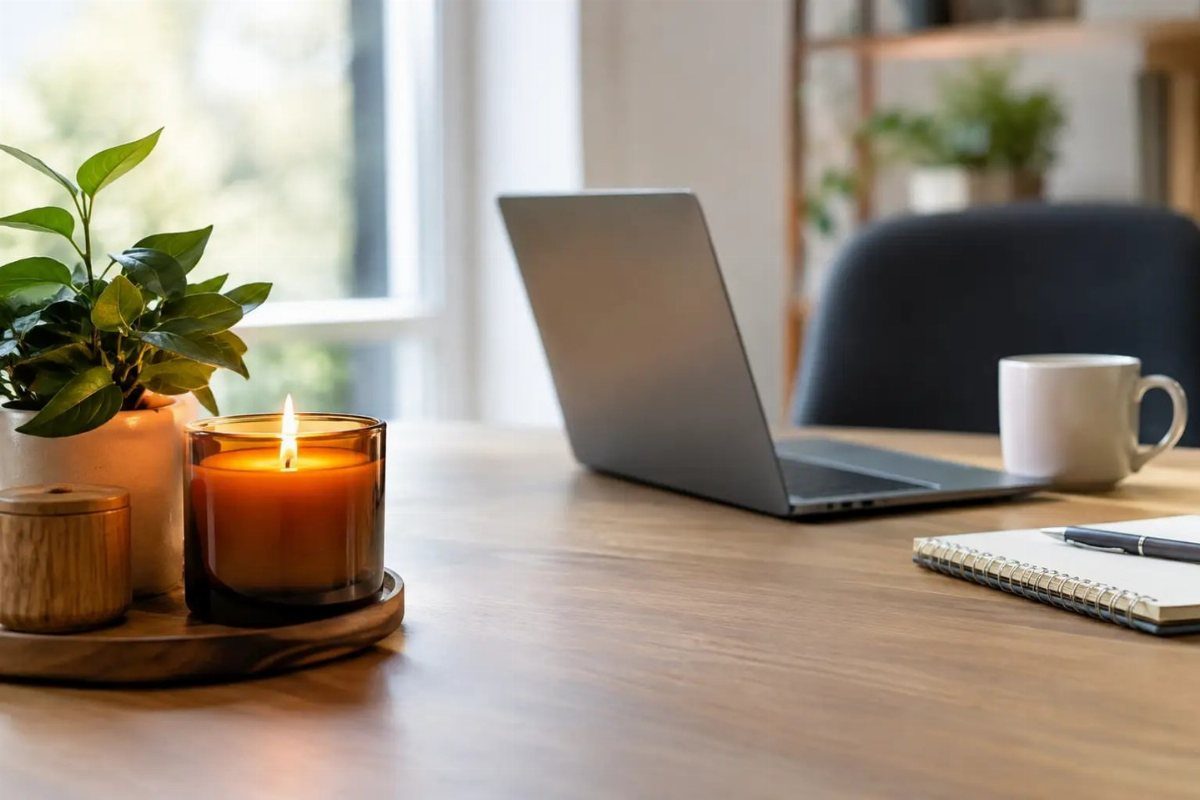
Scent marks the boundary between work and the rest of the house more cleanly than any door. A lit candle in amber glass on a wooden tray signals morning start the way coffee used to, before the commute disappeared.
I prefer diffusers for safety; I have knocked over a jar reaching for a notebook more than once. Soothing scents, not loud ones, sustain focus through afternoon review sessions.
The cost runs low enough to swap seasonally: something green in spring, something resinous when the heating kicks on. Skip this if your office is the kitchen table where dinner also happens, or if housemates have scent sensitivities.
Best for dedicated desk workers who need a ritual to replace the old boundaries of leaving and arriving.
7. Bedroom Corner Workspace
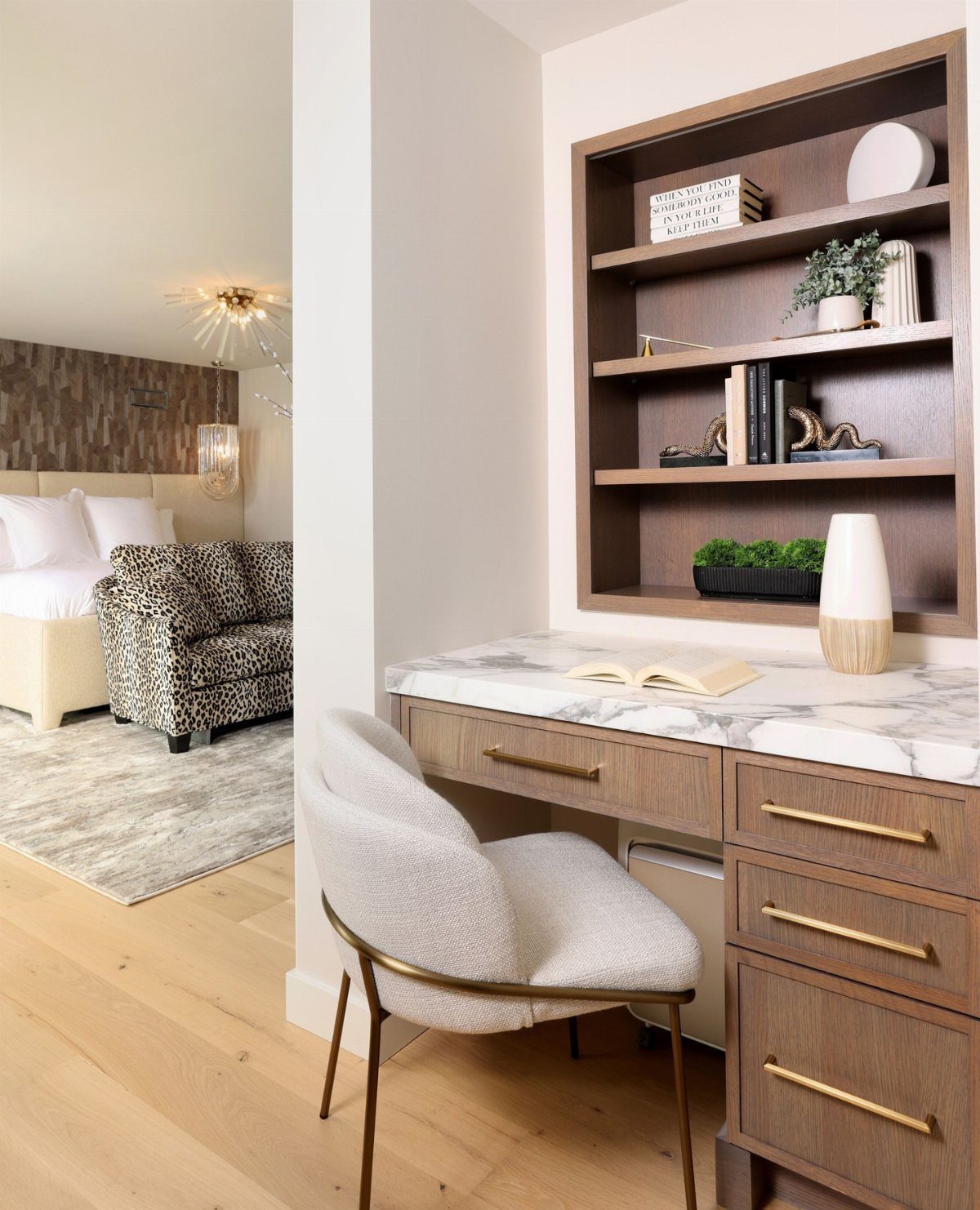
A bedroom corner office turns the gap between sleep and work into a single wall. The desk sits where a dresser might have stood, with shelves above taking the place of a headboard.
That proximity cuts both ways: the commute is zero steps, but the laptop glow stays in view when you are trying to wind down.
Built-ins keep the footprint tight. Drawers under the desk swallow cables and paperwork; shelves overhead hold books you actually reach for, not the ones you mean to read someday.
A marble top that wipes clean and reflects light works for a corner that may only get morning sun.
Check the wall before you buy. Older plaster may not carry the load of floating shelves, and a rental probably rules out recessing anything.
Freestanding bookcases flanking a simple desk give the same look with holes you can patch later.
Best for someone whose work hours bleed, who needs to close a door that is not there.
8. Wood Slat Accent Wall
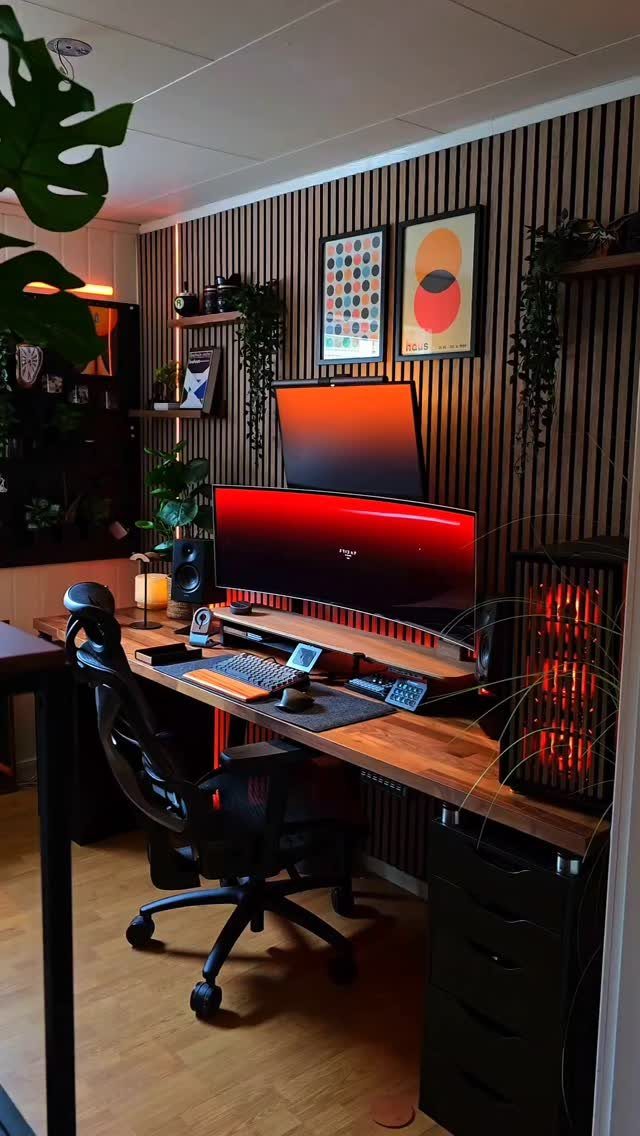
Vertical slats add texture without the weight of paneling. They run floor to ceiling behind the desk, turning a flat wall into something that catches light differently as the day moves.
A dark stain reads as moody; pine left natural would brighten a smaller room by the same logic.
Spacing matters more than species. Gaps of half an inch to three quarters let the wall behind breathe and give you a place to tuck clip-on lamps or small shelves without drilling new holes.
The slats themselves are usually furring strips or lath, cheap at any lumberyard, though you will spend an afternoon leveling each one.
Paint the wall behind dark first. The gaps show, and a pale wall behind dark slats looks like a mistake.
Red ambient light is one route; a warmer bulb in a clip lamp aimed upward does nearly the same for less wiring.
This trades silence for style. The hard surface bounces sound, so a rug under the desk and something soft on the opposite wall help if you are on calls all day.
9. Traditional Library Style with Fireplace
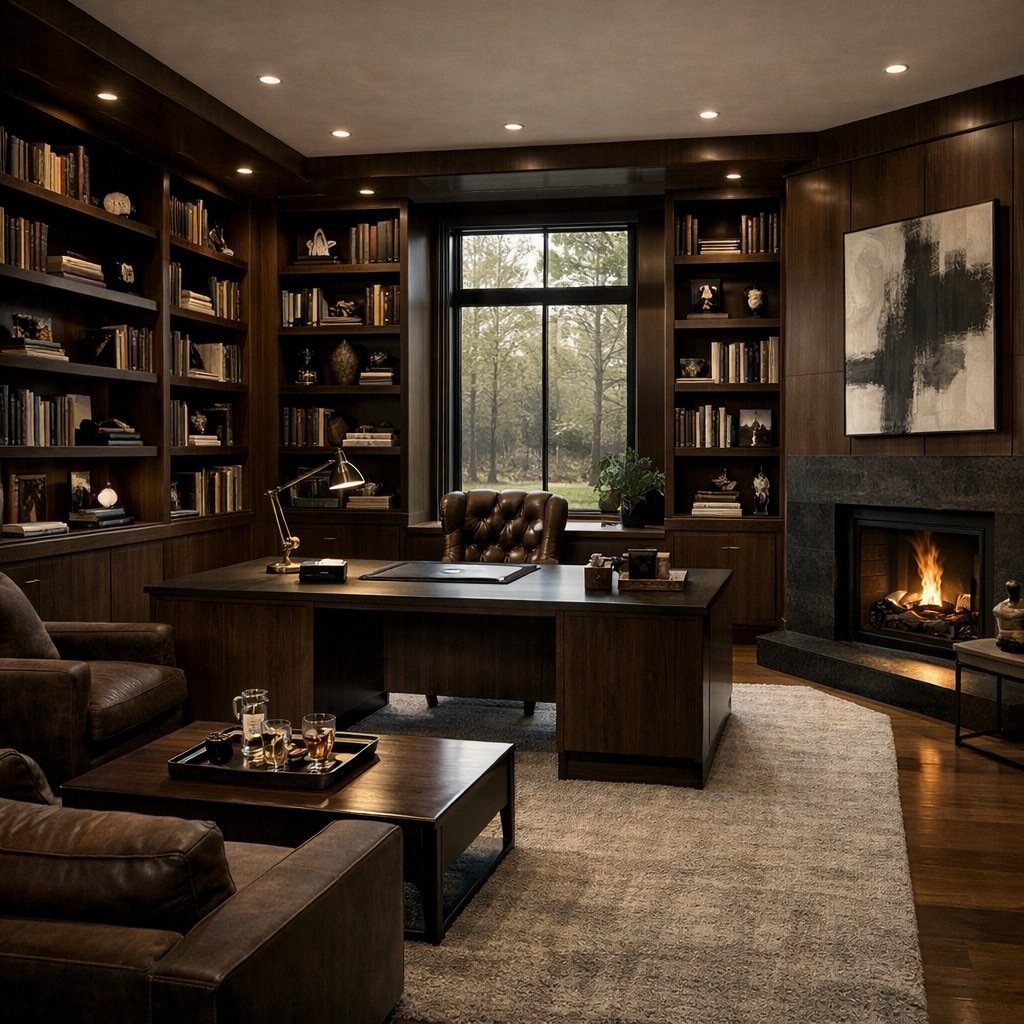
A fireplace in the office is the old money version of a candle.
The fire itself is rarely the heat source; the glow is what you are after, the small movement in peripheral vision that keeps a long afternoon from feeling boxed in.
Dark wood and leather around it just formalize what the flame already suggests.
The bookshelves are doing real work here. They hold enough volume to soften sound, enough height to frame the desk as a destination rather than a leftover.
A room this heavy wants a window nearby, and woods outside are doing as much as the paneling to keep it from closing in.
This is not a retrofit for most houses. The cost is in the masonry, the flue, the structural check, and the months of dust.
If you are starting from a blank room, the fireplace goes in first; everything else arranges around it.
For the rest of us, an electric insert in a salvaged mantel gives the posture without the permit. It will not warm your hands, but it will light your face on a November Zoom call, and that is often enough.
10. Built-in Floating Desk Nook
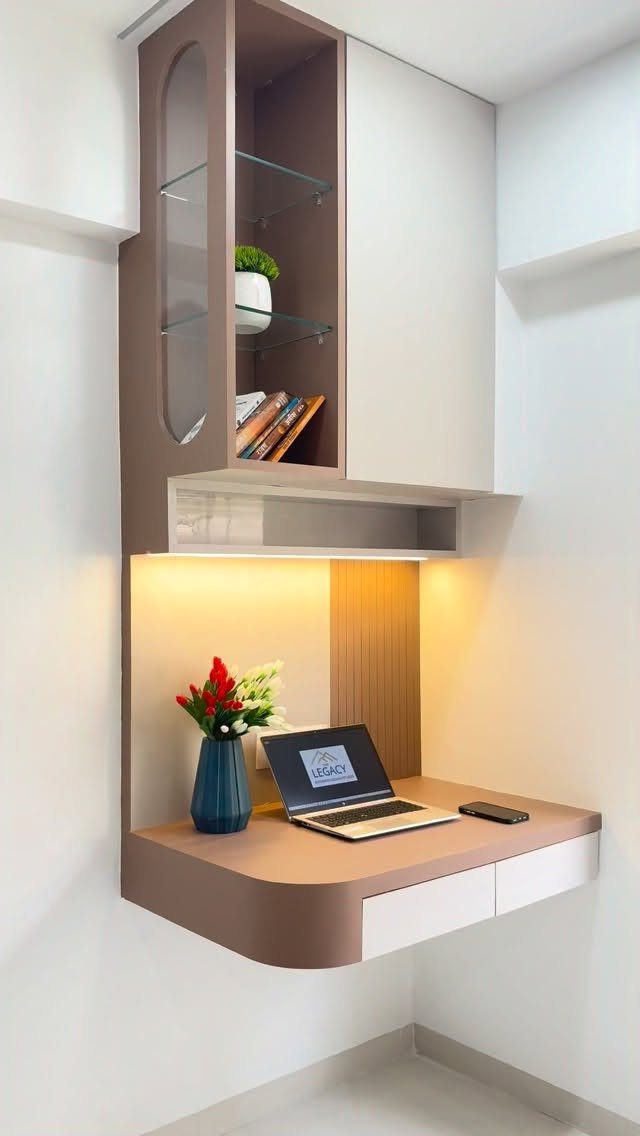
Drawers on one side only keep the span lighter and the install simpler; two banks of drawers need either a deeper corner or a tolerance for knee-bumping.
Integrated lighting under the overhead cabinets is the detail that makes evening work possible. A battery puck light stuck on afterward gives the same wash across the desk, though you will replace batteries twice a year.
The back panel, the strip running between desk surface and shelves, hides the router and the rat’s nest; leave a gap top and bottom or the heat builds.
Wall construction is the hidden question. A nook with studs on both walls holds weight fine.
Drywall over steel studs, common in newer apartments, may need a plywood backing plate hidden behind the desk mount. Check with a magnet: steel studs attract, wood does not.
Best for the room that is not quite a room, the landing at the top of stairs, the space beside a closet that framing left awkward.
Creating a Distraction-free Zone
A clear desk surface is not the same as a clear mind, but it helps. One open notebook and one cup is enough surface clutter; the rest belongs in a drawer you can shut.
Personal items belong on a shelf across the room, where they wait for breaks rather than catching my eye mid-sentence.
Noise is the harder problem to solve. A door you can close is ideal; a pair of headphones playing nothing is sometimes enough.
I face away from high-traffic areas when I can, since movement in peripheral vision pulls attention the same way a notification does.
Perfection isn’t the point. A single toy from your child on the desk is a distraction; the same toy on a windowsill across the room becomes a reason to stand up and stretch.
Importance of Lighting
Natural light does more than let you see the keyboard. Position your desk near a window if the layout allows; the view outside keeps you connected to the day without the demands of a conversation.
A sheer curtain or a blind you tilt cuts the glare on your screen and still lets the room breathe.
No window? Softly-lit lamps warm a space that overhead fixtures flatten.
I aim for pools of light rather than one blazing center; a desk lamp and a floor lamp in opposite corners erase shadows that tire the eyes by 3 PM.
Mirrors and pale walls bounce what light you have, which matters in a converted closet or a basement corner. The mirror goes where it catches the lamp, not the window; you want reflection, not a direct beam in your eyes.
Personalizing Your Workspace
Color does the motivating if you let it. A rug or a tray in the shade of your company logo ties the room to your working identity without turning the space into a billboard.
Branded color works best in small doses; a navy stapler and wastebasket look chosen, a navy wall looks like you couldn’t stop.
A framed quote near your sightline works only if you still notice it after month three. I rotate mine seasonally, the same way I swap desk plants.
The personal mission statement goes here too, if you have one; the words you chose for yourself land harder than anything from a poster shop.
A soft rug underfoot matters more than it should. Cold floors remind you this is a corner of a house, not a place built for focus.
Warmth under the soles fixes that.
Frequently Asked Questions
What is a good home office setup?
A good home office setup needs about 60 inches of width and 84 inches of depth to fit a monitor, laptop, notes, and coffee without cramping your shoulders.
My adjustable chair with a footrest does most of the work; it keeps my hips level and my wrists neutral even when the afternoon drags.
Position yourself near a window if you can; the outside view keeps you connected without being overbearing, and natural light cuts down on eye strain.
What’s an alternative for a home office?
A bedroom corner works when no separate room exists; the desk sits where a dresser might have stood, with shelves above taking the place of a headboard.
Freestanding bookcases flanking a simple desk give the same look as built-ins with holes you can patch later if you rent.