

Stucco is a cement plaster applied in layers roughly one inch thick over wire lath, hardening into a fire-resistant shell that can last a century in dry climates. The catch is brittleness: foundation movement and freeze-thaw cycles crack the surface, and water that gets behind it does damage no hose rinse can fix. In the Southwest, where crews know the material, installation runs $4 to $7 per square foot; elsewhere, expect up to $10, with repairs climbing to $60–$120 per square foot when cracks widen past a quarter inch.
What Stucco Is
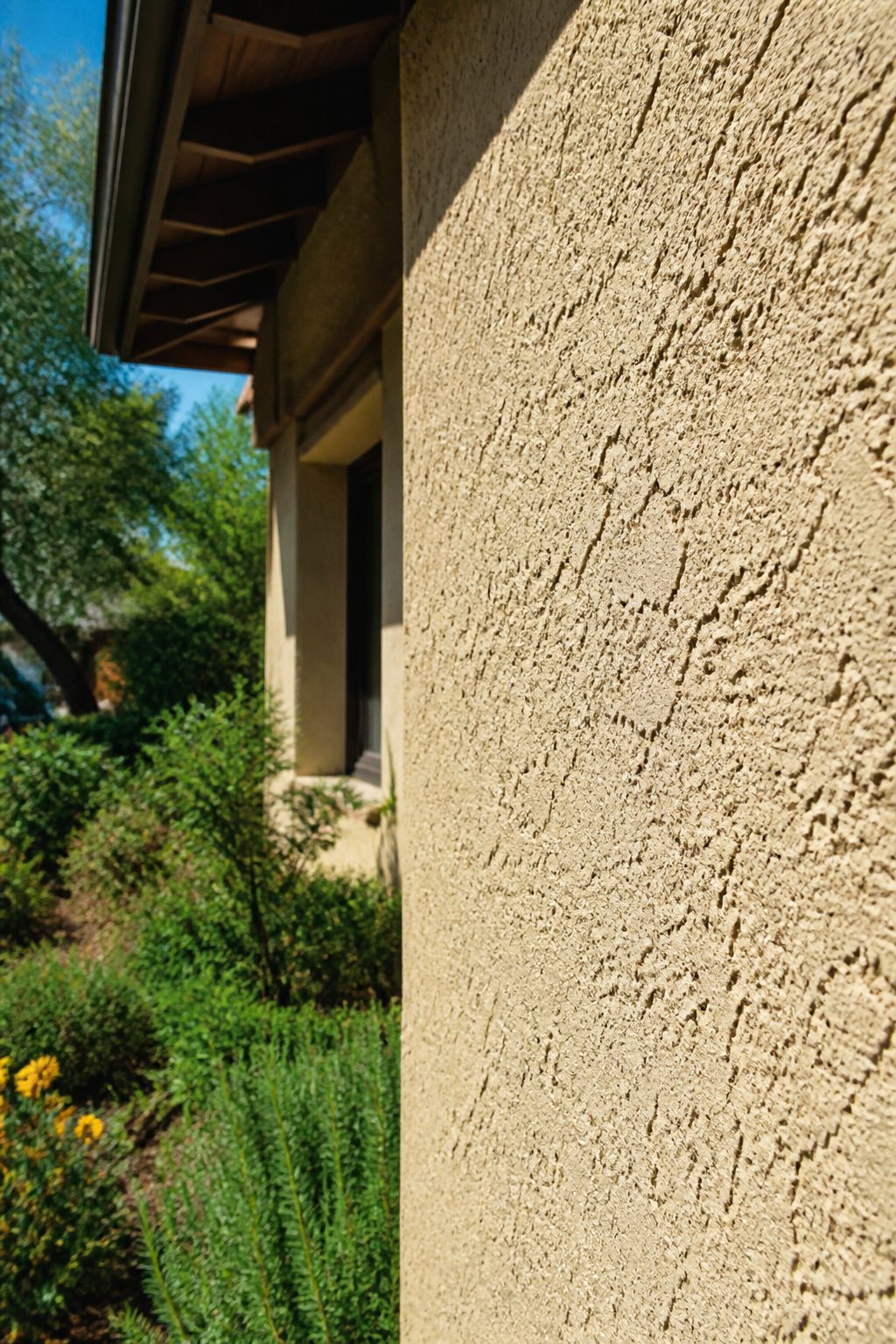
Stucco is a cement plaster made from sand, Portland cement, water, and traditionally lime, applied as a durable exterior wall coating for houses. The standard application builds up in layers roughly one inch thick, with each coat serving a specific purpose: the scratch coat adheres to the structure, the brown coat reinforces the base, and the finish coat carries color and texture. After drying, the material hardens into a rock-solid surface that resists weathering and offers significant fire resistance.
Spanish and Mediterranean architecture made stucco famous, but the material’s range runs from virtually smooth to pebbled or coarsely sandy depending on how that final coat is worked. Two broad categories exist: traditional stucco, still built from lime, sand, cement and water over a wire lath and building paper; and synthetic systems, which fall outside this definition and are covered elsewhere. The distinction matters for what goes on your wall and how it behaves, because traditional stucco breathes and cures differently than its modern counterparts.
How Stucco Arrived in American Neighborhoods

Stucco starts with the simple chemistry of lime, sand, and water, a mix ancient Greeks plastered onto walls thousands of years ago. The material crossed the Atlantic with Spanish builders who brought it to Mexico and the American Southwest, where they troweled it over timber, stone, or stick framing into the hard shell we still recognize on adobe structures and mission-style homes.
The real shift came in the early 1900s, when mass-produced Portland cement replaced lime as the binder. Cement gave workers longer drying times and more forgiving application, but geography still ruled where stucco could succeed. The arid Southwest, with stable, sandy soil and little rain, stayed ideal. Farther north and east, where ground movement made foundations settle, traditional stucco cracked, let water behind it, and peeled from the sheathing underneath.
Modern polymers and other flexible additives have since solved much of that brittleness. The result is stucco spreading well beyond its original desert territory into regions where my grandfather would have called it a risky bet. You will now see it paired with pitched roofs and shingle or metal roofing, not just the flat roofs and clay tiles it once required.
A 1-inch coating of stucco provides a one-hour firewall rating.
— Bob Vila
That fire resistance helped speed its adoption in tight neighborhoods and multi-family zoning, where code demands stricter separation between units. Style and safety together pushed stucco from regional curiosity into a national option.
Traditional Stucco and Synthetic Stucco
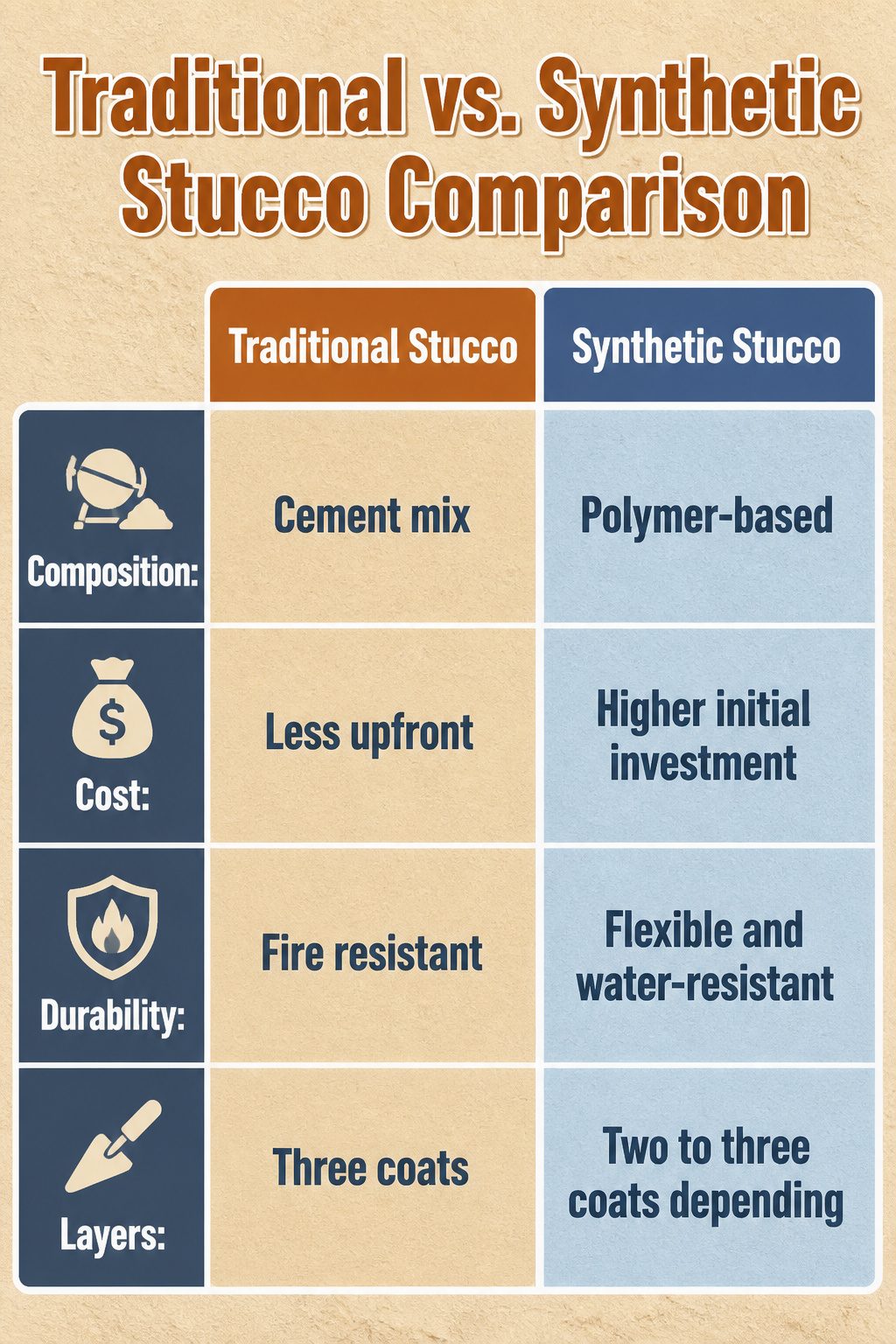
Traditional stucco starts with sand, cement, water, and lime, the same mix builders have used for centuries. Modern versions add acrylics or glass fibers for extra strength, but the core remains a cement plaster applied over wire mesh and building paper in two or three coats: the scratch coat for adhesion, the brown coat for structure, and the finish coat for color and texture. Once cured, it sets rock-hard.
Synthetic stucco, also called Exterior Insulation and Finish System or EIFS, swaps the cement for polymers and adheres to foam board with fiberglass mesh instead of metal lath. The result is thinner, more flexible, and more water-resistant, with better insulation built in. It also costs more.
For homeowners in regions where soil shifts and settling crack rigid siding, synthetic’s flexibility is the deciding factor. Traditional stucco wins on sheer durability and fire resistance, and it costs less upfront. The trade-off is watching for hairline cracks after freeze cycles or foundation movement. I would pay the premium for synthetic only if I lived somewhere with both cold winters and expansive clay soil; otherwise, traditional’s proven track record keeps the math simple.
Why Stucco Lasts

A 1-inch coating of stucco gives a one-hour firewall rating, meaning flames stay on one side of the wall for a full hour before the material breaks down. That hour matters most in two situations: multi-family buildings where code demands it, and tight neighborhoods where one house catching fire can warm the next. The same density that slows fire also absorbs sound, so a bus on the corner reads quieter inside than it would through vinyl or wood.
Stucco resists rot and mold because it is cement plaster, not organic siding. Termites will not eat it, and a stray baseball from the neighbor’s kid leaves a mark but not a hole. In dry climates, the finish can last decades, with some homes pushing toward a century before major work.
The catch is the "correctly applied" part. Stucco is strong once cured, but the layers underneath do the real work: building paper, wire lath, a scratch coat for adhesion, a brown coat for structure, then the finished surface. Skip a layer or rush the cure, and the same thickness that should protect becomes a brittle shell. I have walked past stucco that looked fine from the sidewalk and found hairline cracks propagating behind a downspout where water got in. The material did not fail. The prep did.
For a small yard or balcony gardener used to reading plant tags for zone hardiness, think of stucco the same way: match the application to your climate, or the resilience you paid for will not show up.
The Look You Can Build With Stucco
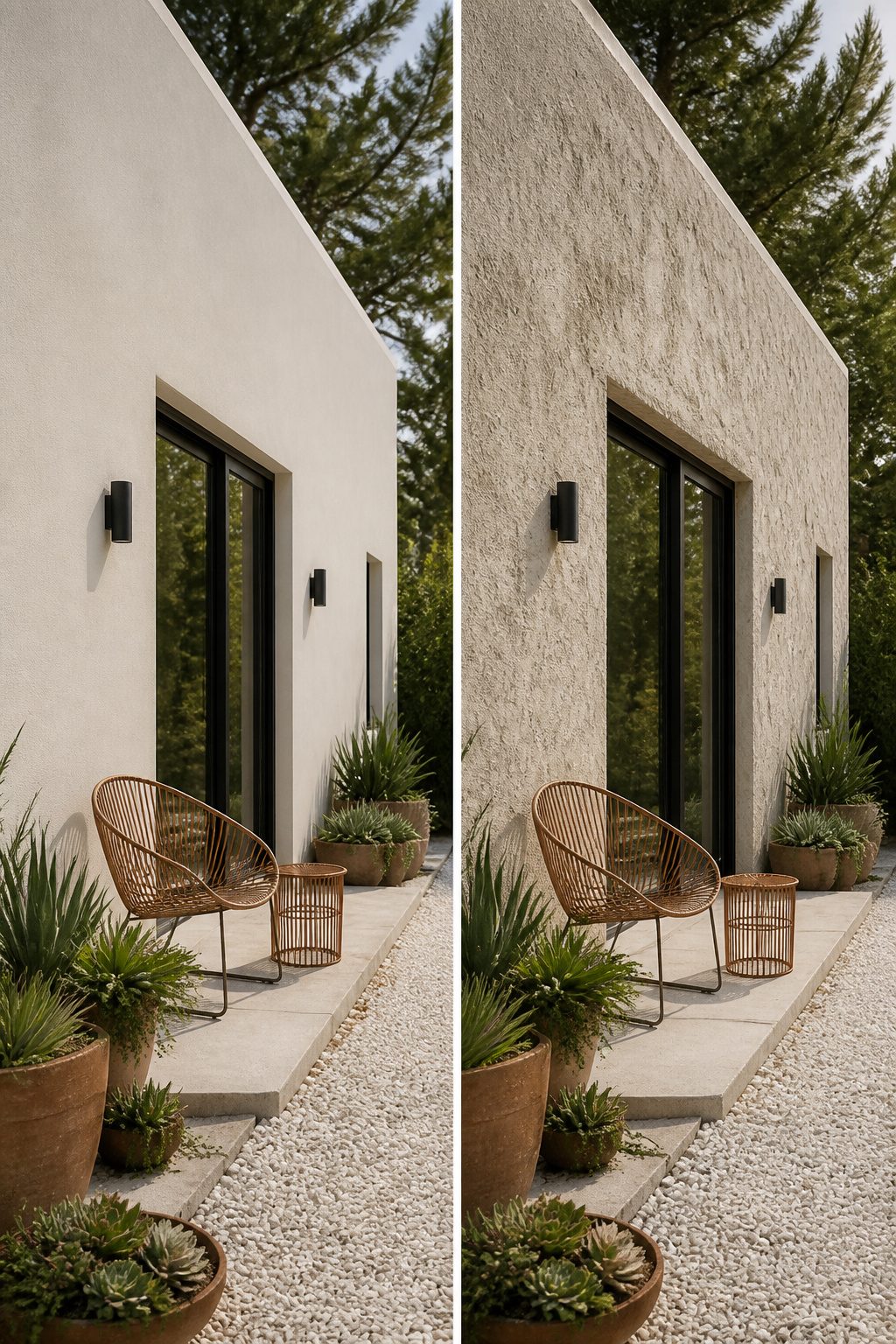
Stucco walls carry color all the way through the material, not just on the surface. That means chips and scratches show the same shade underneath instead of bare substrate, and repainting fades more gracefully than on wood siding. Benjamin Moore’s White Dove (OC-17) and Swiss Coffee (OC-45) dominate the lighter end, soft whites that read warm in afternoon light rather than clinical. Deeper hues like charcoal or forest green turn the flat planes into something sculptural; the shadow lines between trowel strokes become visible architecture rather than texture.
The color choice does the curb appeal work: white stucco reads coastal or Mediterranean depending on trim, while dark greens and charcoals read modern and deliberate from the street. I notice the houses that catch my eye are rarely the ones with the most ornament; they are the ones where the wall color and the texture were chosen together, so the surface plays like plaster rather than like painted concrete. The seamless finish stucco allows means there are no horizontal siding lines breaking up the color field. That continuity makes a long wall feel longer and a small house feel composed.
Upkeep After the Install
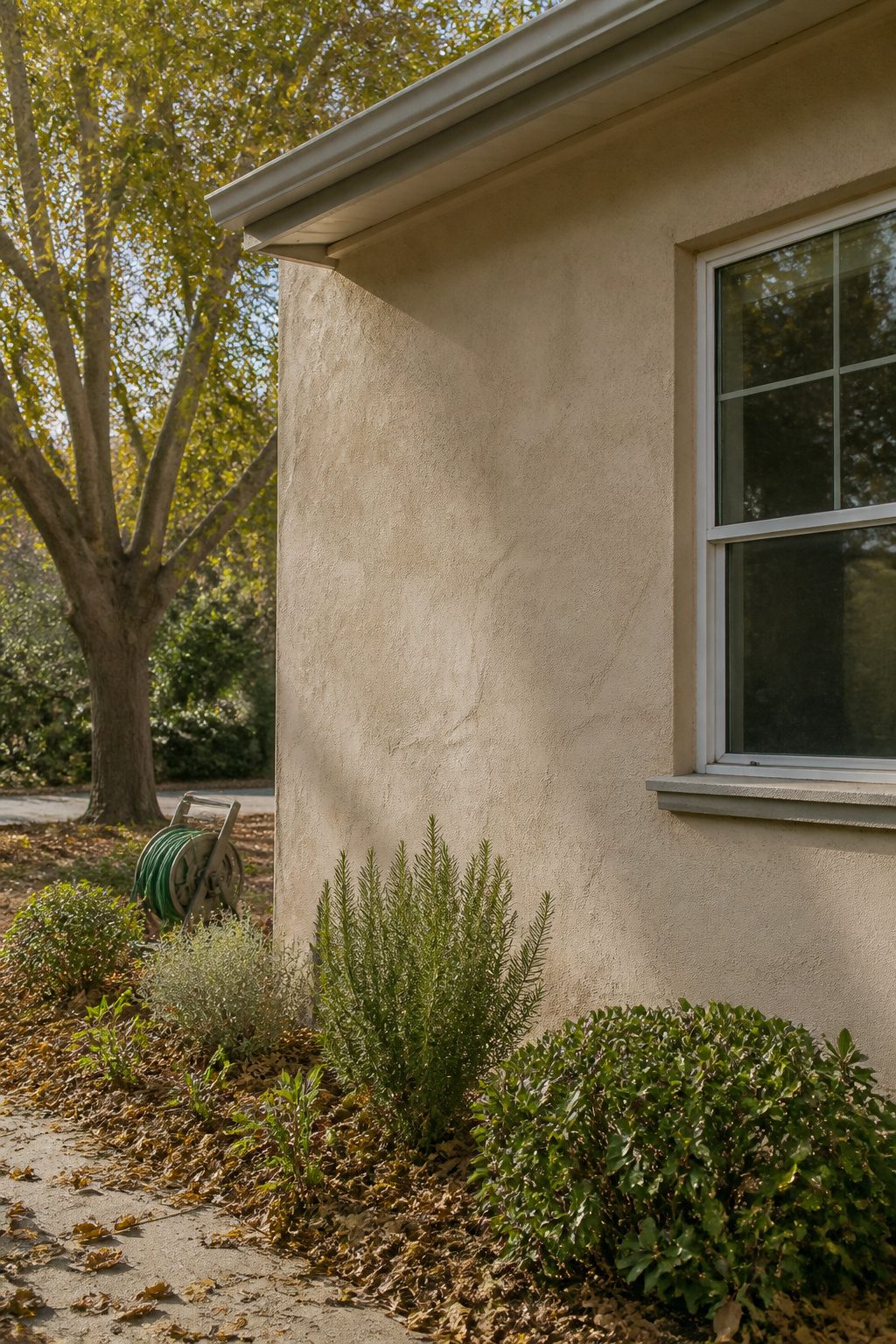
A properly installed stucco finish asks very little of the years that follow. The finish itself can last as long as 100 years, and in practice that means decades pass between anything you would call maintenance. The "minimal" part is real: a yearly walk-around to spot hairline cracks, a rinse with a garden hose when dirt collects, and the occasional scrub with a medium-bristle brush and soapy water for tougher grime. That’s the whole routine.
Don’t power wash. Pressure washing can chew into the surface faster than the dirt comes off, and then you’ve traded a ten-minute chore for real repair. Small cracks, up to a quarter inch, get sealed with masonry-compatible caulking yourself. Anything wider earns a call to a pro, because the problem has moved past the finish and into the structure beneath.
Paint is optional, not required. The pigment blended into the original finish holds its color without the every-few-years repaint cycle other sidings demand. If you do want a change, you can likely handle it yourself.
This low-effort rhythm is the baseline, and it holds steady unless something goes wrong. What goes wrong, and how to head it off, is the next question.
Fire Resistance and Sound Buffering
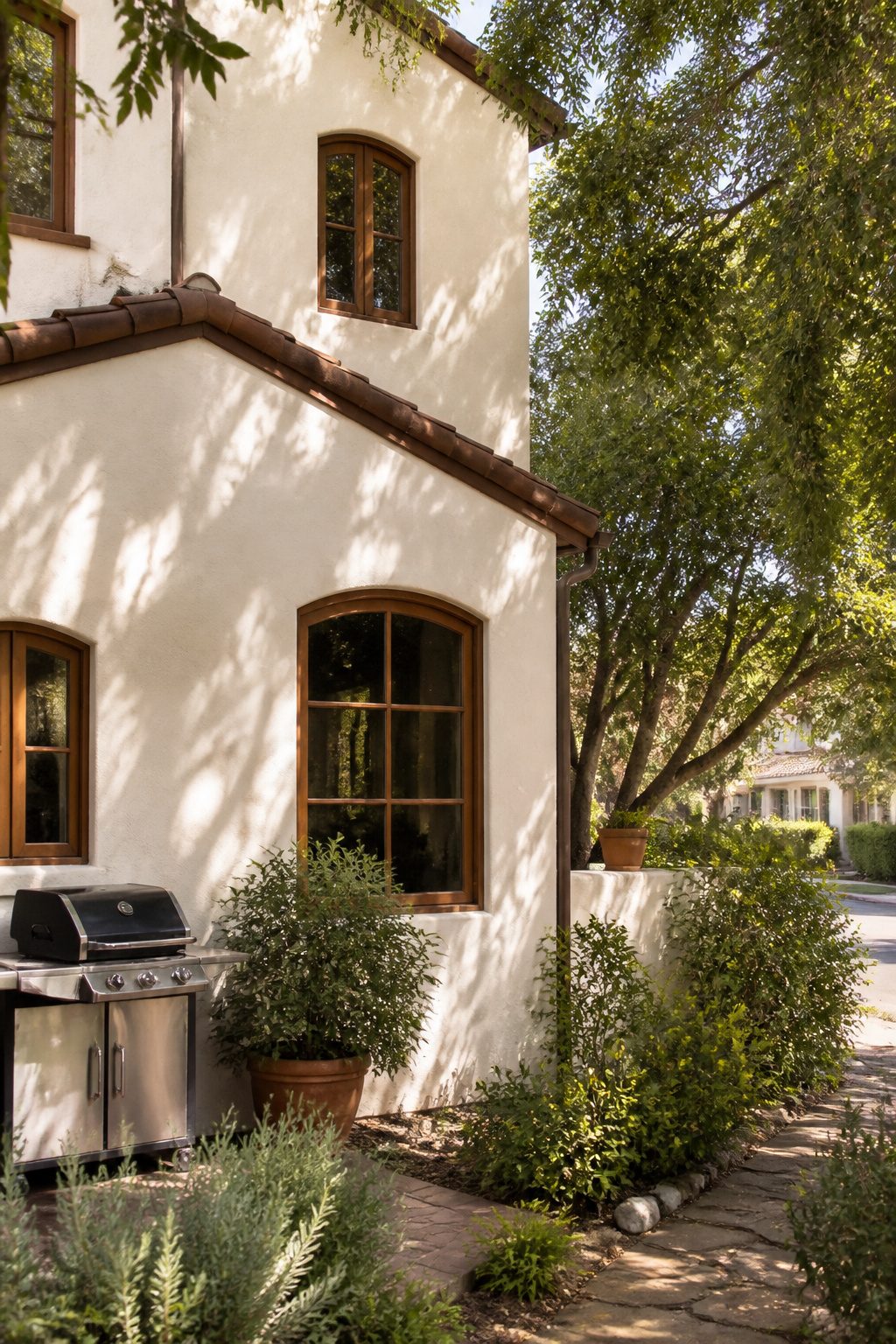
A one-inch coating of stucco earns a one-hour firewall rating, meaning flames take a full hour to burn through from one side to the other. That hour matters most in the minutes before help arrives; living three feet from your neighbor’s garage, I’ve watched embers land on roofs during a brush scare and understood exactly what that delay buys you.
The same thickness that slows fire also knocks down outside noise. Stucco siding buffers sound coming from traffic, delivery trucks, or a neighbor’s power tools in ways thinner veneers simply don’t. You notice it first on weekend mornings, or when you’ve finally gotten an infant down for a nap and a motorcycle revs on the corner. The mass of the material does the work; there are no hidden air gaps or special acoustic layers to install or eventually fail.
In neighborhoods where houses sit close and streets stay busy, these two benefits overlap with practical urgency. The fire rating satisfies code requirements for multi-family construction and tight lots, while the sound damping addresses the daily experience of living in them. Both come from the same material property, density, which is why trying to lighten stucco or thin it out costs you twice.
Where Cracks Come From
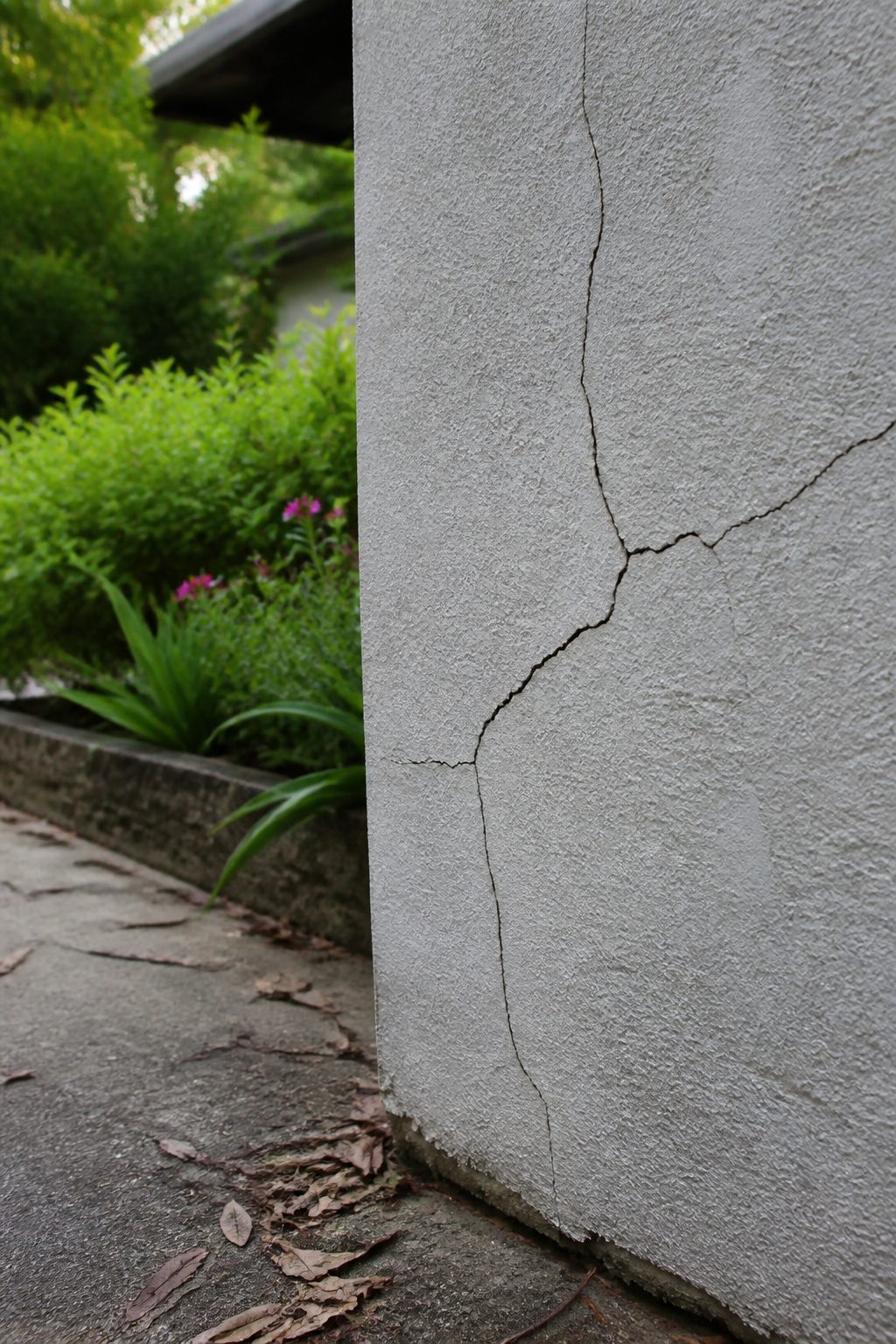
Stucco’s brittle nature makes it vulnerable to cracks when a foundation settles or shifts. If the soil under your house swells and contracts from clay content, that movement telegraphs straight into the wall surface as a crack, because stucco doesn’t flex. Water finding its way behind the surface does similar damage: once moisture intrudes, it weakens the bond and can separate the finish from the building. Hairline cracks appear eventually on most stucco homes even with solid foundations. Those narrower ones stay cosmetic and can be patched without a contractor. The danger threshold starts at 1/4-inch wide, where the crack signals deeper trouble. Some post-WWII spray-on stucco failed to match traditional hand-troweled durability, so homes from that era may develop multiple large cracks or shedding chunks, which means full removal and replacement rather than spot repair.
The Cost of Getting It On the Wall
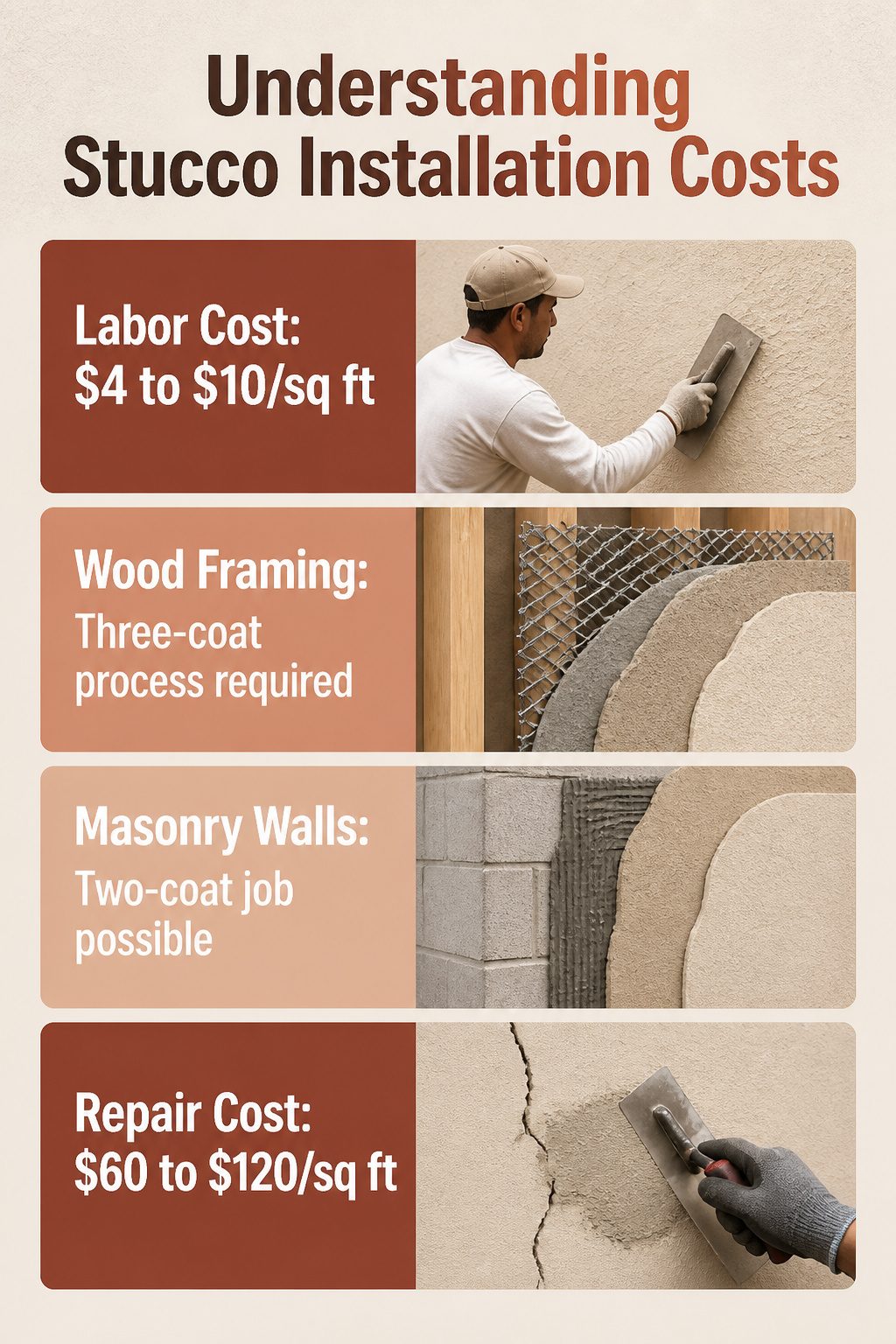
Stucco goes on in layers, each one requiring time and a tradesperson who knows how to read the set. That labor is the reason the price range runs so wide. In the Southwest, where crews have spent careers on stucco houses, the going rate sits closer to $4 to $7 per square foot. In regions where specialists are scarcer, expect $6 to $10.
The wall underneath matters too. Wood framing demands the full three-coat build, scratch coat through finish coat, across metal lath. Concrete or block skips the scratch coat for a two-coat job using bonding adhesive instead. One-coat stucco, mixed with fiberglass and applied over lath, exists only where a contractor offers it, which narrows the field further and can nudge the price.
Repair runs steeper: $60 to $120 per square foot, and it is not weekend-warrior territory. Matching an existing texture by hand, managing the moisture behind the patch, and feathering the repair into old material all take training. Skimp on the tradesperson and the patch telegraphs, or worse, traps water that spreads the damage outward.
Insulation and Moisture Limits
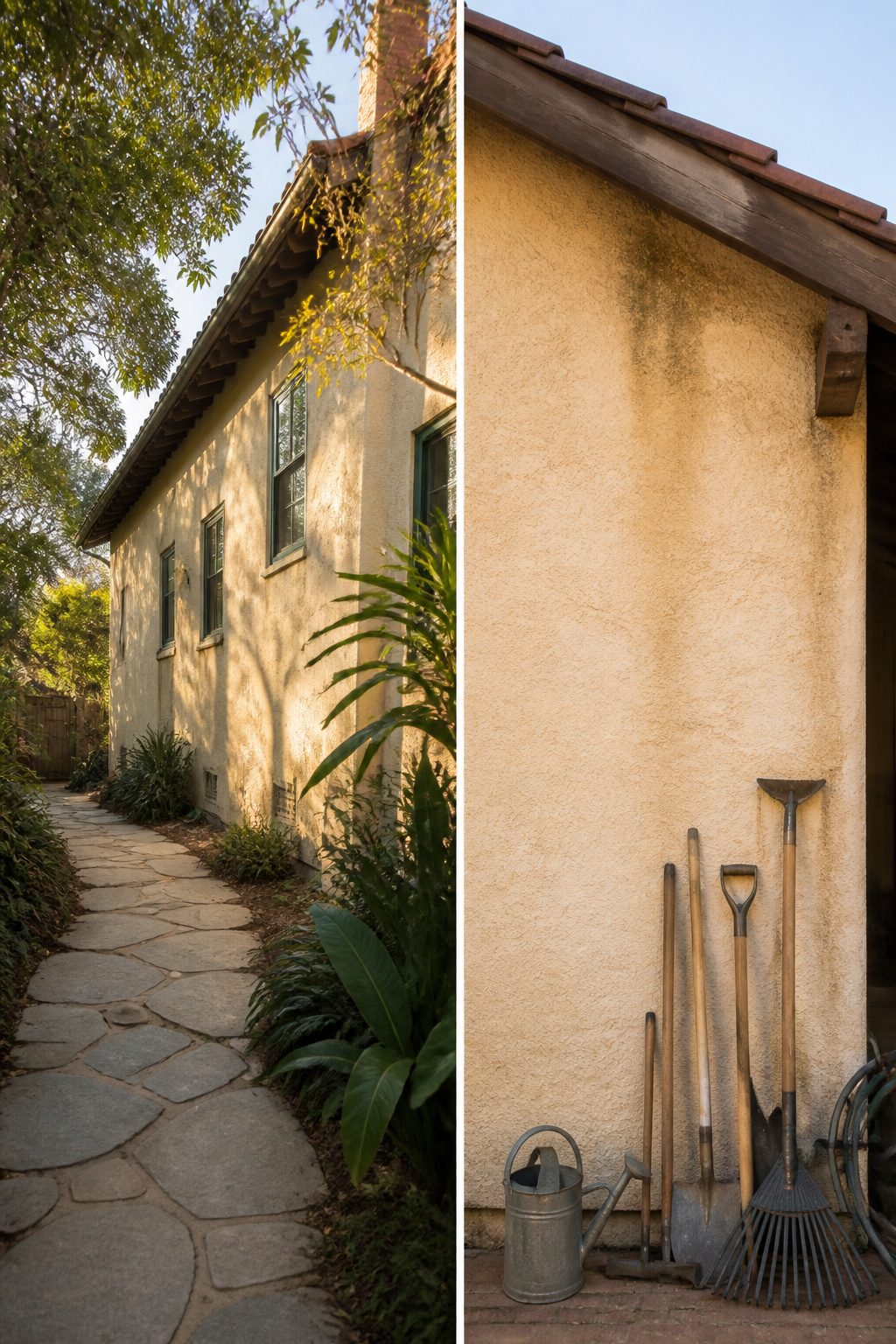
Traditional stucco carries an R-value far below what insulation-backed siding offers, which means the wall itself does little to stop heat from moving in or out. The house relies on whatever batt or foam sits behind that finish coat, and in older homes even that layer can be thin.
Moisture works the same way: the material is porous by nature, and once water finds a path behind the surface it tends to stay there. Hairline cracks let it in; freeze-thaw cycles in cold, wet winters force those cracks wider; staining and softening follow. Keeping the finish sealed, the caulk lines intact, and gutters running clear is not cosmetic upkeep. It is the barrier between routine maintenance and the damage a home inspector flags.
Polymer-modified mixes have helped with flexibility, but they do not change the core risk. A stucco wall breathes both ways, and in a wet or cold climate that breathing needs watching.
How Stucco Goes On in Four Coats
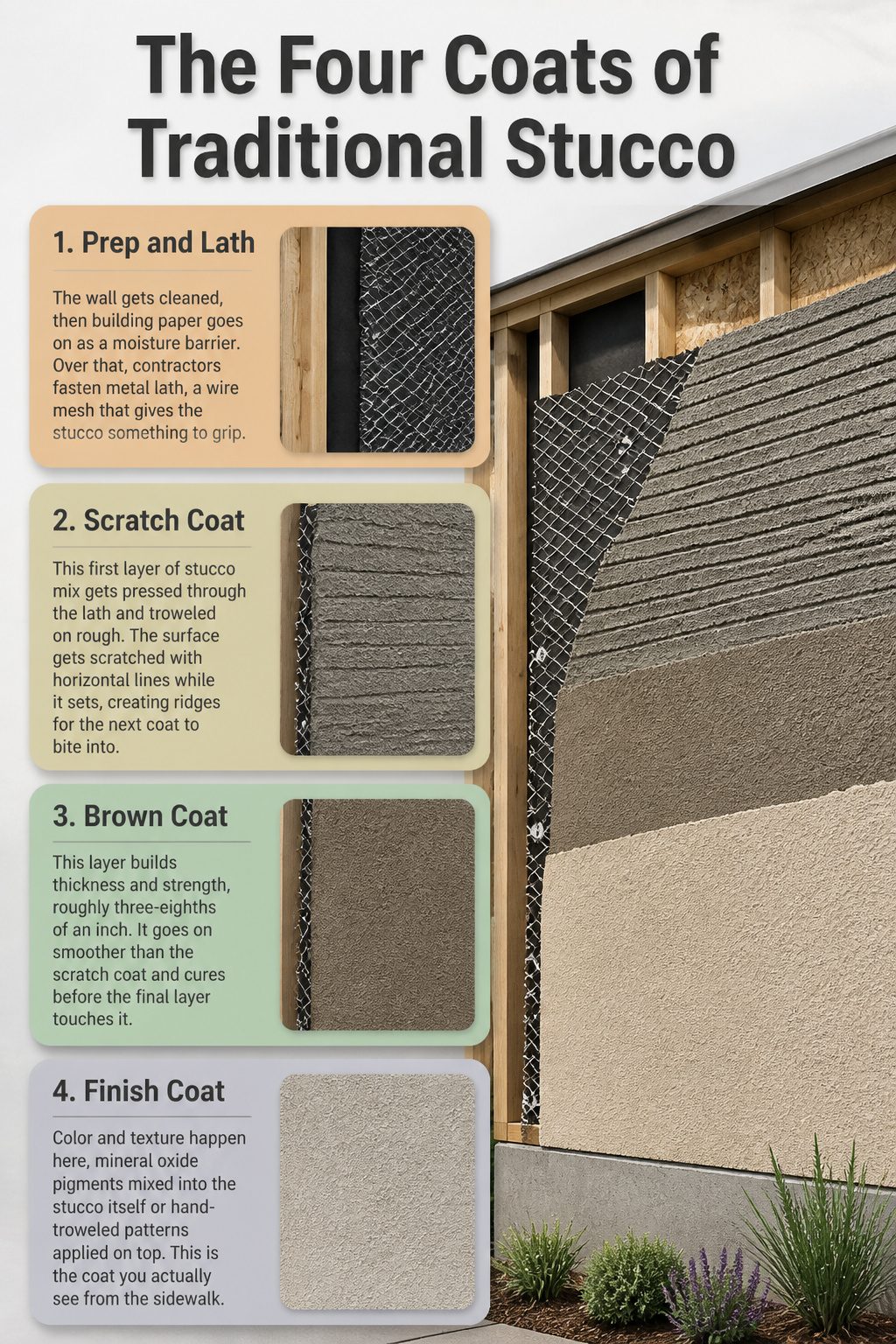
Traditional stucco on a wood-framed house goes on in four distinct layers, each with a specific job.
- The prep and lath. The wall gets cleaned, then building paper goes on as a moisture barrier. Over that, contractors fasten metal lath, a wire mesh that gives the stucco something to grip.
- The scratch coat. This first layer of stucco mix gets pressed through the lath and troweled on rough. The surface gets scratched with horizontal lines while it sets, creating ridges for the next coat to bite into.
- The brown coat. This layer builds thickness and strength, roughly three-eighths of an inch. It goes on smoother than the scratch coat and cures before the final layer touches it.
- The finish coat. Color and texture happen here, mineral oxide pigments mixed into the stucco itself or hand-troweled patterns applied on top. This is the coat you actually see from the sidewalk.
On masonry walls, builders can skip the scratch coat, bonding directly to concrete or block with just two coats total. One-coat systems exist too, fiberglass-reinforced stucco over lath, though not every contractor in every region offers them.
Checking and Cleaning Stucco Yearly
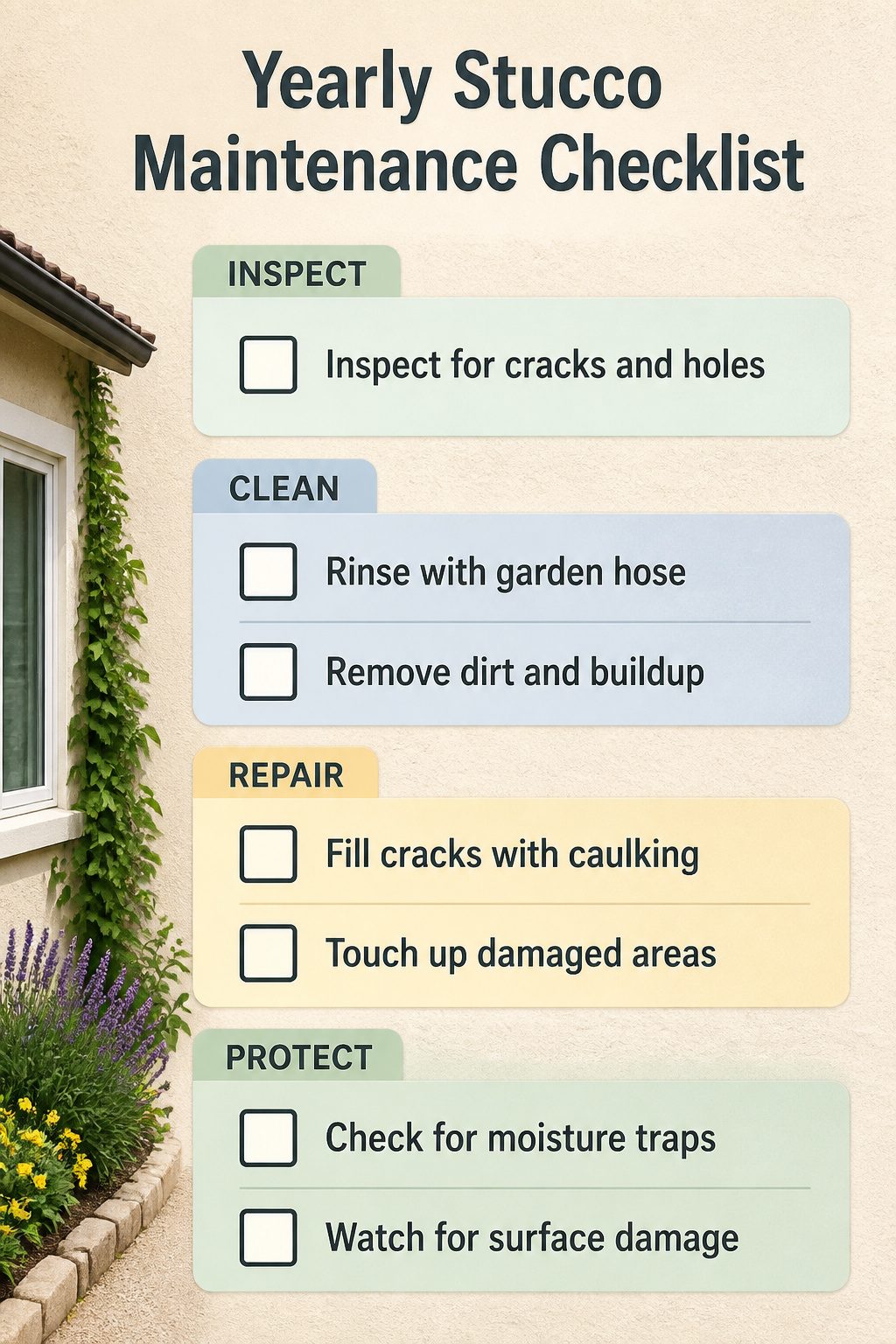
Spring rain on stucco tells you quick what winter did. The first warm Saturday, I circle the house with a garden hose and a pocket of masonry-compatible caulking, looking for hairline cracks that opened while the wall was breathing through freeze and thaw. Those cracks are the whole story; let them sit and water gets behind the finish, and then you are not maintaining, you are repairing.
- Inspect the surface for cracks and holes. Anything a quarter-inch or wider needs a pro. Anything thinner, I fill myself while the caulking is still workable.
- Rinse with a garden hose, working dirt loose with a medium-bristle brush if it sticks. Pressure washing is off the table; the force digs into the finish and opens pores it took three coats to close.
- Fill cleaned cracks with masonry-compatible caulking and tool it smooth. The right sealant moves with the wall. Paintable latex in a squeezed tube won’t survive two summers.
Some years I find nothing and the whole loop takes twenty minutes. Other years the south wall keeps me busy till lunch. Either way, the cost is a tube of caulk and a morning, which beats a remediation quote by a distance I have no desire to measure.
Stucco in Wet and Cold Climates

Traditional stucco’s rigidity becomes a real liability where freeze-thaw cycles run hard. A 1-inch layer carries only a 0.20 R-value, roughly a fifth of what the same thickness of wood provides, so the wall itself does not buffer much cold. Hairline cracks open naturally over time, and once water finds its way inside, it freezes, expands, and widens the damage. Stucco also stains from constant water exposure, leaving dark streaks below gutters or anywhere runoff collects.
Synthetic stucco, the Exterior Insulation and Finish System, swaps cement and lime for synthetic polymers over foam board and fiberglass mesh. That substitution gives it more flexibility, thinner walls, better water resistance, and actual insulation. The tradeoff is cost: it runs more expensive than traditional work. For cold, wet winters or heavy rainy seasons, the newer material wins on performance. Traditional stucco wants drier ground and milder temperature swings to stay intact.
What Stucco Costs to Live With
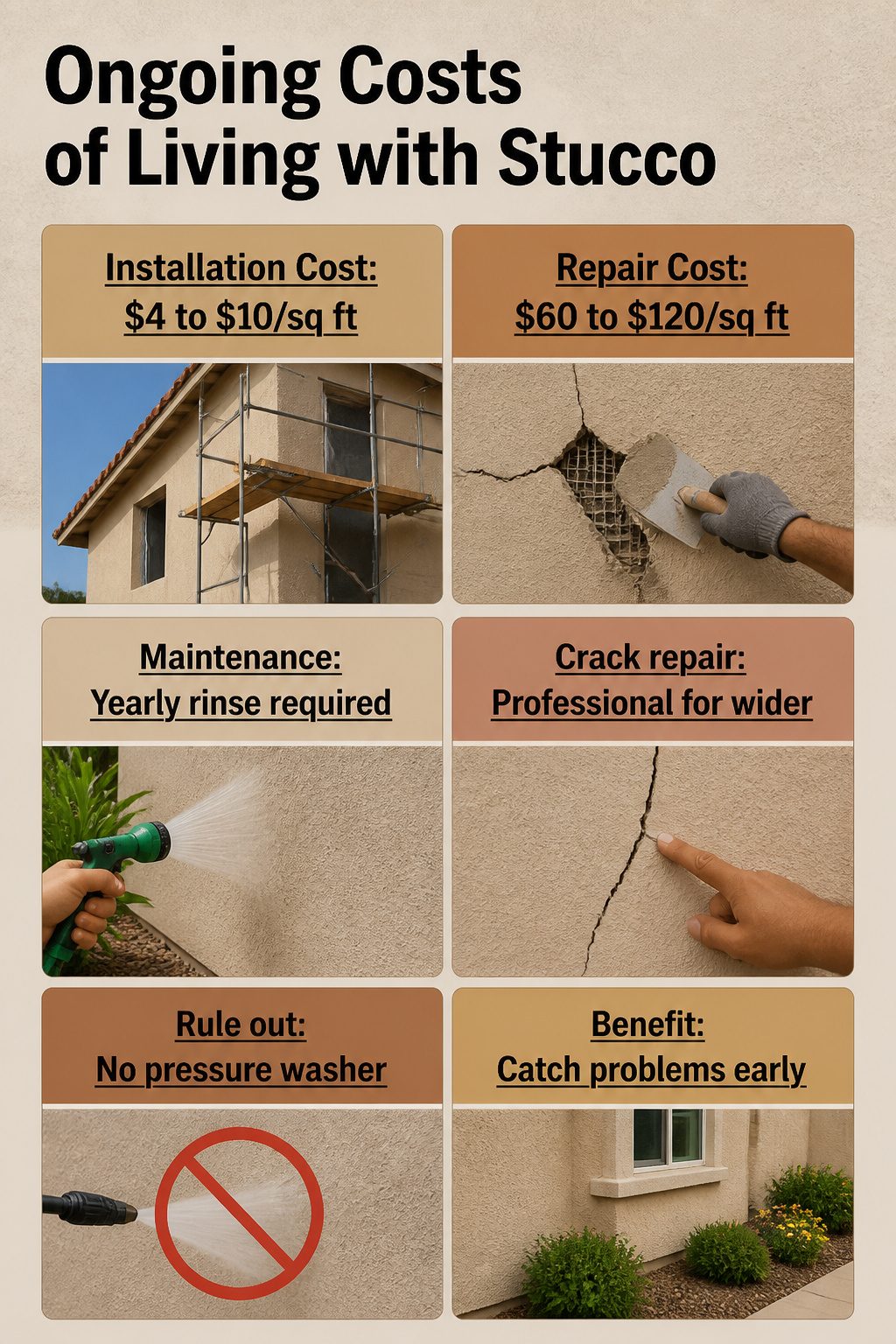
Living with stucco means budgeting for more than the day it goes on the wall. In the Southwest, where contractors know the material inside and out, installing stucco runs $4 to $7 per square foot. Elsewhere, that figure climbs to $6–$10. Wood-framed houses cost more because they need the full three-coat process—scratch, brown, and finish—over metal lath, while masonry walls can sometimes skip to a two-coat job.
Repair is where the real sting lives: $60 to $120 per square foot, and not a corner you can cut yourself. The work demands specific tools and training, and a botched fix often opens the door to worse damage. Hairline cracks call for a simple sealant fill, but anything wider than a quarter-inch needs a pro.
The cheap insurance is a yearly rinse with a garden hose and a walk-around for cracks. Skip the pressure washer; the blast will chew the surface. Catch problems early, and you’ll rarely face those repair rates.
Frequently Asked Questions
What is stucco?
Stucco is a cement plaster made from sand, Portland cement, water, and traditionally lime, applied as a durable exterior wall coating for houses. It hardens into a rock-solid surface that resists weathering and offers significant fire resistance. The standard application builds up in layers roughly one inch thick, with each coat serving a specific purpose: adhesion, structure, and the final color and texture you see.
What are the pros and cons of stucco houses?
Stucco homes offer durability, fire resistance with a one-hour firewall rating, sound buffering, and resistance to rot, mold, and termites. The finish can last decades or even approach a century in dry climates. On the downside, stucco is brittle and cracks when foundations settle or shift, repairs run $60 to $120 per square foot, and traditional stucco carries a low R-value and risks moisture intrusion in wet or cold climates.
How do you maintain stucco?
Walk the exterior yearly, looking for hairline cracks that opened during freeze-thaw cycles. Rinse dirt away with a garden hose and scrub stubborn spots with a medium-bristle brush and soapy water. Fill cracks under a quarter inch wide with masonry-compatible caulking yourself; anything wider needs a professional. Skip the pressure washer, which can chew into the finish.