Backyard landscaping ideas for 2026 run from a $15 strand of lights to a $65,000 pool, and the only filter that matters is how many years you plan to stay in the house. A fire pit you can set on pavers yourself for under $100 makes sense for renters; running gas conduit during a patio pour you are already paying for makes sense if you are not. The $500-to-$800 annual yard budget most of us actually spend is the number that decides which of these projects happens this season and which stays in the folder labeled later.
1. Fire Pit
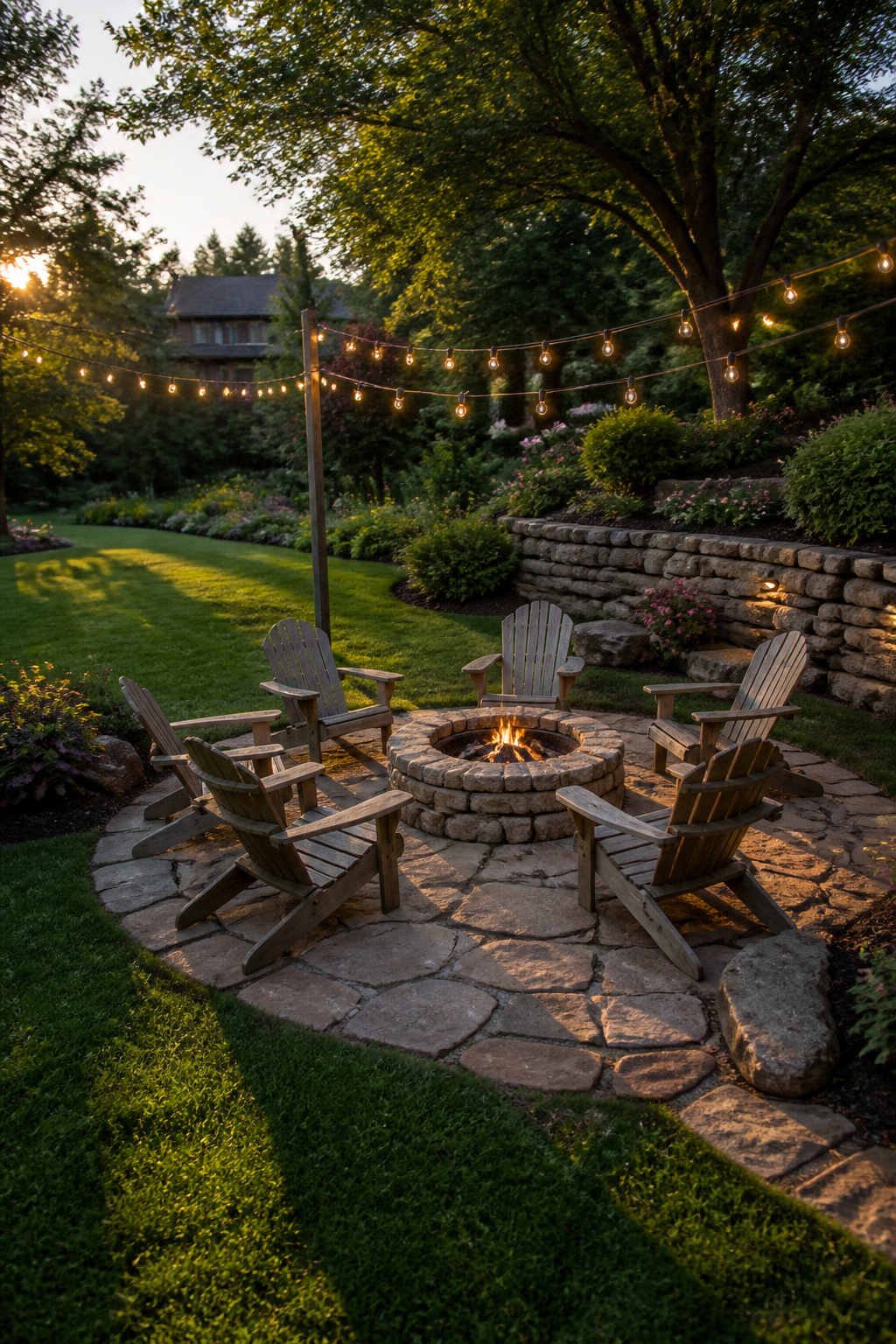
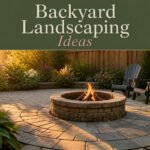
A fire pit turns the coldest corner of a yard into the spot people drift toward after dinner. Prices start below $100 for a simple bowl or ring you set on gravel yourself, and they climb to about $1,400 for built-in stone with seating walls. That spread matters because it lets you anchor a gathering zone without touching the rest of your budget.
For around $500 to $800 a year, most of us are not pouring concrete. A steel or cast-iron bowl on a paver base, bought on sale in late summer, does the same work. Wood-burning models cost less up front; propane saves you the kindling hunt but adds refill costs the passages do not cover, so I will not guess at them.
The project lands squarely in a single weekend. Level a circle, lay sand and pavers, set the bowl. By Sunday evening you have a defined zone that pulls chairs inward and gives the yard a center it probably lacked. S’mores are the usual payoff, though a flat grate turns the same pit into a cooking surface once you figure out the heat.
2. Pergola
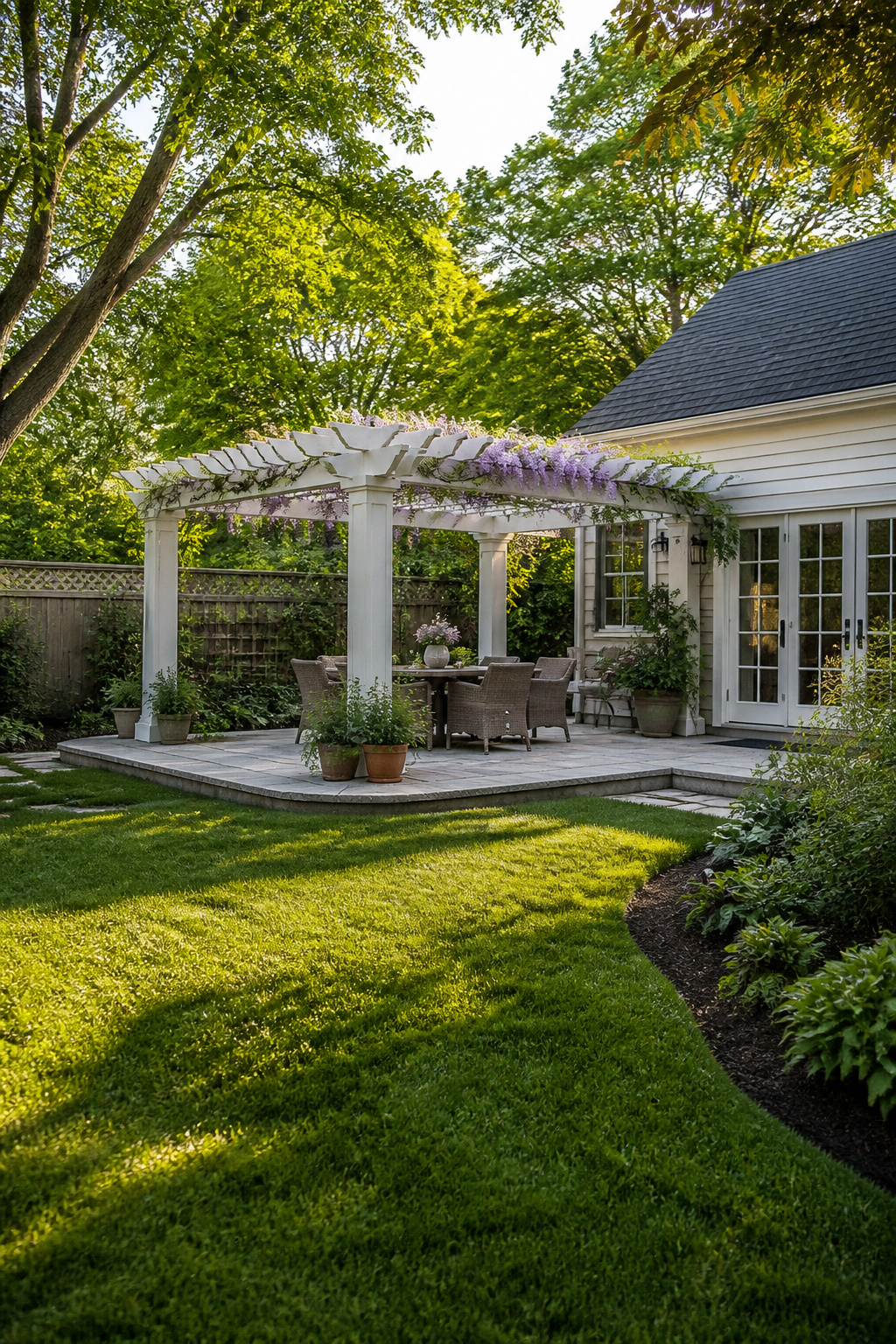
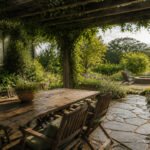
A pergola does the heavy lifting of turning open yard into a room you actually use. Without walls or a roof, it still marks where the patio ends and the lawn begins, and that boundary is what makes an outdoor space feel finished rather than accidental. Shade comes from the slatted top, which you can leave bare for dappled light or train a climbing vine across for fuller cover. Flower pots hung along the beams, curtains on the sides, or a self-climbing plant on the posts all soften the frame and give it something to do besides stand there.
The cost lands at $3,500 on average, with larger or more detailed builds running toward $6,000. That price buys you the structure that anchors an entertaining area: a spot for seating, a serving station, string lights after dark. In a small yard, it is especially useful for carving out zones where none existed, a trick borrowed from the tiniest backyards where every square foot has to pull double duty. One corner becomes the living room, another stays open for planting or a bistro table, and the pergola is the line between them.
3. Outdoor Kitchen
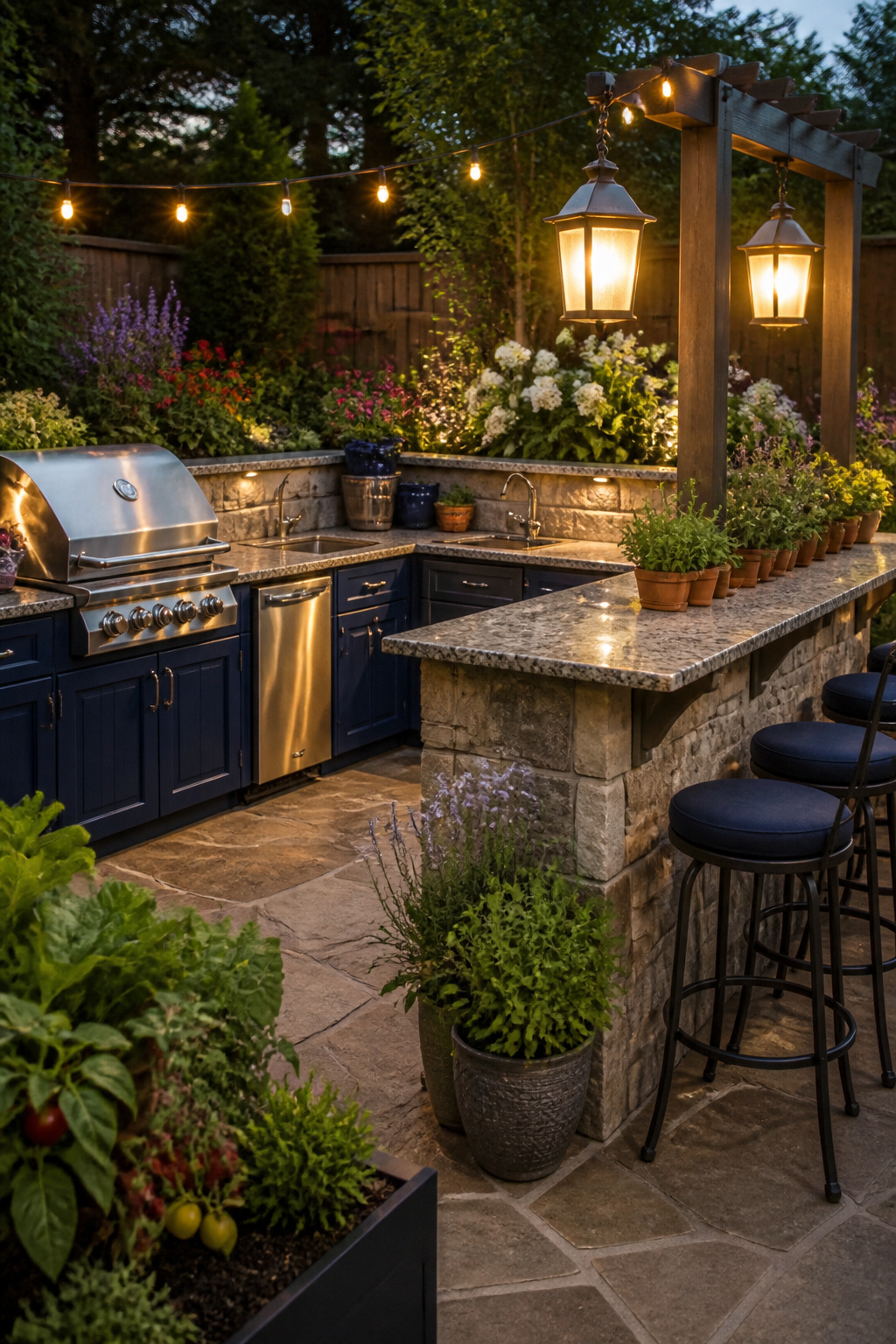
An outdoor kitchen sits at the far end of what most of us will spend on backyard landscaping ideas, with a full build running $5,000 to north of $20,000 depending on whether you are talking about a stone grill island or a covered station with plumbing, refrigeration, and a pizza oven. That price spread is wide enough to be almost useless until you walk a showroom and start choosing between a drop-in burner and a side sear zone. What struck me, reading through project breakdowns, is how many homeowners now treat this as an extension of the indoor kitchen rather than a separate cooking shed. The same countertop material runs through the sliding door. The same cabinet pulls. The trend is less about grilling outside and more about not breaking the conversation when you move between spaces.
For a $500–800 annual yard budget, this is not a this-year project. It is worth knowing the numbers anyway, because the integrated look is shaping what people expect from resale and from neighborhood gatherings. If you are planning hardscape or patio work now, running conduit and gas lines while the ground is open costs a fraction of coming back later. That is the practical move: prep for the kitchen you might build in five years, even if this summer you are still cooking on a $200 cart.
4. Swimming Pool
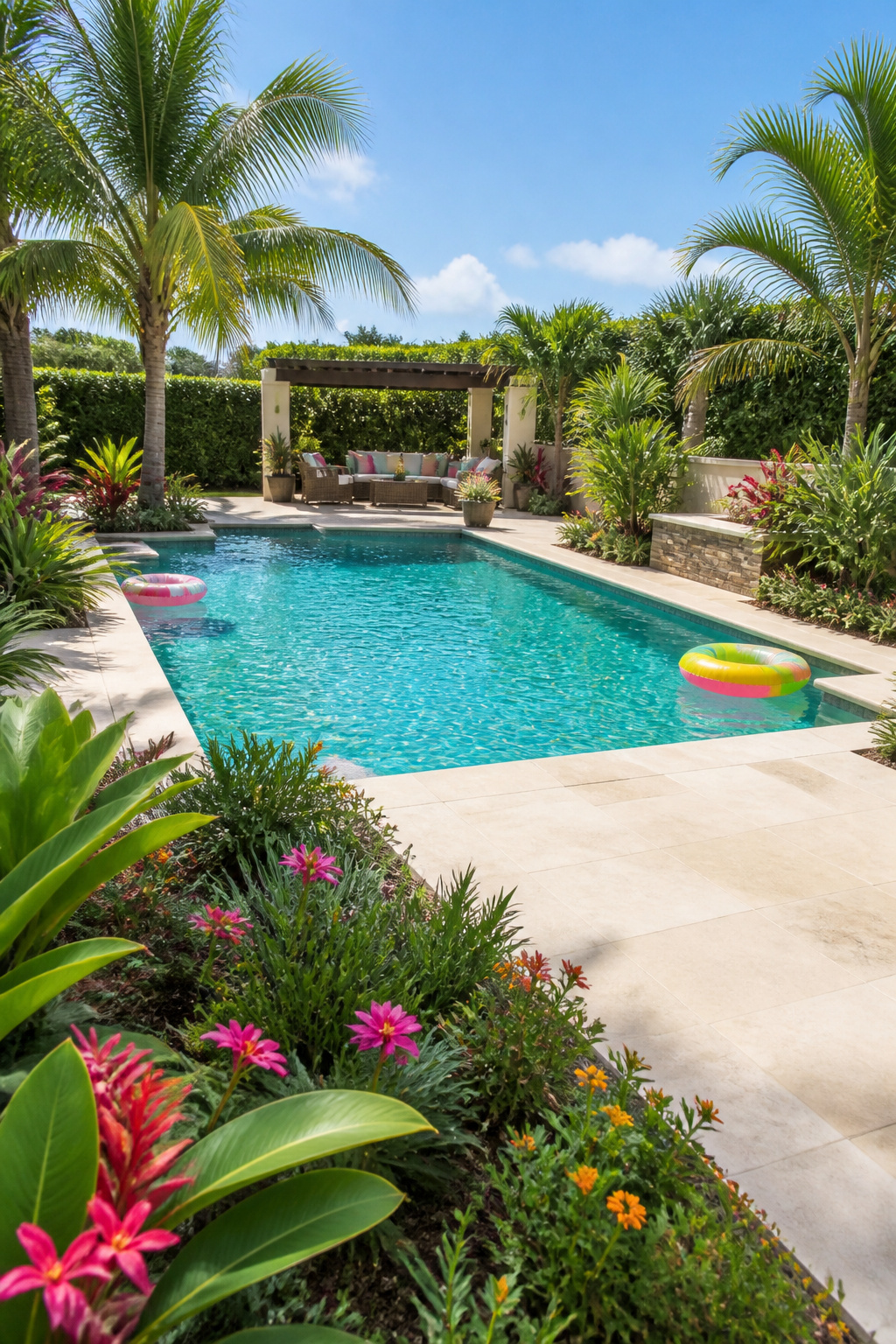
A full in-ground pool runs $20,000 to $65,000, which puts it well outside the annual $500–$800 most of us spend on a small yard or patio. That number matters even if you are not buying one, because it sets the ceiling on what landscaping can cost and helps you judge where to put your own money instead.
Plunge pools are the design trend worth watching. They fit into tight spaces a standard pool would not, and they show up in small-yard designs from Florida to California. The tropical plantings that often surround them, dense with large-leafed species and layered so no bare ground shows, can be adapted to containers or narrow borders even without the water.
Above-ground pools run $730 to $4,000, which sounds closer to our range until you factor in decking, leveling, and the seven-to-fifteen-year lifespan against decades for in-ground. For my own budget, the pool stays a benchmark I measure other choices against, not a project I am building.
5. Vegetable Garden
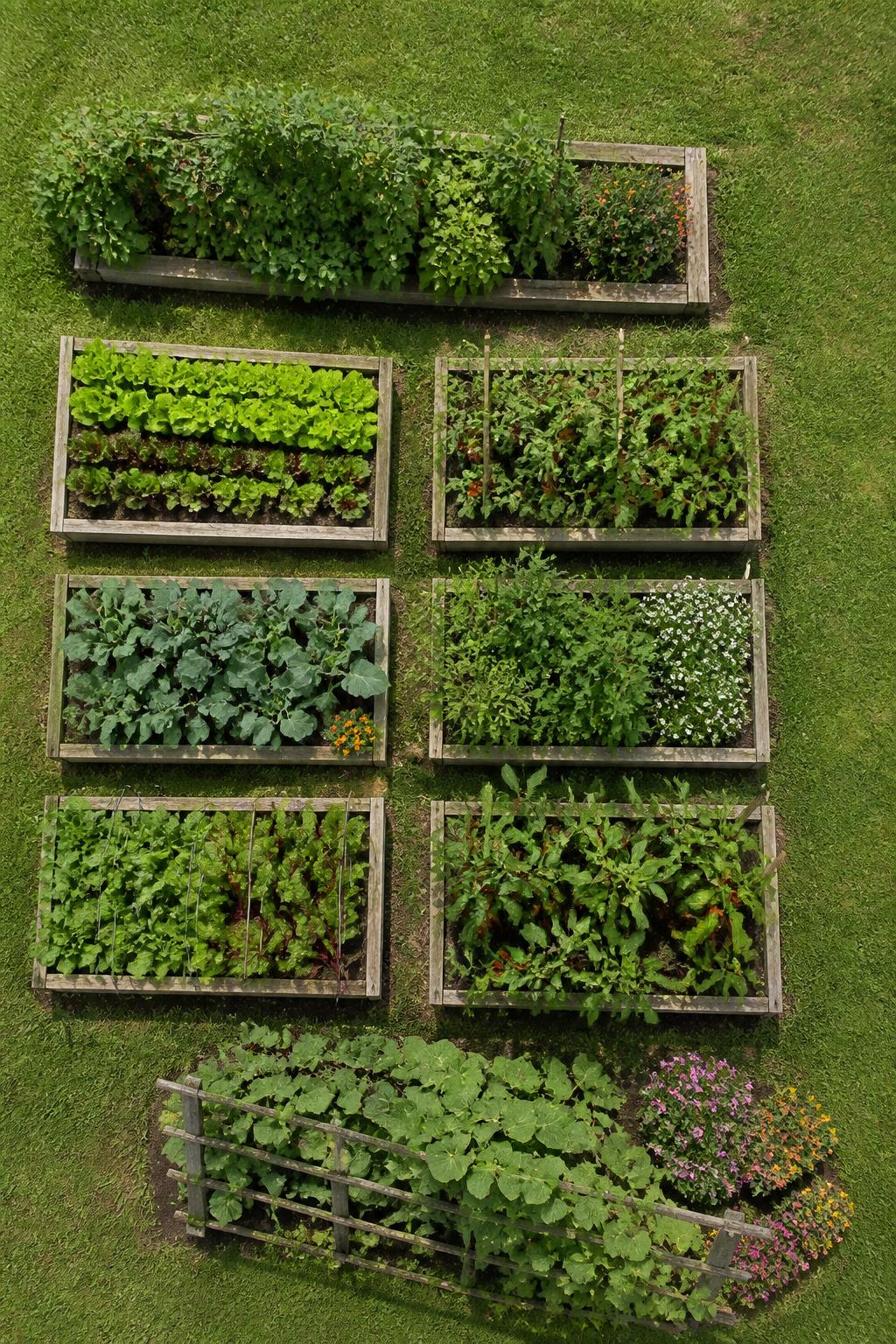
A vegetable garden belongs in backyard landscaping ideas because it gives you a clear seasonal job and a result you can eat. Seeds run about $2 a pack, which fits a $500–800 yearly budget without strain. I start mine in whatever sunny patch the yard offers, even a narrow side strip, and build up from there.
Raised beds make the work easier on your back and keep the soil from compacting the way turf does. Wood works, steel works; the material matters less than the depth and the drainage. If the soil is tired, test it and amend before you plant. Native perennials planted at the bed edges draw the pollinators that vegetables need, so the garden folds into the larger yard rather than sitting apart from it.
The upfront cost stays low if you skip the fence and build beds yourself. A few good harvests and the garden covers what you spent. Children can pick what to grow, which gets them past the suspicion of anything green on their plate. My own early tries failed more than they succeeded, but the failures were cheap and the next season started the same way: scratch the soil, drop the seed, wait.
6. She-Shed or He-Shed
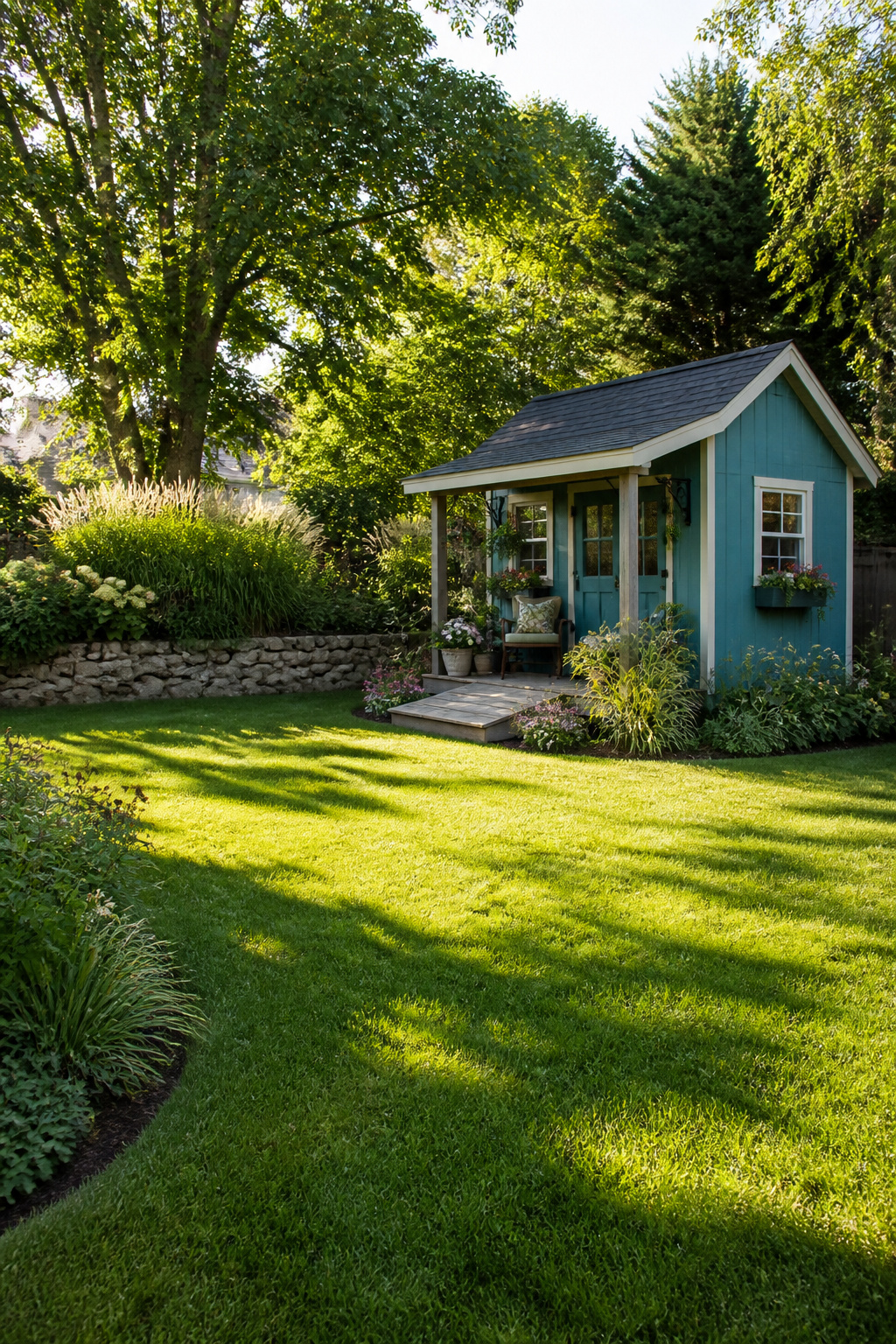
A backyard shed turned personal retreat sits somewhere between a fire pit and an outdoor kitchen in both cost and effort. You are looking at roughly $600 on the low end if you build it yourself, up to $30,000 if you hire out the full package with paint, pavers, and a picket fence. That spread makes the project flexible; you can stop wherever your budget does.
The value is in the separation. A shed twenty or thirty feet from the house becomes its own zone, not just more patio. Window boxes with hydrangeas, a small seating corner, and the walls you choose give it a purpose distinct from the main garden. I have seen the greenhouse version too, built onto an existing shed with recycled windows for around $1,000. That is a steeper climb in skill, but the same principle: a structure that pulls you out of the house without leaving the yard.
For most gardeners in their first few seasons, the simpler path wins. Paint the thing yourself, add a few pots, and accept that the real luxury is the door you can close.
7. Playset
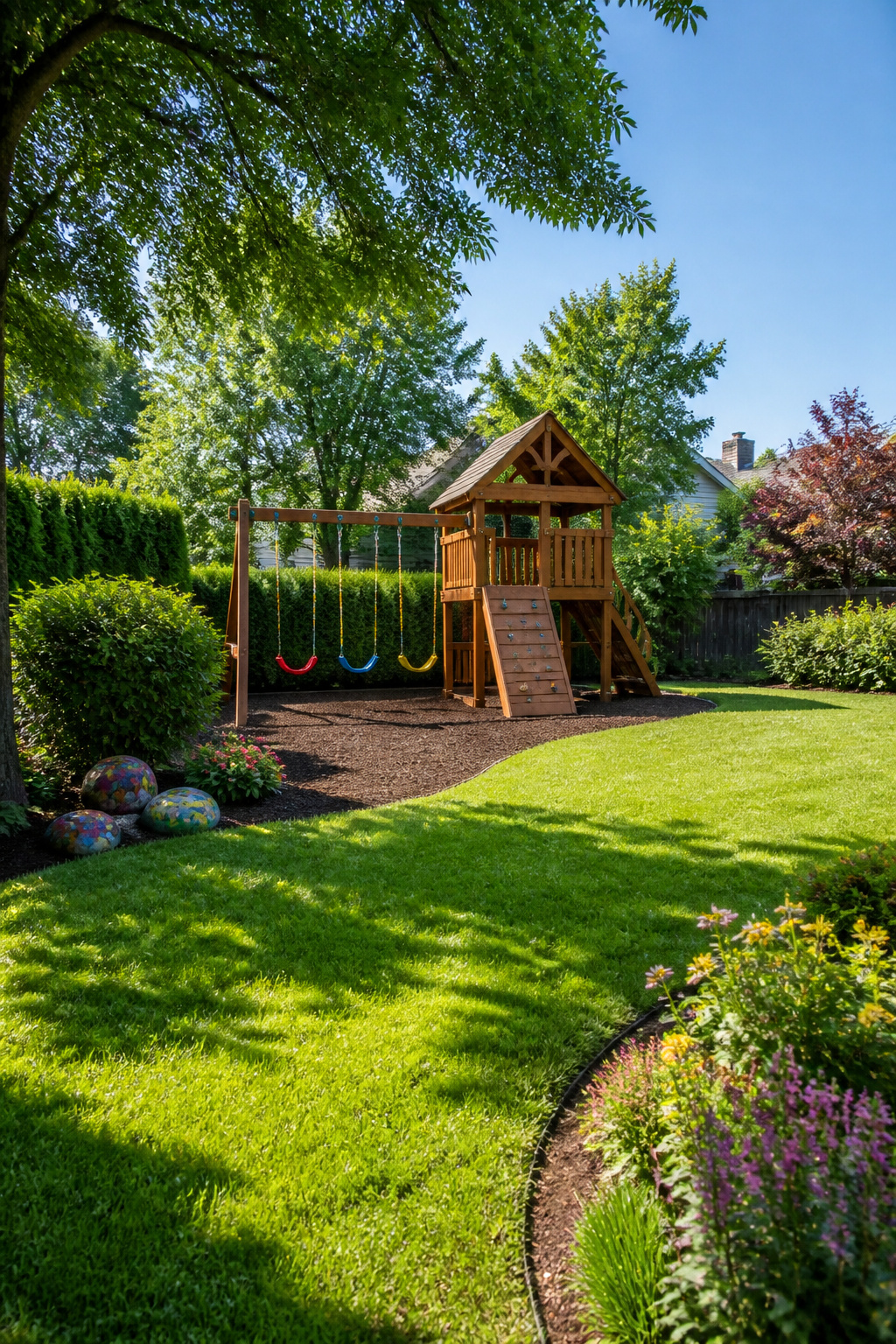
A playset carves out one of the clearest zones in a yard, but it comes with an expiration date most parents do not think about until the climbing wall goes quiet. Children age out of these structures faster than any other landscape feature, which turns placement into a long-term decision about what comes after.
I watched a neighbor sink posts in concrete right against her fence line, then struggle to dismantle the thing when her youngest turned twelve. Plan the footprint so you can resell or convert it without tearing up half the lawn. A swing beam anchored with ground stakes rather than buried posts lifts out clean; the same beam bolted to a small deck platform becomes a potting bench or a frame for hanging baskets once the swings come down.
Set it where it reads as its own room, not a toy dropped in the middle of the garden. A low hedge or a shift from lawn to wood chips marks the boundary without building a wall. That framing helps the resale, too: buyers with small children see a ready-made playspace, and buyers without see a defined area they can reclaim for something else.
8. Outdoor Sauna
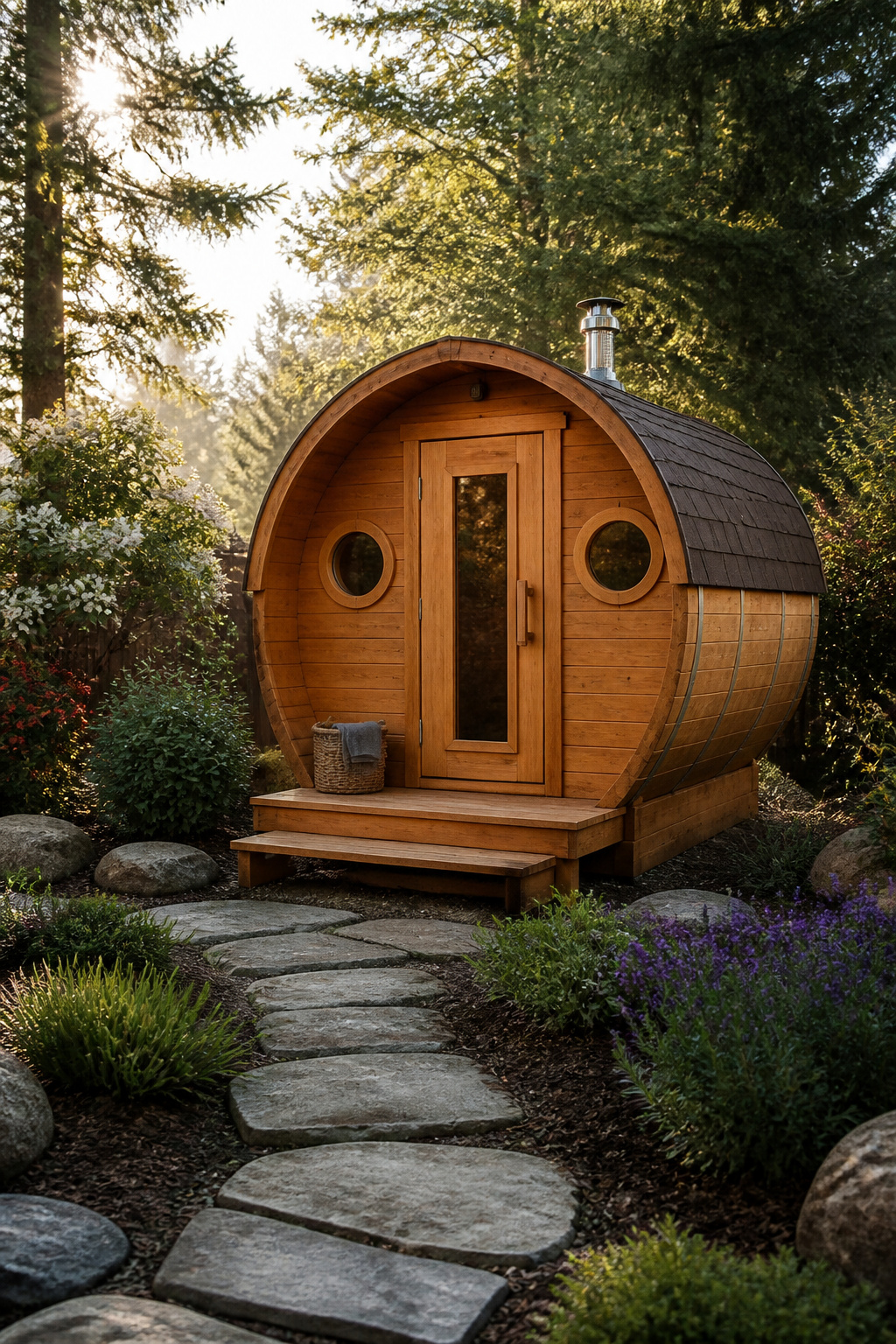
Outdoor saunas are turning up in more backyard plans for 2026, though they still sit outside the mainstream. A proper installation runs $3,000 to $6,000, which puts it well above the annual budget most of us garden on, and the payoff depends almost entirely on how many months your zone keeps you indoors. In the northern tier, where the growing season ends hard and fast, a sauna extends usable outdoor time from May-through-September into something closer to year-round. The structure itself can anchor a corner of the yard the way a pool house might, giving you a focal point to build seating and plantings around.
The climate math matters more than the design. Someone in Minneapolis gets a different value from the same box than someone in Atlanta, and the difference is not subtle. If your winters already send you inside by November and keep you there until April, the case is straightforward. If you are in a zone where January still brings afternoons outside, the same money buys more use almost anywhere else in the landscape.
9. Greenhouse
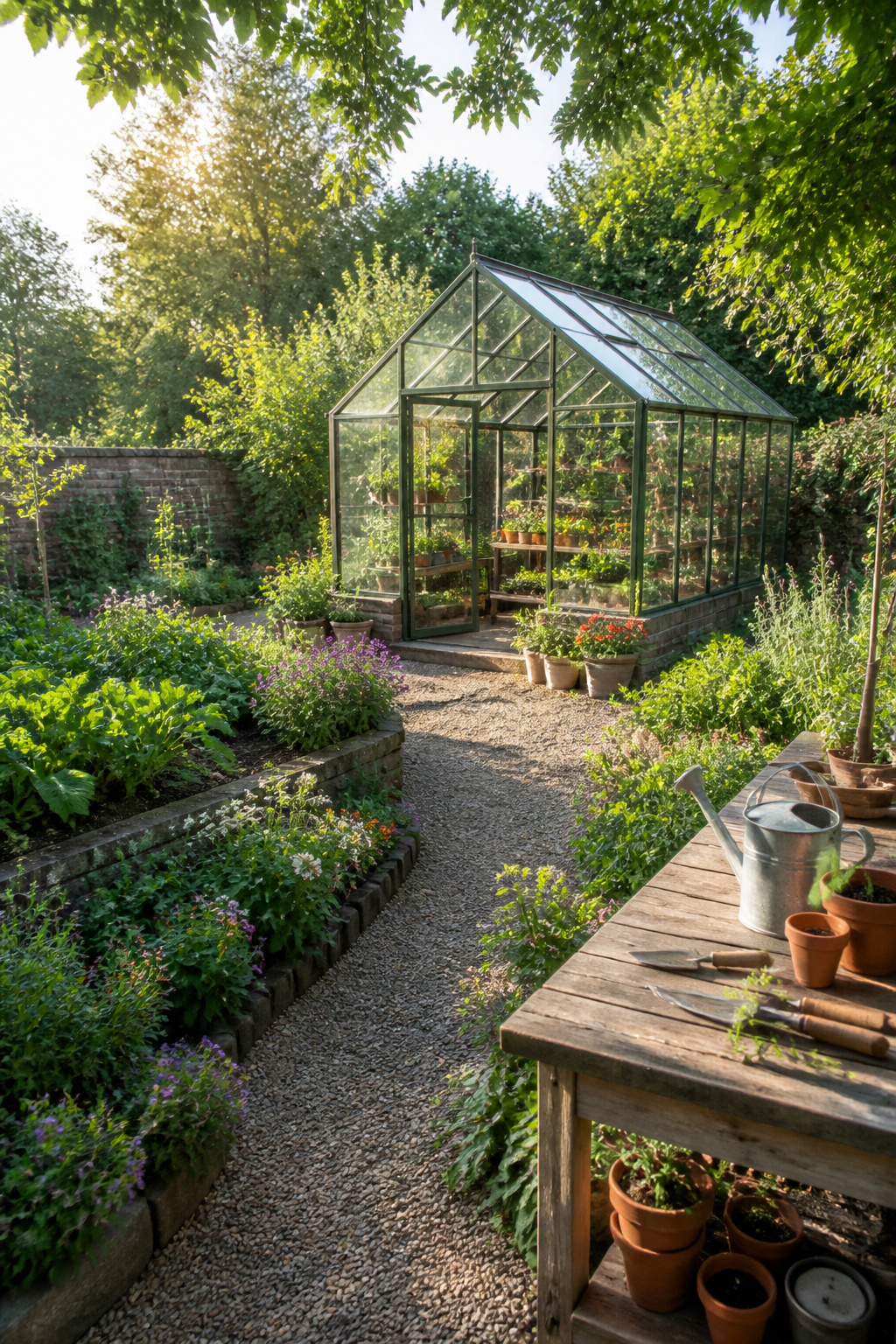
A greenhouse runs $18,000 on average, with most builds landing between $7,000 and $30,000. That figure sits well above what most of us spend on a whole year of gardening, and I would not have considered one at that price. Then I found the kit route. Small polycarbonate greenhouses start around a few hundred dollars, and a basic 6-by-8-foot metal-and-glass kit can be had for under $1,000 if you watch sales or buy used windows and frame them yourself.
All’s not lost if your budget isn’t that high, though.
The payoff is real: a greenhouse buys you six to eight extra weeks on each end of the growing season, which matters when your tomato seedlings freeze off in April or your basil quits in October. For a vegetable gardener working a small plot, that extension turns a hobby into something closer to a pantry. The kit I set up three years ago paid for itself in starts I did not have to buy and in greens I harvested past Thanksgiving.
10. Privacy Fence
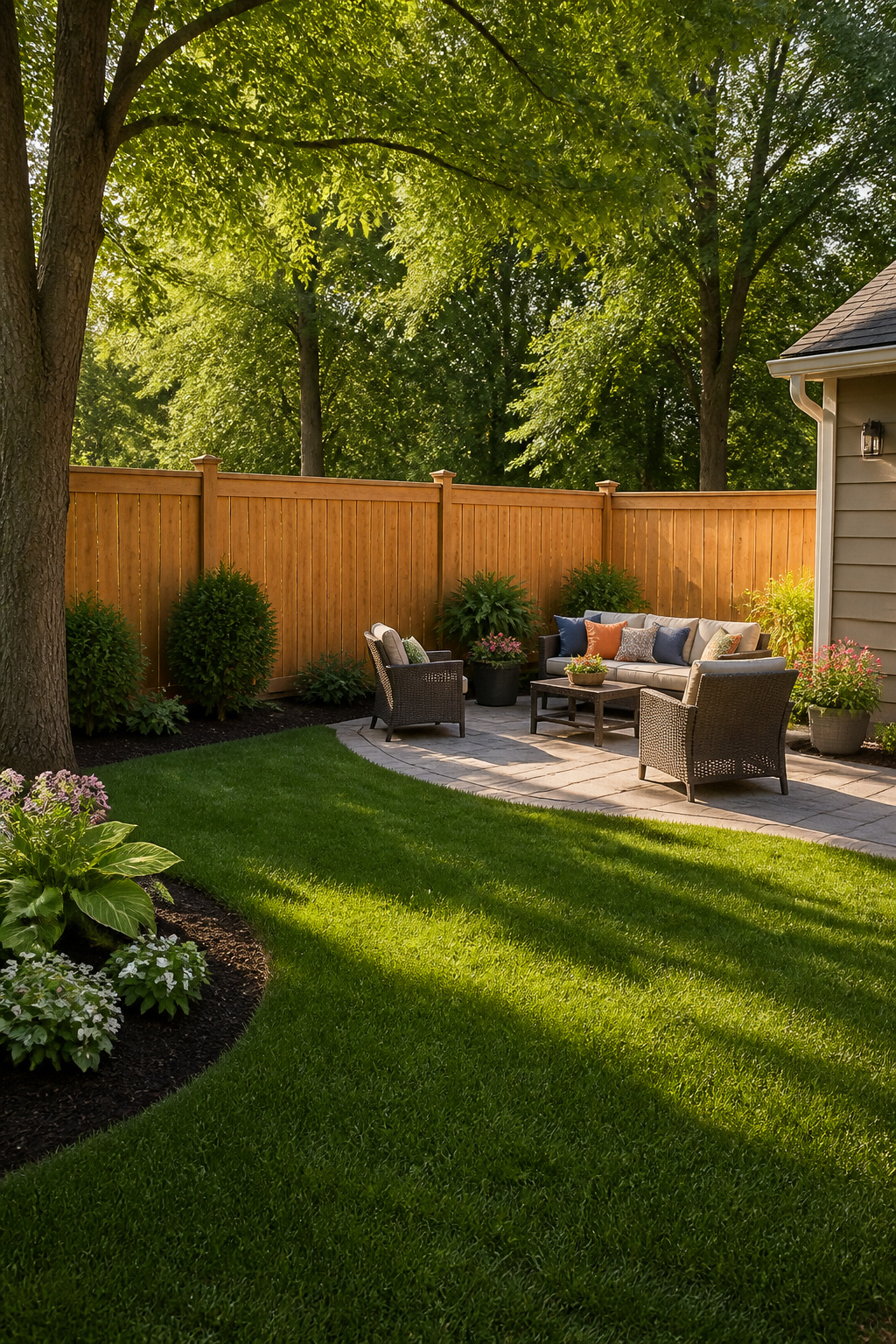
A privacy fence is often the first thing that has to happen before any other backyard landscaping ideas can take shape. Without it, the yard feels exposed, and the impulse to plant or entertain stalls out because the space still reads as public. Once the boards go up, the same footprint becomes a room: somewhere defined enough for a dining set, a fire pit, or a border of shrubs that would otherwise look like foundation planting gone rogue.
Budget around $2,500 total, or $8 to $18 per linear foot, and treat that as the entry fee for everything that follows. The fence blocks sight lines, which is obvious, but it also blocks wind and cuts the carry of sound, so conversation at a table actually stays at the table. Neighbors become background instead of audience. That shift, from performing in your yard to living in it, is what makes the cost recoverable. I have watched friends spend twice as much on patio furniture they never use because they skipped this step and the space never felt enclosed enough to sit down in.
Wood, vinyl, and composite each have their partisans, but the material matters less than the height and the condition of the posts. A six-foot panel on properly set posts does the work; a taller fence with rails that bow after two winters is a fence you replace, not one you landscape against.
11. Outdoor Dining Area
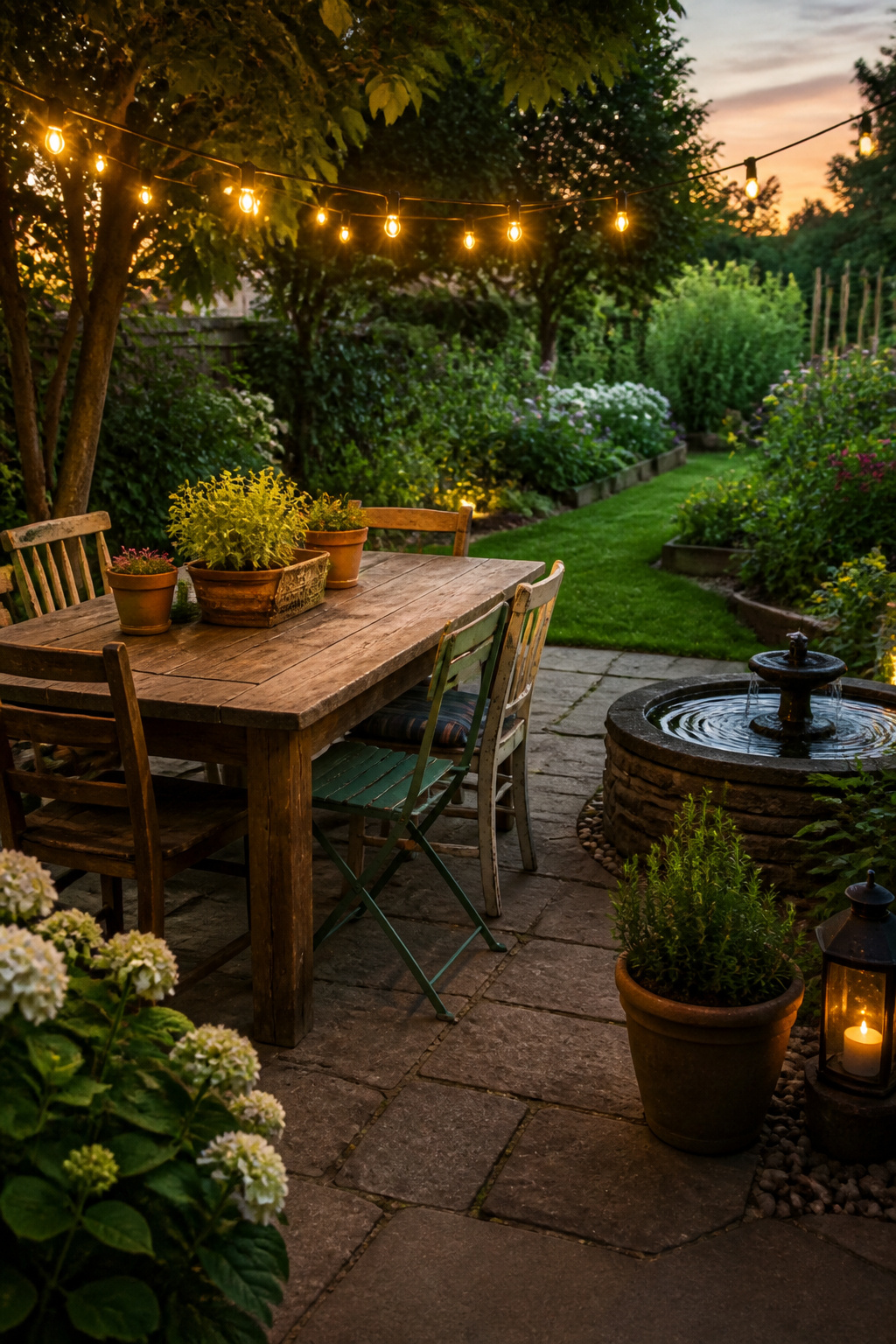
Most backyard landscaping ideas start with a dining area because the furniture is probably already sitting in your garage. I dragged our old kitchen table onto the patio two summers ago, added four mismatched chairs from a neighbor’s curb pile, and that was the zone that got used every evening until October. The separation from the rest of the yard cost nothing: two potted tomatoes on one side, a tall rosemary on the other, enough to signal "this spot is for sitting down with a plate."
Flow matters more than the table itself. Leave at least 24 inches behind each chair so people can push back without hitting a planter or the grill. Pathways into the space need the same breathing room; a cramped route from the kitchen door ruins the meal before it starts. Position the dining area close to that indoor kitchen if you can. The walk carrying hot dishes and cold drinks should be short, while quieter corners of the yard, a reading chair or a morning coffee spot, can sit farther out where you actually want the excuse to wander.
New furniture runs $150–$200 for basic sets and climbs past $2,000 for quality pieces built to last more than a few seasons. The durable buy saves money long-term, but most of us are better off starting with what we own and upgrading once the location proves itself. My curb chairs are still there, paint peeling, holding up fine.
12. Landscape Lighting
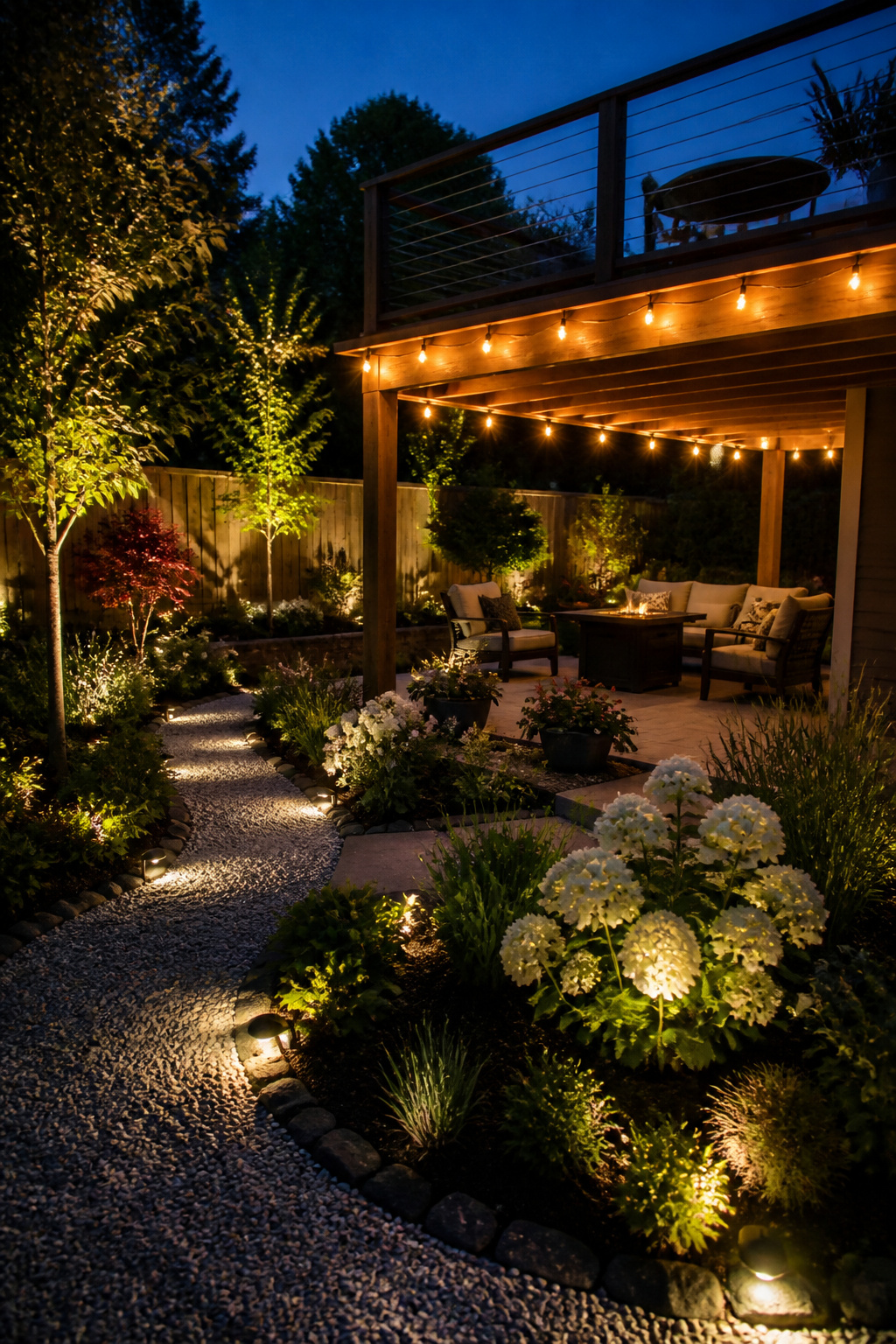
String lights run between $15 and $50 and do more than decorate. They stretch usable hours past sunset without touching the breaker box or hiring an electrician. A basic strand along a porch beam or zigzagged overhead turns dinner cleanup into an evening outside. The same lights mark a path to the shed or wash a feature tree in soft light from a single outdoor outlet. Winter comes early some years, and the dark shrinks the yard to nothing. Fifteen dollars of warm bulbs gives that time back. Lamps in bundled sets climb toward $100, but the entry point is the strand: plug, hang, done. Complex wired designs run $2,000–$6,000 once you bring in a pro. For a season or two of gardening on a tight budget, the plug-in strand is the move that actually happens.
13. Patio
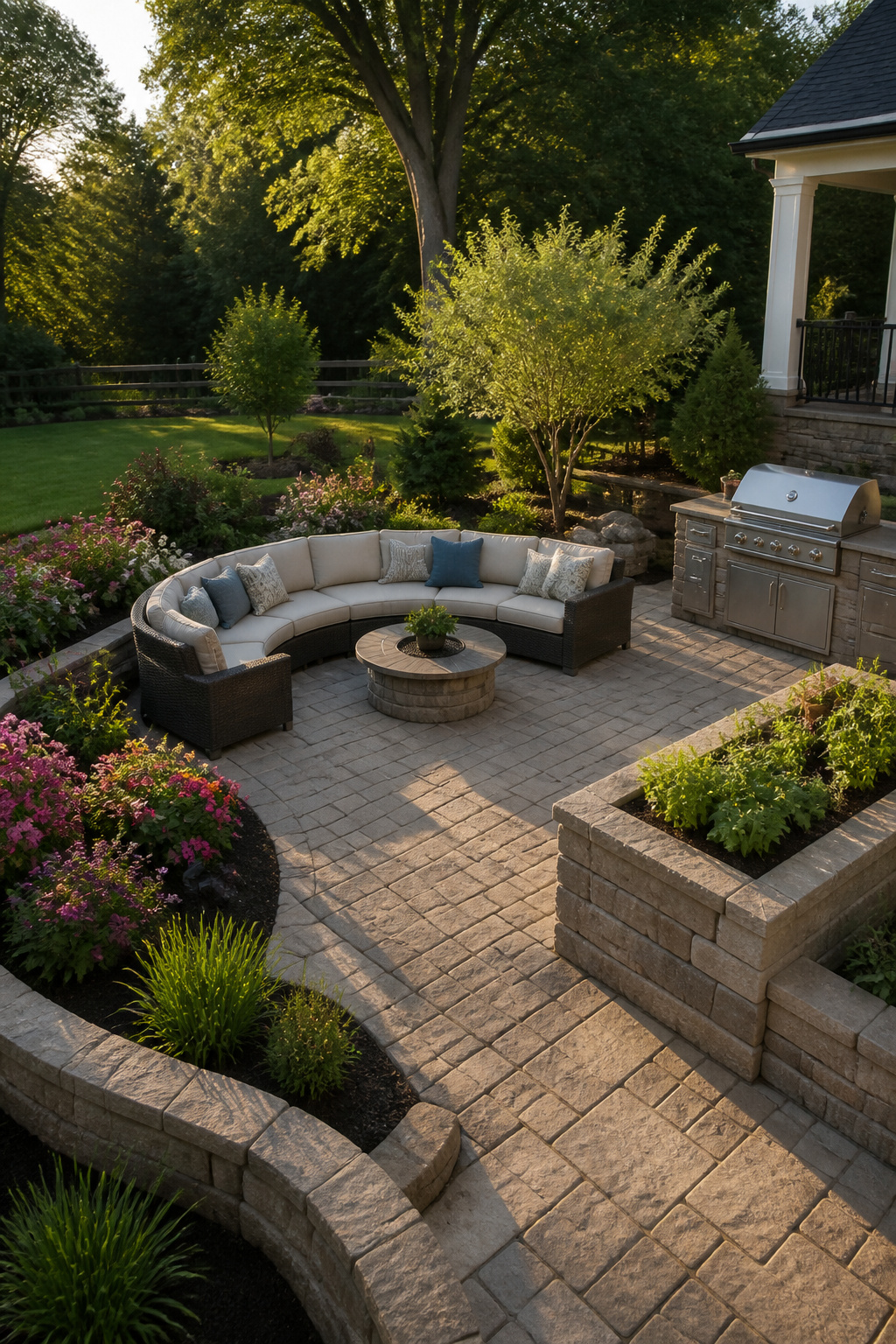
A patio is the first hardscaping element that makes every other backyard landscaping idea possible. Without a solid floor, furniture sinks into turf, gravel migrates into mud after rain, and the whole space stays a single undefined lawn. Concrete runs the cheapest, pavers split the difference and give you patterns to work with, and compacted gravel costs the least upfront though it needs releveling every couple of seasons. Patio installation typically runs $1,800 to $5,000, which sounds steep until you price replacing sod wrecked by chair legs and realizing you have nowhere to set a grill. My own preference leans toward pavers for a first project: they forgive a slightly uneven base, and lifting one to run a hose or fix a drain beats sawing cured concrete. The patio does not need to be large. A 10-by-12 slab by the back door holds a seating cluster and leaves circulation around it, and that one anchored zone lets you build outward, adding planting beds or a fire pit later without everything floating on grass.
14. Water Feature
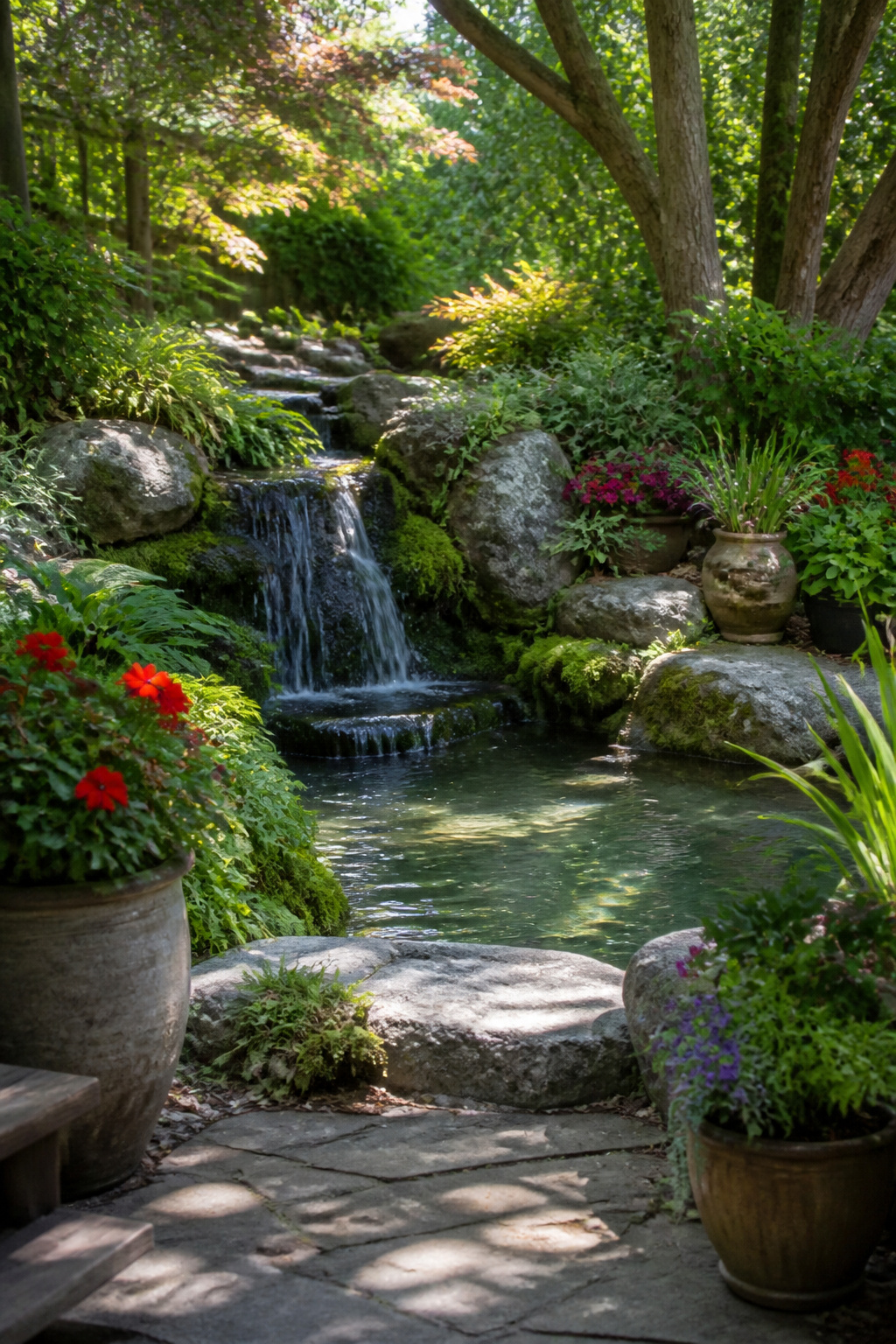
A water feature does more than fill an empty corner. The sound of moving water masks street noise, and even a small fountain will bring birds down from the trees for a drink. Solar-powered pumps have made this far more reachable on a tight budget; no electrician needed, no trenching for cable, just a basin, a pump, and sun. I have watched a cheap resin fountain turn a concrete patio into the spot where everyone lingers.
A pond goes deeper, literally and figuratively. One Delaware couple built their whole garden around a natural pond that became a haven for wildlife. A backyard fountain or waterfall typically runs $900 to $5,000, so the solar route keeps you well under that ceiling while still getting the sound and the visitors. Frogs arrive on their own. Dragonflies stake out territory. The water connects your yard to the larger landscape in a way that a bird feeder alone never quite manages.
Start smaller than you imagine. A recirculating basin with a single spout teaches you what you actually hear and what you actually maintain before you commit to digging.
15. Gazebo
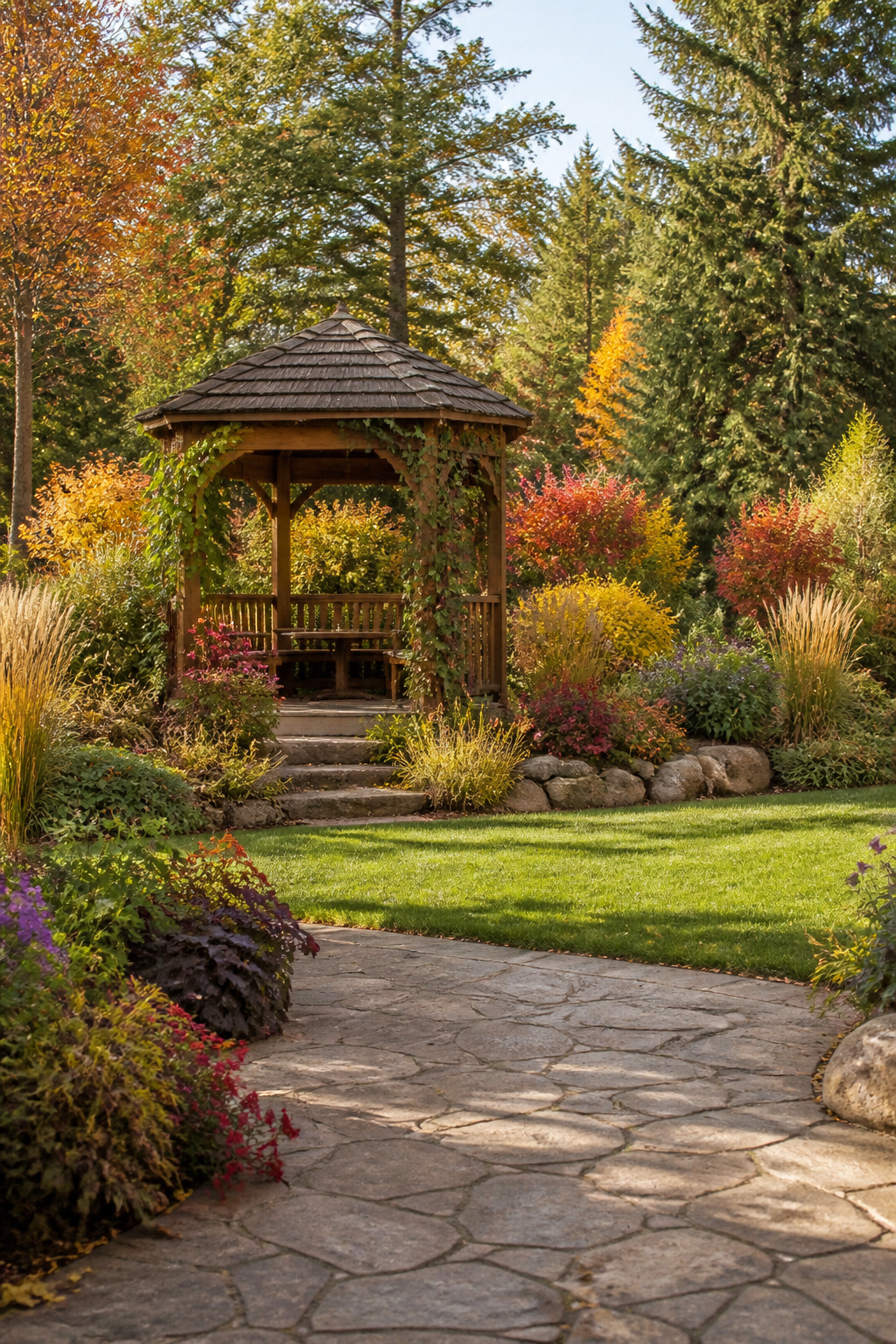
A gazebo differs from a pergola in one clear way: it has a full roof. Where a pergola filters sunlight through slats, a gazebo closes overhead and walls off weather on every side. That roof turns the structure into something closer to a room, a dedicated zone you can furnish and use through more of the year.
Most people I know started with a pergola. It costs less, installs faster, and reads as a starter structure. After two or three seasons of outdoor living, the limits start showing. Rain cuts the evening short. Midday sun angles under the slats. A gazebo is where you land once you want to stay outside longer and more deliberately.
The average gazebo runs about $6,000, which puts it well above pergola territory. That price buys the enclosed feel, the year-round anchor point, and a structure that reads as permanent architecture rather than shade accessory. In a small yard, it can dominate the sightline, so placement matters: set it where it frames the garden rather than blocking it, and treat the interior as a furnished room with a rug, a small table, and chairs that can stay put.
16. Rock Garden
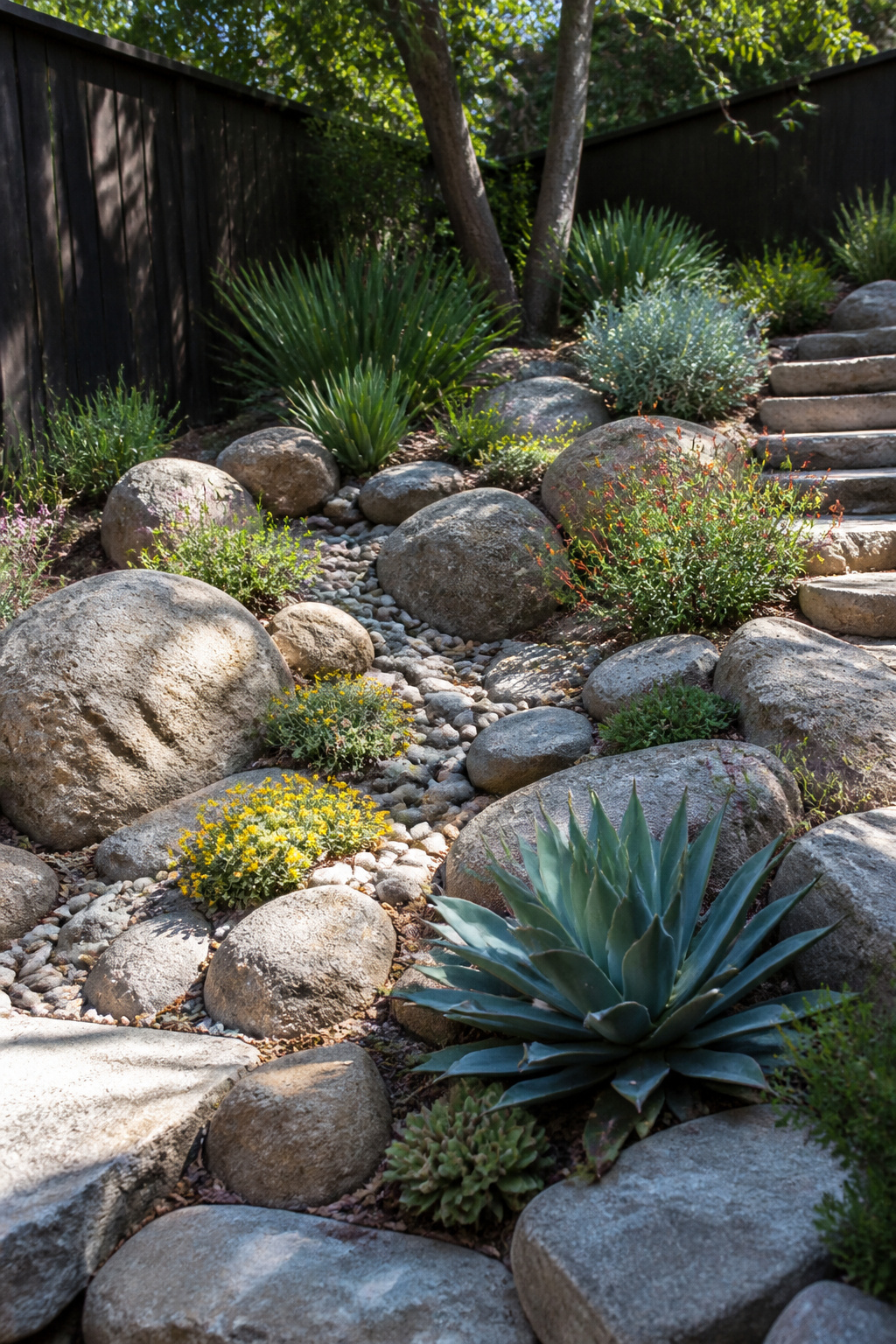
A rock garden runs about $600 to $700 for most homeowners, with the range stretching from $400 on the low end to $1,000 if you’re buying larger boulders and paying for delivery. That puts it squarely in the middle of a typical annual gardening budget, but the payoff is that it stops costing you after year one.
This is hardscaping that actually earns the label low-maintenance. No mowing, no seasonal replanting, no irrigation system to winterize. The rocks stay where you put them, and the plants you choose either survive your conditions or they were the wrong plants to begin with.
Dry zones and slopes where lawn turns brown by July are where this approach makes the most sense. Grass fights for purchase on a grade; rocks do not. A slope that sheds water too fast for turf becomes useful terrain once you switch to drought-tolerant species spaced between stones with room to breathe. Desert-style plantings use the same logic: agave, red yucca, or a single accent cactus where a shrub would demand steady moisture. Native plants adapted to your zone need even less intervention than the generic "drought-tolerant" tag implies, because they already understand your rainfall pattern.
Stone sourcing can trim the budget. Farmers and construction crews sometimes have fieldstone or riprap they plan to discard. A single large anchor rock, free except for the effort of moving it, changes the whole composition. Smaller stones collected from your own property carry the same color and geology as your site, which reads as intentional rather than imported.
17. Tool Shed
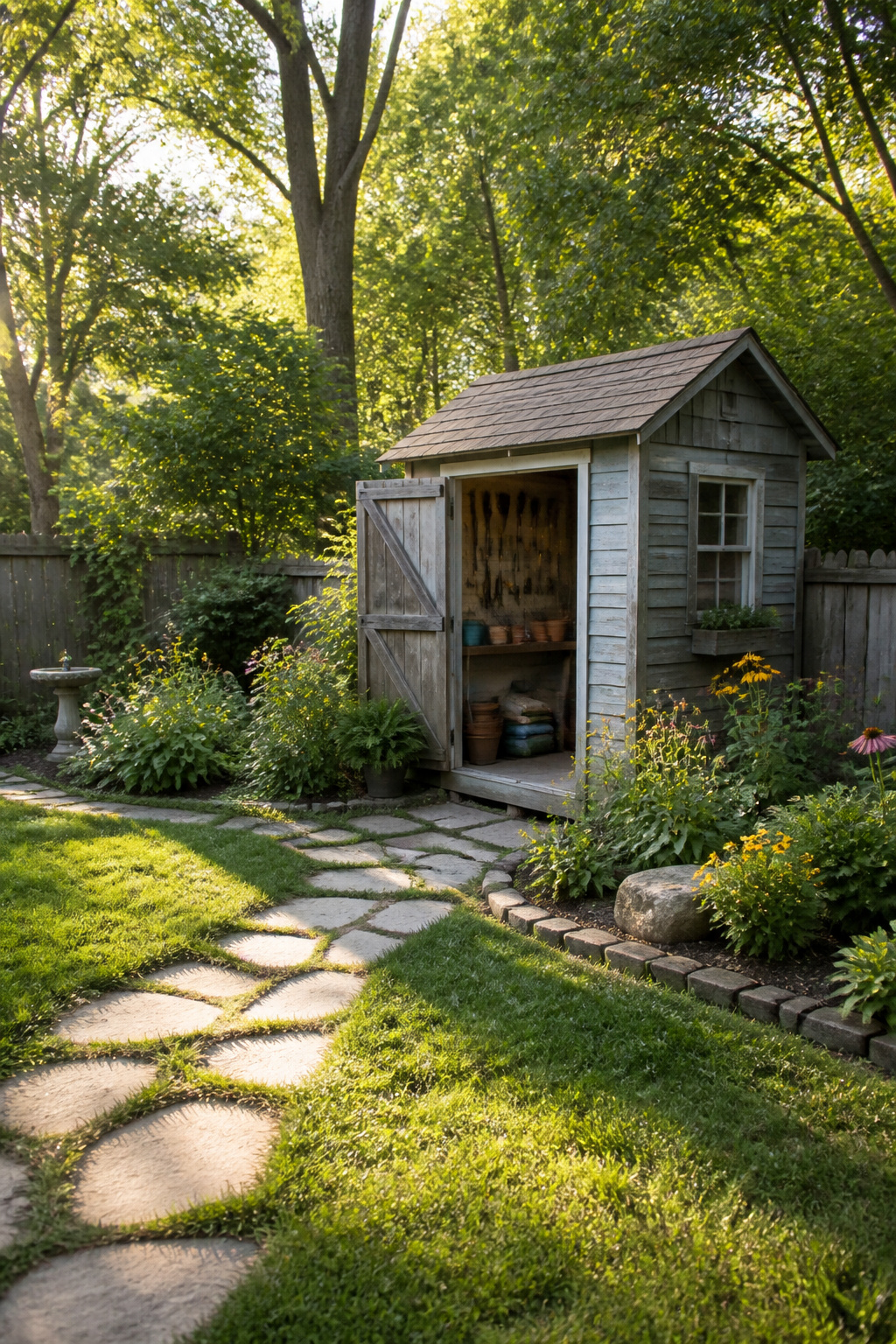
A tool shed belongs in the backyard before the raised beds go in, not after. I learned that the hard way the year I stacked bags of soil against the garage until the siding stained. A standard tool shed runs $300 to $2,000, and the lower end buys a perfectly sound metal or resin box that keeps the mower, wheelbarrow, and hand tools out of the rain. The upper end gets you something with a window, a pitched roof, maybe cedar siding that looks like a small barn rather than an afterthought.
This is not a she-shed. No daybed, no fairy lights, no $30,000 retreat. The tool shed is purely utilitarian, and that utility is what protects the rest of your landscaping investment. Without dry storage, you replace rusted shears, warped handles, and sodden bags of fertilizer on a schedule that quietly doubles your annual garden spend. Plant a few compact evergreens or a low shrub border around the base and the shed stops reading as industrial equipment and starts reading as garden architecture. Pick the placement first, before you commit to bed placement or hardscaping lines; shifting a shed after the fact means tearing up something you already paid to install.
18. Butterfly Garden
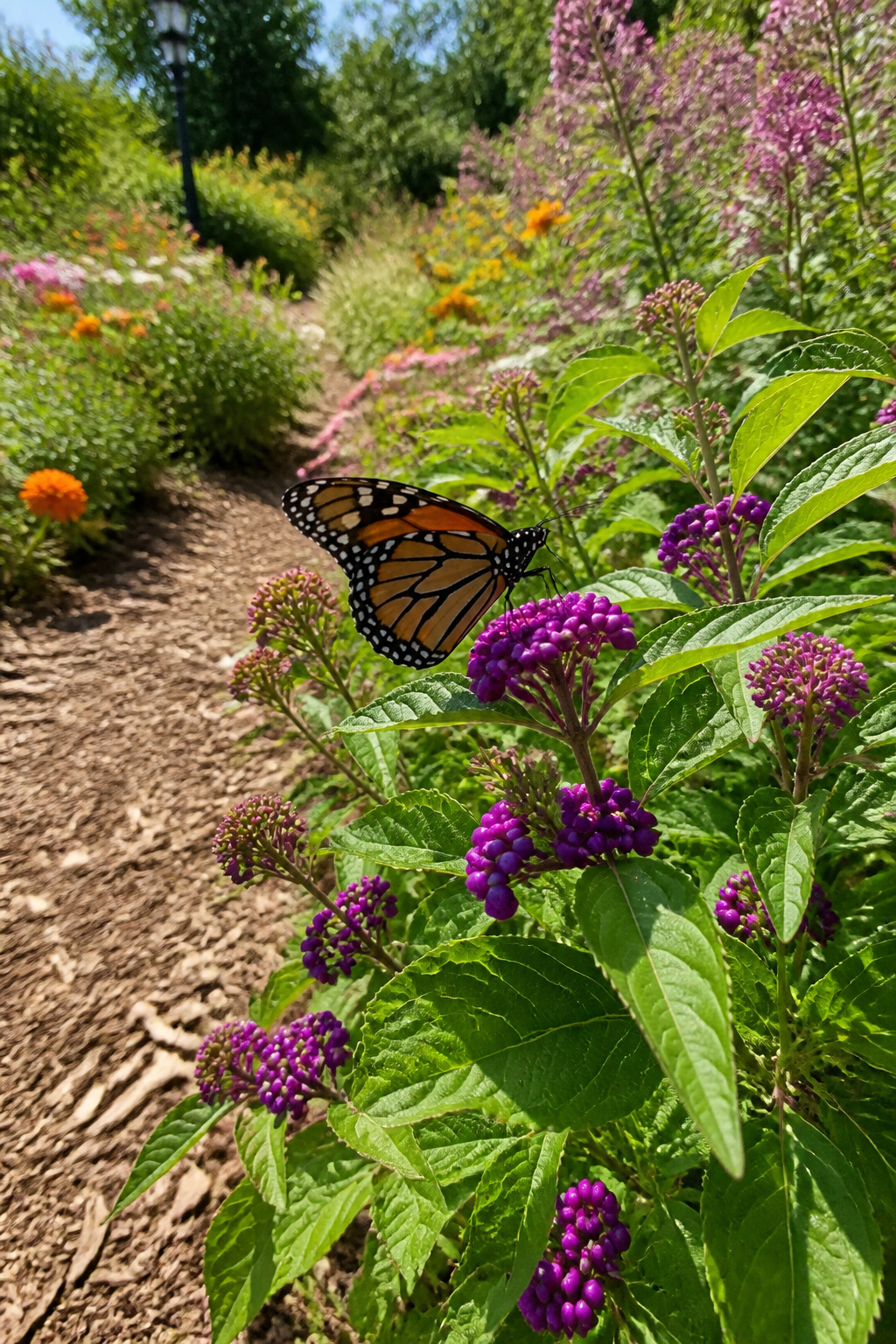
A butterfly garden runs on native plants your local butterflies and hummingbirds already recognize as food, which is why it lands so hard for the cost. Most nursery starts run $10 to $30 each, and a corner of the yard planted with a few milkweeds, a beautyberry, and some tulips gives you a season’s worth of motion and color without the water bill or the fuss of a lawn.
The work lines up cleanly with the calendar. Spring is for planting and staking out the sunny spots most natives want. Summer shifts to deadheading and letting the caterpillars chew a little, because a stripped leaf usually means a monarch is on its way. Fall is when you leave the seed heads standing for birds and let the plant litter settle into next year’s mulch. That rhythm turns a small plot into something that feeds itself and the things flying through it.
I came to this after watching a single volunteer milkweed pull in three species I could not name at the time. The garden that followed cost maybe $60 in starts over two years, and it is the one part of the yard I do not have to talk myself into maintaining. The weeding is light, the watering is rare once things are established, and the payoff is movement you do not stage yourself.
19. Treehouse
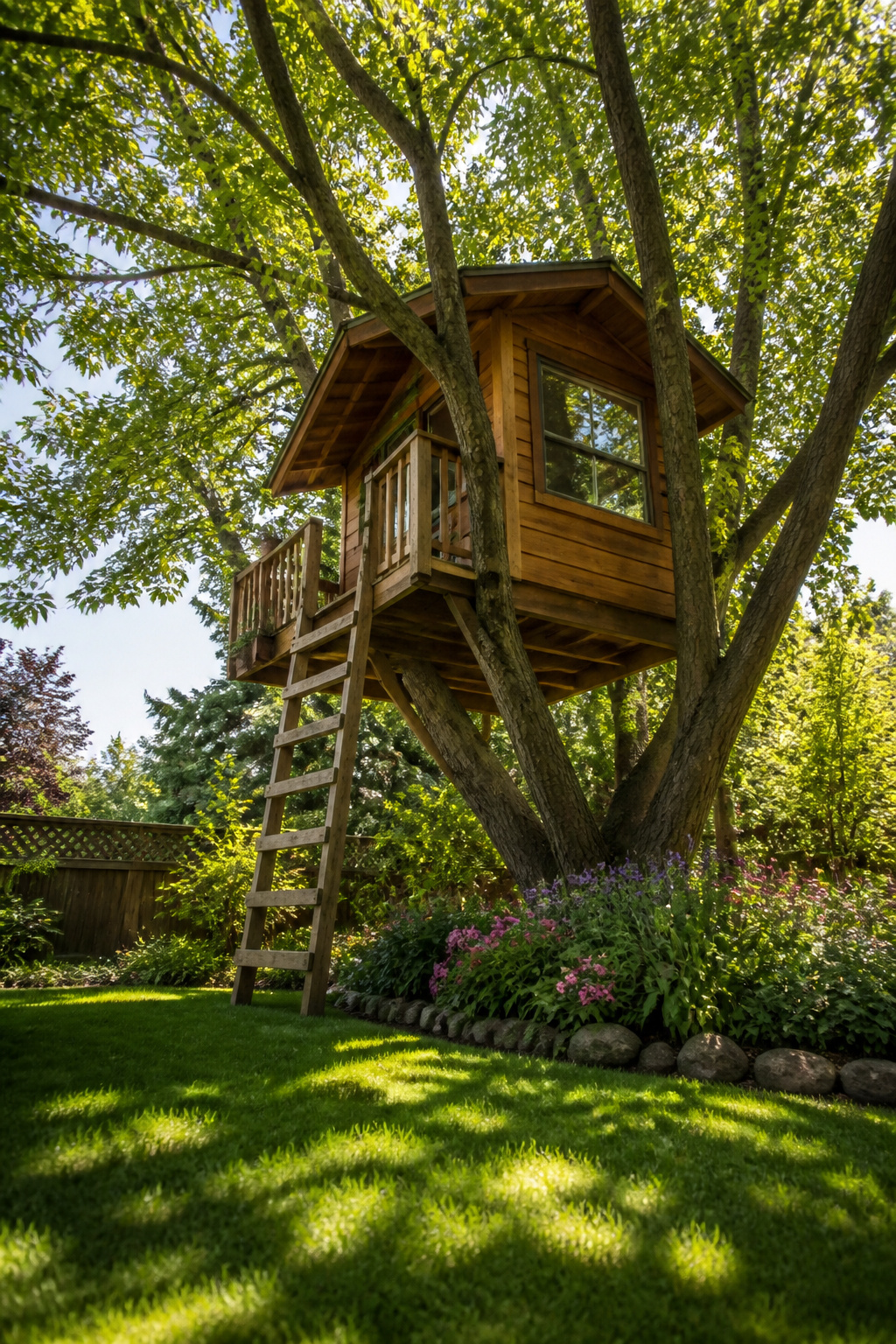
A treehouse runs $400 to $15,000 depending on whether you buy a kit off the shelf, hire a carpenter, or spend weekends with cedar and a level. The lower end gets you a simple platform with railings; the upper end buys electrical, windows, and weatherproofing tight enough for year-round sleepovers.
The same limitation that haunts a playset applies here: the child-focused lifespan is short. A six-year-old who begged for a loft and rope ladder turns twelve and wants nothing to do with it. Design with that exit in mind. A stout floor, real walls, and a door that locks can convert the space into garden tool storage or a shaded reading nook once the kids move on. Skip the trapdoor-only entry and the cartoon proportions. Headroom you can stand in and a window that faces the yard, not just the trunk, makes the second act plausible.
I would put the money into structure over novelty. A treehouse that sways or leaks loses its users fast, and a rotting platform is harder to dismantle than it looks.
20. Stepping Stones
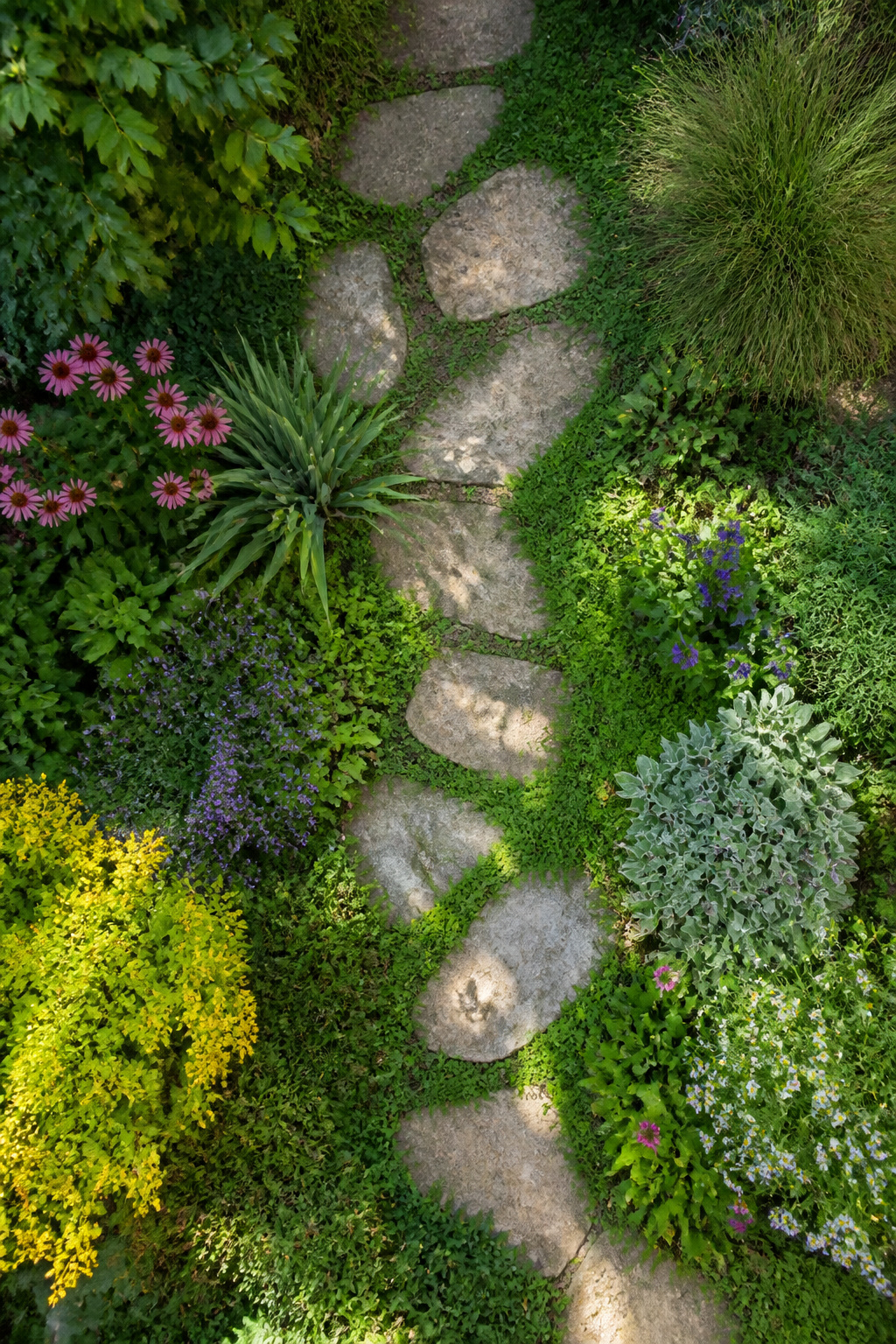
Stepping stones are the cheapest entry point on this list, running $1 to $15 each at any home improvement store. That range matters because it means you can lay a path across a muddy worn track for under twenty dollars if you catch the sale end of the stock.
The real payoff is practical. Grass dies where feet walk every day, and mud follows. A few flat stones set flush to the ground stop the wear without the commitment of a full patio. They also give a backyard instant structure, a line that leads from the back door to a shed or a garden bed and makes the space feel planned rather than accidental.
Most people can start and finish this project the same weekend. No concrete, no delivery truck, just a shovel to cut the sod, an inch or two of sand for leveling, and the stone dropped into place. I have watched friends spend months debating larger projects while their side yard turned to muck; the ones who just bought the stones first solved the problem that Saturday and built outward from there.
Budget-Friendly Upgrades
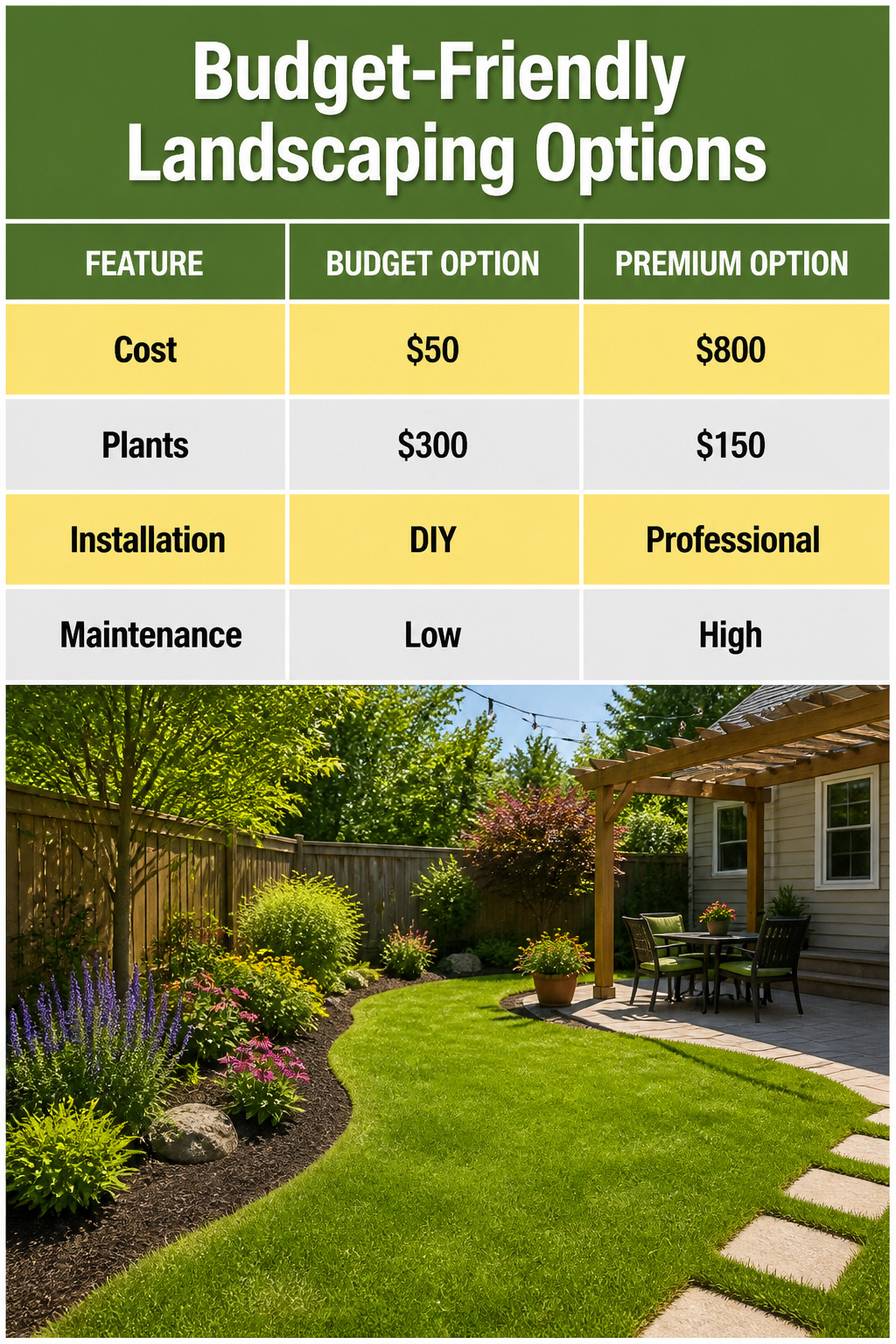
Most of the ideas worth trying in a backyard this size can be handled well inside an annual budget of $500 to $800. Mulch is the clearest place to start. A fresh layer, two to three inches deep, covers tired soil and makes any planting look intentional for the cost of the material and an afternoon of wheelbarrow work. New plants fill gaps without the price of hardscape, and native species keep the maintenance low enough that you are not buying replacements the next year. String lights run on a plug or a small solar panel and stretch the usable hours of a small yard into winter evenings when the sun drops early. A pressure wash on existing patio or deck does the same refreshing work as replacement, only cheaper. The swap I make most often: skip the built fire pit and use a simple metal bowl or even a cleared corner with stones you already have. The warmth and the gathering spot are what matter, not the masonry bill.
Low-Maintenance Landscaping

Drought-tolerant plants cut the work in half once they are established, but the first season still asks something of you. I lost a tray of sedum plugs two summers ago because I assumed "drought-tolerant" meant "water never." It means water deeply and rarely while roots find their depth, then back off. Lavender, yarrow, and ornamental grasses handle this rhythm well in most zones, and a single palo verde tree anchors a small xeriscape bed without the leaf litter of thirstier species.
Gravel or stone hardscaping fills the gaps where plants would struggle and you would rather not drag a hose. A gravel pathway between patio and fence line, or a stone planter raised above poor soil, adds structure that needs no deadheading. Rock garden projects run roughly $600 to $700 on average, though sourcing stone from construction discards or your own yard edges can pull that down. The neutral palette of xeriscape suits almost any house style, which matters when you are fitting one project into a larger plan.
Native plants close the loop. Climate-adapted species already know your soil and your rainfall, so the survival rate jumps without heroic measures. Limit the variety and repeat in bold masses; it reads cleaner and trims your care list to a few familiar names.
Creating Zones
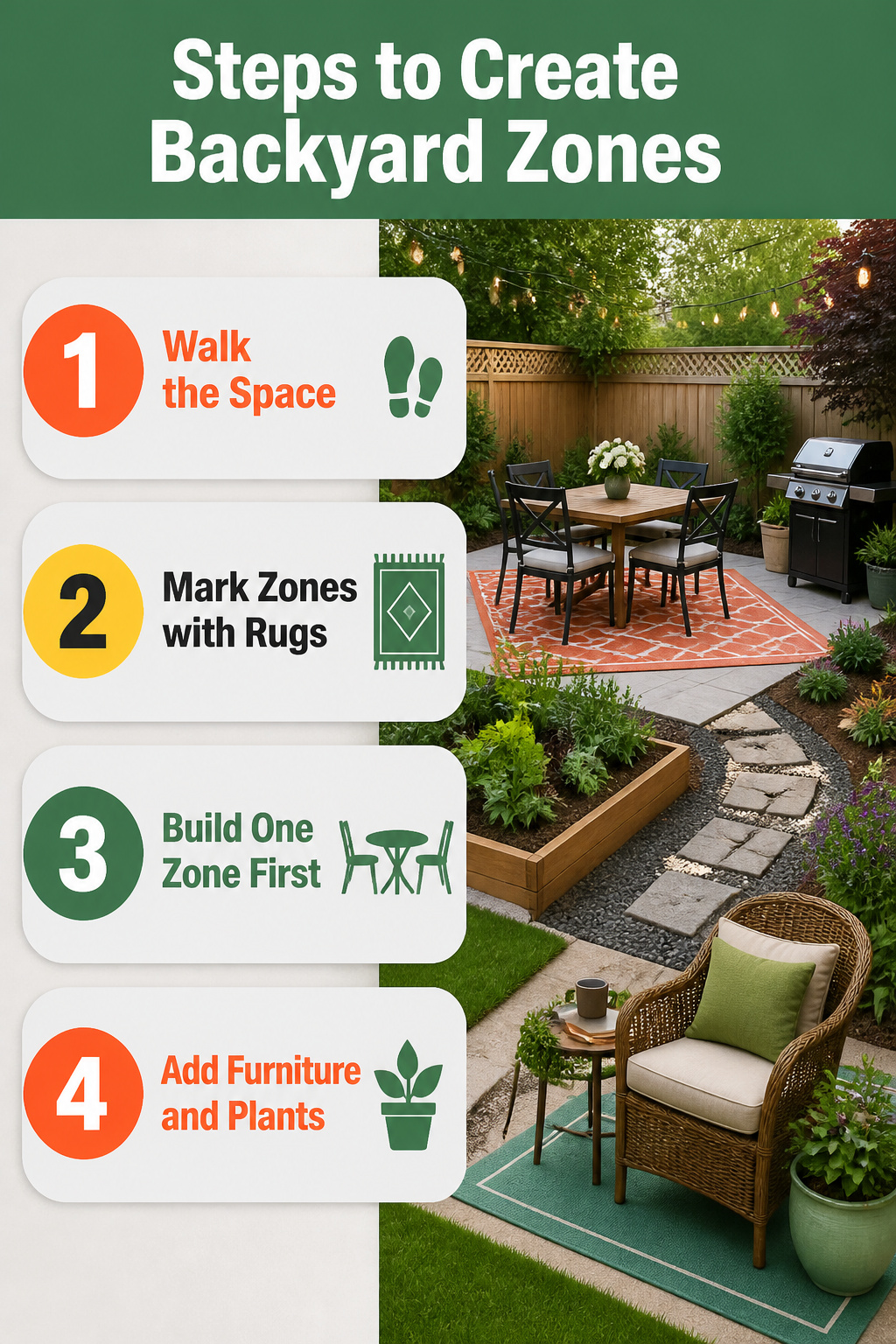
Dividing a backyard into distinct areas for dining, relaxing, and gardening starts with walking the space with a hose or a line of flour, not with a tape measure. Lay out where you actually sit now, where the grill ends up, and where the sun hits at 6 p.m. Most people overestimate how much room a dining table needs; 3 feet of clear space around the chairs lets people push back without hitting a planter or a path. A raised bed for herbs or a reading bench tucked against the fence can sit further from the house, which draws you into parts of the yard you otherwise ignore.
Outdoor rugs mark zones without construction. A single rug under a bistro table turns concrete into a morning coffee spot; another near the grill separates cooking from lounging. Potted plants on a deck edge do the same work, and they move if the first arrangement feels cramped. Pathways between zones matter more than the zones themselves. A narrow strip of gravel or stepping stones keeps the dining area from bleeding into the garden and gives you a dry route after watering.
Sequencing zones on a limited budget means building one that works completely before starting the next. A $150–$200 patio set with a table and chairs, placed on a rug you already own, gives you a usable dining area this season. Next year, add the seating corner or the raised bed. Cheap furniture replaced every two years costs more than one durable set, so the second zone is where you save for better materials. By year three, the yard has three functioning rooms instead of one half-finished project and two sketches on graph paper.
Incorporating Nature
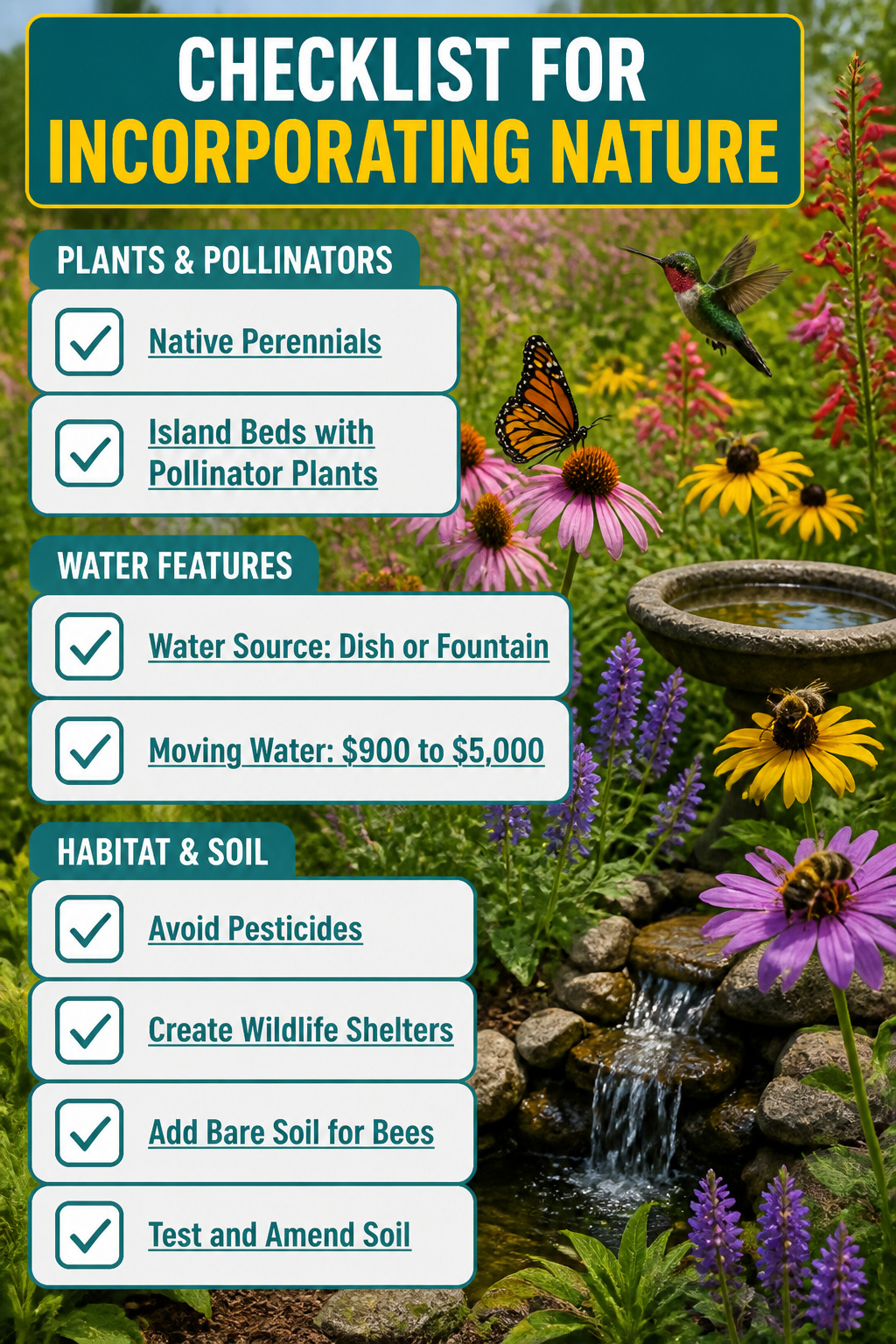
A yard that feeds something besides the gardener starts with plants that already know the neighborhood. Native perennials, the ones local pollinators evolved alongside, draw butterflies and hummingbirds without the fuss of annual replacements. The cost lands between $10 and $30 per plant at most nurseries, and the return is a living thread between your space and whatever flies, crawls, or nests nearby.
Water pulls them in faster than flowers alone. A simple dish of clean water, refreshed every few days, brings bees and birds in numbers that surprised me when I first tried it. Moving water from a small fountain or waterfall, which typically runs $900 to $5,000, stays cleaner longer and doubles as the sound you want near a sitting area. Either way, skip the pesticides. What kills aphids fast kills the caterpillars you need for a butterfly garden, and the birds that eat those caterpillars.
Shelter matters more than most new gardeners budget for. A brush pile at the yard’s edge, a patch of unmulched bare soil for ground-nesting bees, or even the hollow stems of last year’s perennials left standing through winter: these are the rooms wildlife actually rents. The vegetable garden benefits directly. Insect pollinators drawn by the flowers increase harvest weight on squash, cucumbers, tomatoes. Island beds that mix vegetables with perennial pollinator plants, as some designers now do, put the partnership right in front of you. The soil underneath still needs testing and amendment, especially where lawn used to grow compacted and thin on nutrients, but the plants themselves do more of the maintenance once they’re established.
Outdoor Entertaining
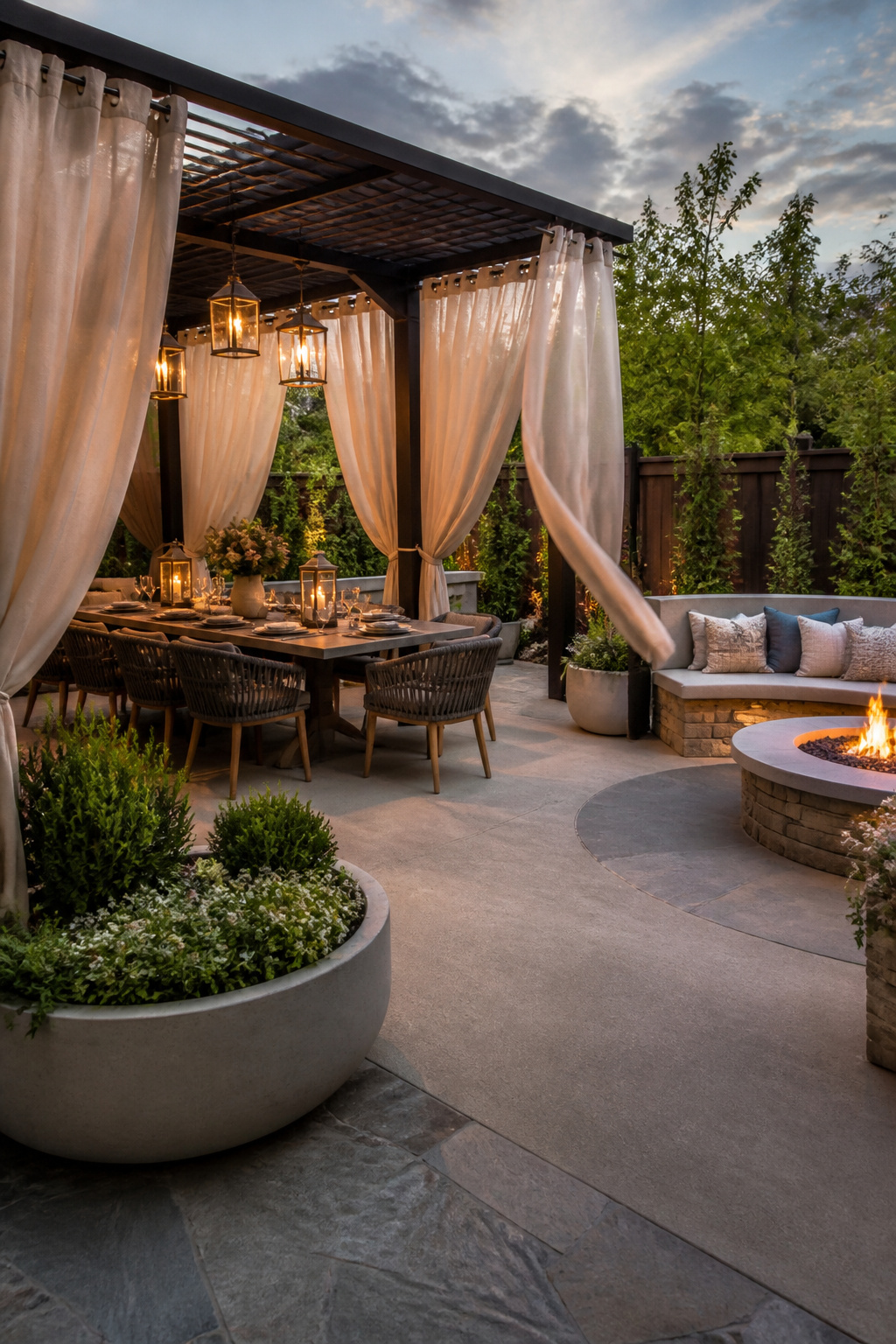
The hardest part of hosting outside is not the cooking; it is the moment guests arrive and nobody knows where to stand. Three feet of clearance behind every chair is the number that fixes this, enough for someone to push back from the table without bumping the person walking behind them. I learned that the expensive way after squeezing eight people around a table with eighteen inches of backing space, which meant half the party spent dinner pressed against a fence.
Flow works better when you think in zones rather than rooms. A pergola with hanging baskets or a curtain on one side can mark where lounging ends and dining begins without building a wall. The same structure that defines space also holds lights overhead, so you are not stuck with one flat layer of illumination after dark. A fire pit with built-in seating tucked against that perimeter keeps people from drifting into the cooking lane, and the bench seating itself costs less over five years than replacing a set of low-grade chairs every spring.
Weather contingency is where most small yards fail. No guest wants to be the one who asks to move inside. A pergola with side curtains gives you a windbreak and a little rain cover without the full cost of a roofed structure; candles or lanterns on the table keep the mood when overhead string lights are too bright. The built-in bench around the fire pit becomes the backup gathering point when the dining area is too exposed, and moving between those two spots feels like a change of scene rather than a retreat.
DIY Weekend Projects
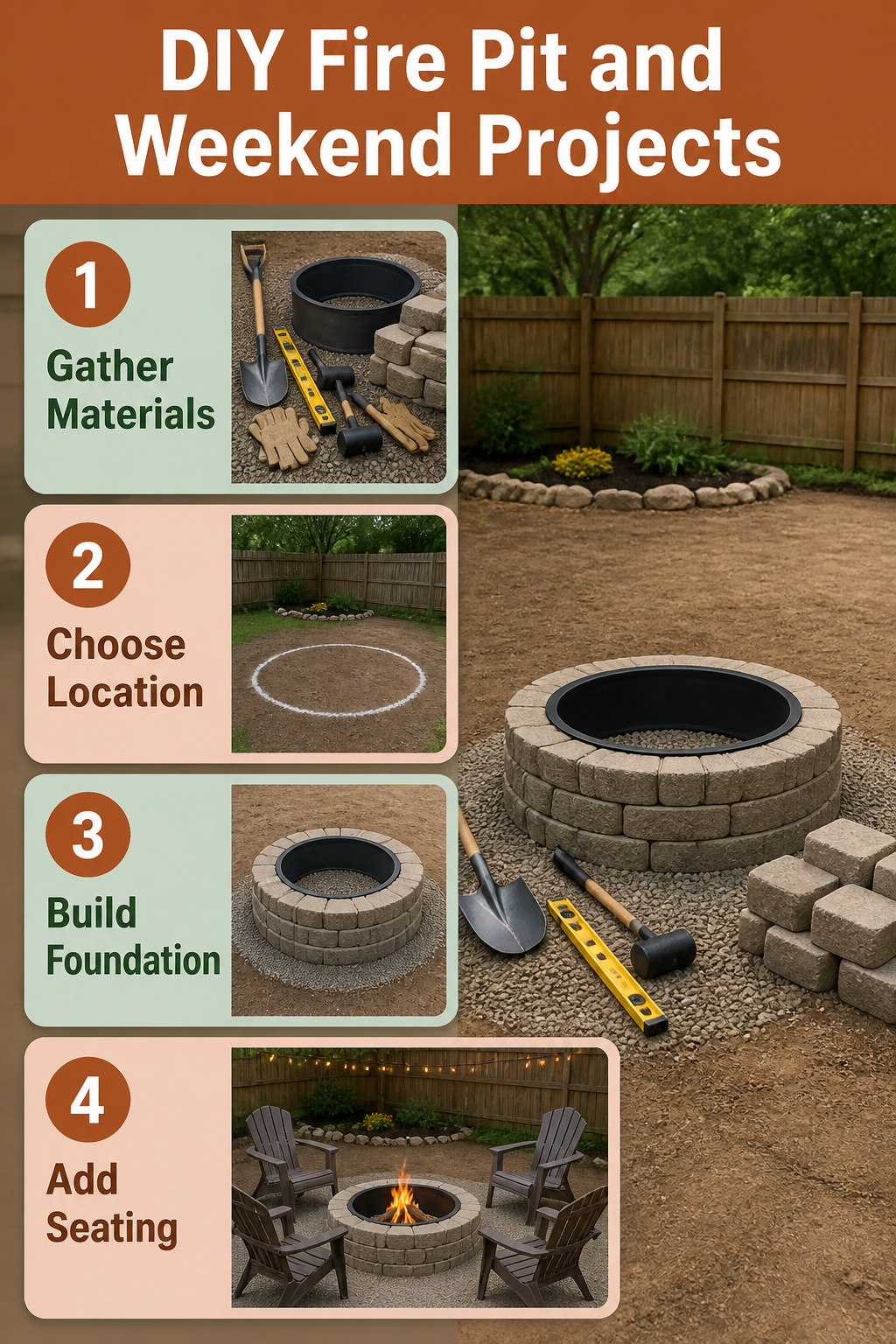
A fire pit build starts below $100 and can run to $1,400, but the sweet spot for a first-timer sits closer to the low end of that range. I spent one Saturday digging a shallow ring, laying paver base, and stacking a steel insert with retaining-wall blocks from the home improvement store. The second day went to seating: four Adirondack chairs dragged from the garage, positioned close enough to feel the heat without singeing the armrests. You will need a shovel, a level, and a rubber mallet. No masonry experience required, though checking your local burn ordinance first saves the headache of moving it later.
Vertical gardens suit the same two-day window if you keep the structure simple. A freestanding pallet frame or wall-mounted pot system goes up with a drill, deck screws, and potting mix. I would skip the tomato vine on a first attempt; herbs in 6-inch pots are lighter, easier to rearrange, and forgive uneven watering. The sky really is the limit here, but two seasons of gardening taught me that limit expands only after you have killed something on the first try.
Stepping stones run $1 to $15 each and connect the back door to whatever sits at the far end of your yard. Layout takes an evening, digging and leveling the second morning. Roll your mower across the finished path before the sand sets; a wobble you notice now becomes a sprained ankle later.
Simple lighting means solar path lights or a string of LED bulbs on a guide wire. No trenching, no transformer, no electrician. Press the stakes in Saturday dusk, see where the pools of light fall, and adjust Sunday morning before the soil firms up.
Design Trends to Know
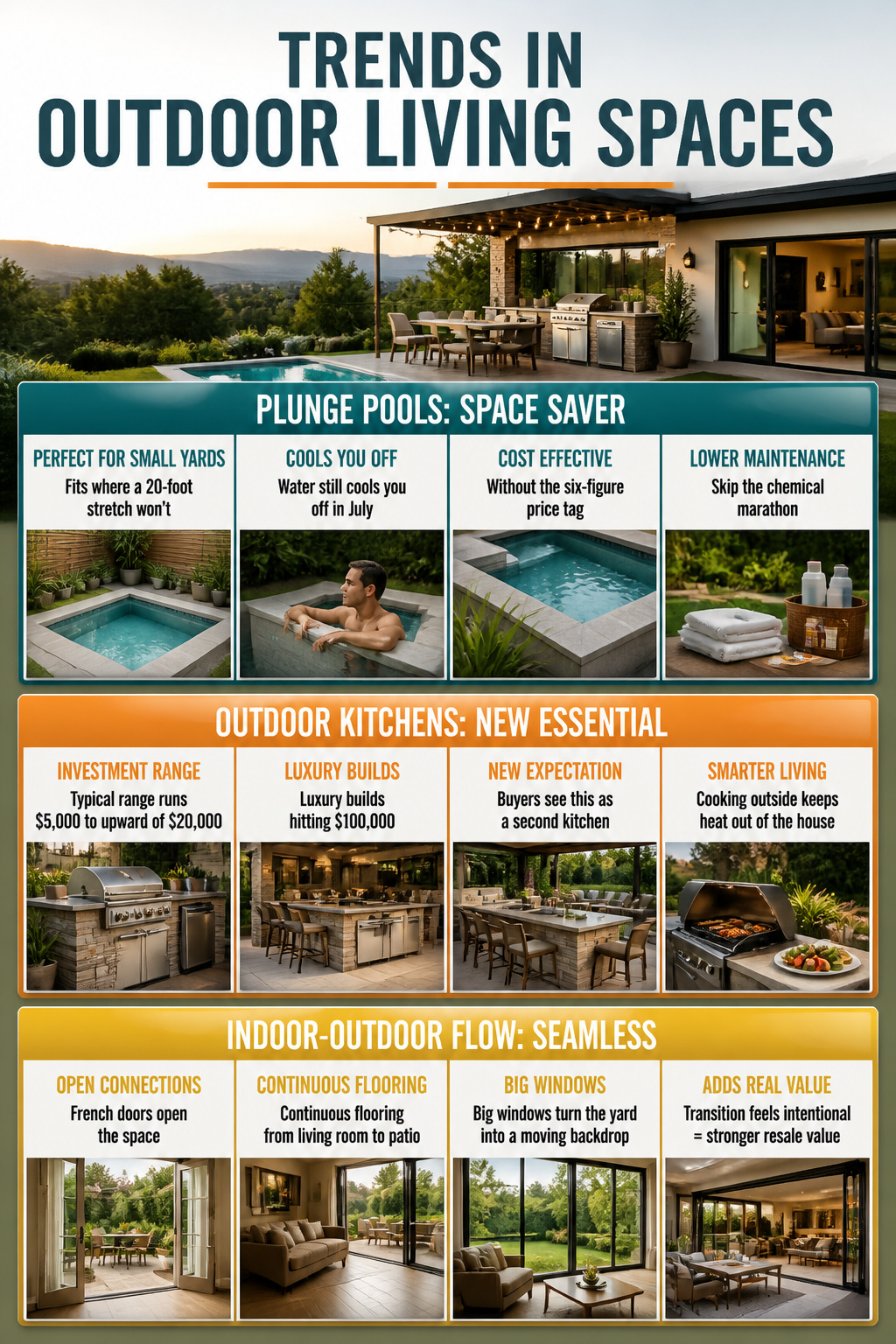
Plunge pools have overtaken full-size pools in new builds, and the shift makes sense for the yards most of us actually have. A plunge pool fits where a 20-foot stretch would eat the whole lawn, and the water still cools you off in July without the six-figure price tag or the chemical marathon.
Outdoor kitchens have moved from luxury add-on to standard expectation in resale markets. The typical range runs $5,000 to upward of $20,000, with luxury builds hitting $100,000. What changed is the framing: buyers now see this as a second kitchen, not a grill on a slab. Cooking outside also keeps heat out of the house, which your air conditioner notices.
The indoor-outdoor blur is the third shift worth watching. French doors, continuous flooring from living room to patio, big windows that turn the yard into a moving backdrop; these features make the backyard read as square footage, not an afterthought. For planning purposes, know that resale value increasingly hinges on whether the transition feels intentional. A sliding door slapped onto the back wall no longer cuts it.
Frequently Asked Questions
What are some backyard landscaping ideas?
Fire pits, pergolas, outdoor kitchens, vegetable gardens, she-sheds, playsets, outdoor saunas, greenhouses, privacy fences, dining areas, landscape lighting, patios, water features, gazebos, rock gardens, tool sheds, and butterfly gardens all belong on the list. Each one carves out a different use for the space, from cooking and entertaining to growing food or simply finding a quiet corner. Start with whichever matches how you actually want to spend time outside.
How can I make my backyard low-maintenance?
Hardscaping cuts the workload sharply: gravel, stone, and concrete need no watering, no mowing, and no seasonal replanting. Drought-tolerant native plants, once established, survive on rainfall without babysitting. A rock garden runs about $600 to $700 upfront and costs almost nothing after year one. Drip irrigation or smart sprinklers automate what little watering remains.
What is the cost of building a pergola?
The average runs about $3,500, with larger or more detailed builds climbing toward $6,000. That price buys the structure that turns open yard into a defined outdoor room. For a smaller budget, the same zone-marking effect can come later; the pergola is a project you save toward, not a starting requirement.
What plants are best for a butterfly garden?
Native plants that your local butterflies and hummingbirds already recognize as food. Milkweed, beautyberry, and tulips are common draws, and nursery starts run $10 to $30 each. The garden does not need to be large; a single sunny corner with a few well-chosen species brings motion and color through the season.
How can I create zones in my backyard?
Use structures and surfaces to mark where one activity ends and another begins. A pergola or gazebo defines a seating area, a shift from lawn to pavers signals the dining spot, and a low hedge or wood-chip border sets a playset apart from the rest of the garden. Even a fire pit on gravel, ringed by chairs, pulls people inward and gives the yard a center it probably lacked.