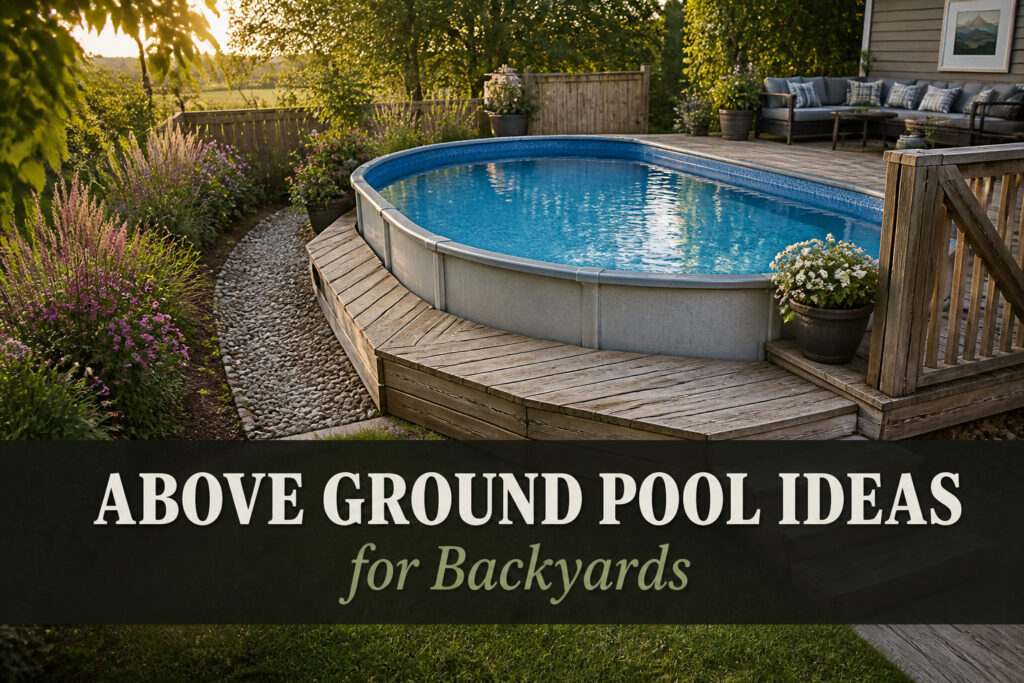
Above ground pool ideas for 2026 run from a $200 stock tank on a patio to a $8,000 pressure-treated deck wrapped around a full-sized frame, and the right pick depends on whether you own the yard or the lease.
The gravel border that stops mud splash takes two inches of stone over landscape fabric; the semi-inground build needs excavation and a retaining wall that most people will not do alone.
What separates the projects you finish from the ones you abandon is matching the fix to the actual problem your yard presents, not the one the photo showed.
1. Add a Gravel Border
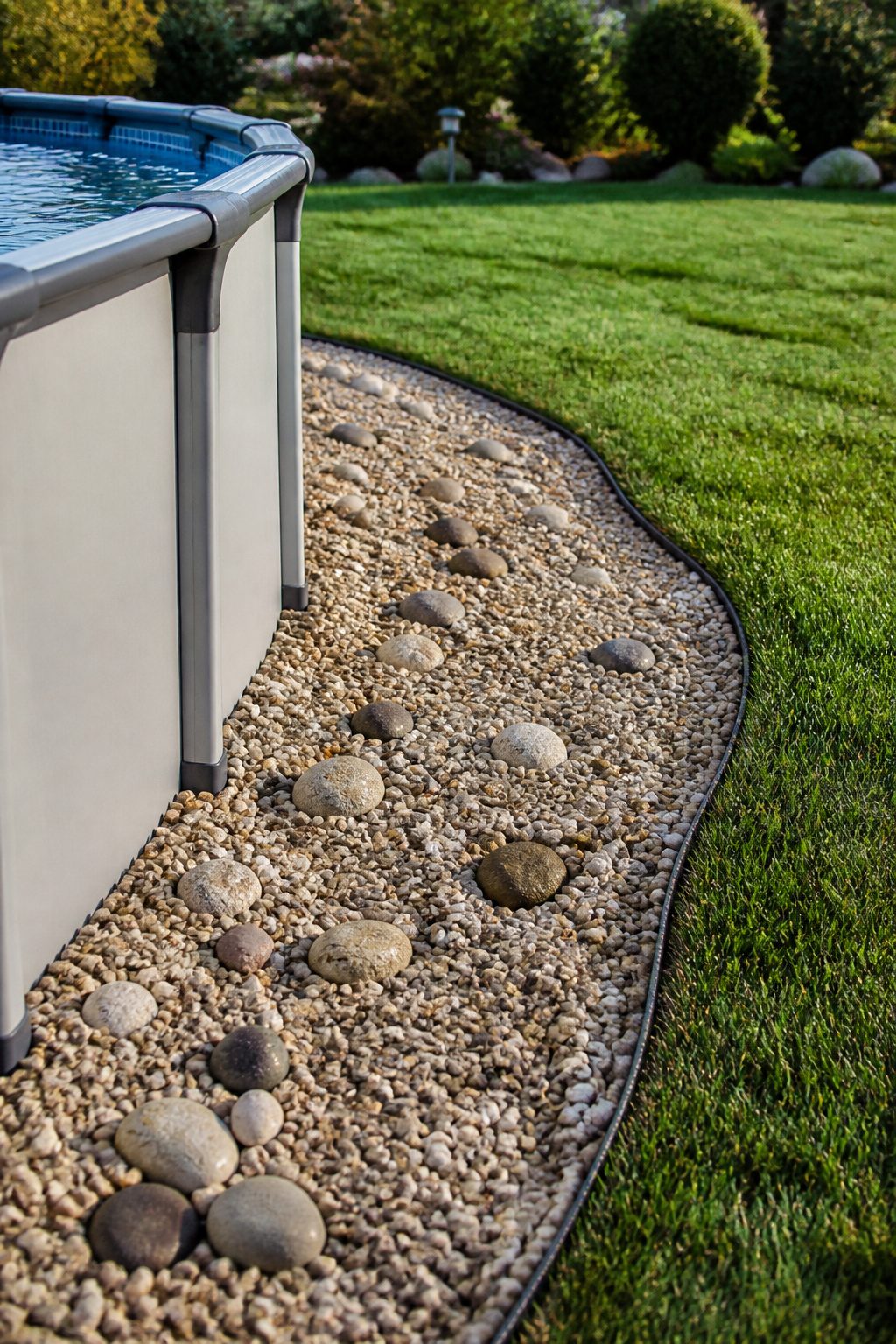
A gravel border rings the pool base with the simplest material fix for two problems at once: mud splashing up the walls after rain, and a lawn that grows right to the edge and complicates every mow.
The stones define the perimeter cleanly, and the voids between them let water drain instead of pooling.
River rock reads as more designed, a deliberate landscape move. Pea gravel is softer under bare feet, which matters when swimmers are stepping in and out all afternoon.
Either way, lay landscape fabric underneath first to block weeds from colonizing the gaps.
Two inches of depth is enough for stability underfoot and drainage, though a skirt of metal or plastic edging keeps the scatter from migrating into the grass.
Without that edge, the gravel wanders with every footstep and every season’s freeze-thaw, and the clean line you paid for dissolves into the yard.
2. Build a Surrounding Deck
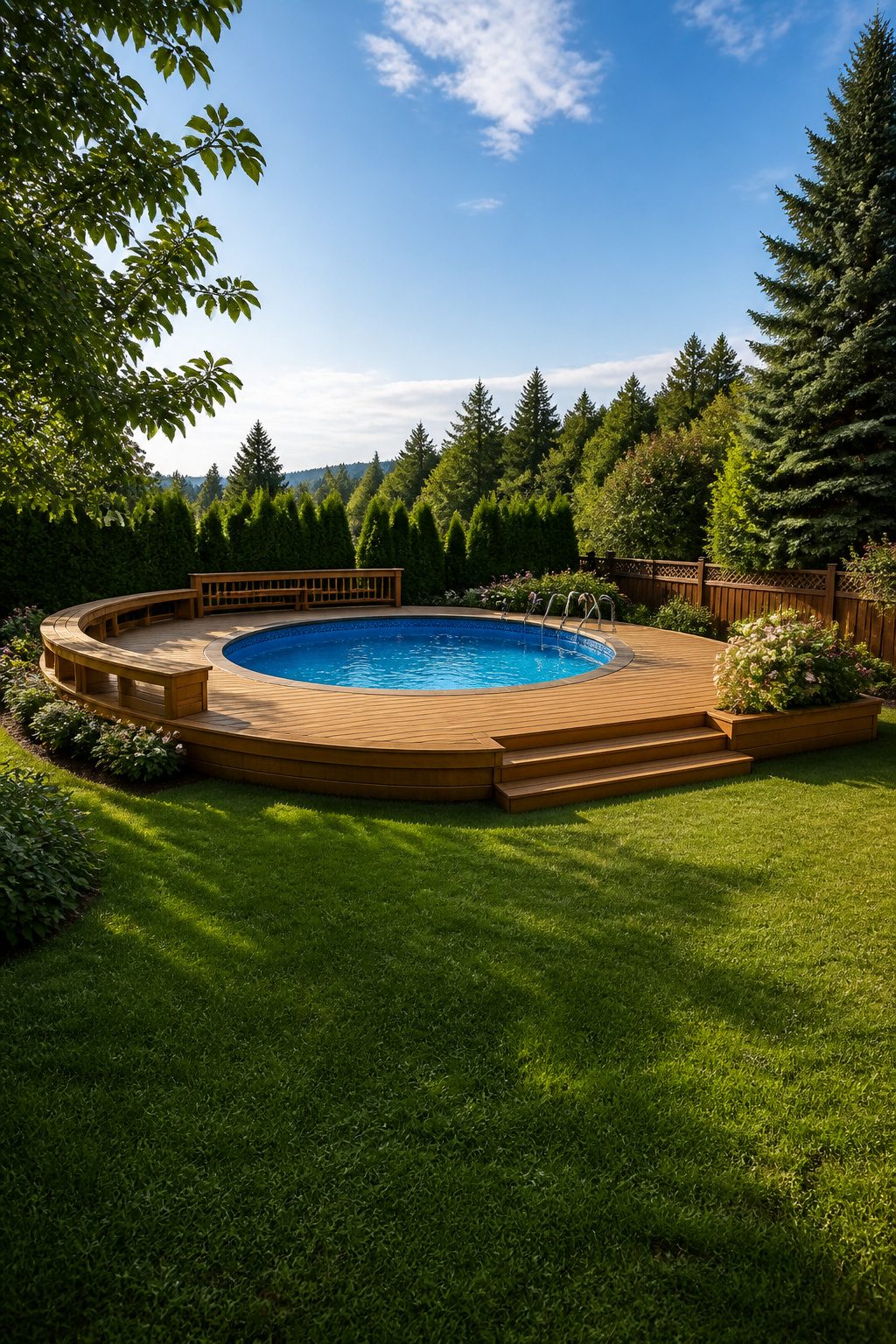
A deck built flush with the pool rim is the upgrade most homeowners actually end up doing, and for clear reasons.
It hides the corrugated siding, gives you level ground to step out onto, and turns a pool you climb into on a ladder into one you walk into from a stable platform.
A basic pressure-treated wood deck runs $3,000–$8,000 installed, which is the go-to starting point for budget planning. Round pools almost always get the wraparound treatment; the geometry just invites it.
Rectangular pools usually take a deck along one long side or both, which costs less and still gives you the main transition you need.
I used to think wraparound was the obvious choice until I saw a neighbor’s partial build. She lost about four feet of deck width but gained back most of her yard for the vegetable beds she actually wanted.
The choice depends on whether you’re optimizing for the pool as destination or as one stop in a working backyard. Composite holds up better than pressure-treated lumber in the wet environment, though the upfront price is steeper.
Cedar stays cooler underfoot, rot-resistant naturally, but it demands the same annual maintenance as cheaper woods. What stops most composite builds isn’t the material cost; it’s the heat in direct sun.
If your pool sits in open afternoon light, you’ll want shoes or shade before you go that route.
Wraparound decks do one thing partial builds can’t: they treat the pool as a piece of built-in furniture rather than a freestanding tank.
Built-in benches along the railing save space and get used more than you’d expect, for towels and for people who want to be near the water without being in it. Post lights on the railing extend usable hours without complication.
What the deck is really buying you is the shift from "we have a pool" to "we have somewhere to be outside."
3. Decorate with Tile
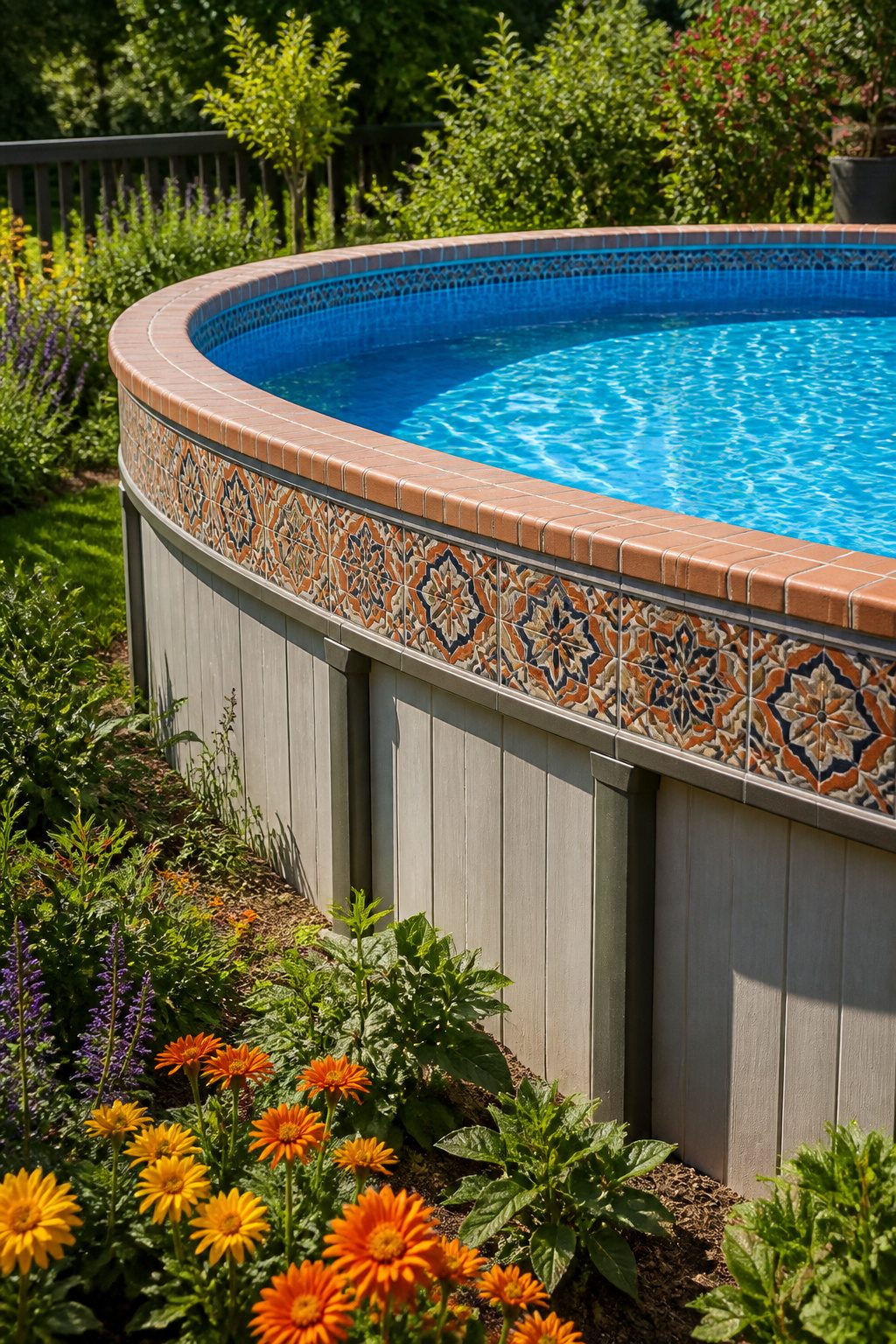
Mosaic tile turns an above ground pool’s plain rim or wall into something that looks considered, not temporary. Waterproof adhesive-backed strips make the application manageable as a weekend project, though the prep work matters more than the sticking.
Clean the surface, let it dry fully, and press firmly at the edges where water spray hits hardest.
Terracotta patterns and cement tile designs hold up well outdoors, but placement above the waterline is what keeps the bond from failing.
Along the top rim or the upper exterior cladding, the tile stays drier and the adhesive cures without constant soak. Inside the pool itself, even marine-grade epoxies eventually gas off or crack as the walls flex.
Rectangular pools get the most convincing result.
A horizontal band of mosaic along the waterline mimics what you’d see on an in-ground build, and the flat sides give you long straight runs instead of coping with the curve of a round frame.
I would skip intricate patterns on a pool that sees heavy kid traffic; the grout lines chip, and repairs on a curved wall never blend invisibly.
4. Use Stone Pavers
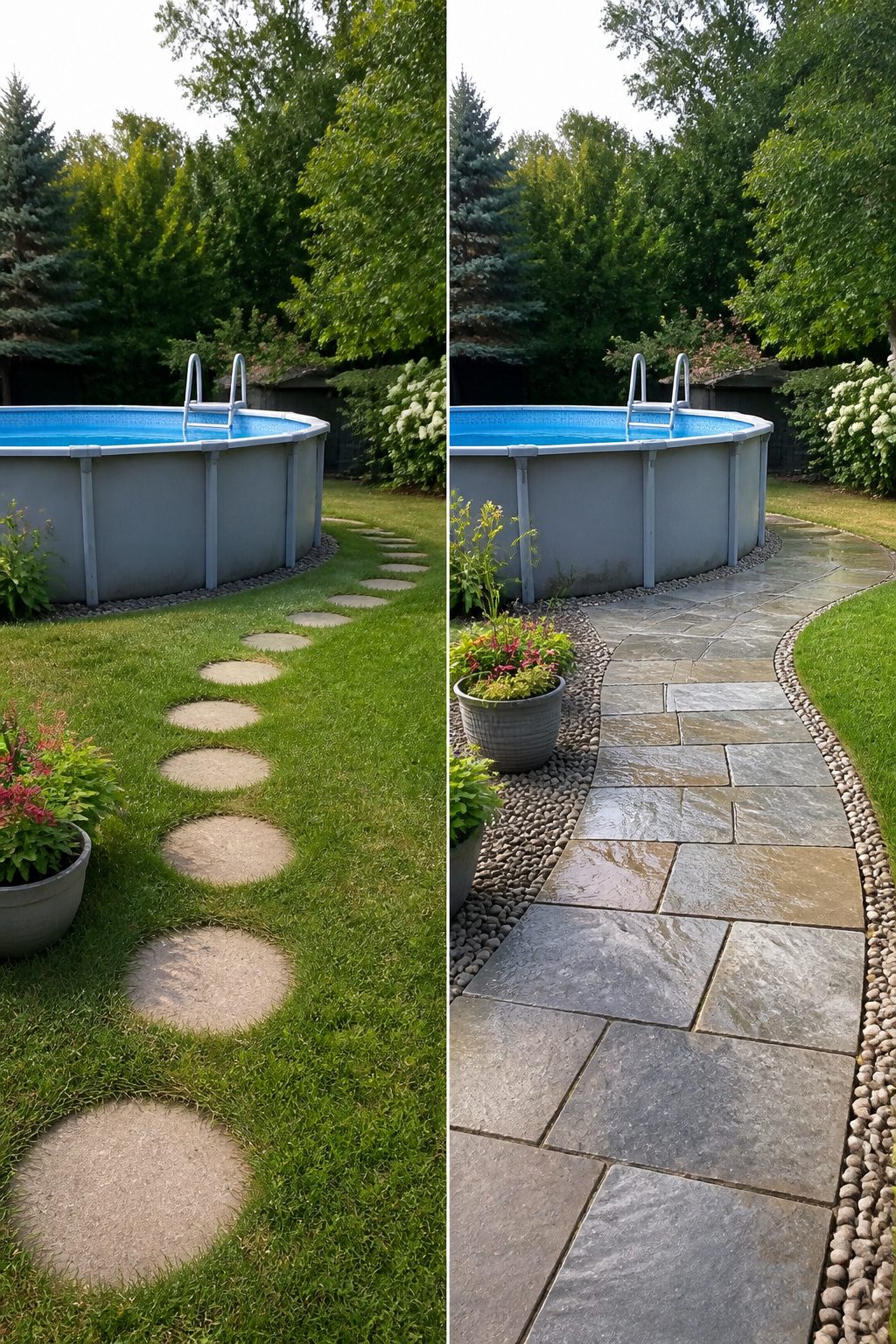
Stone pavers give this area enough weight to feel settled. Unlike gravel, they set a solid walkway on every side, and the pool stops looking like a thing that drifted onto the lawn and started looking like it belongs there.
Pavers run you more than a poured concrete pad but less than natural stone, which matters when the total budget needs to cover plants, seating, and whatever the pump does this year.
Poured concrete cracks in one line across the middle and you live with it or you tear the whole thing out.
A single paver shifts, lifts, or stains, and you pull that one piece, level the sand underneath, and set it back.
The surface stays mud-free after rain, which is the real test around a pool, and the joints drain better than a solid slab.
Keep the outer edge flush with the grass or raise it slightly so runoff from the yard does not slide straight into the water you just balanced.
Concrete pavers are the cheapest route in; natural flagstone or bluestone step up the look if the budget loosens later.
5. Wrap the Sides in Wood Cladding
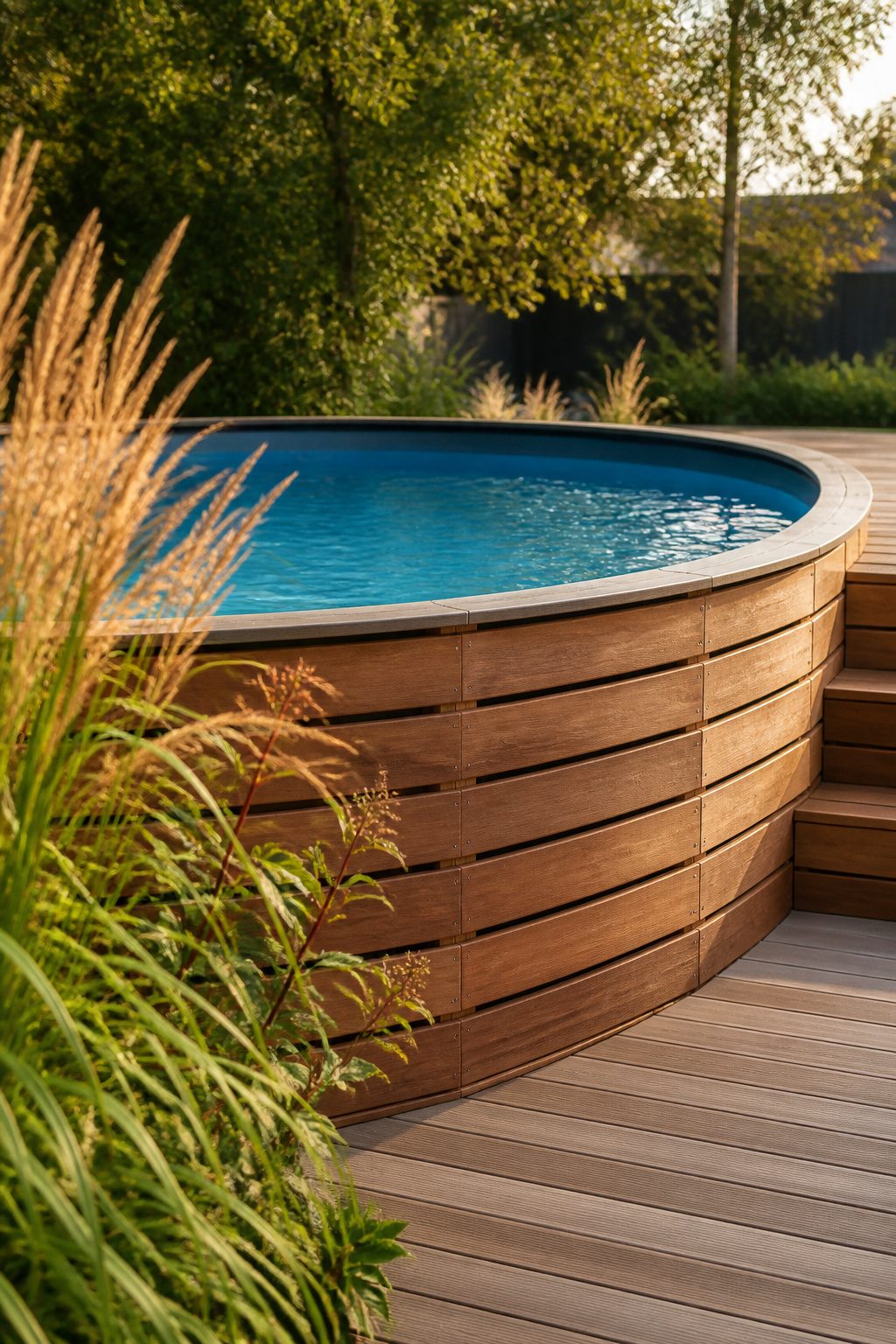
Metal walls never quite settle into a yard the way anything else does. Wood cladding fixes that.
Cedar and redwood both resist moisture and insects well enough to last, though pressure-treated pine costs less upfront and still looks warm once stained.
I have read enough build logs to know the detail that ruins most of these projects gets skipped in the planning: gaps between boards for airflow.
Without them, moisture traps against the metal underneath and the boards rot from the back out.
Horizontal boards with hidden fasteners give the cleanest face. Leave those gaps deliberate, about the width of a heavy contractor’s pencil.
Bamboo reads more tropical if that fits the rest of your space, though it holds up best in mild climates.
On doing it yourself versus hiring out, the structure is straightforward. A patient DIYer can manage the frame and boardwork over a weekend.
What slows most people is cutting around uprights precisely and keeping courses level on a circle.
If your pool wall has its original liner track or skimmer openings to work around, a carpenter charges for that puzzle-solving but usually finishes faster.
Either way, leave the bottom board slightly off the ground or the splash zone will wick water straight up.
6. Install String Lights
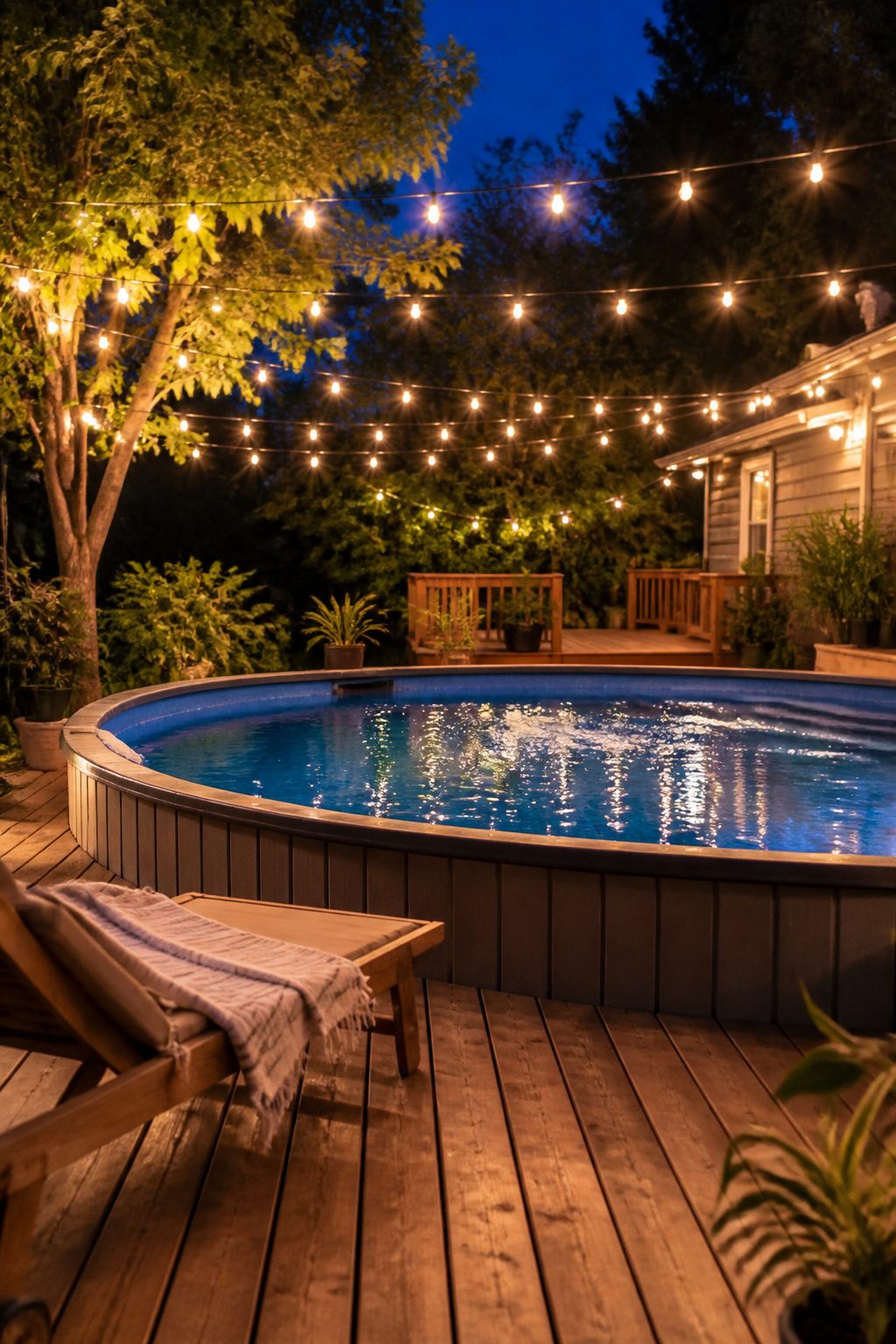
String lights are the fastest project on this list for stretching the usable hours of an above ground pool.
Hung from a pergola frame, stretched between two poles, or draped from the house to a nearby tree, they turn evening swims into something people plan around rather than stumble into.
LED vintage shatterproof bulbs have become the practical choice, since they withstand weather and rough handling better than incandescent filaments and draw less power across a long summer.
Use waterproof-rated fixtures and outdoor-rated extension cords, because any line near water needs that insulation. Zigzag patterns cast wider, more even light overhead, while perimeter draping traces the pool’s edge and keeps the glow close to where people actually sit.
Installation takes an afternoon, maybe two if poles need sinking.
The mistake to avoid is running the lowest point low enough that a tall swimmer could snag it; keep the sag at seven feet or higher, and anchor the plug end on the house side so a light rain does not pool at the socket.
7. Create a Tropical Paradise
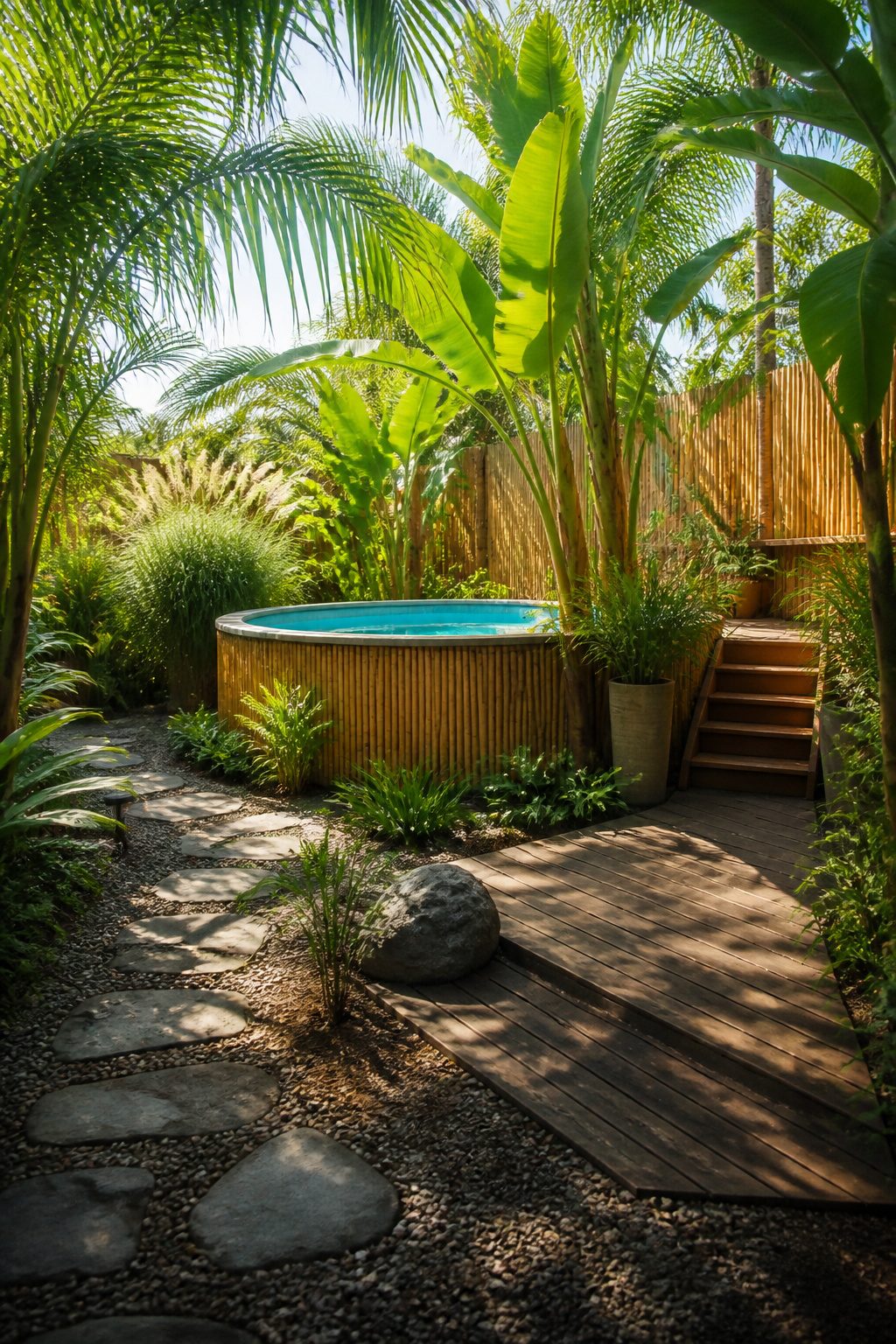
Bamboo fencing or tiki-style panels around the pool set the tone fast, and layered plantings finish the job.
Tall planters with palms or banana trees give that relaxed, vacation-screening effect, though anyone north of zone 8 will watch those die back hard or fail entirely.
Cold-hardy substitutes like bamboo, ornamental grasses, or even hardy banana roots that resprout after frost keep the look alive without the replacement cycle.
Container placement matters more than pool people let on. Roots pressing against walls trap moisture and eventually damage the shell, so planters sit on wheeled platforms or are set back with airspace.
Small movable containers also let you shift things for cleaning access, which fixed beds never do.
String lights and a thatched shade structure near the seating area stretch the usability into evening without wiring headaches.
Cedar or redwood cladding on the pool sides resists the constant splash better than pine, though bamboo cladding works only where winters stay mild enough to keep from splitting.
8. Add Seating Areas
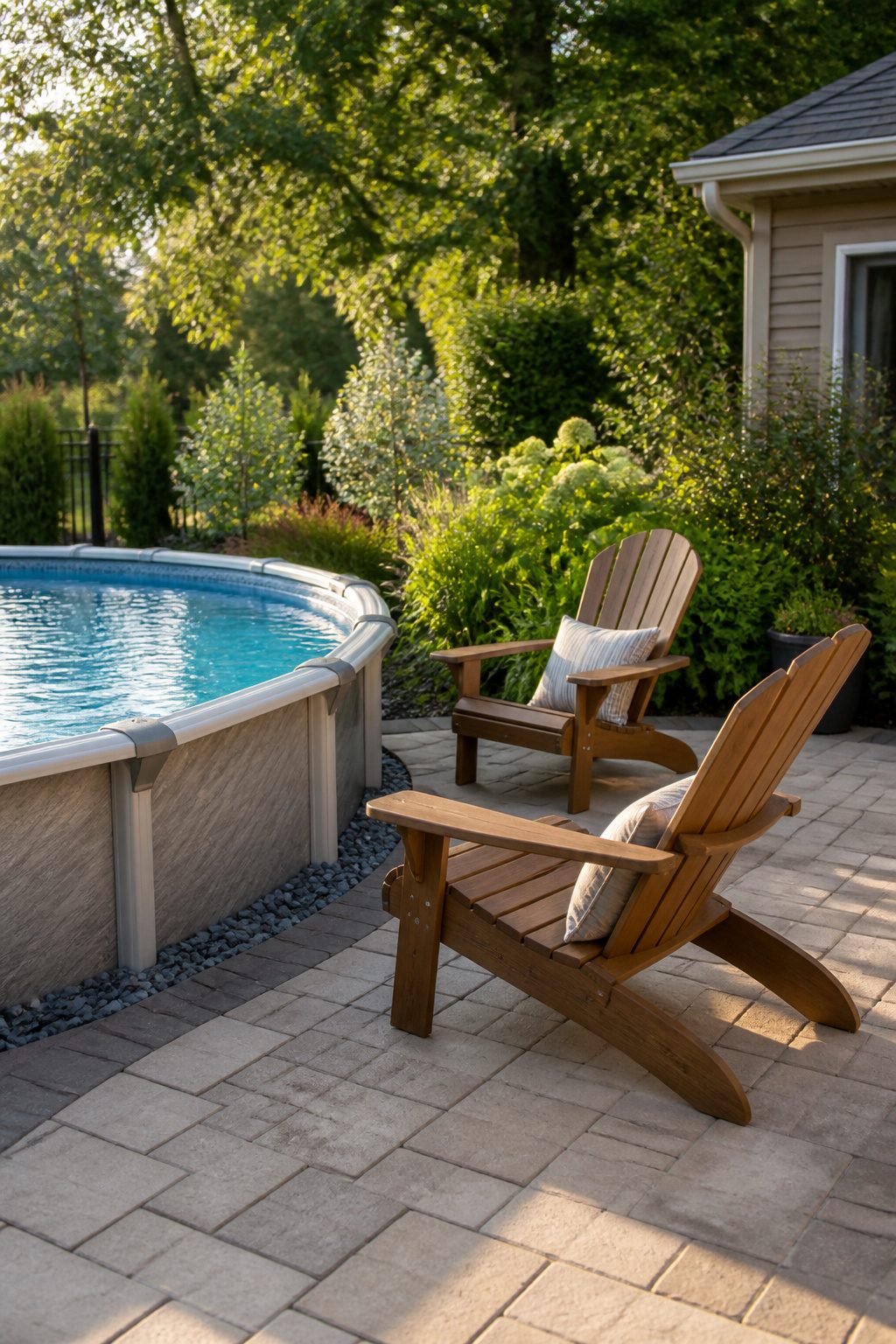
Seating around an above ground pool takes two paths, and the right one depends on how permanent your setup is.
Built-in benches along the deck edge use the space without stealing walking room, which matters on the typical 10–12 foot deck that wraps these pools.
I favor this when the deck is already going in, because the framing cost barely shifts and you are not dragging chairs out of chlorinated splash range every evening.
Freestanding Adirondack chairs on a paver pad give you the option to shift with the shade, and pavers handle chlorine spray better than wood decking, which starts showing water marks by midsummer if the chairs sit wet.
Storage-integrated seating solves the towel-and-float problem that turns pool decks into drying racks.
A bench with a hinged lid keeps the clutter out of sight, and the material choice here is whatDetermines whether you are replacing it in three years or ten.
Resin wicker and marine-grade polymer stand up to both UV and the chemical haze that rises from shock-treated water. Powder-coated aluminum works too, though the coating eventually chalks where the cushions rub.
Skip anything labeled simply "weather-resistant" without a salt-spray or chlorine-exposure rating; the vague promise is how manufacturers sell furniture that warps by August.
Position seating to face the pool and catch afternoon shade from a fence or structure. That last detail is worth more than the seating itself on a July day when the deck surface hits 120°F and nobody sits down anyway.
9. Hide the Sides with Shrubs
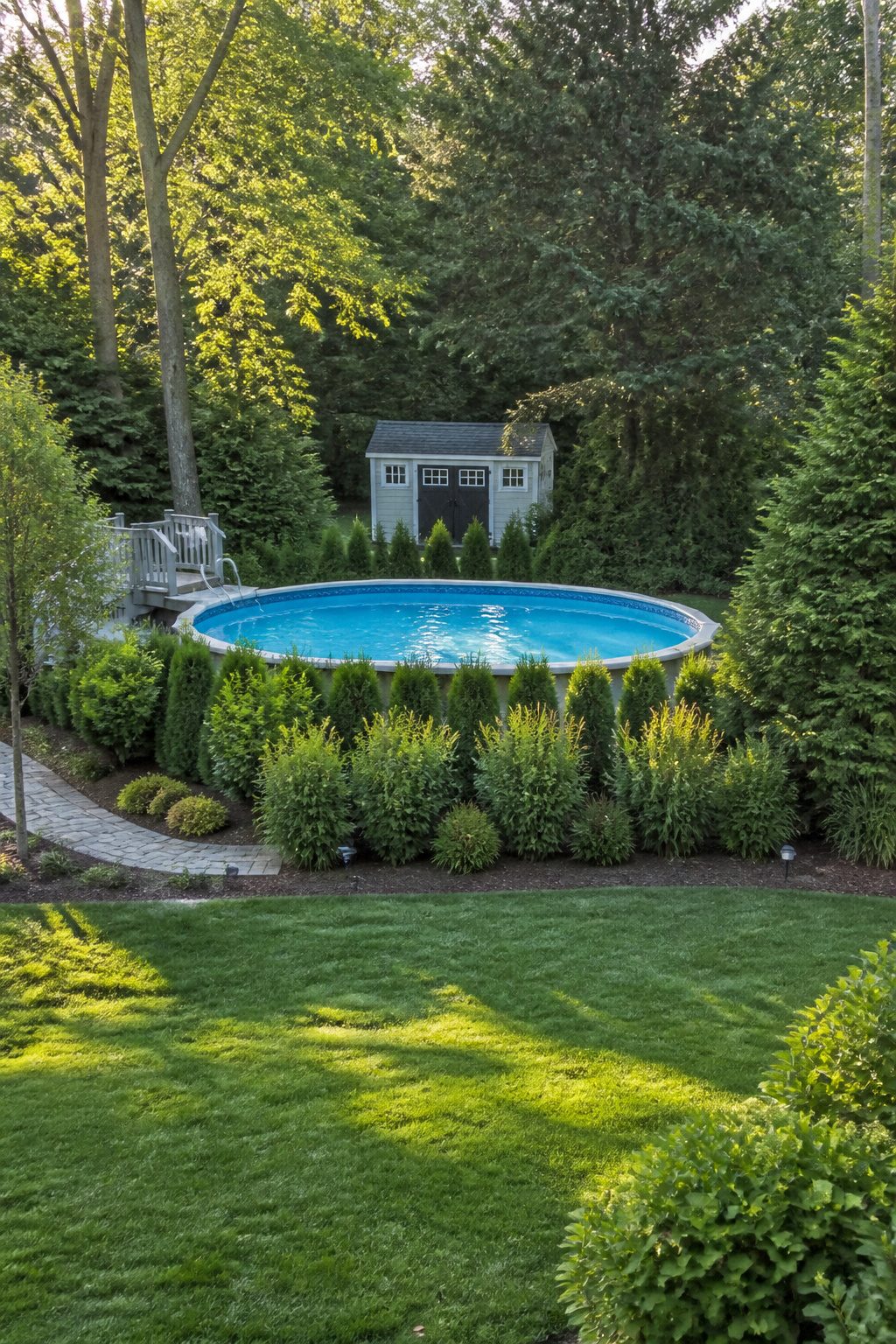
Dense shrubs planted close to the pool perimeter will conceal the walls over a season or two, but the real work is choosing plants that do not become a maintenance headache.
Arborvitae grows fast and stays narrow, which makes it practical for tight side yards where you do not have room for something that sprawls.
Boxwood gives a more formal, sculpted look if you want the structure to read as intentional rather than hidden.
Holly and other evergreen options keep the wall covered in winter when deciduous shrubs drop their leaves and leave you staring at bare branches.
Leave 18 to 24 inches of clearance between the plants and the water, otherwise you will spend your afternoons skimming.
That buffer matters most for what you rule out: anything that drops seeds, fruit, or heavy petals belongs somewhere else in the yard.
Ornamental grasses like Feather Reed Grass or Maiden Grass add movement and texture at three to five feet tall, and they do not litter the way flowering perennials do.
Skip the black-eyed Susans and coneflowers here; save them for a bed farther from the pool where their debris is not your problem.
10. Use a Semi-Inground Design
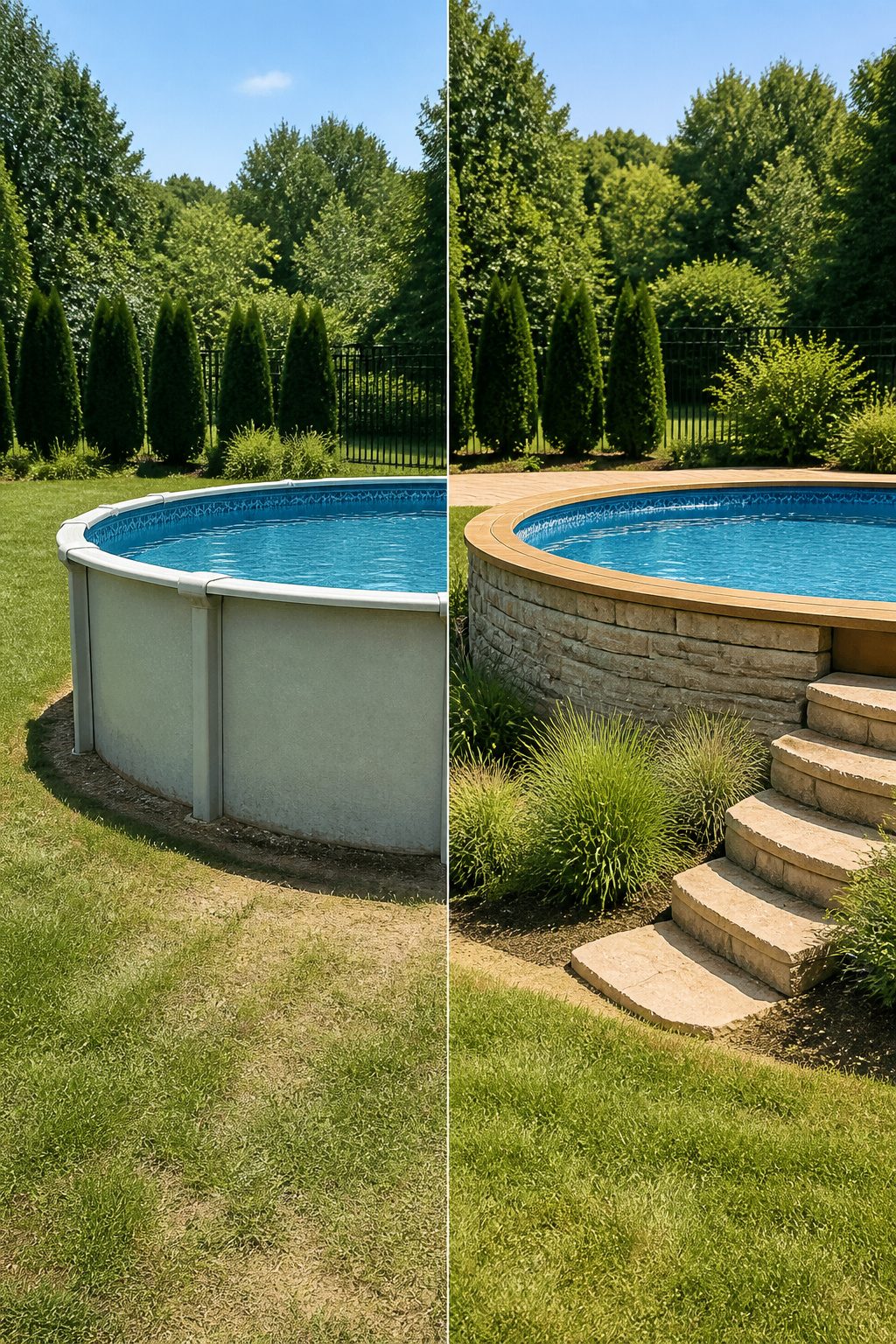
A semi-inground pool sits partly below grade, which changes how the whole yard reads from the curb.
The top edge can sit flush with a deck on the uphill side while the lower wall stays exposed; clad that visible wall in stone veneer, brick, or timber and it starts to look architecturally intentional rather than apologetic.
Excavation and a retaining wall are not optional here, and most people will need professional installation. On a sloped lot, the real advantage is not having to level the entire yard.
One side of the pool drops deeper while the other remains at or near original grade, held back by a stone or concrete-block wall that doubles as the visual base of the pool.
Gravel or textured panels around the exposed perimeter manage drainage and keep the pool edge from turning to mud every time it rains.
Low shrubs or ornamental grasses planted along that retaining wall soften the structure and help it settle into the surrounding yard.
A short flight of stone steps leading down toward the pool finishes the transition and keeps the whole thing from looking like a workaround.
11. Incorporate Water Features
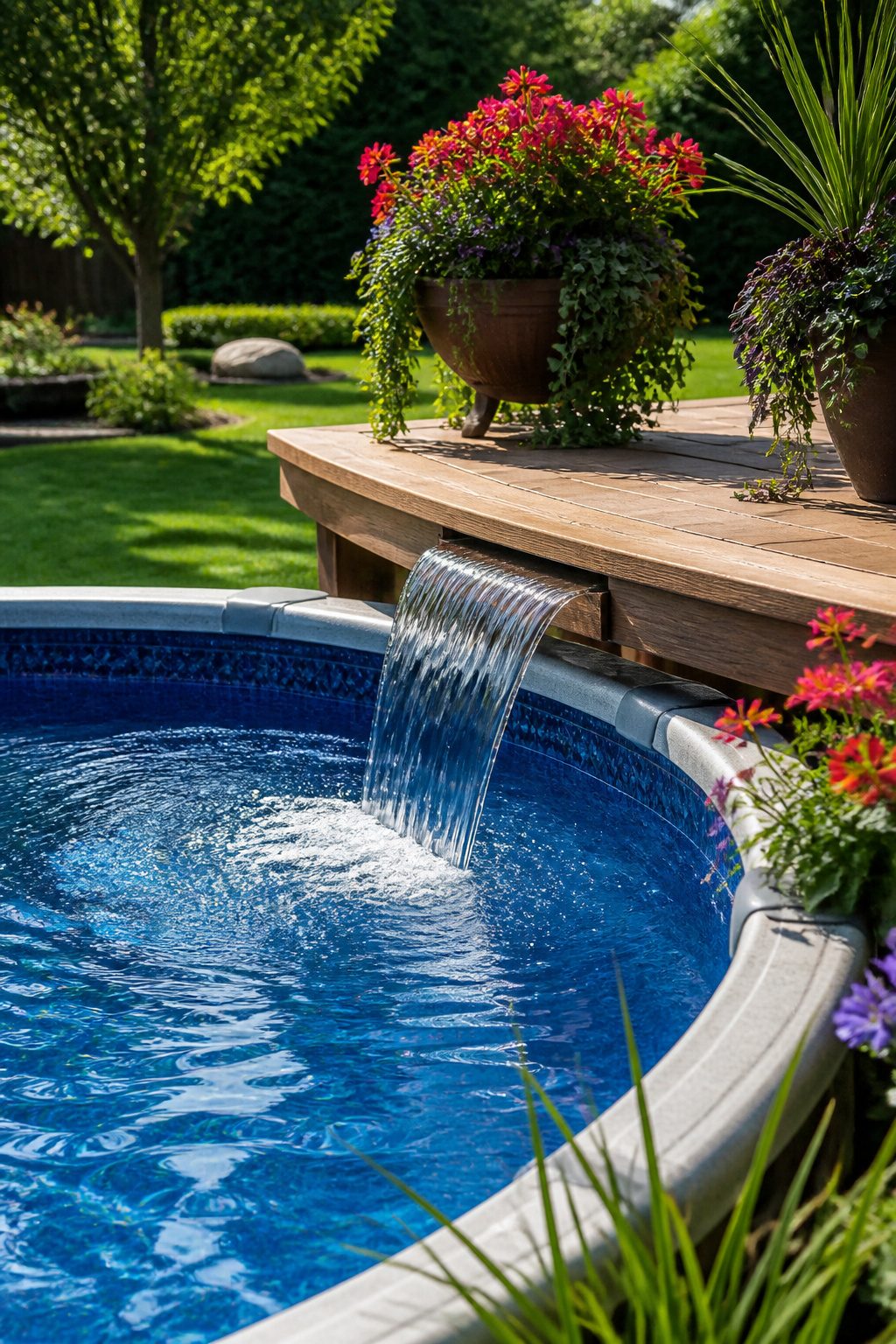
Water that moves catches the ear better than water that sits.
Last summer I watched a neighbor rig a small deck-mounted waterfall above her pool’s edge, nothing more than a scupper spilling over the coping, and the sound carried across the whole yard.
She had not plumbed into the pool itself; the feature recirculated its own small reservoir, so her filtration system stayed untouched.
Solar-powered pumps make this simpler now. A small panel stakes into the ground nearby, runs a fountain jet or a narrow arc of water from the pool return, and costs nothing past the initial kit.
The calm that running water brings is real, though you have to place it where you will actually hear it from your usual chair, not tucked behind the ladder where the noise disappears into the fence.
What turned me against the idea at first was maintenance. Leaves collect in any basin, and algae grows faster where water splashes and evaporates.
My neighbor’s scupper needed clearing twice a week in July. The tradeoff is yours: the sound is worth the scooping, or it is not.
12. Create Privacy Screens
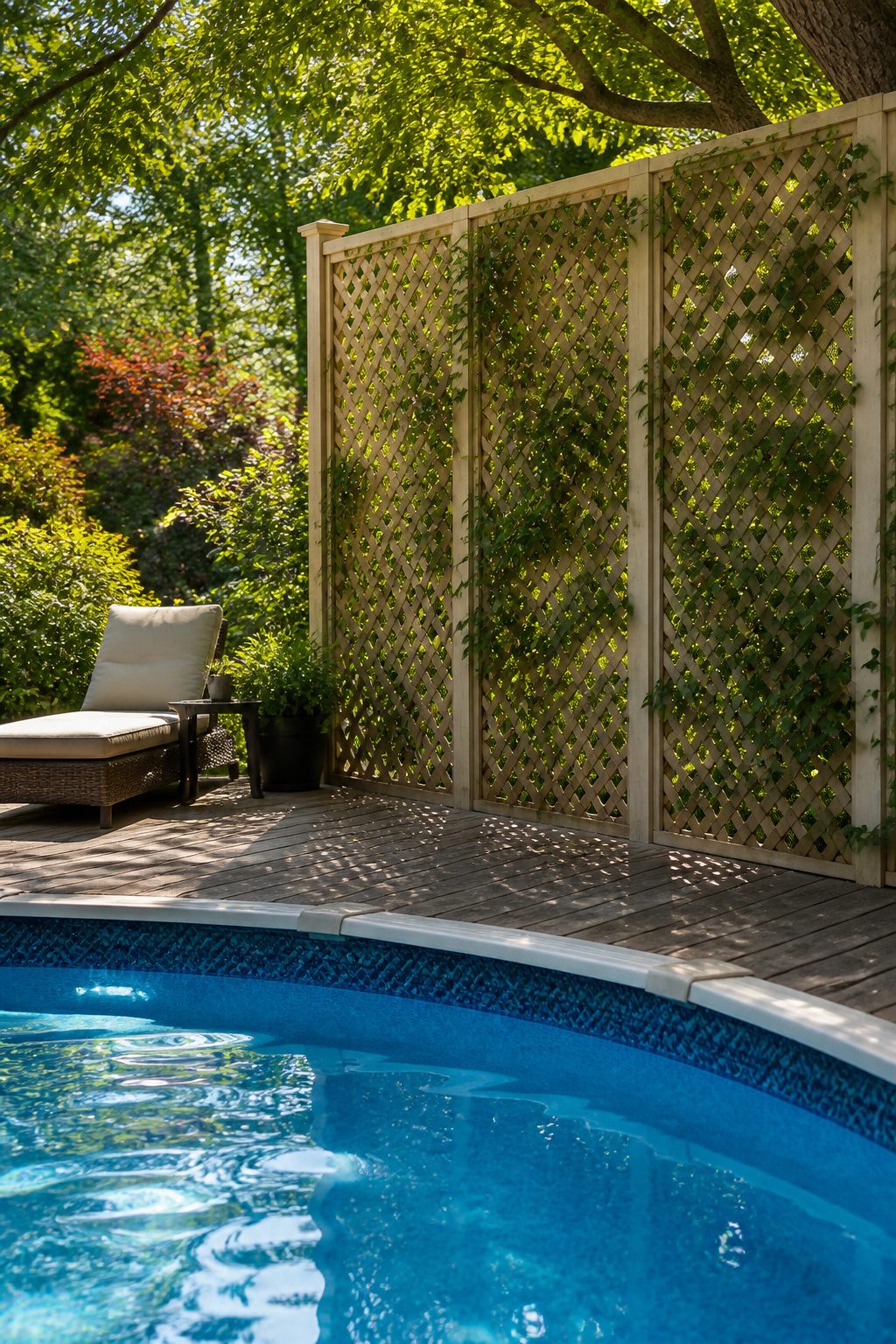
Privacy screens around an above ground pool run into a hard limit before aesthetics even start: most local codes require a fence at least 48 inches high around any pool deeper than 24 inches, and that includes above ground pools.
The pool wall itself can serve as that 48-inch barrier if it meets the height, but your ladder needs to be removable or lockable.
If you are adding a privacy screen on top of that, plan from the code up, not the other way around.
Lattice panels rank as the cheapest starting point, especially when you let clematis or ivy climb them into a living wall.
Slatted wood fencing reads cleaner and moves more air, which matters on a pool deck where still heat collects fast.
Bamboo roll screens or outdoor fabric stretched on a cable frame work for renters or anyone who wants to move the boundary later.
The placement trick is height that blocks the sightline from neighboring windows without dropping afternoon shadow across the water.
I have seen yards where a solid screen turned the pool into a cave by four o’clock because no one checked the sun path first.
Wind needs a path too; solid panels create a sail effect, while gaps or lattice let summer breeze through.
If your screen doubles as a legal fence, self-latching and self-closing gates are non-negotiable where children are present, and the walkaround surface needs to be non-slip whether it is broom-finished concrete or deck paint with grit additive.
Consider the screen part of the safety system, not decoration wearing a compliance hat.
13. Use Color Strategically
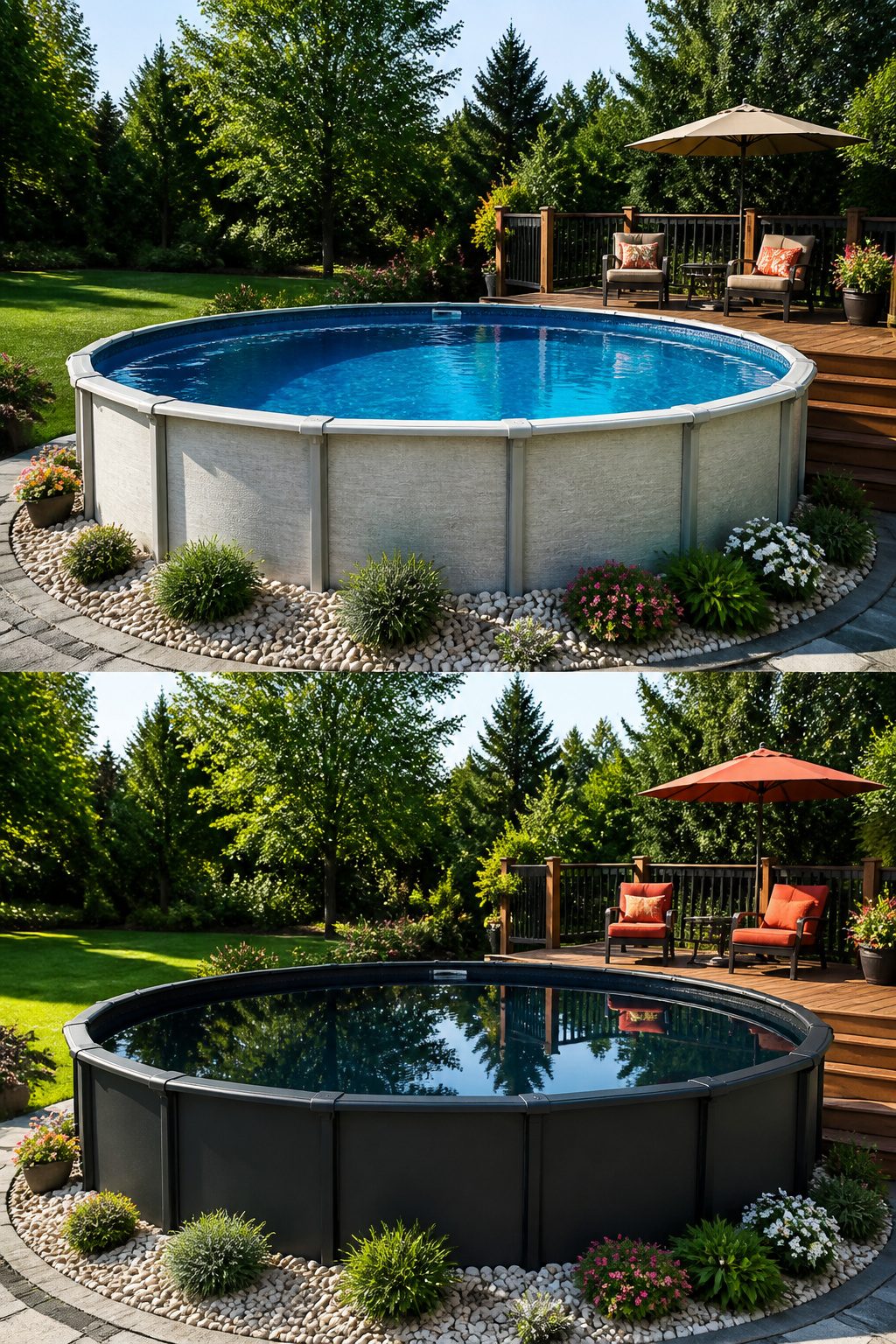
The liner color you choose does more than change the look. A dark liner makes the water read as deeper and more polished in natural light, and it absorbs extra heat from the sun on cooler days.
A light liner, soft blue or gray or white, pushes the tropical feel harder and keeps the water temperature down where summers run hot.
Painting the pool wall itself is the move most people skip. Stock charcoal, deep green, or warm sand reads as intentional where factory beige looks like storage.
The exterior paint needs to be outdoor or pool-specific, waterproof and chemical-resistant, or it will bubble by August.
From there the color has to travel. Cushions, umbrellas, and planter boxes should carry that same tone onto the deck.
Charcoal pool walls with charcoal-stained decking and a single warm sand on the seat cushions pulls the whole area together; mixed palettes make an above-ground pool read as the thing the yard got stuck with rather than the thing the yard was built around.
String lighting and simple outdoor rugs can bridge the gap, but the base decision is the liner and the wall, and everything else follows.
14. Install a Pergola
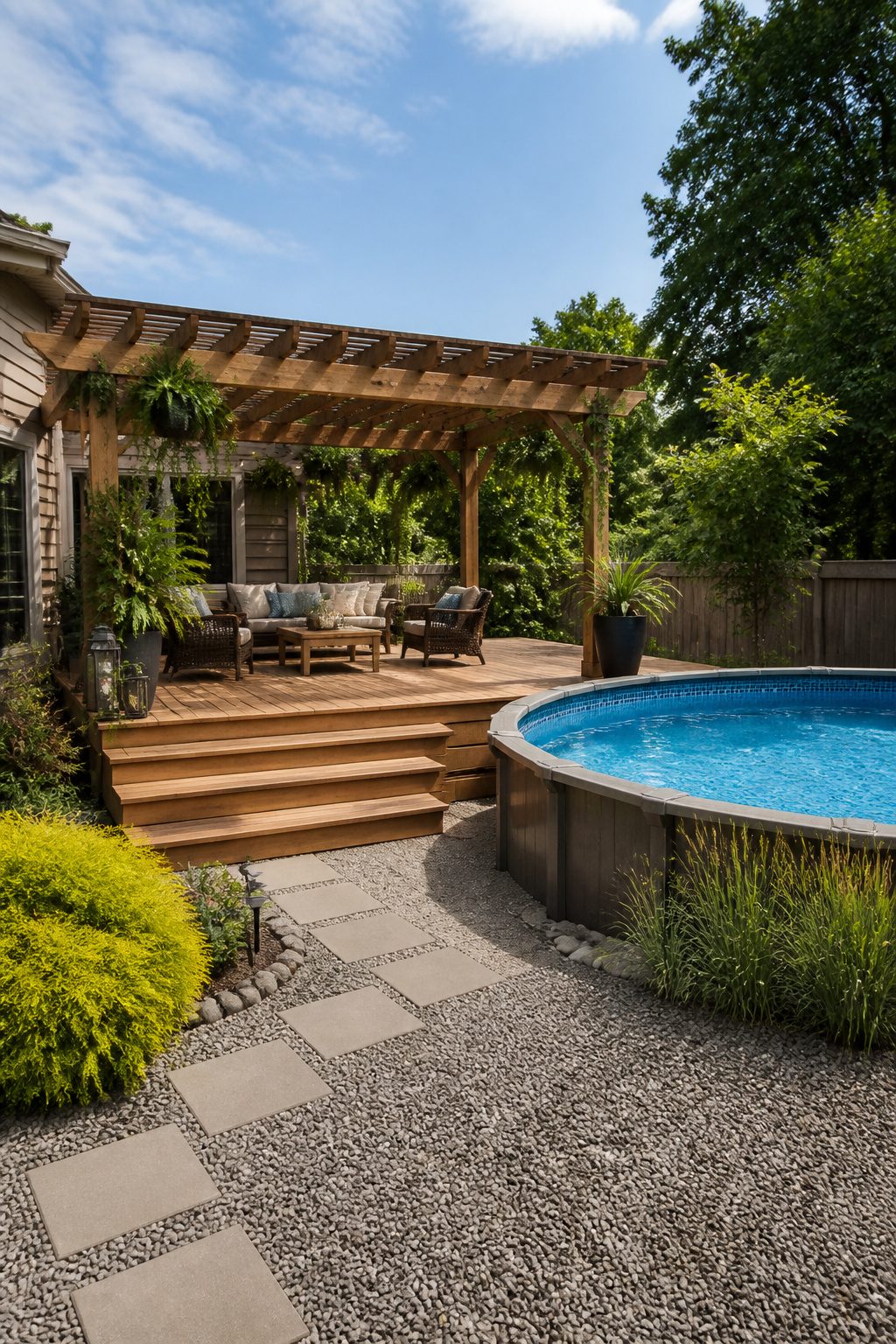
A pergola does what an umbrella cannot: it fixes a lounging zone beside the pool so people actually stay outside after swimming. I have watched this shift happen.
The structure turns the bare deck into a room with a roof of slatted beams, open enough for air but dense enough to drop real shade during the hot hours.
Material comes down to maintenance tolerance. Wood needs sealing every couple of seasons; metal holds up longer but carries a harder visual line.
Either works with outdoor curtains hung along the sides for privacy from neighboring yards, or string lights and a ceiling fan wired to the center beam.
The real choice is whether to anchor the pergola directly to the pool deck or keep it freestanding beside it. Anchoring saves space and keeps traffic flow tight; freestanding lets you move it if the pool layout ever changes.
Both are weekend builds for a competent DIYer, though a louvered roof adds a day.
Climbing vines on the posts change the math entirely. Clematis or ivy started in year one will soften the frame by year three, threading green through the beams until the pergola reads as planted, not built.
That living fill does what curtains cannot: it thickens with age instead of fading.
Cost sits in the middle of the project range, but the visual lift is immediate. For a pool area that still looks temporary, this is the single piece that makes it feel finished.
15. Utilize Stock Tank Pools
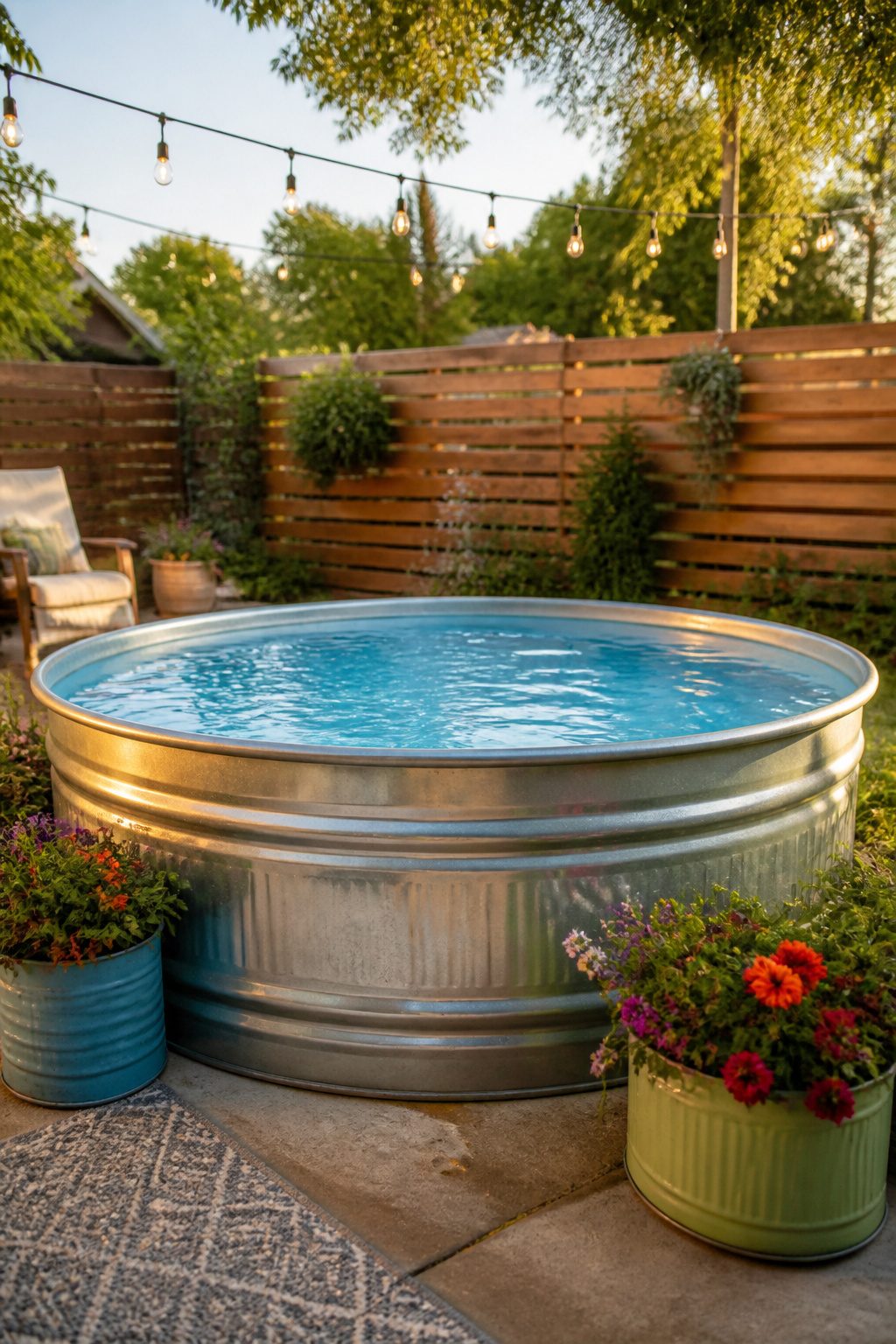
A stock tank pool can sit on a patio, a sliver of yard, or even a balcony that can take the weight, and a few hundred dollars plus a weekend gets you water you can step into.
The galvanized steel shell, the same kind built to water livestock, lasts for years with basic care and cleanup that takes minutes, not an afternoon.
Costs climb fast if you want bigger diameters, a small filter system, or a wooden surround to step onto instead of cold metal. Projects start around a few hundred dollars and run past $2,000 once you add the finishing pieces.
Renters like the deal because the whole thing bolts back apart when the lease ends.
Gardeners who are not sure they want a full above-ground installation yet can trial the lifestyle, see how often they actually swim, and decide next season with real numbers behind them.
The industrial look is hard to hide, so most people do not try.
Matte black fixtures or exposed piping play it up, and in tight backyards a painted fence mural or bold wall behind the tank turns the metal into a deliberate focal point.
String lights overhead and metal planters with hardy plants keep the edges from feeling too spare without fighting the material.
16. Add a Fire Pit
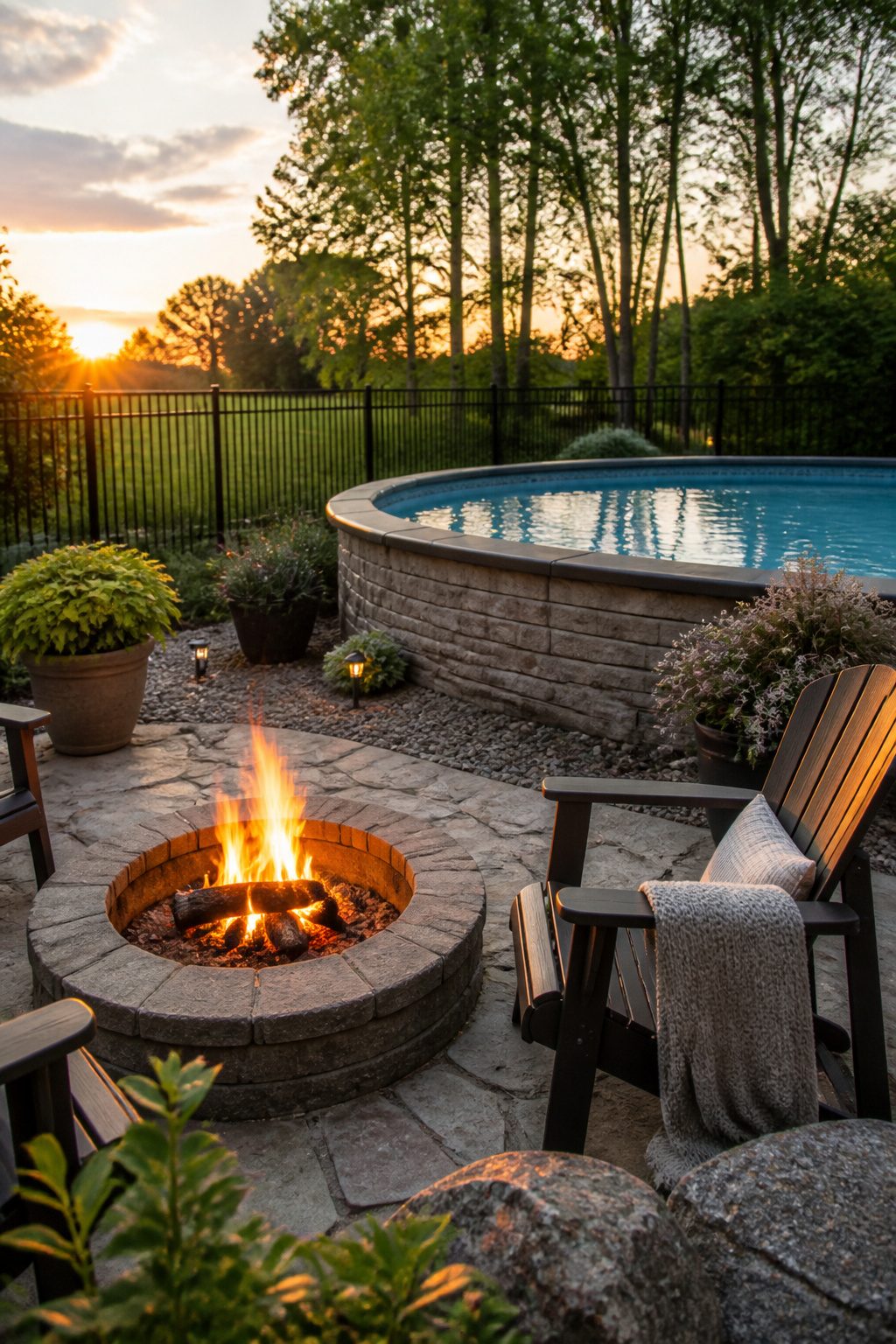
A fire pit turns the pool from a daytime-only fixture into an evening gathering spot.
Placement is where most people trip up, because the same setback rules that keep your above ground pool 5–10 feet from any house or shed wall also govern where the fire can sit.
Gas lines run cleanly and stop when you hit the switch, but a wood fire throws sparks that matter more near synthetic pool walls and overhanging patio covers.
Check local open-burn restrictions before you size anything; many western and drought-prone counties ban wood burning outright during summer months, which is exactly when you are out there after swimming.
My own backyard runs propane for that reason, and the trade is worth it for the hours gained once the water gets too cool for kids but adults still want to stay outside.
Keep any flame source at least ten feet from the pool wall and any vinyl liner, and confirm that distance against your town’s adopted fire code, not just the pool ordinance.
17. Use Decorative Tile Accents
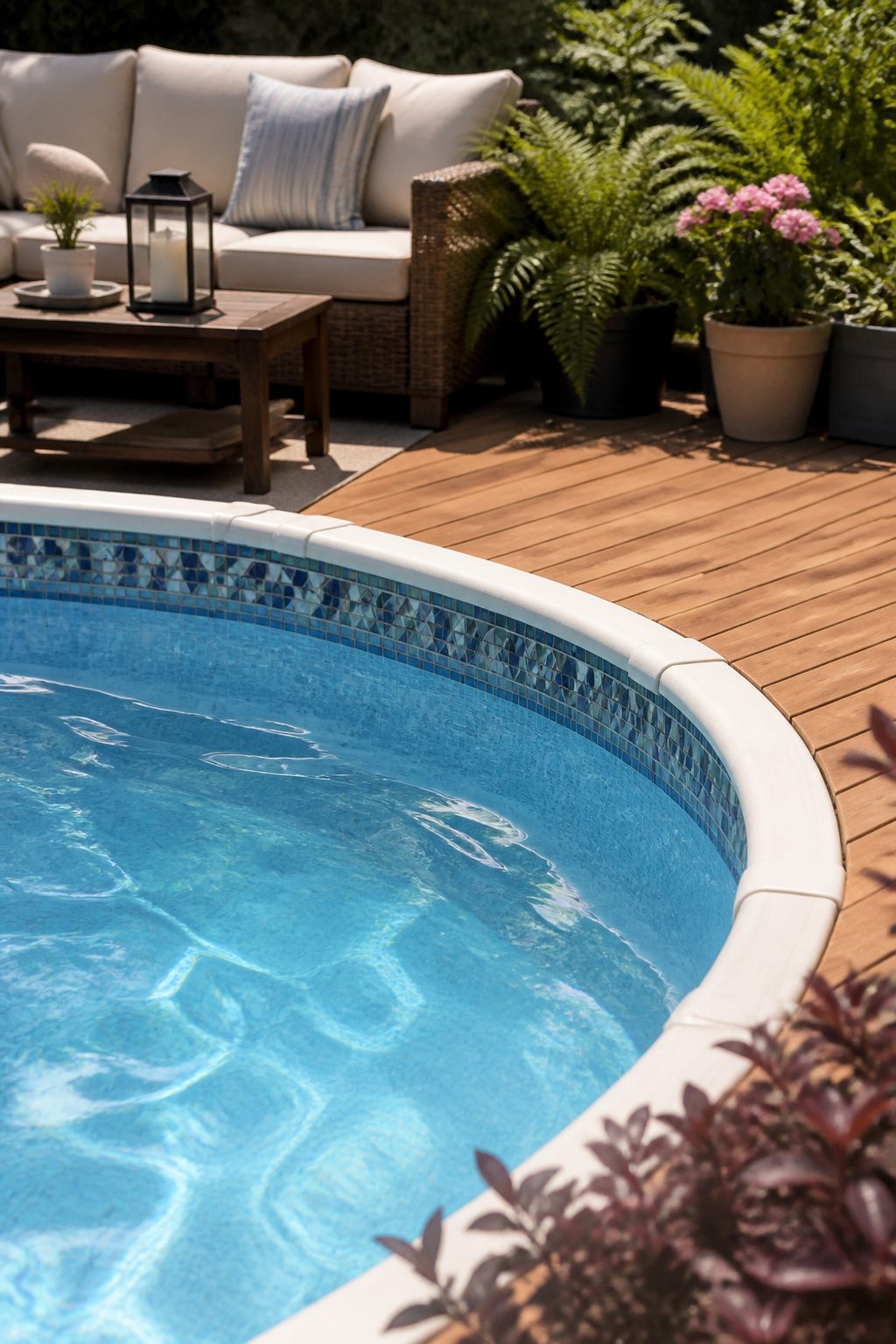
Full tile on an above ground pool is a project that can run past the cost of the pool itself and commit you to weeks of prep and sealing.
Accent strips, a medallion at the ladder base, or a coping band give you pattern and polish without that scope.
A six-inch mosaic strip where the rim meets the deck catches light and draws the eye without dominating the whole structure.
Placement matters more than density. I would put the accent where people pause: the top of each step, the handrail post base, the coping edge that faces the seating area.
These are the sightlines you actually use, not the far side you see from the kitchen window.
For pattern, small geometric tiles read as texture from a distance and keep the look clean. A busy floral or large motif fights the curve of the pool wall and can look like a repair rather than a choice.
I have seen medallions work best when they are scaled to the width of the top rail itself, not spilling over the sides where they have to be cut awkwardly.
18. Create a Zen Rock Garden
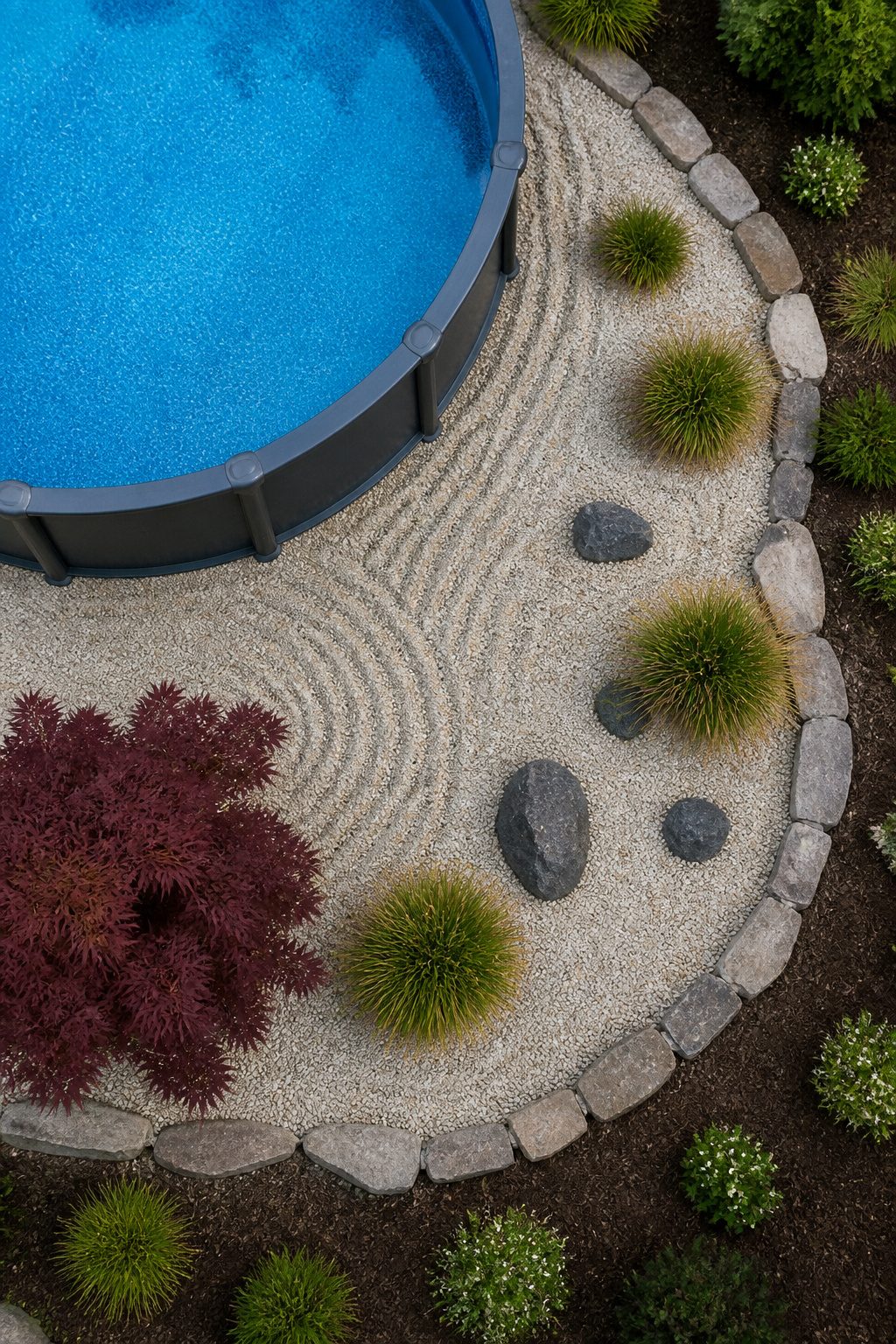
A ring of pale gravel raked into slow arcs around the pool does most of the work. I learned that the hard way after watching my first attempt wash into the grass every rainstorm.
Now I use a shallow stone edging set just below grade to hold the line, and the maintenance drops to raking twice a season.
Natural stone in soft grays and warm tans gives the only color the water reflects back. Ornamental grasses, feather reed or blue fescue, go in loose clusters at the corners and wherever the gravel meets a fixed edge.
They move in the breeze, which is the point: stillness in the stone, motion in the grass. A Japanese maple, the dwarf dissectum types, works tucked against a fence where afternoon sun would burn anything else.
Bamboo in a contained planter gives height without the root invasion that makes neighbors call code enforcement.
The whole style asks for minimal hardscaping. Concrete or wide pavers fight the calm; stone dust paths barely wider than a foot fit it better.
Water use stays low once the grasses establish, and the gravel never needs mowing. The mistake is overdoing it.
One specimen tree, three grass clusters, and the rest open ground. More than that, and the quiet becomes clutter.
19. Build a Pool House or Storage Shed
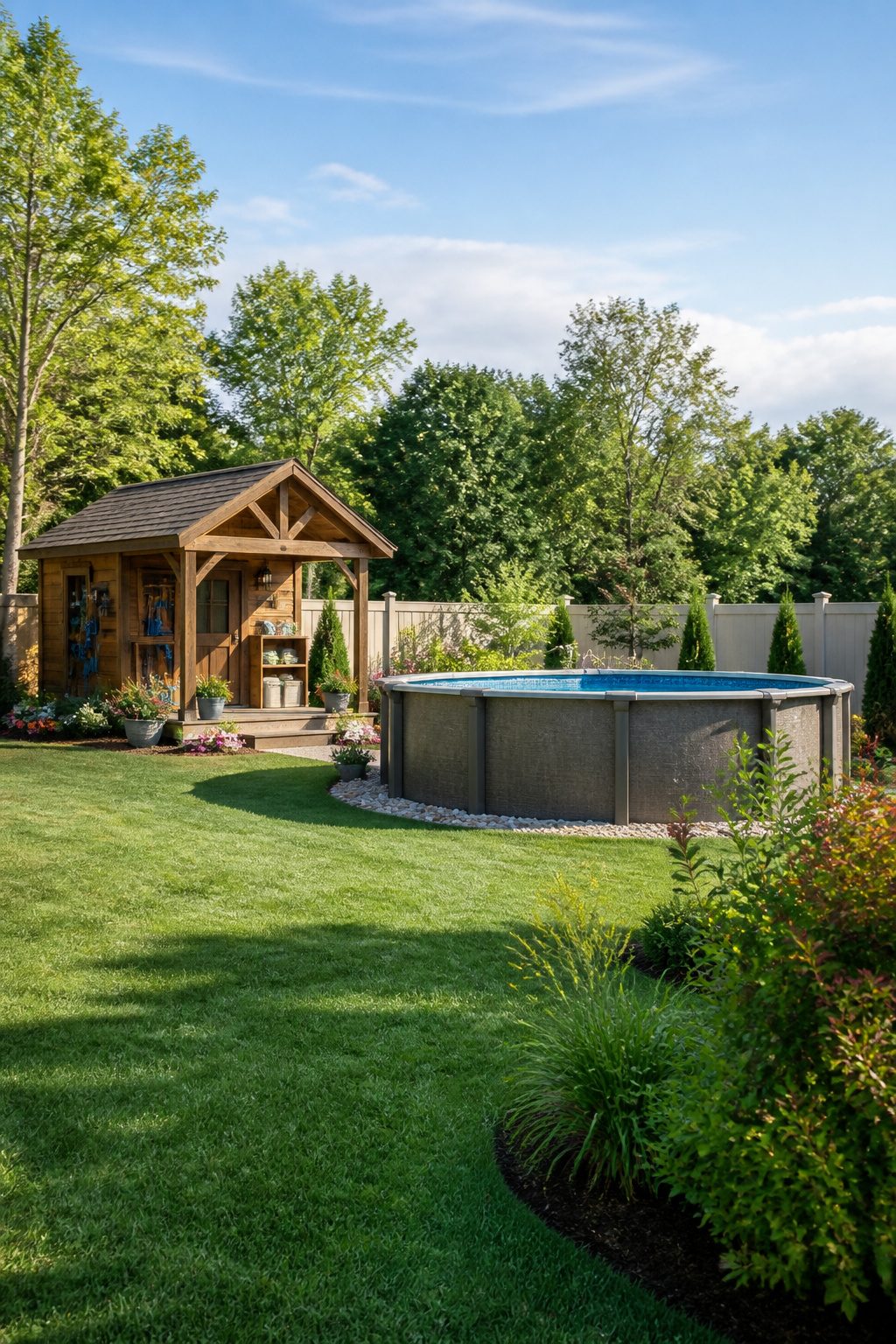
A small structure at the edge of an above-ground pool pulls double duty. It stores the mess and gives the eye something deliberate to land on.
Chemicals, floats, and the vacuum hose that otherwise migrates across the lawn finally have a wall to live behind.
A bench with a hook rail and a small cabinet built into the fence line handles most of this in a tighter space, but a painted shed or a proper pool house with a changing room anchors the far end of the pool in a way nothing else does.
Above-ground pools install in 1 to 3 days, so it is easy to forget that a permanent structure needs planning, permits, and a foundation decision that the pool itself does not.
I would decide on the shed before the yard is torn up for the pool base, because walking equipment across fresh grading is not a detail you want to solve after the fact.
20. Install Outdoor Lighting Fixtures
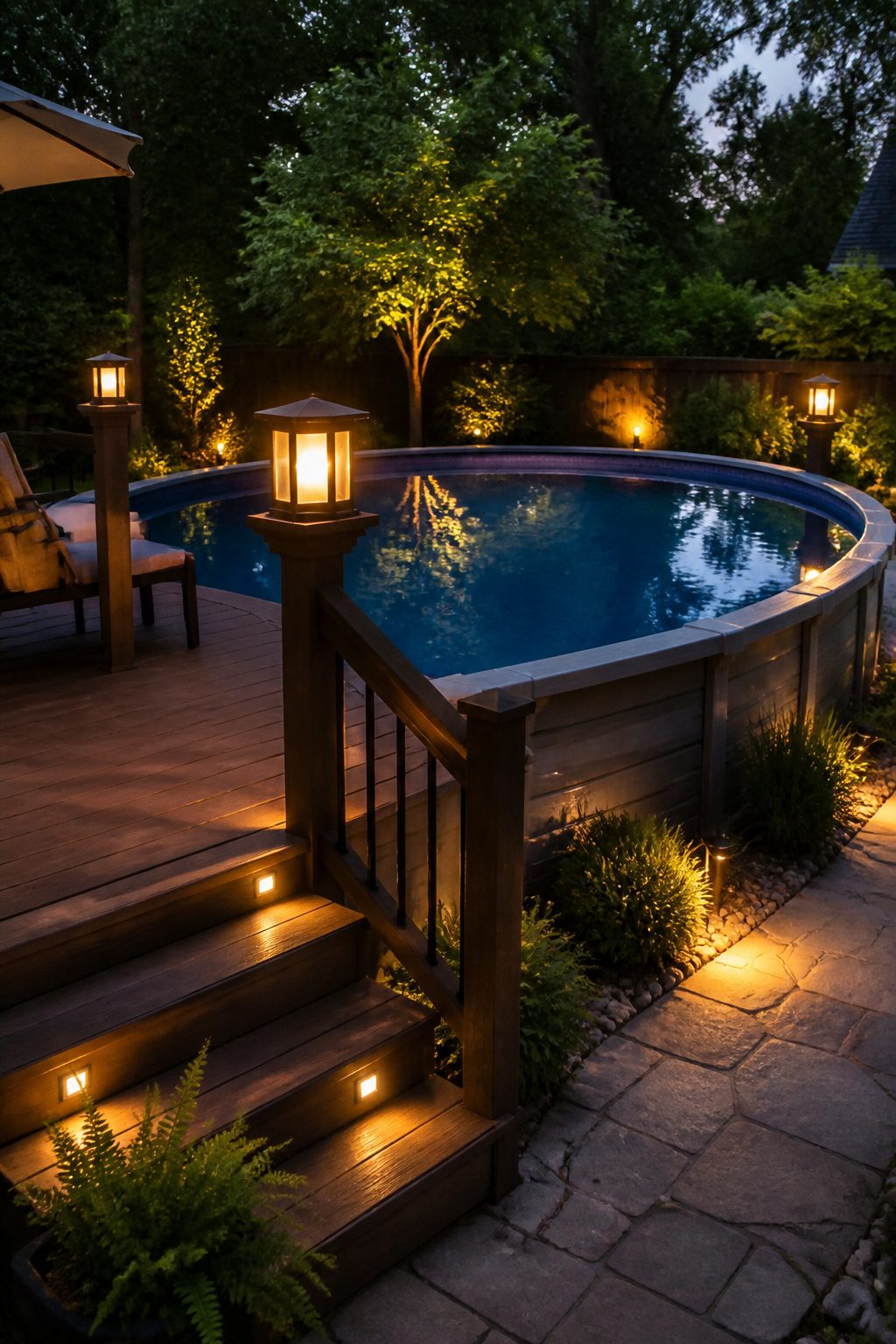
Permanent fixtures do more for an above-ground pool than string lights ever will.
Wall-mounted sconces on a fence or nearby structure, post-mounted lanterns at deck corners, and recessed deck lights built into the boards themselves all add architectural weight that solar stake lights simply lack.
Hardwired fixtures last longer and perform more consistently, though plug-in weatherproof pathway lights on a timer offer a workable middle ground if you are not ready to commit.
Safety lighting matters most on steps and deck edges where bare feet and water meet. Most above-ground pools have a returns port that accepts an aftermarket LED light fitting, which gives the water a glow closer to an in-ground installation.
Solar-powered perimeter lights along the deck edge or pool pathway serve both safety and visual function, while low-voltage landscape lighting integrated into the surrounding garden adds depth without electrical complexity.
The wiring decision should account for how long you plan to keep the pool. Above-ground pools typically last 7–15 years, so a major hardwired investment only pays off if you are staying in that range.
Solar avoids the upfront labor and cost entirely, but performance varies with your specific sun exposure.
21. Match the Pool to an Outdoor Fireplace
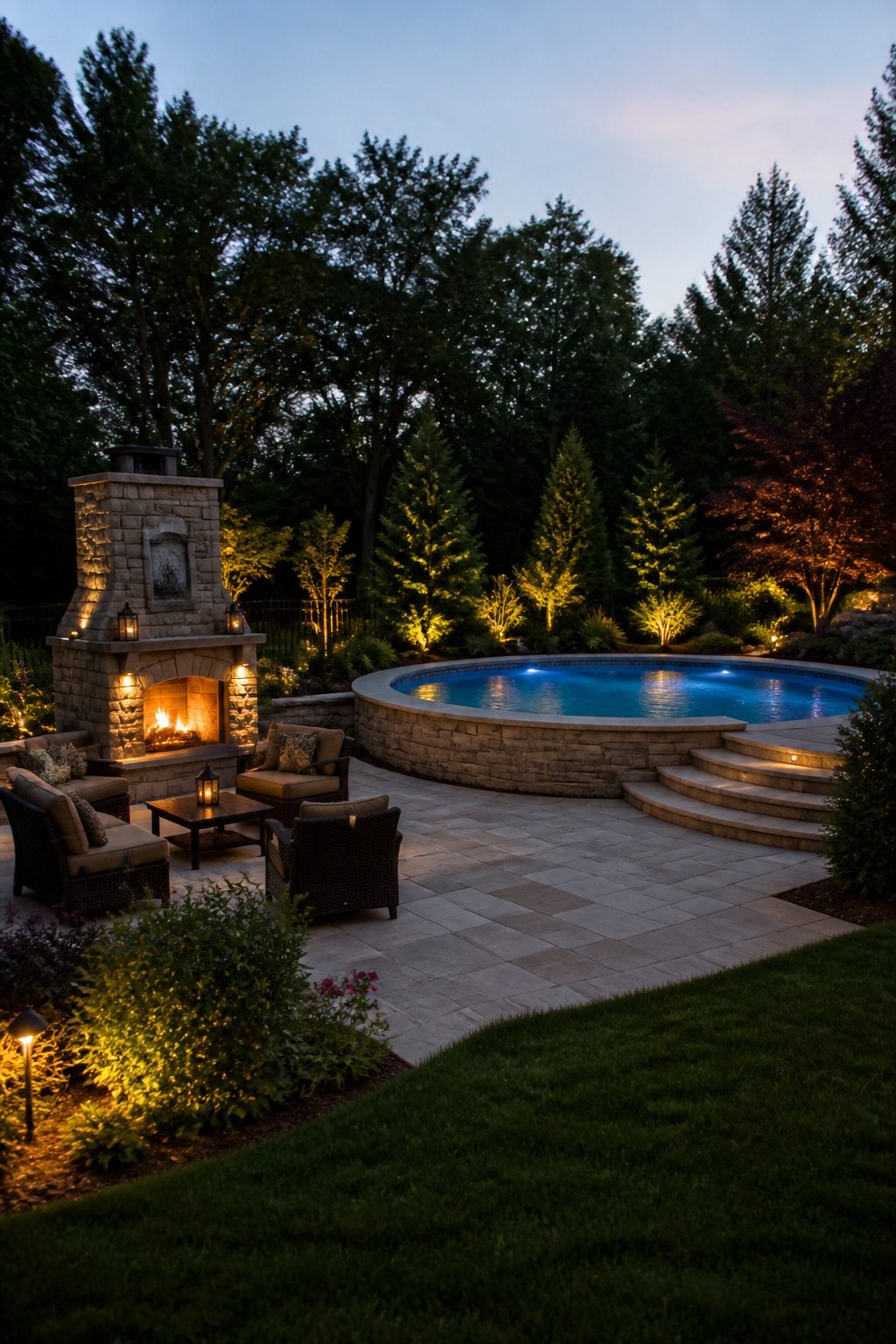
A fire feature near the pool creates a gathering zone for the hours after swimming when the air cools down. The same stone on the pool walls as on the fireplace ties the two pieces into one outdoor room.
If the fireplace is built with brick, bringing brick into the pool deck does the same work. Stucco or stacked fieldstone can play the same linking role.
The space between them matters as much as the match. Seating has to sit close enough to both that guests move from water to warmth without crossing a lawn.
That strip of patio becomes the living room floor, and it needs real furniture, not just a few folding chairs. A matching pool, fireplace, and seating area turns the yard into a whole entertainment system outside.
This pairing runs higher than most pool projects. The fireplace, the hardscape, the coordinated materials all add up.
The payoff is a resort-like space that gets used past sunset, which is when most pool days actually end.
22. Incorporate a Dedicated Seating Area
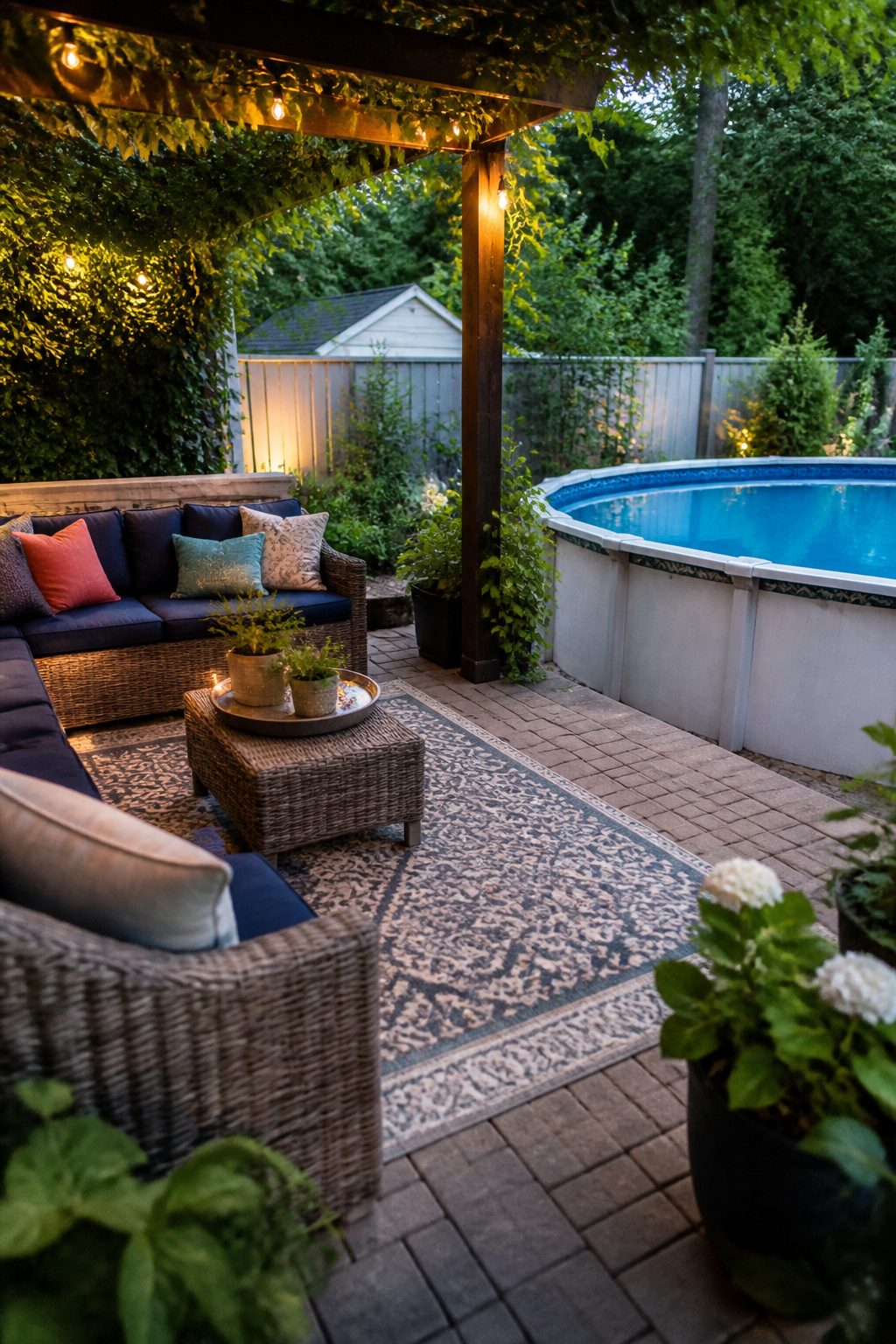
A few dragged chairs on the lawn will not do it.
What separates a usable pool area from one you stay in is a defined zone with its own surface, shade, and furniture arrangement, so the pool becomes one room and the seating becomes another.
I laid my first attempt on grass, and the chairs sank unevenly within a week. Pavers or a deck extension, even a modest one, fix that.
An outdoor rug on top brings the furniture together the way a rug does indoors; without it, Adirondack chairs or a sectional just float.
Shade placement matters more than most people figure. Bowls soup out west from morning sun, but the relentless afternoon light is what drives you inside.
Position the seating so a fence, a freestanding gazebo, or a louvered four-post structure blocks that western exposure.
I have seen afternoon shade extend usable hours by two or three, which is the difference between a swim-and-flee setup and somewhere you actually stay.
Built-in bench seating along a deck perimeter uses space efficiently and eliminates the seasonal furniture shuffle. Face it toward the pool so the people in chairs and the people in water share the same moment, not two separate afternoons.
Decking Materials Compared
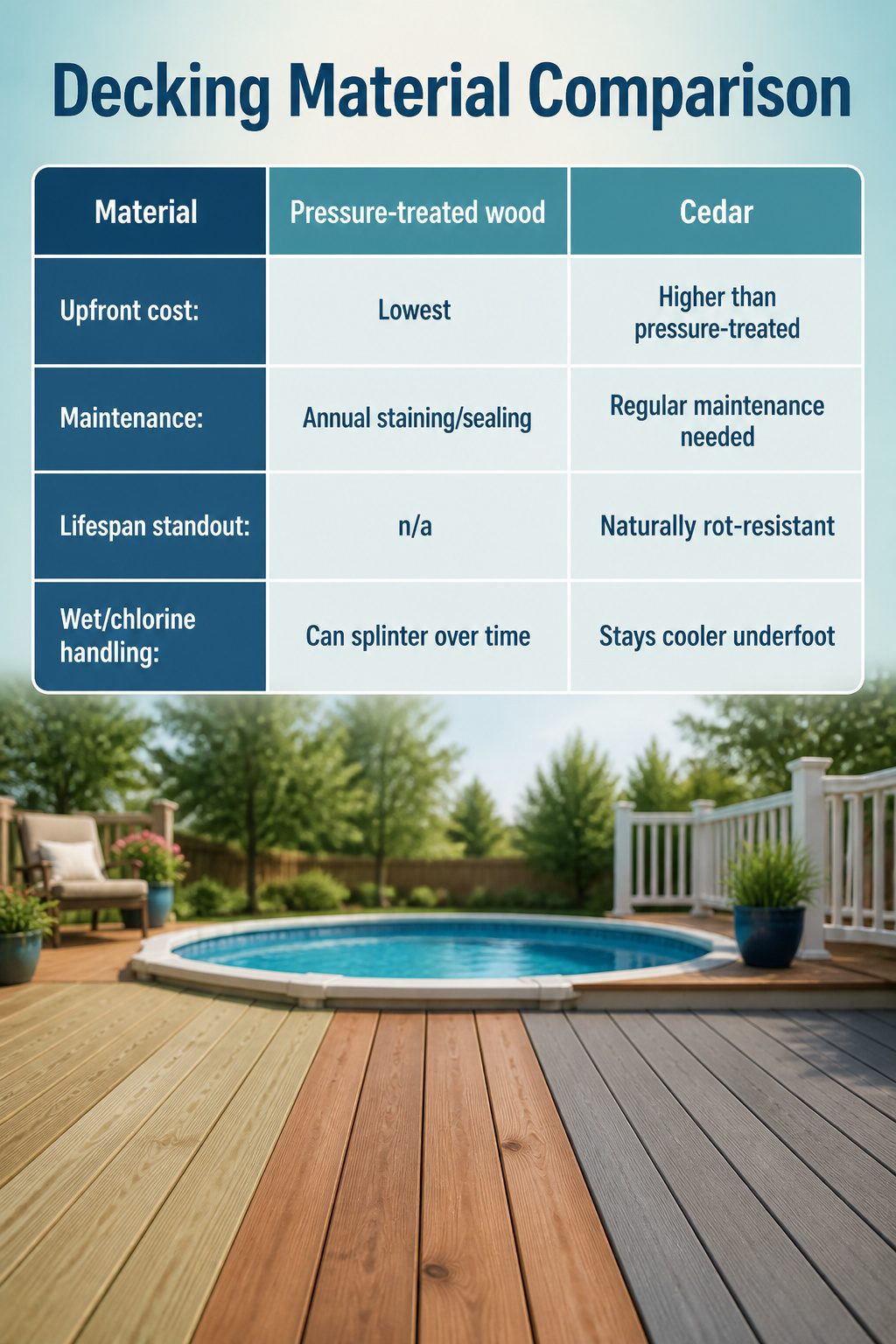
Pressure-treated lumber drew me in first because the upfront cost stays low and it takes screws without complaint. Annual staining or sealing is non-negotiable though, and after a few seasons the surface can start to splinter under wet feet.
Cedar runs higher at the register but stays cooler barefoot and fights rot on its own; it still wants regular attention to keep that advantage.
Composite hits the wallet hardest initially, yet chlorine and constant moisture barely register against it, and the no-splinter finish matters when kids are climbing out dripping. It can get hot in direct sun, so midday July use takes planning.
| Material | Upfront cost | Maintenance | Lifespan standout | Wet/chlorine handling |
|---|---|---|---|---|
| Pressure-treated wood | Lowest | Annual staining/sealing | n/a | Can splinter over time |
| Cedar | Higher than pressure-treated | Regular maintenance needed | Naturally rot-resistant | Stays cooler underfoot |
| Composite (HDPE) | Highest | Extremely low | Resists mold | No splinters; can get hot in sun |
For my own call, composite wins if you want to use the deck rather than maintain it, and cedar wins only if you genuinely prefer the feel of wood and will schedule the upkeep.
Pressure-treated saves money now but costs time later; budget for that trade or you will be sanding and sealing again next spring.
Ground Cover Options Beyond Grass
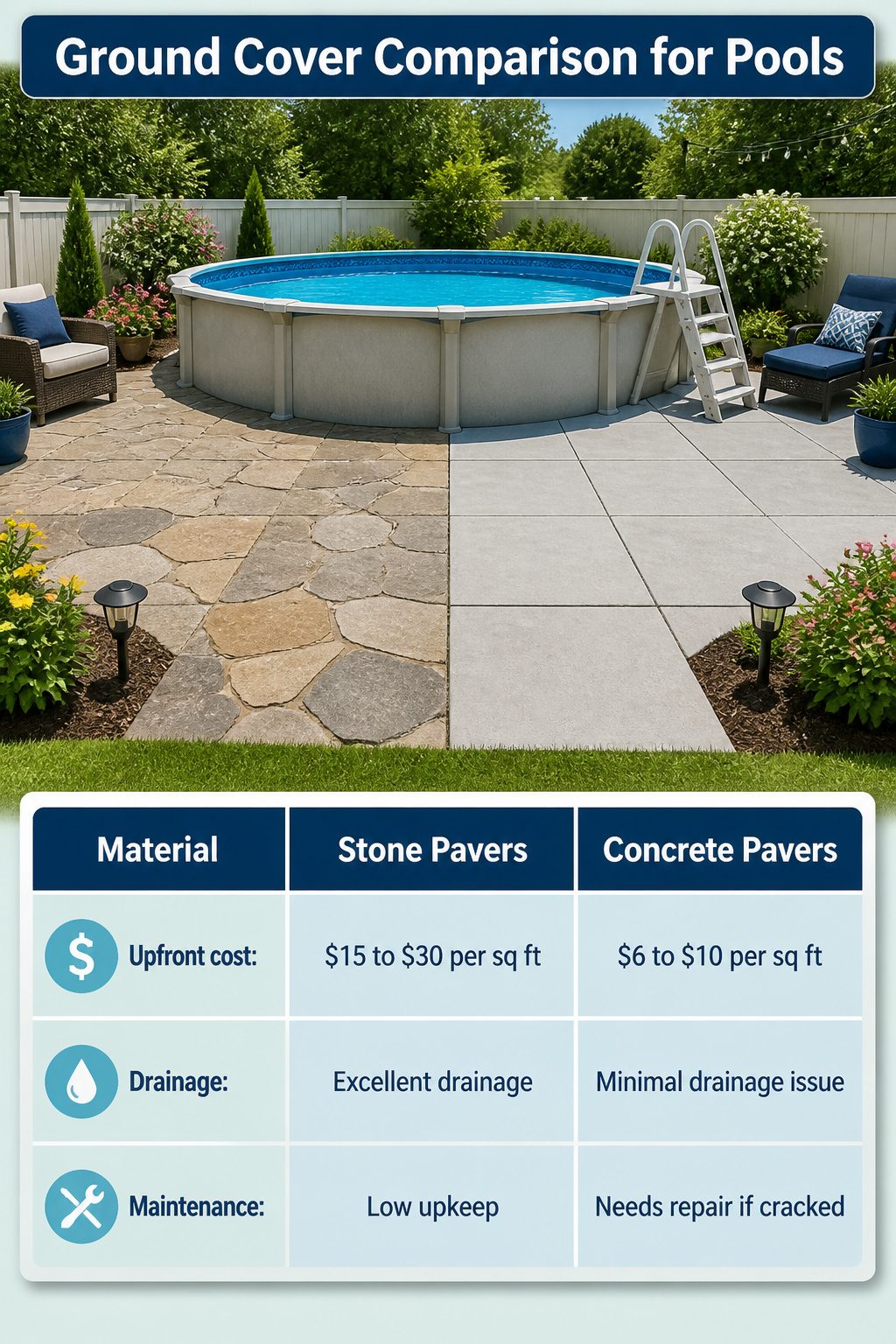
Grass around an above ground pool turns to mud fast, and that mud ends up in the water on every wet footstep.
Stone pavers sit level and stay put, though natural flagstone runs $15 to $30 per square foot installed, making concrete pavers at a similar $6 to $10 range the more common choice.
Concrete itself lands in that same spread and needs almost no upkeep, but a crack means tearing out the whole pad rather than popping out one piece.
Decomposed granite drains well and compacts firm enough for barefoot traffic, yet it still migrates into the pool on shoes and paws.
Artificial turf eliminates the mud problem entirely, though the cheaper vinyl heats up enough to burn skin on August afternoons.
Rubber mulch cushions falls better than stone, which matters if kids use the pool daily, and it stays put unlike loose gravel that gets tracked everywhere.
What I dropped from my own list: fine gravel of any kind. Every source warned that wet feet carry it straight into the water, where it settles in the liner seams and the pump basket.
Plants That Work Near Pools
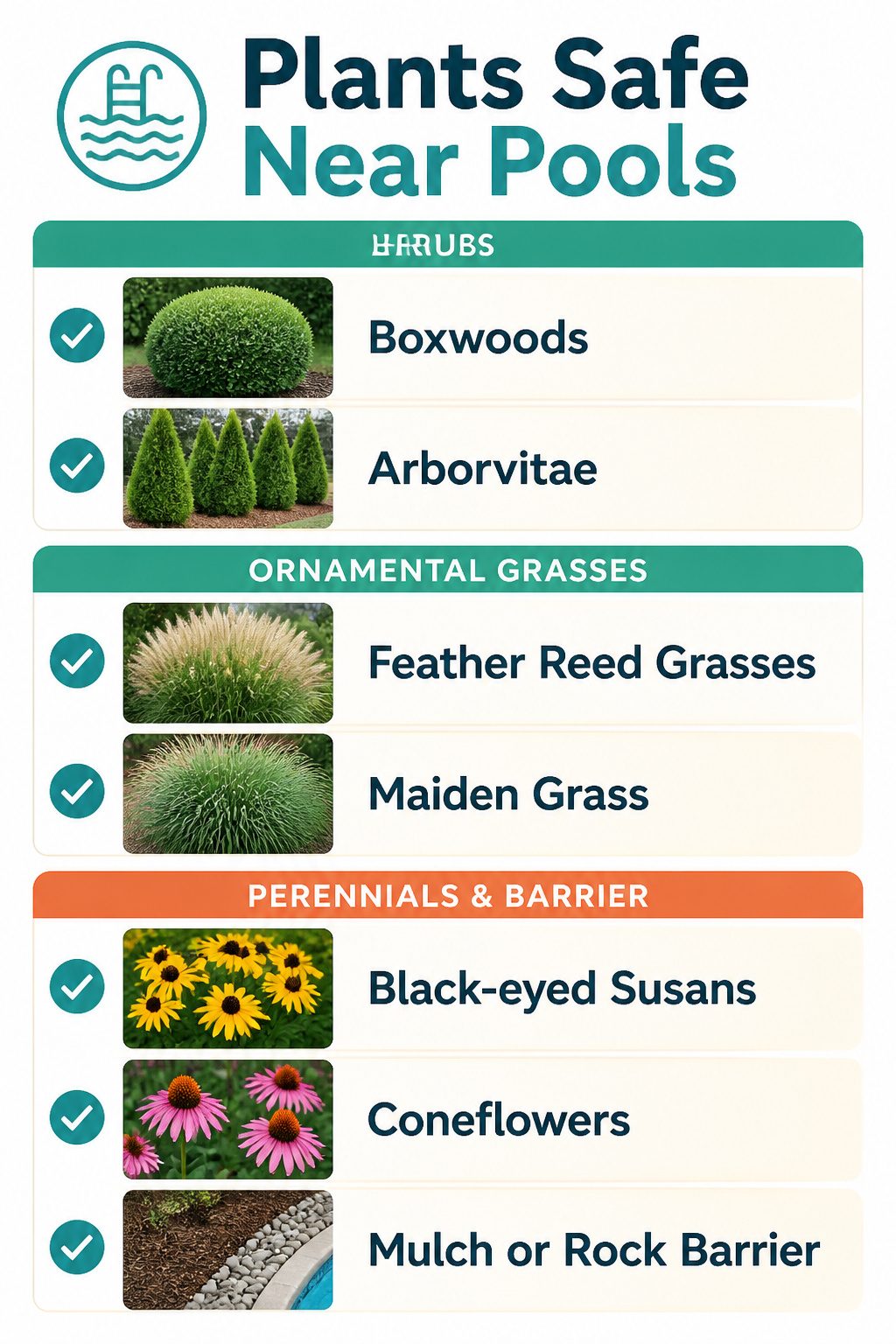
Salt and chlorine splashback will kill most garden plants within a season. I learned to watch for the warning signs, browning on the sunny side where the water hits.
The survivors are the ones to build around.
Shrubs like boxwoods and arborvitae handle it fine, and they don’t dump leaves into the water come fall.
Ornamental grasses, feather reed or maiden grass, move in the breeze and grow tall enough to soften the pool wall without touching it.
Black-eyed Susans and coneflowers work too, as long as you keep them set back with a clear strip of mulch or rock between the bed and the pool edge.
Keep anything that drops seeds, fruit, or heavy petals well away from the water. One season of scrubbing out decomposing petals from the skimmer basket will cure you of planting sweetgum or crabapple nearby fast.
Same for fast-growing trees with aggressive roots: they need a buffer zone, never closer than 6 to 10 feet, or you will end up fighting the liner and the wall both.
Frequently Asked Questions
What can I put around my above-ground pool instead of grass?
Stone pavers, gravel, concrete, or a wood deck all work well. Gravel rings the base cleanly and drains water without pooling; stone pavers set a solid walkway that makes the pool look settled in place.
A deck hides the corrugated siding and gives you level ground to step onto. Each option solves mud and mowing problems better than turf right up to the wall.
Is it cheaper to put concrete or pavers around a pool?
Poured concrete costs less upfront than natural stone pavers but more than basic concrete pavers. Pavers run more than a poured pad but less than natural stone like flagstone or bluestone.
The real savings with pavers come later: if one shifts or stains, you lift and relevel that single piece instead of tearing out a cracked slab.
How much does it typically cost to deck an above-ground pool?
A basic pressure-treated wood deck runs $3,000–$8,000 installed, which is the standard starting point for budgeting. Wraparound designs cost more than partial builds along one or two sides.
Composite and cedar both step up from that baseline, composite for durability in wet conditions and cedar for cooler, rot-resistant boards underfoot.
What should I not plant next to an above-ground pool?
Skip anything that drops seeds, fruit, or heavy petals into the water. That buffer also rules out plants with invasive roots that can shift the ground under the pool over time.
Ornamental grasses and narrow evergreens like arborvitae work better; they stay tidy and do not colonize the gaps or clog your skimmer.
How far away from a house should an above-ground pool be?
Most local codes require a minimum of 5–10 feet from any structure, though the exact distance varies by municipality. The same setback rules govern fire pits and other fixtures near the pool.
Check your town’s adopted code before you stake out placement; the pool ordinance and fire code may set different numbers, and the stricter one wins.