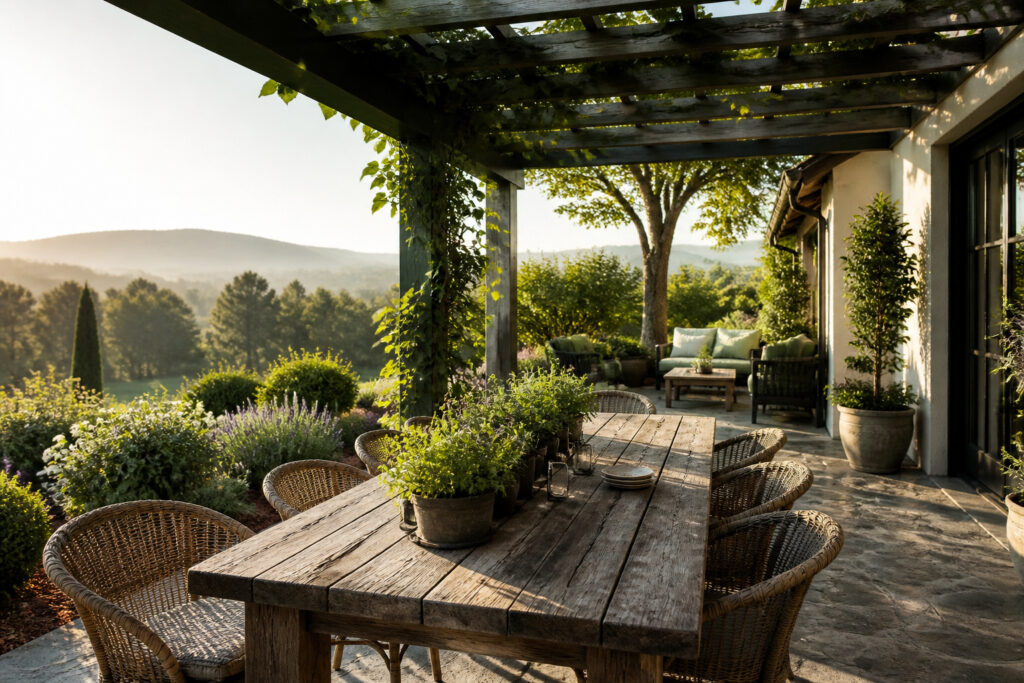
The right attached covered patio idea depends on whether you need shade this afternoon or a room that lasts decades.
A $50 table umbrella buys instant, movable cover; a glass box extension runs $8,000–$20,000 for doors alone and triggers permits, insulation codes, and HVAC ties. Most homeowners land between those poles, and the deciding factor is rarely style.
It is climate: wet summers make solid roofs worth the locked-in sky, while dry heat keeps open pergolas useful.
1. Covered Pergola
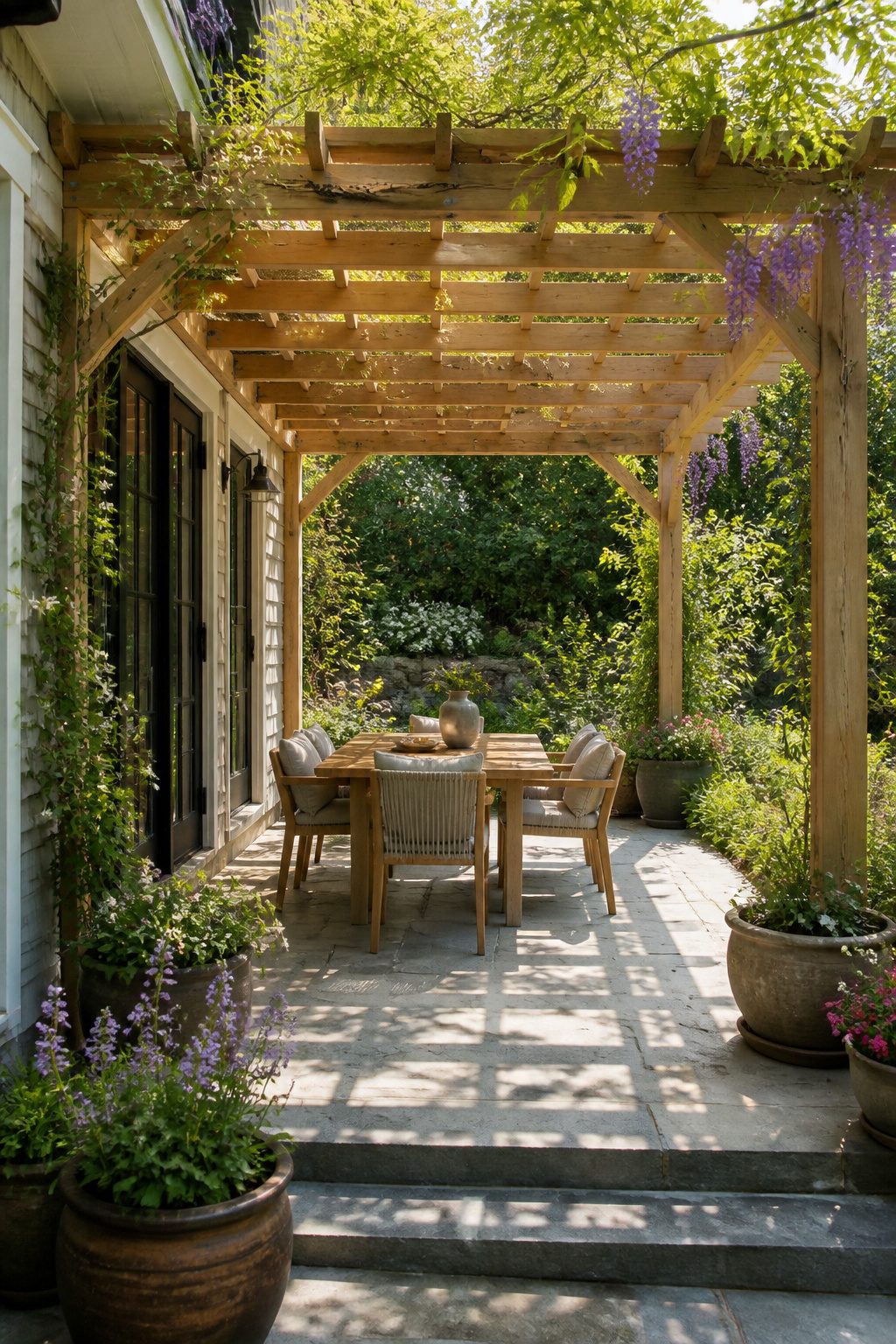
A covered pergola gives you partial shade under an open frame and leaves room for vines to close the gap over two or three growing seasons. Wood and metal each carry a different workload.
Pressure-treated lumber needs brackets, bolts, and galvanized fasteners to anchor solidly against the house, plus stain or sealant every few years to keep it from warping.
Aluminum costs more upfront but shrugs off rot and the weight of mature wisteria without sagging.
The real shade comes slowly. Most climbers, including jasmine and grape vines, need two to three years before the leaf canopy feels like a ceiling.
Wisteria takes even longer but builds the thickest cover once it fills in. Spring and summer reward that wait with flowers and pollinators, though deciduous varieties drop everything in winter and leave you under bare rafters again.
Evergreen jasmine helps where winters stay mild, or you accept the seasonal cycle and add corrugated panels for year-round rain cover.
Maintenance splits two ways: the structure itself, and the vines that soften its lines. Aluminum demands less of the first.
Lightweight wood frames risk damage if a heavy vine is left to overgrow and weigh down the beams. Pruning twice a season keeps either structure safe and the canopy open enough to let light through where you want it.
Cost sits higher than a kit awning and lower than a glass enclosure. Wood kits run roughly $1,000–$5,000; aluminum climbs above that but holds value longer.
The plants themselves add $20–$100 each, a small fraction against the frame they will eventually hide.
2. Roll-Out Awning
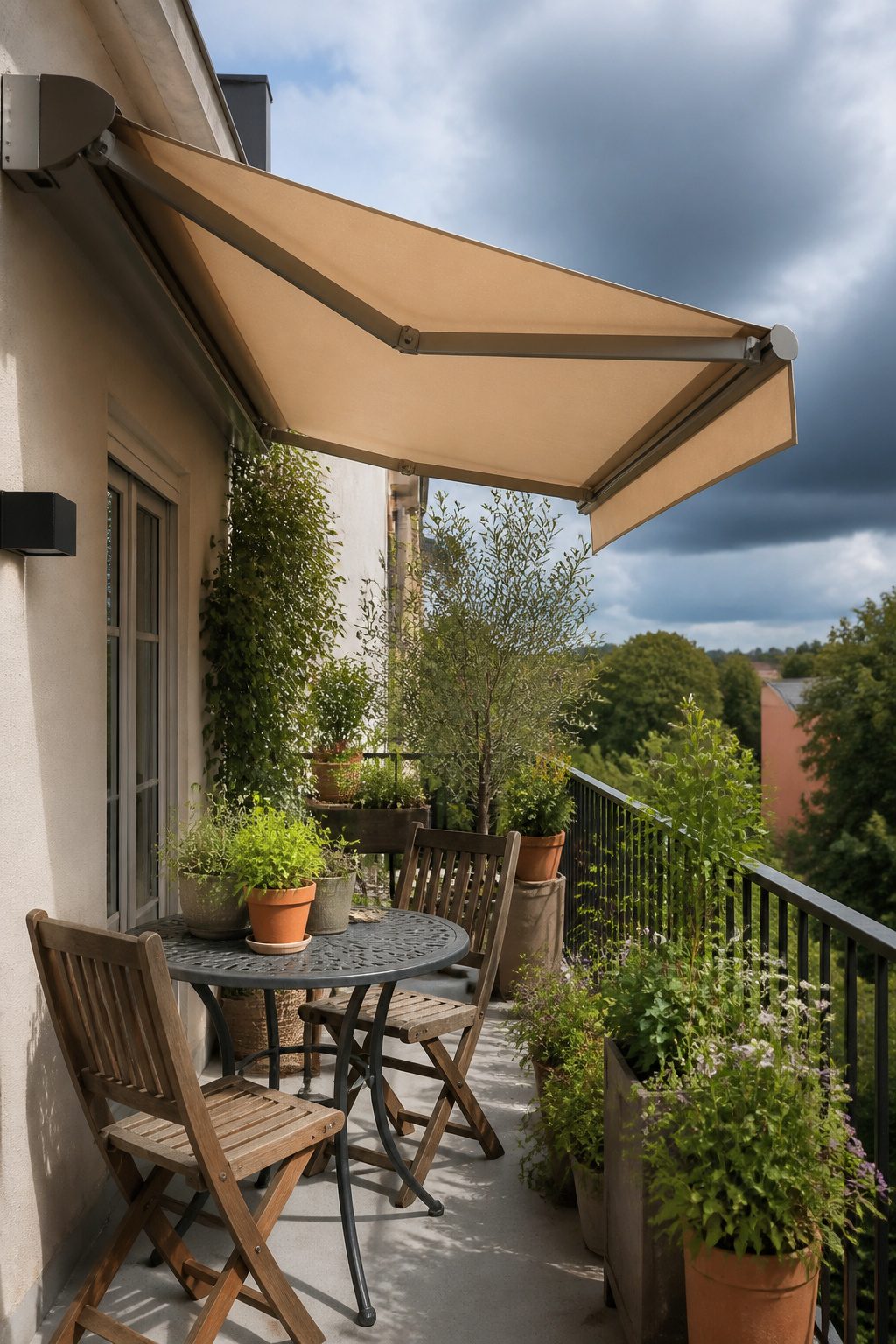
A roll-out awning mounts to your exterior wall or fascia board and projects outward anywhere from 8 to 14 feet depending on the model. Manual operation means a hand crank or pull strap, no electrical work, no remote to lose.
The fabric on budget models is water-resistant rather than waterproof, so a light drizzle beads off but a real storm soaks through or pools until you roll it back in.
Plan to replace the fabric every 5 to 10 years from UV breakdown, sooner if you leave it extended daily. For small patios or balconies where a permanent roof steals morning light, this is the compromise that keeps the option open.
The manual version runs about $1,000 against $2,500 to $5,000 for motorized kits with wind sensors. That gap matters when your whole outdoor budget sits under $800 and you are still buying containers and soil.
I would put the savings toward a sturdier mounting bracket and better fabric grade, since the mechanism outlasts the cloth every time.
Wind above 25 to 30 mph means rolling it in regardless, motorized or not; the arms bend or snap when gusts catch the extended span.
3. Retractable Awning
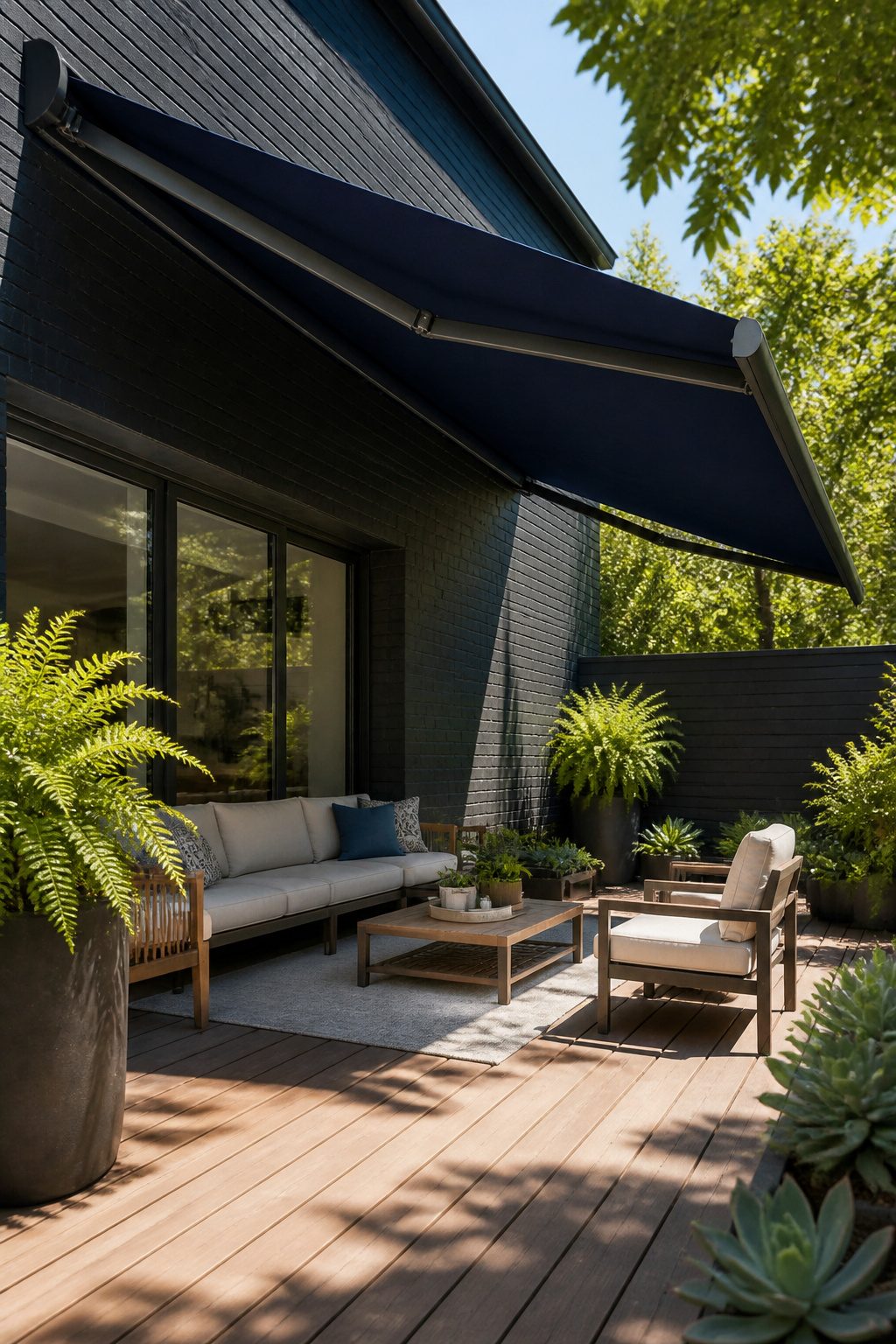
A retractable awning bolts to your exterior wall or fascia and projects outward 8 to 14 feet. That wall-only constraint means it fits an attached patio like mine but leaves a freestanding space in the middle of the yard with nothing.
I priced one last spring after watching a neighbor’s manual crank model fight a gust and nearly fold. Motorized awnings with wind sensors run $2,500 to $5,000 installed, against roughly $1,000 for manual.
The sensor matters: most arms bend or snap above 25–30 mph, and the motor does the retracting fast enough that you are not racing outside in your socks.
The fabric tradeoff stopped me. It handles a light drizzle but pools in real rain and needs replacement every 5–10 years at $300–$800.
For that money spread over a decade, I kept picturing myself still cranking, still cheaper, still getting wet when I forgot to check the forecast. Whether the motor justifies itself depends on how often you would actually retract it.
I would have used it twice a week in May, then ignored it by July.
4. Enclosed Patio
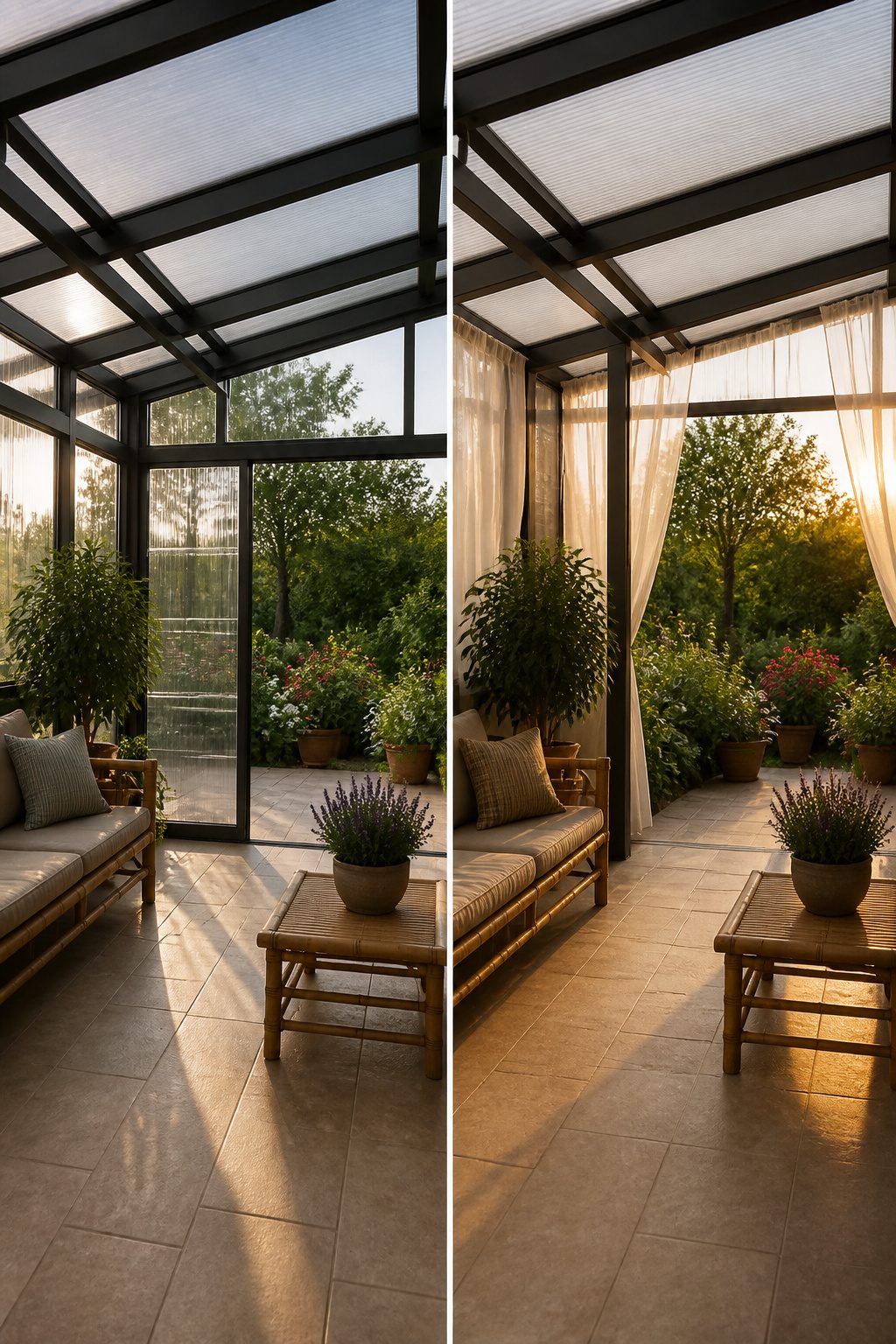
Enclosing a covered patio changes what the space actually is.
Permanent polycarbonate walls lock it into a semi-indoor room with steel posts and baseboard hardware, while transparent curtains stay removable, letting you pull them back when summer air matters more than wind block.
I read through enough setups to notice the hinge detail: curtains mount to either the house frame or to those same polycarbonate walls, so the choice isn’t always either-or. Some builders do both.
That shift from outdoor to enclosed carries a cost for plants. A space that keeps out snowfall and wind chill also filters the light and blocks rain your containers might still need.
Tender plants overwinter better inside, but anything counting on real weather exposure, dormancy included, will behave like it’s sitting in a greenhouse that never opens its vents. Account for that before you commit to walls on all sides.
5. Louvered Roof
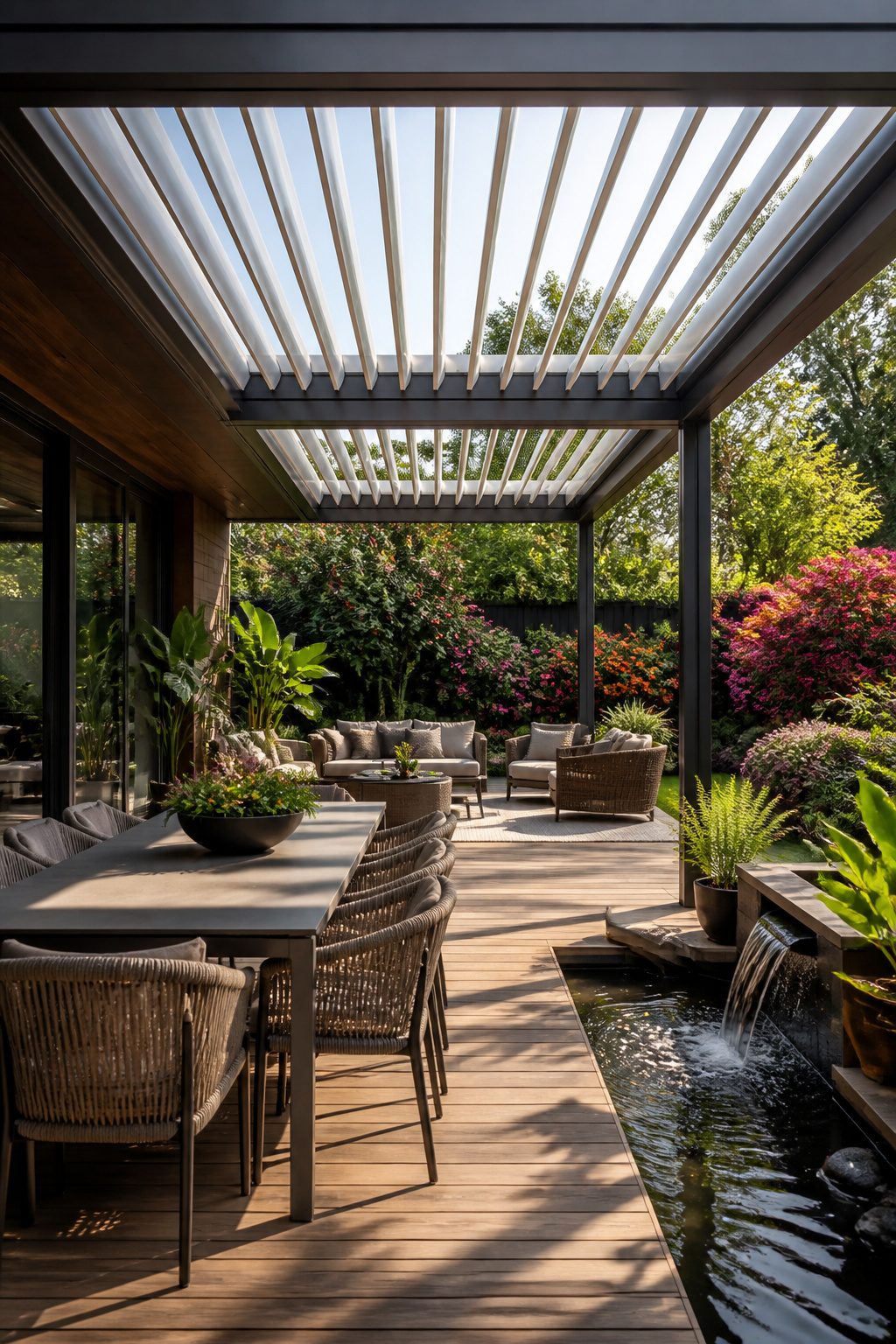
Louvered roofs run $5,000 to $20,000 or more, with commercial-grade systems like The Luxury Pergola hitting $10,000–$21,000 factory-direct. Budget imports exist at $3,000–$6,000, though the thinner aluminum is something I’d watch if my area sees heavy snow or wind.
The mechanical parts are where this option separates itself from fixed covers, not always in a good way. Motors, sensors and tracks add failure points that a basic roof simply doesn’t have.
I live with enough broken garden timers to know that moving parts in outdoor conditions need a maintenance budget and a tolerance for the day it won’t close during a storm.
For gardeners, the adjustability is the real argument. Morning sun on the tomatoes, afternoon shade when the basil flags, rain protection that actually seals.
A fixed cover guesses at one condition; louvered slats respond to the hour. The question is whether that responsiveness is worth roughly double the cost of a simpler structure, plus the gamble on mechanical reliability over a decade.
For someone managing tight light conditions across a small space, it might be. For a gardener who mostly needs consistent shade, the complexity could be paying for flexibility they’d never use.
6. Glass Box Extension
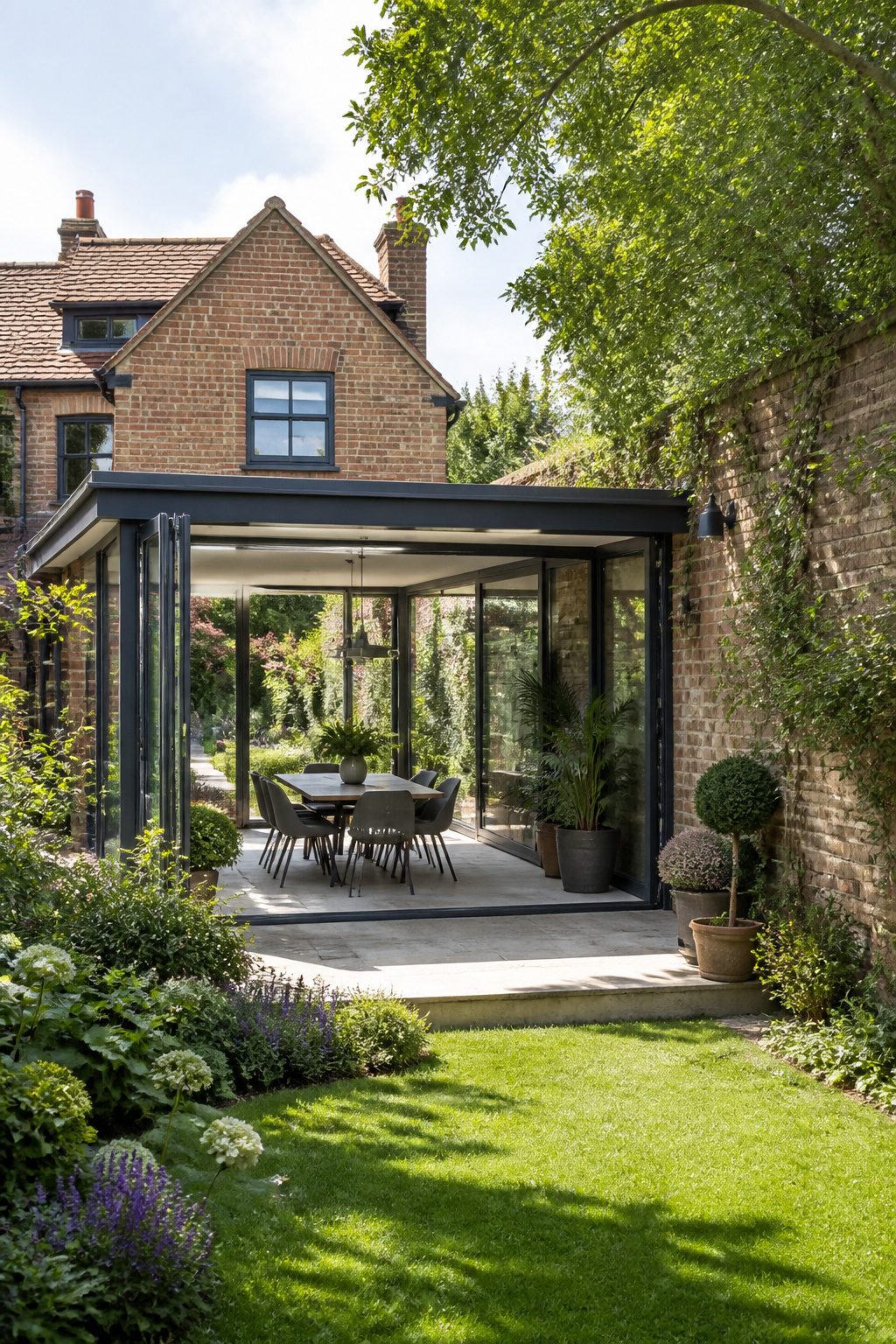
A glass box extension reads as an extra room for a reason.
Folding or sliding glass door systems run $8,000 to $20,000 for the door package alone, and that is before the header beam upgrade, the foundation work, and the permit that treats this as a house addition rather than a patio cover.
Most zoning departments will call it livable square footage, which means codes for insulation, HVAC ties, and possibly egress windows depending on size.
The greenhouse effect is real inside these walls. Natural light floods the space, but trapped heat does too.
Without mechanical ventilation or ceiling fans pushing air through those full glass walls, summer afternoons become unusable. One path around this is specifying low-e glass and operable panels, though that pushes the budget further toward room-addition territory.
What grows inside changes with that heat. Herbs and leafy greens that collapse under a standard patio cover thrive in the brightness.
Tomatoes or peppers will bake without airflow. Under a louvered roof or pergola, you get dappled shade and easier gardening; in a glass box, you are managing a microclimate deliberately.
Most gardeners on a $500–800 annual budget will feel the squeeze here, since the structure itself consumes years of that allotment in one go.
7. Freestanding Pergola
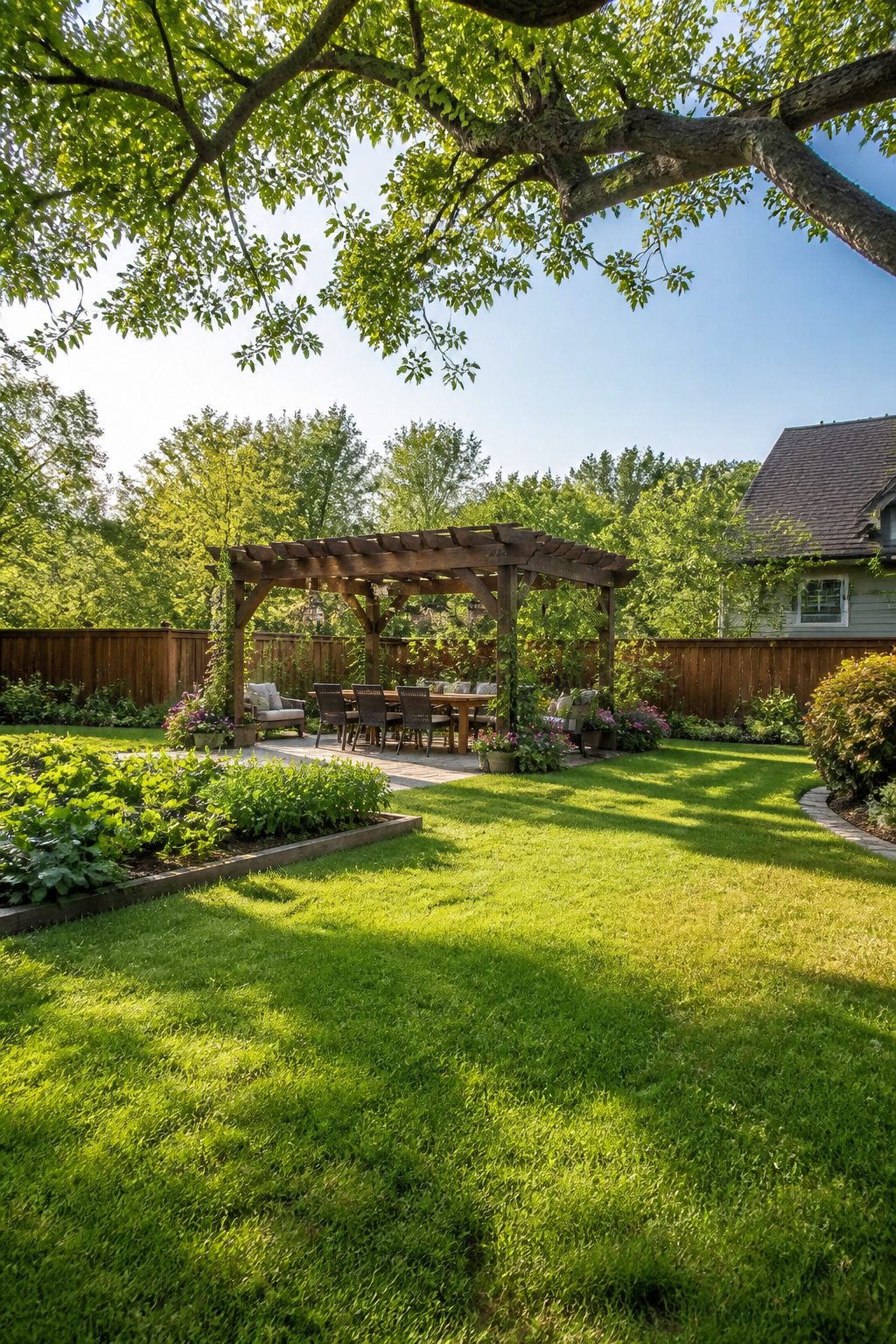
A freestanding pergola sits where you want it, not where your foundation dictates.
That alone made me reconsider my own yard last spring, when the only flat ground worth using was thirty feet from the back door and shaded by an oak I had no intention of cutting.
Footings are the trade you make for that freedom.
Any freestanding structure meant to last needs concrete pillars below the frost line, typically 36 to 48 inches in most northern U.S. zones, and the posts carried above on saddles or wrapped concrete to keep water from wicking upward.
I have watched neighbors skip this and heard their posts groan in freeze-thaw cycles two winters later. Attached patios lean on the house for stability; freestanding ones earn it from the ground.
Four open sides give airflow no attached porch matches. In humid summers that matters more than I expected.
You can train ivy or wisteria up the rafters for living shade, add waterproof sheeting ahead of storms, or string festoon lights for evening use. Each choice keeps the structure movable in spirit even after the footings cure.
The placement flexibility reshaped my garden layout entirely; the sitting area became its own destination rather than an appendage to the house, and the path between door and pergola now passes through a bed I never would have built otherwise.
8. Trellis with Vines
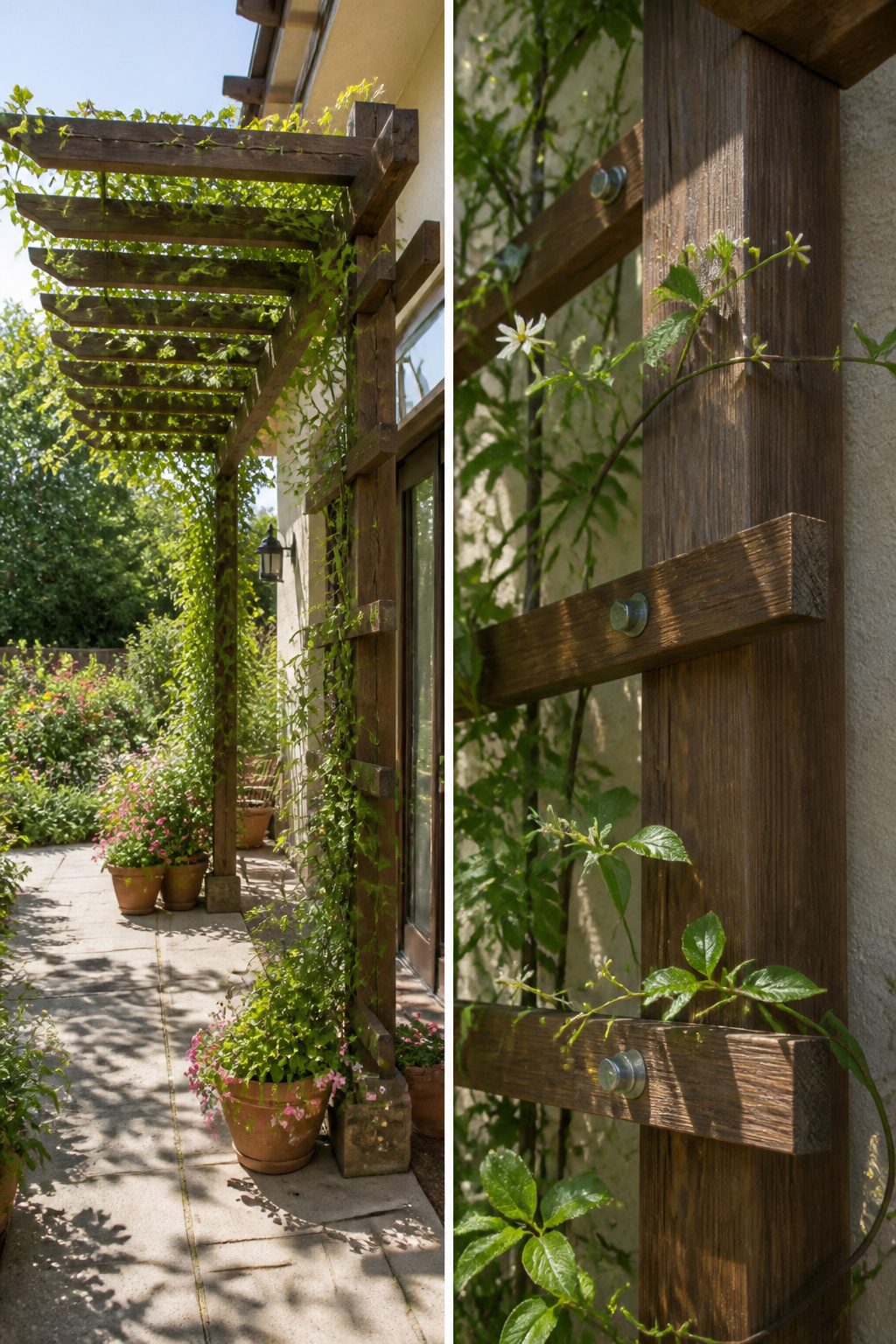
A wooden trellis bolted to the house and wired for climbing plants is the cheapest attached covered patio idea on paper.
The frame itself runs about $1,000 to $5,000 if you build it from timber, or more for aluminum that lasts decades under vine weight. After that, the plants run roughly $20 to $100 each.
What you are really spending is time.
Most vines need two to three years before they give you meaningful shade. Wisteria and grape vines take even longer, though they eventually knit the thickest canopy.
Virginia creeper or honeysuckle move faster in many zones, climbing 10 feet in a season if the soil holds moisture.
Bougainvillea and jasmine work only where winters stay mild; in zone 6 or below, you are looking at clematis, climbing hydrangea, or an annual like morning glory if you want coverage by August.
The trade is straightforward: material costs stay low, rain protection stays nonexistent, and your shade disappears entirely from late fall through early spring unless you plant evergreen jasmine in a warm-enough climate.
The real mistake is planting something that will not stop growing. English ivy, Japanese honeysuckle, and wisteria planted too close to siding will pry into gaps, pull down lightweight rafters, and colonize gutters you cannot reach.
I lost a weekend three summers ago tearing trumpet vine out of a neighbor’s soffit; the roots had traveled fifteen feet from the original post. Check your state’s invasive list before you order.
A living roof is patient work, and patience only holds if the plant stays where you put it.
9. Outdoor Curtains
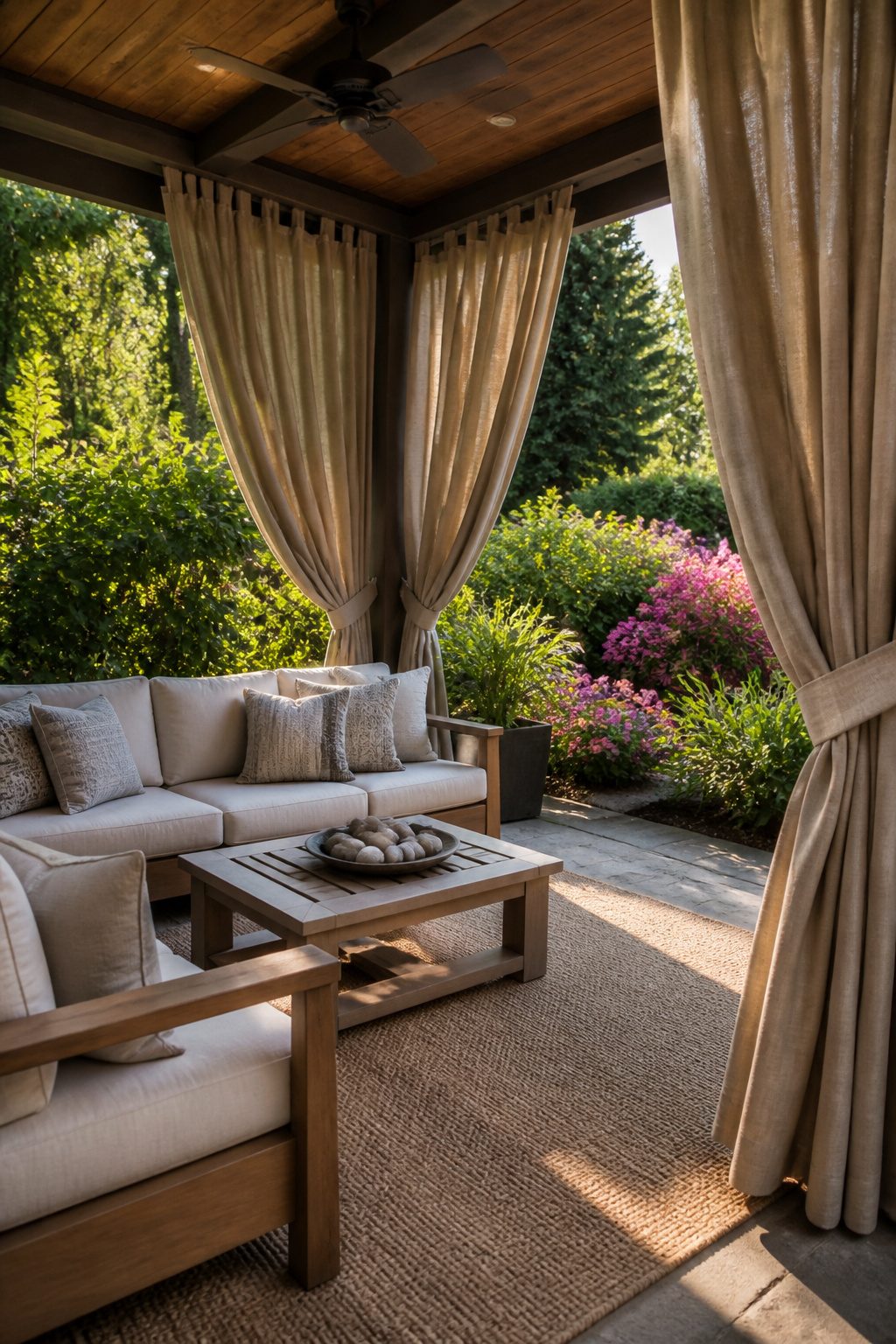
Outdoor curtains hang from a rod or wire system along the edge of your attached covered patio, not overhead.
They give you side-shade and privacy you can pull closed or tie back, but they will not keep rain off your head. Fabric choice decides whether you replace them every season or every decade.
Solution-dyed acrylics like Sunbrella resist UV fading and mildew for 5 to 10 years. Cheaper polyester looks fine at first and degrades within 1 to 2 seasons, faster in humid climates where mildew sets in before the color even fades.
Wind is the other ruin. Fabric that flaps hard enough will tear its hardware loose from whatever post or beam you mounted it to.
I would not trust light-duty curtain rods in anything above a breeze; galvanized wire or commercial track systems hold better, though nothing stops tangles if you leave them drawn in gusts.
Think of these as a supplement, not a standalone. Pair them with a solid roof or pergola for overhead cover, then draw the curtains where low-angle afternoon sun slips past.
A full set runs anywhere from $200 up to $1,000 for Sunbrella panels, or $30 to $50 per panel for polyester that you will replace.
For context, a patio umbrella sits at $50 to $500 and actually covers overhead, so curtains only make sense if you already have that top solved and want walls you can open.
10. Patio Umbrellas
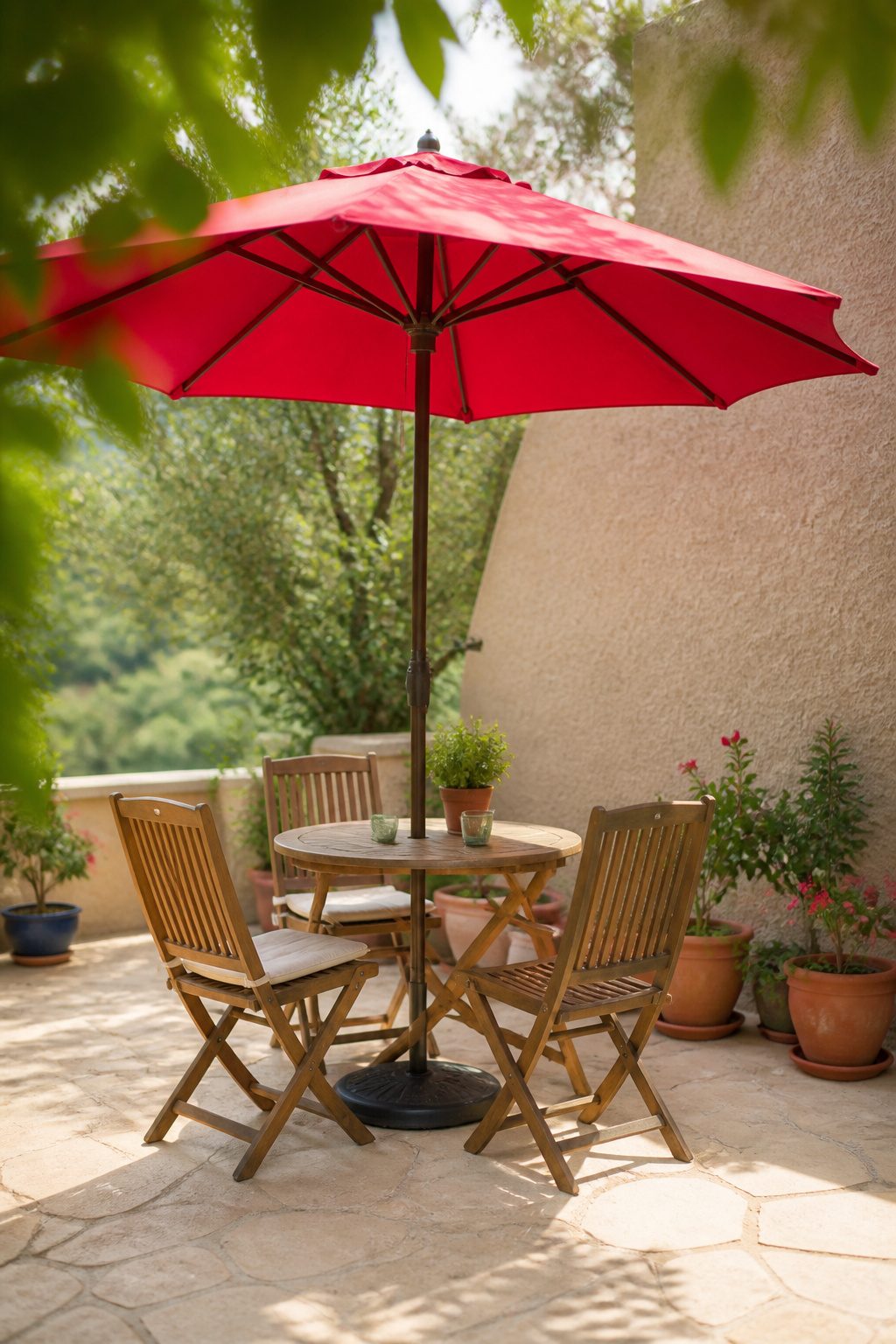
A $50 table umbrella from the hardware store gets you shade this afternoon with zero permits, zero tools, and zero commitment to where it lives. That portability matters more than it sounds like it should on a small patio or balcony.
The sun angle at 4 p.m. in July is not the sun angle at 10 a.m. in May, and a built structure fixes you to one guess.
With an umbrella, you move the shade to where you actually need it, or you move it off the deck entirely when the space needs to breathe.
The cantilever models, the ones that hang the canopy from a side pole so nothing blocks the center of your table, run closer to $200–$500 and tilt or swivel to track the sun.
Even at that price, you are still in stopgap territory. The failure mode is wind.
A weighted base helps until it does not; moderate gusts will still send the whole thing over, and a flying umbrella is a genuine hazard, not just a mess to retrieve from the neighbor’s yard.
Most fabric canopies also deteriorate within two to three seasons of full exposure, so figure this as a trial run.
Live with the placement for a couple of years, notice where you actually sit and when, and let that inform whether you later build something fixed.
Cost Ranges by Square Foot
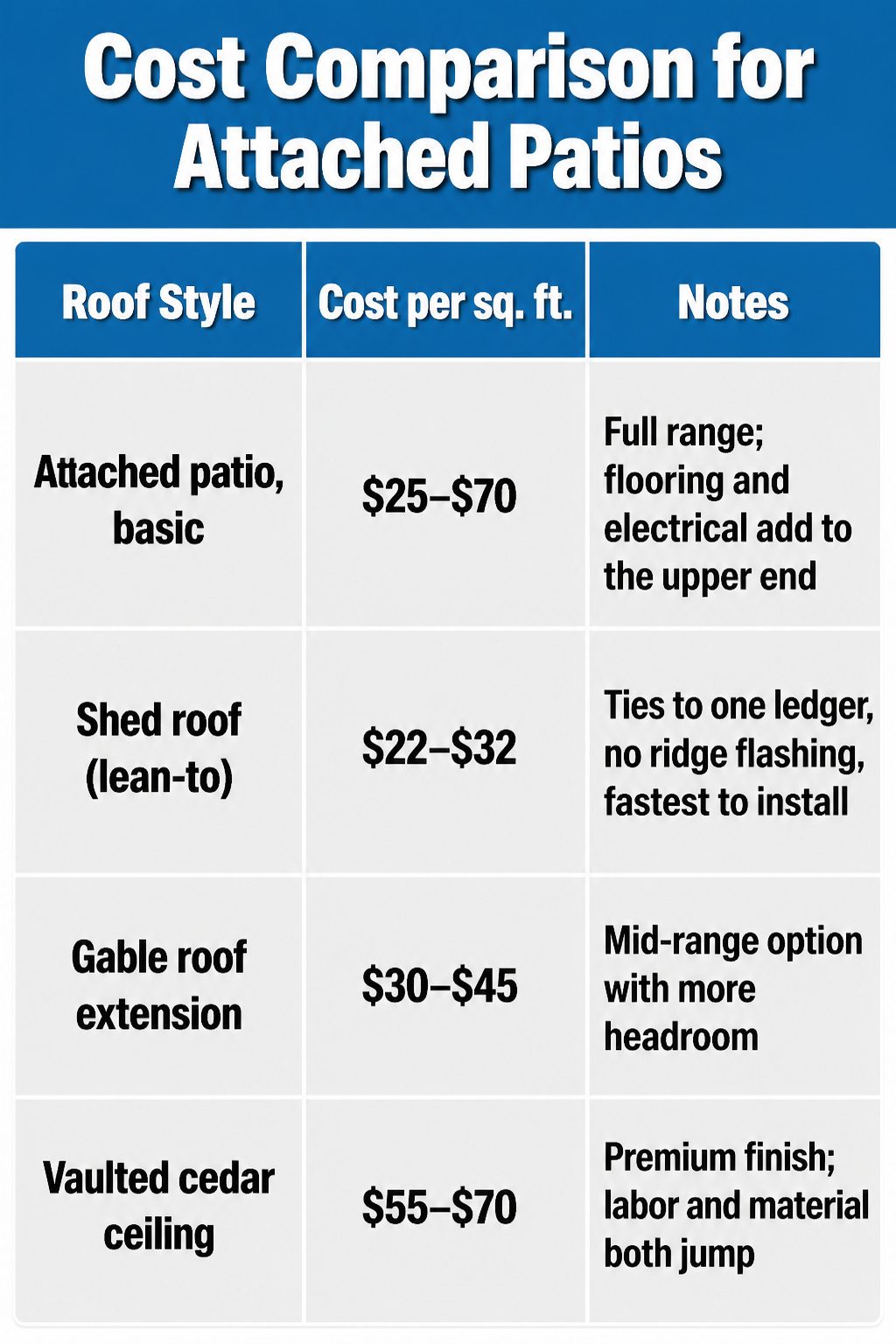
A basic 200-square-foot shed-roof patio runs about $6,000–$9,000, while vaulted cedar ceilings can push the same footprint well past $20,000. The spread matters more than most people expect when they first ask for quotes.
| Roof style | Cost per sq. ft. | Notes |
|---|---|---|
| Attached patio, basic | $25–$70 | Full range; flooring and electrical add to the upper end |
| Shed roof (lean-to) | $22–$32 | Ties to one ledger, no ridge flashing, fastest to install |
| Gable roof extension | $30–$45 | Mid-range option with more headroom |
| Vaulted cedar ceiling | $55–$70 | Premium finish; labor and material both jump |
If you are collecting bids, ask each contractor to itemize structure, roofing, and flooring separately. Two quotes that both say "outdoor covered patio" can diverge by thousands in the line items, and the itemization shows exactly where.
What Holds Up in Your Climate
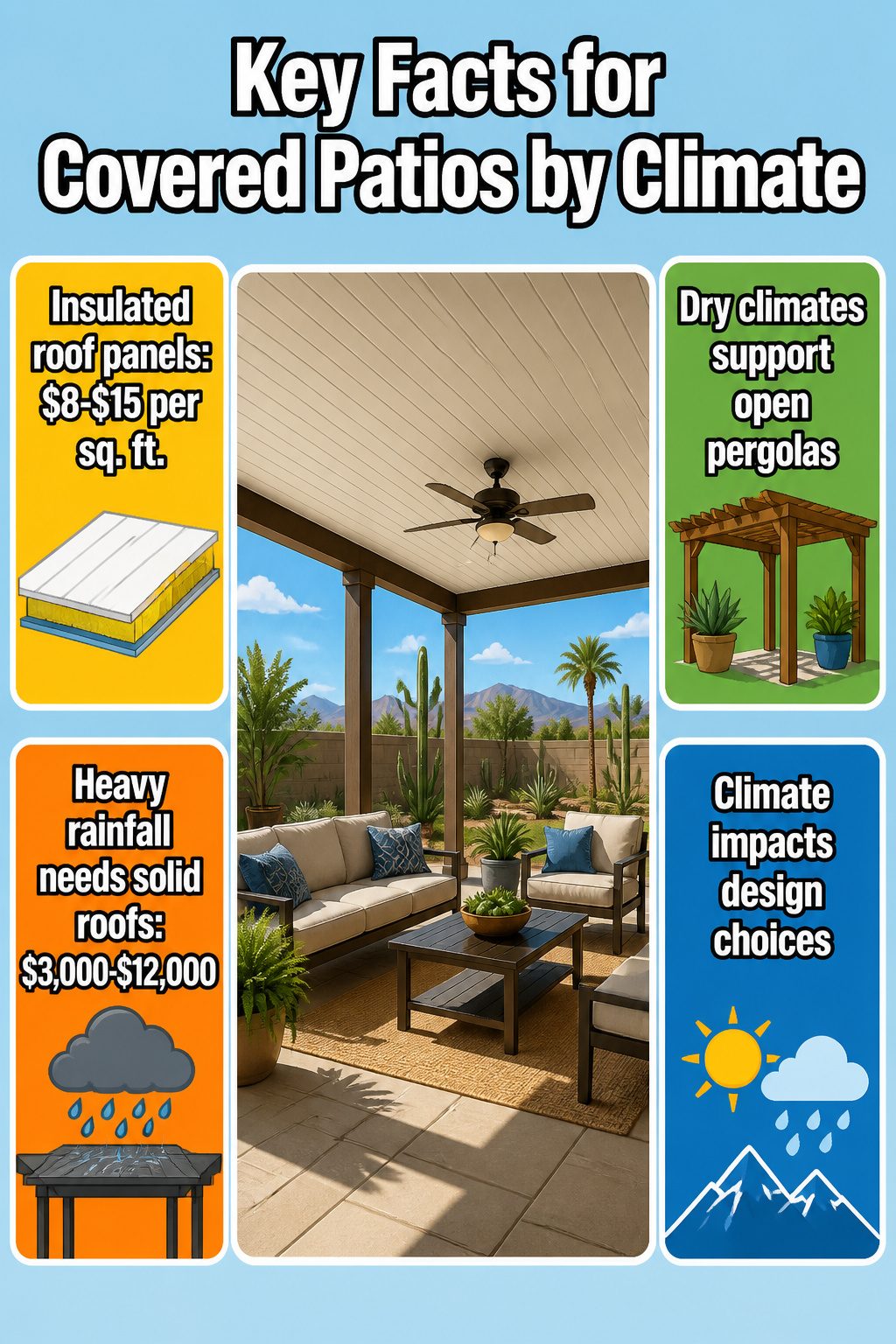
Insulated roof panels drop the felt temperature under your cover by up to 20 degrees against standard metal, which matters when you’re trying to use the space past Memorial Day in Arizona, Texas, or Florida.
The panels bolt to a new or existing frame, give you a flat finished ceiling, and let you hang wet-rated ceiling fans; figure $8 to $15 per square foot for the panels alone, with a 12-by-16-foot system running $6,000 to $12,000 installed.
Permits are standard.
Heavy rainfall changes the math entirely. A solid fixed roof, whether aluminum or polycarbonate, keeps the water off without moving parts to fail, and it costs less than any motorized system at roughly $3,000 to $12,000.
The downside locks in with the upside: no sky, ever, and aluminum drums loud under a downpour.
Dry climates are where open pergolas still make sense. I ignored this once.
Put a classic slatted pergola on a Wisconsin house in a summer that turned wetter than the averages promised, and spent August watching the patio furniture go under trash bags while the neighbors’ solid-roofed covers stayed in use.
Climate first, style second. Get the slope plan before you chase any design.
Materials and What They Demand
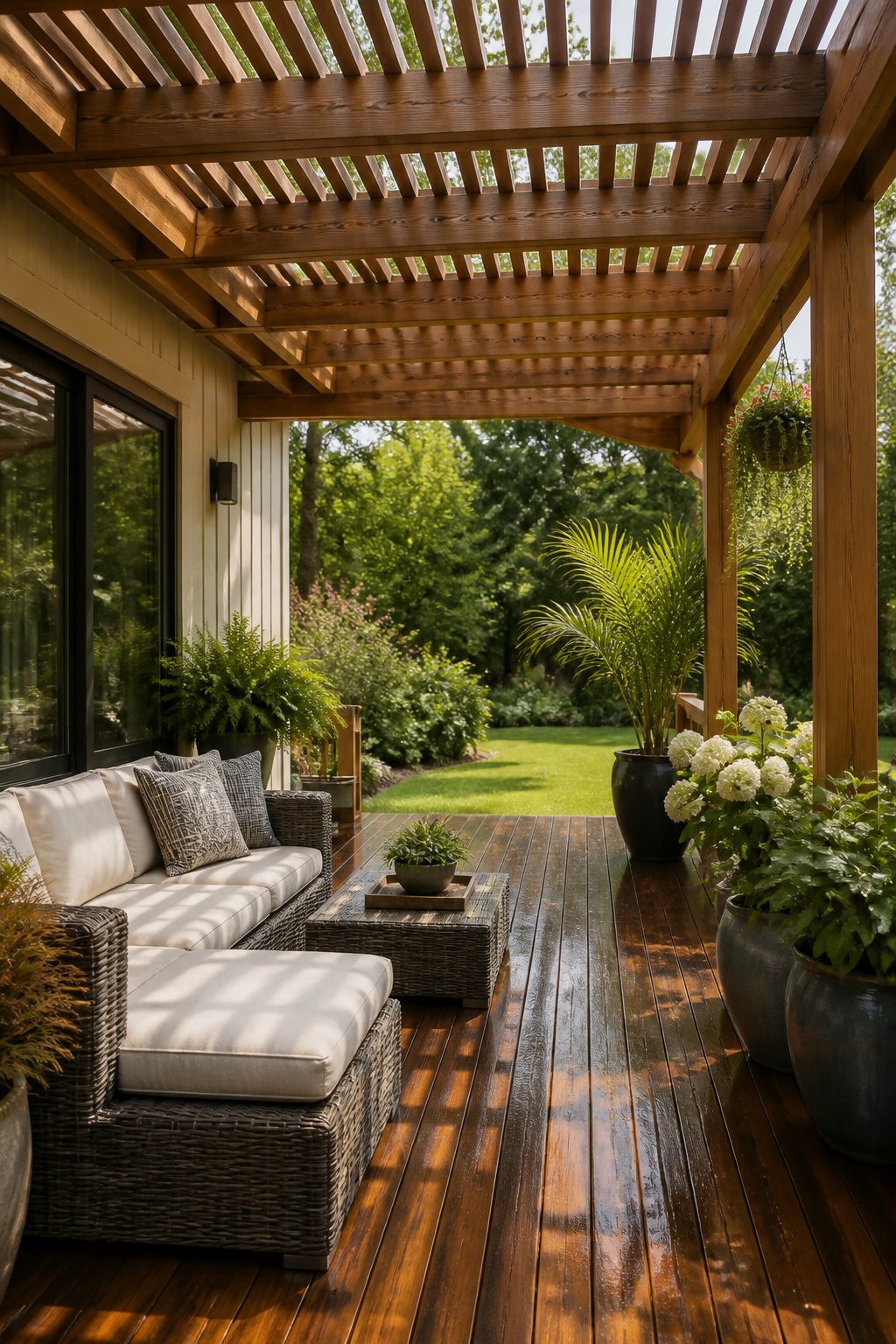
Wood frames the classic look most people picture first, but that charm comes with a standing obligation.
Cedar and redwood resist rot better than pressure-treated pine, yet all three demand annual staining or sealing to prevent the cracking and fading that starts by year five.
Skip it, and the lifespan drops well below the usual 10–15 years, with insect damage from termites or carpenter bees compounding the trouble.
I once watched a neighbor’s beautiful lattice pergola begin dripping sap onto his furniture the first rain after installation, a problem aluminum simply does not have.
Powder-coated aluminum costs more upfront but repays the difference in hours not spent with a brush. The finish does not fade, and the structure stays rust-proof through wet seasons without any annual attention.
Glass, used in box extensions, creates the seamless indoor-outdoor link that walls would destroy, though it leaves you fully exposed to whatever temperature the day brings.
Fabric occupies the lightest end of the spectrum.
Sheer-pleated exterior fabric or a simple airy cover over a pergola frame softens the structure visually and can define an intimate dining space, but it offers no structural strength and limited weather protection.
For heavy-snow regions, the slope of whatever solid roof you choose matters more than the material itself: a flat roof there is a maintenance problem waiting to happen, whatever it is built from.
Design Elements That Make It Usable
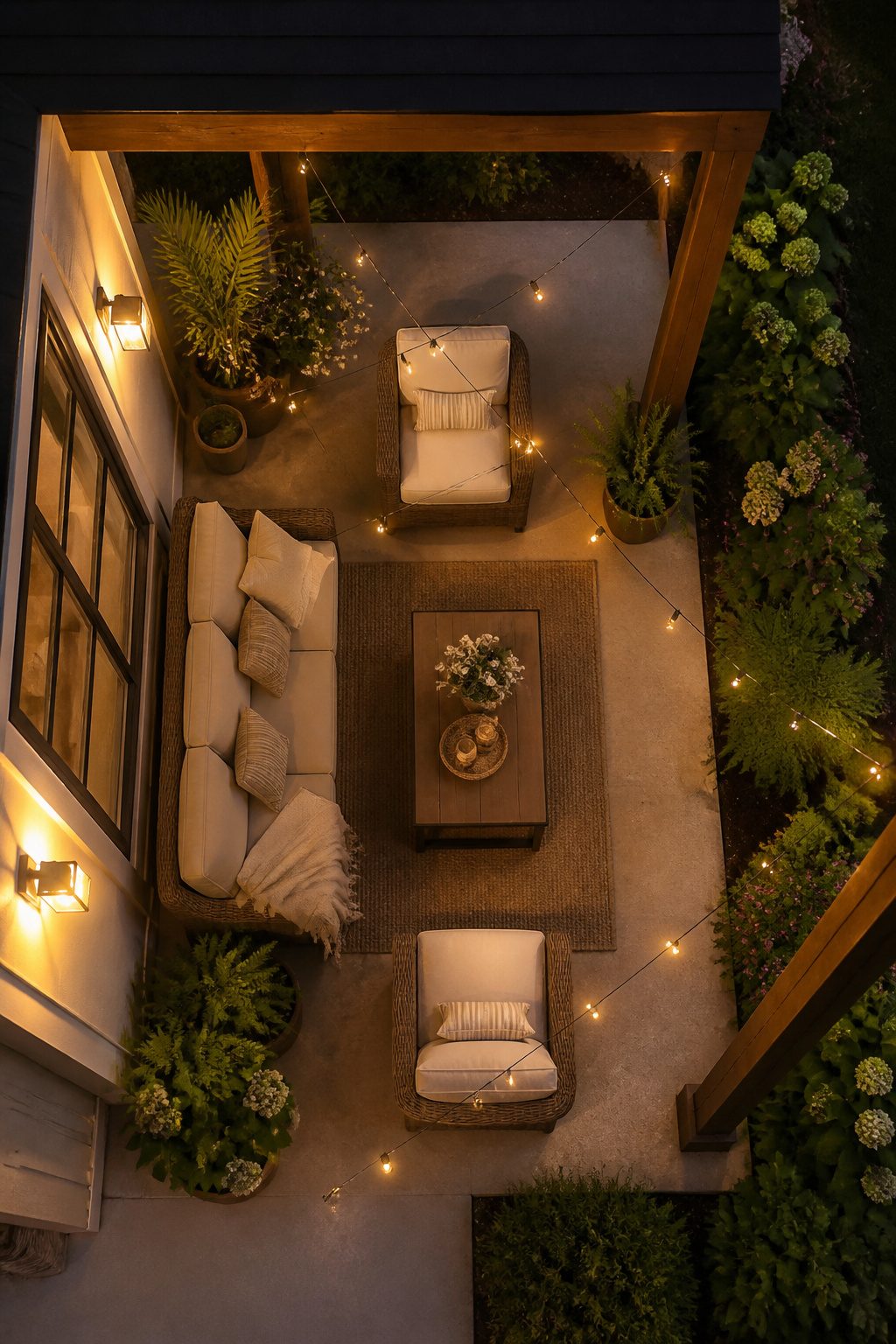
Layering light at two heights, not one, is what makes an attached covered patio usable after dark.
Wall sconces at seating height plus string lights overhead run about $300–$1,200 for a full plan, and the work is cheapest if you schedule it while the framing is open. Retrofitting doubles the electrician visits and the bill.
I over-lit my first covered patio. Three fixtures overhead, dimmers I never touched, and moths clustering the brightest one like a runway.
The seating wall stayed dark, guests squinted at their plates, and I spent two seasons adjusting what should have been obvious: light what people use, not the air above them.
Plants photograph differently than they live. Under a solid roof, hanging baskets dry slowly and corner pots stay too damp; both rotted on me before I moved to containers on palettes, air moving underneath.
For a $500–$800 annual garden budget, two sturdy wheeled containers with clipped boxwood or variegated vinca give structure year-round and roll out for sweeping.
Furniture that looks right in a catalog often assumes a freestanding site. On attached covered patios, the house wall is already there; a bench or low console against it uses the structure instead of fighting it.
I bought a deep outdoor sofa once that blocked the door swing. Measured wrong, or measured the room without the roof posts.
Either way, it sat in the garage that summer.
Frequently Asked Questions
What can I use to cover up my patio?
Options range from light and temporary to permanent and structural. A $50 patio umbrella or outdoor curtains give quick shade with no permits, while a wood or aluminum pergola, roll-out awning, louvered roof, or solid shed-roof cover provide more lasting protection.
For full enclosure, polycarbonate walls or a glass box extension turn the patio into a semi-indoor room, though costs jump to $8,000–$20,000 or more.
How much does it cost to cover a 12×12 patio?
A 12-by-12-foot cover runs roughly $2,500 to $5,000 if hired out, and about $1,600 to $2,500 in materials for a DIY build.
The article’s cost table puts a basic attached patio at $25–$70 per square foot, so a 144-square-foot space lands in that same range before flooring or electrical.
Is a covered patio worth it?
It extends usable hours and seasons by blocking rain, snow, and harsh sun, and it protects furniture from weather damage.
The article notes it can also add home value and create a distinct entertaining space, though installation costs are real and climate should drive the roof style more than looks.
How do I cover my patio on a budget?
Start with a $50 table umbrella or $200–$500 cantilever model to test placement before committing to construction. Outdoor curtains run $200–$1,000 and pair with an existing roof for side shade.
A wooden trellis with vines costs roughly $1,000–$5,000 for the frame plus $20–$100 per plant, but shade takes two to three years to fill in.
Can I build a covered patio attached to my house myself?
A simple shed-roof cover on a single-story ranch is within reach for an experienced DIYer using a pre-engineered kit at $12–$20 per square foot in materials.
The roof tie-in to the house, flashing, and ledger sizing are the parts most homeowners still hire out even when doing the rest themselves. Check with your local building department before ordering.