The best fall decor ideas run from a $2.99 thrift store basket to a single heirloom pumpkin that costs more than a full grocery-store cluster, and the one that fits your space depends on whether you can stand to watch real produce soften on the counter.
Most of the entries below use what you already own or gather free, but a few only work if you replace them on schedule.
Pampas grass, for instance, outlasts October without rotting, yet it sheds until you hit it with cheap hairspray.
1. Swap Pumpkins for Pampas Grass
Pumpkins fill a room fast. They roll, they bruise, and three of them on a console table leave no space for the mail, the keys, or your morning coffee.
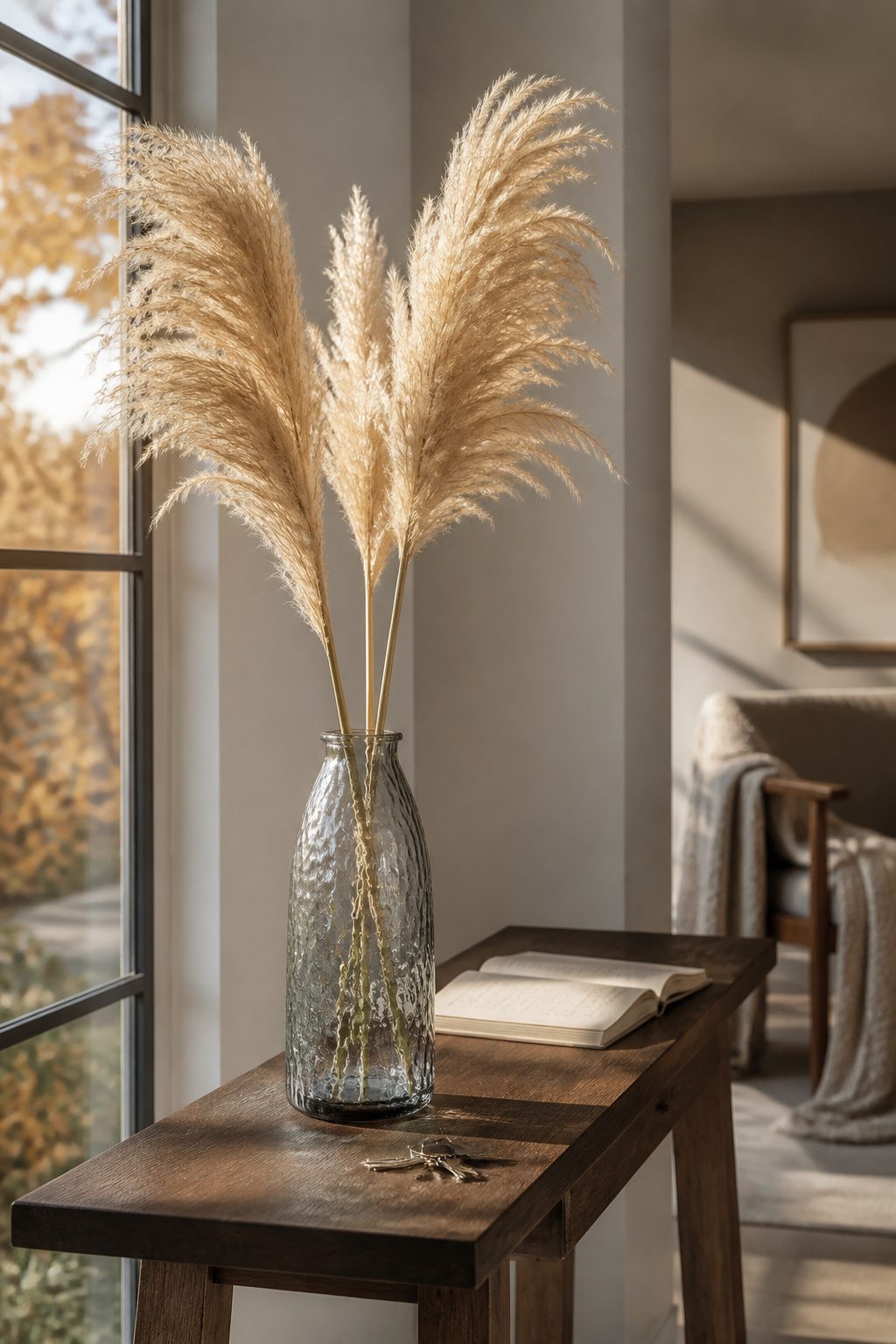
Tall pampas grass plumes do the opposite. They draw the eye upward and take almost nothing from the surface they stand on.
A single grocery-store pumpkin crowds more table space than six or seven pampas stems in a narrow-neck vase.
For a small apartment mantel or a balcony console, three to five stems fill enough visual volume that you stop looking for more. The plumes run sandy and warm against fall light, and they read as autumn without announcing it.
I buy mine dried, usually from the same flower markets that sell dried lavender in August or from farm stands that stack them in cardboard bins by the road. They shed.
Run your hand up a plume before you buy and check what comes loose. Once home, a light mist of cheap hairspray sets the fluff for the season.
Months after October, the stems stay where I put them. They do not liquefy on the counter the way a decorative gourd eventually will.
That durability matters on a $500 garden budget; one purchase carries both fall and the quiet months after.
2. Mix Faux and Real Fall Nature Decor
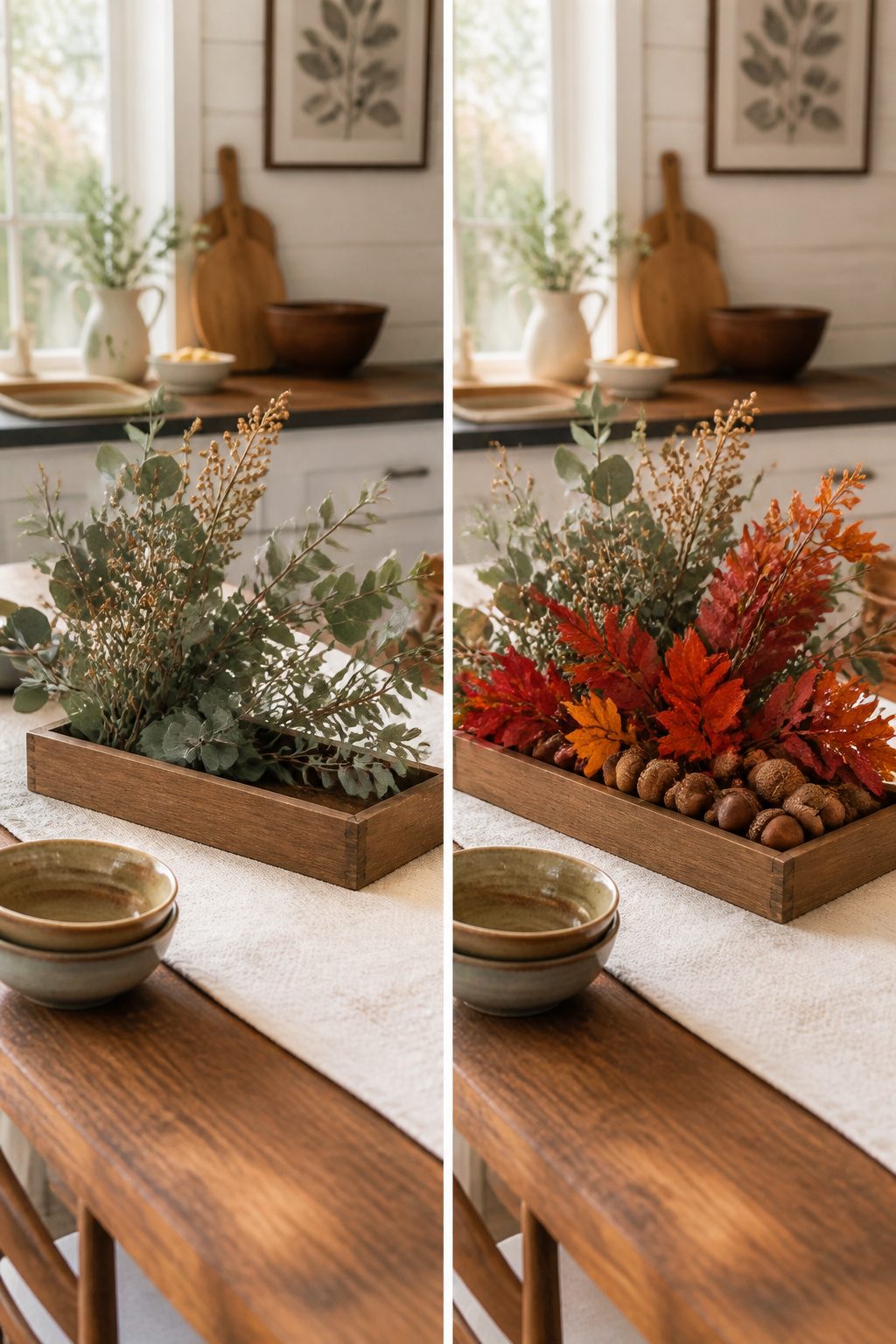
Dried wheat and eucalyptus are the two things I buy fake every year. The wheat keeps its shape through October without shedding, and good faux eucalyptus has that silvery cast real stems lose after a week in a vase.
Everything else I gather: bare twigs from the patio birch, seed heads from the spent coneflowers, a few clipped branches of red twig dogwood once the leaves drop.
The mix that looks convincing is about one third artificial, two thirds real. Any more fake and the arrangement goes flat and waxy; any less and it collapses in ten days.
I tuck the faux stems deep, where they provide structure, and let the real pieces sit forward with their irregular edges catching light.
A handful of acorns in the same bowl helps, or a couple of small gourds if the squirrels have not taken them first. Flowering kale lasts longer than you’d expect on a windowsill and bridges the two textures nicely.
Clip your own leaves if you have a redbud or similar, dry them flat, and trade them in as the real stuff yellows.
3. Fall Wreaths Aren’t Just for Doors
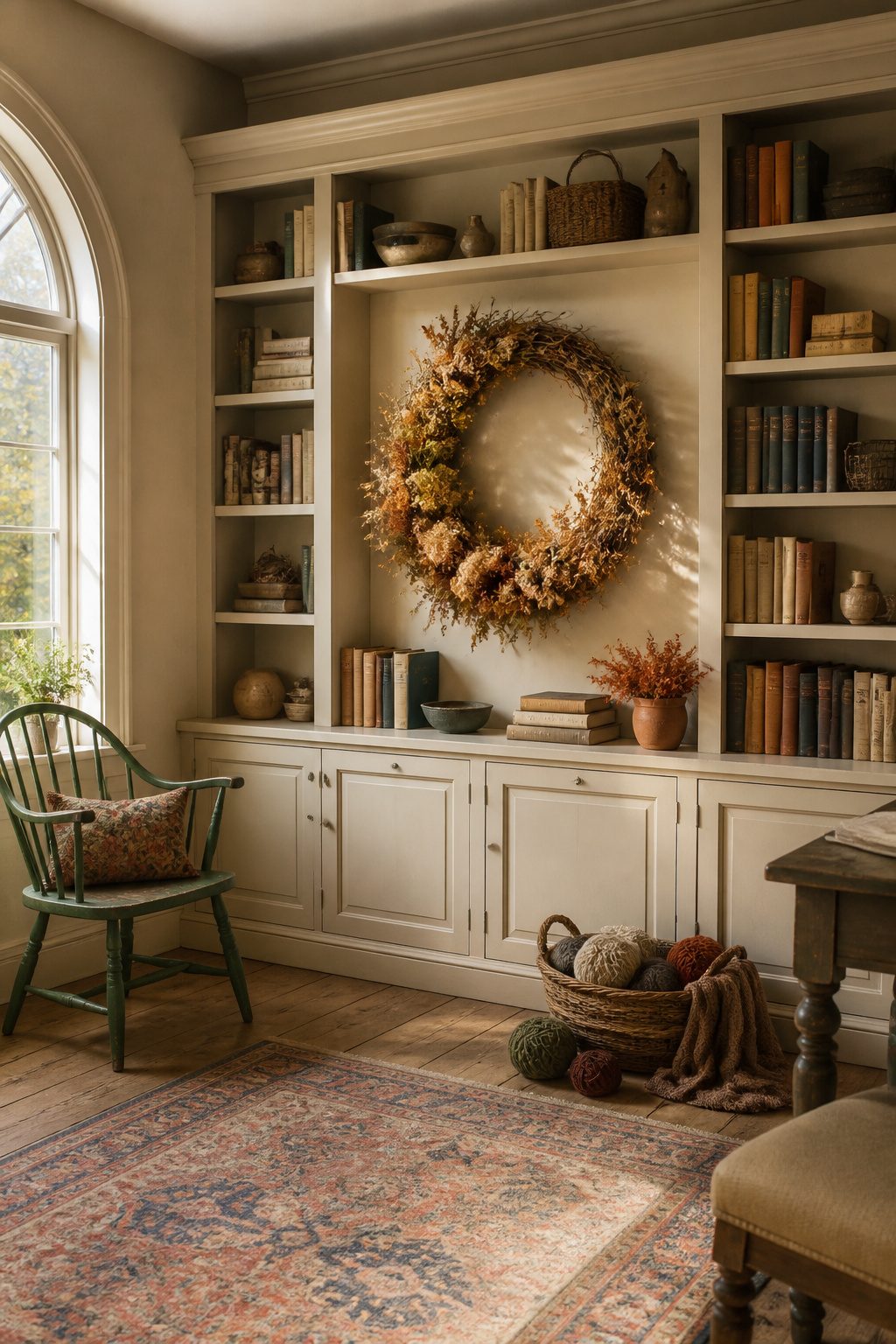
A wreath hung on a bare interior wall reads as circular art, not leftover door decoration.
Last autumn I leaned a 12-inch grapevine wreath on a floating shelf against vintage scrapbook paper and it filled the vertical space without crowding the room.
That scale matters: anything over 18 inches starts to own the wall in a small space, whereas a trio of smaller wreaths, each around 10 inches, groups tightly above a console or window frame and reads as intentional gallery arrangement rather than scattered clutter.
Windows are the other natural home for interior wreaths. Hung from a ribbon on the frame itself, they catch afternoon light and cast the shadow of the weave onto the glass.
The effect is seasonal but not loud, which is useful when you share walls or rent.
If you already have art on every wall, swapping one piece for a wreath for October through November changes the room without adding storage bins of decor later.
What convinced me in the end was seeing how a wreath layered over a frame, as if it were a mat, turned a photograph into something that felt collected rather than hung.
The circle breaks up all that rectangle-fatigue from televisions, phones, and standardized prints.
Keep interior wreaths under 16 inches unless you have a double-height wall or a fireplace to anchor them, or they stop looking like art and start looking like you forgot where the front door was.
4. Try an Unexpected Color Combo
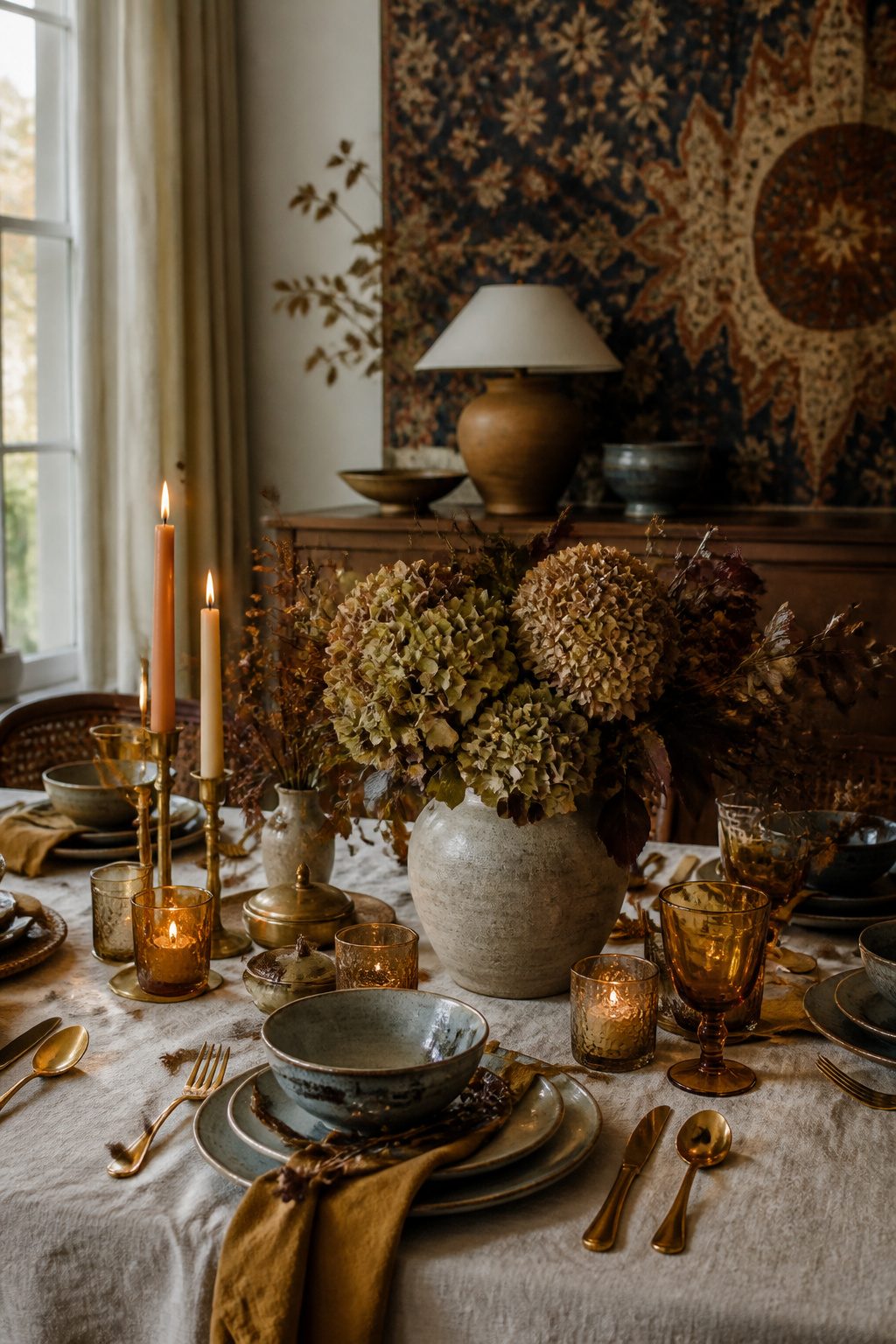
The usual fall palette asks a lot of orange.
Marie Flanigan puts the counterargument in a set of wine glasses she styled last season: soft blushes, amber, creams, and muted golds read as autumn once you layer them against deeper tones.
I saw the same logic in a painted pumpkin tutorial that skipped orange entirely for dusty blue and olive green, then parked the result under a glass dome.
These pairings work because they keep the warmth but lose the shout. Dusty blue against amber reads cooler than rust but still catches candlelight.
Olive and blush do something similar, letting a cream table runner ground the whole arrangement rather than fight it. The trick is the layering.
One muted tone on its own looks lost; three or four, with a low florals or a woven runner underneath, register as depth instead of noise.
If orange still wants to sneak in, let it come from the garden. The painted pumpkins, the glasses, the textiles.
The architecture can stay quiet.
5. Style a Trio of Fall Wreaths
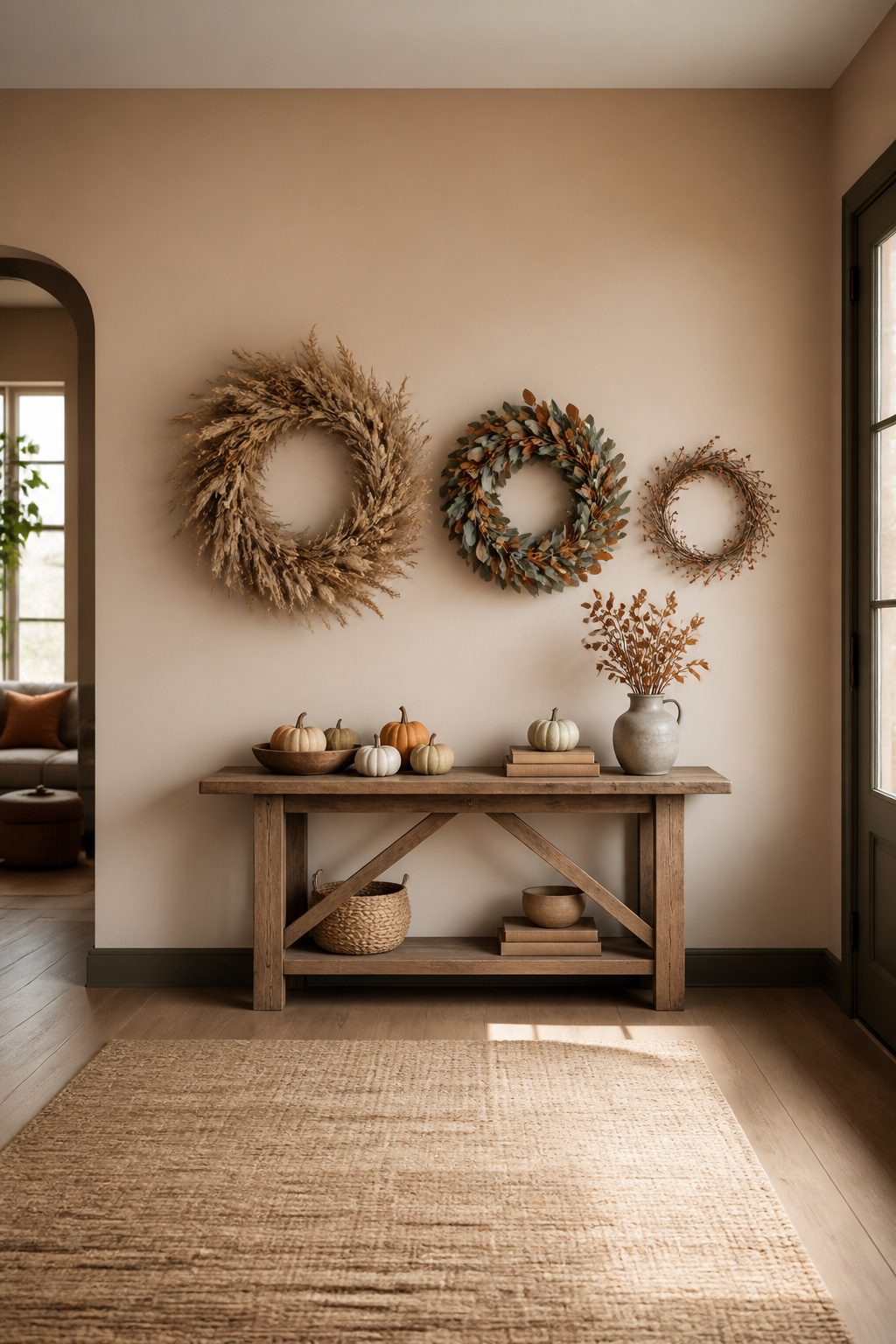
A single wreath on a blank wall disappears fast. Three wreaths in descending sizes, hung 4–6 inches apart on a vertical line, read as one intentional piece and fill the space for less than the cost of a framed print.
Balled grapevine or straw forms run small to large at most craft stores in autumn, and three will set you back roughly the price of one boutique wreath.
I use simple cup hooks rated for the weight; two support the largest at top, one each for the middle and bottom.
The vertical line draws the eye up, so the grouping works even on a narrow slice of wall between windows or beside an entry mirror.
spacing matters more than the wreaths themselves. Too tight and they cluster like a traffic jam; too loose and the eye reads three separate objects instead of a single composition.
Six inches became my rule after a trial where four inches felt crowded and eight let the middle wreath float lonely.
The cheap fill is the point. Ribbon, dried pods, or clipped backyard stems wired to the forms cost almost nothing and read richer in a cluster than any one wreath could alone.
6. Style Open Shelves as a Fall Vignette
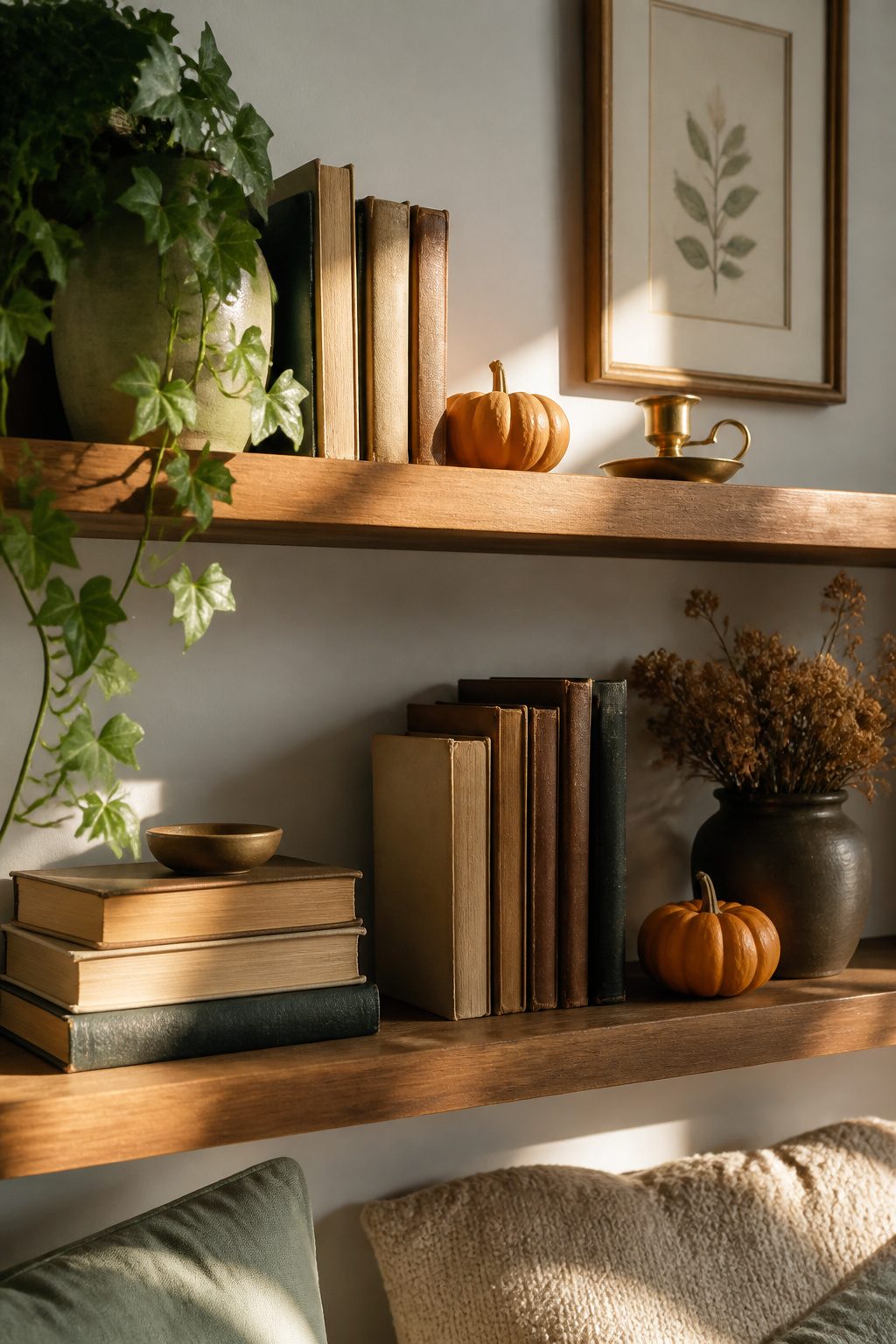
A single shelf is enough. The trick is crossing the horizontal plane with something vertical, something trailing downward, and a block of solid mass in between so your eye travels rather than rests.
A short stack of well-worn paperbacks sits flat as the base. On that goes a squat pumpkin, the real kind that softens in two weeks and smells like October before it goes.
A brass candle cup tucks beside it, low enough not to compete.
The trailing stem, maybe a stem of dried amaranth or a length of English ivy you’ve already got potted, drapes over the front edge so the shelf feels lived-in rather than staged.
Renters and small-space dwellers do not need the whole bookcase. One shelf at eye level, cleared of its ordinary clutter, reads as intention rather than afterthought.
The books go back into storage in November. The candle was already yours.
The pumpkin becomes soup.
7. Use Feathers as Fall Decor
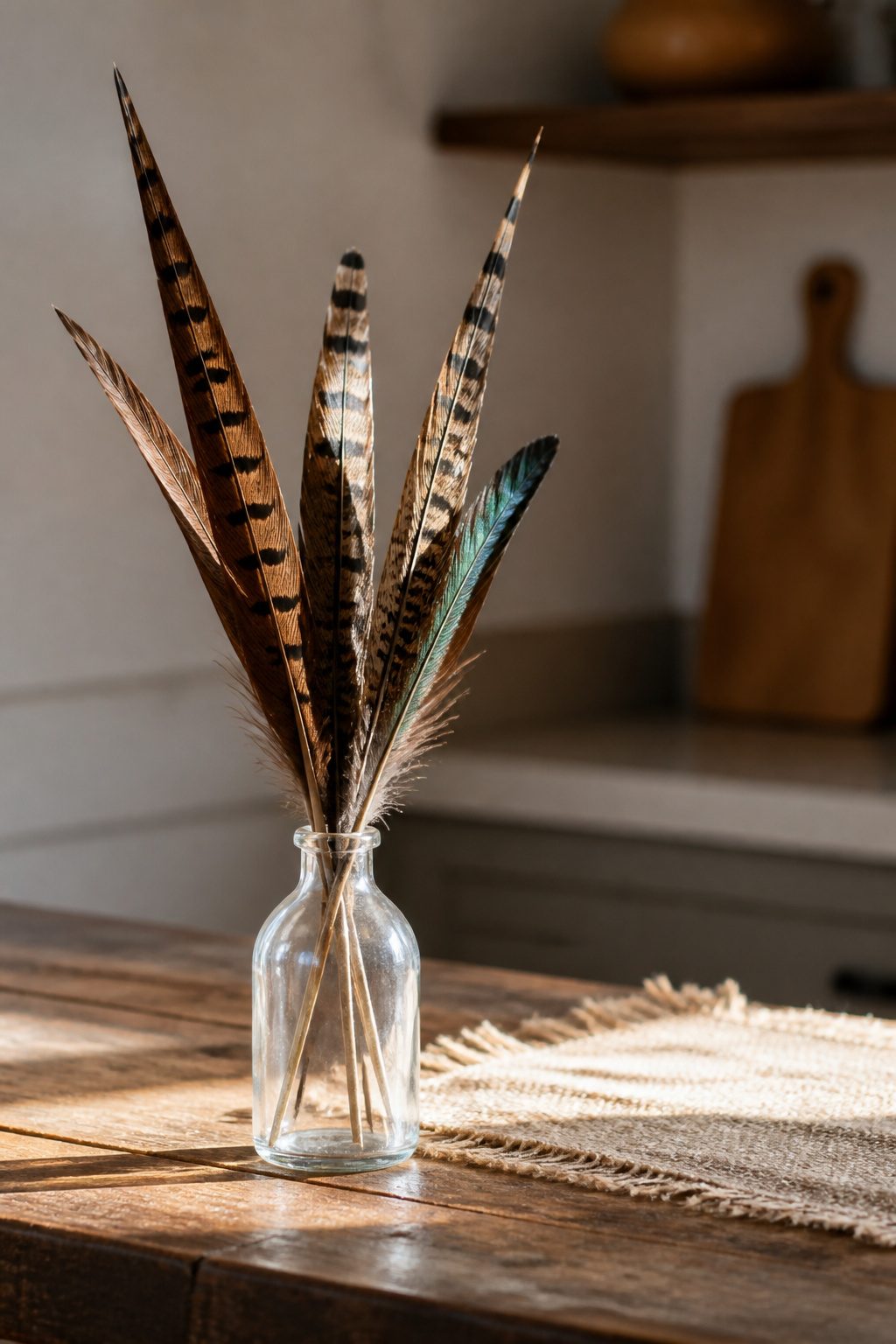
A small cluster of pheasant or guinea feathers in a bud vase adds texture without the clutter of a full floral arrangement.
Six or seven feathers gathered at varying heights makes a balanced shape; fewer reads sparse, more starts looking like a costume shop.
The trick is finding them without the guilt of craft-store bulk packs of questionable origin.
Local 4-H poultry swaps, county fair auctions, or a note posted at the farm supply store will usually turn up a backyard flock owner with feathers to spare.
Most keepers sweep them out of the coop anyway and are glad to sell a small bag for a few dollars.
Once dried, they last the full season untouched. A light mist of unscented hairspray keeps the barbs from shedding if the vase sits near a heating vent.
I left mine out through Thanksgiving last year, and the only change was a little dust that a soft brush took care of in seconds.
They work best where you would not expect them: a bathroom windowsill, the narrow shelf above a desk, the corner of a kitchen counter already crowded with produce.
The eye reads them as neutral, but their iridescence catches late autumn light in a way dried grass never quite manages.
8. Use Dried Florals
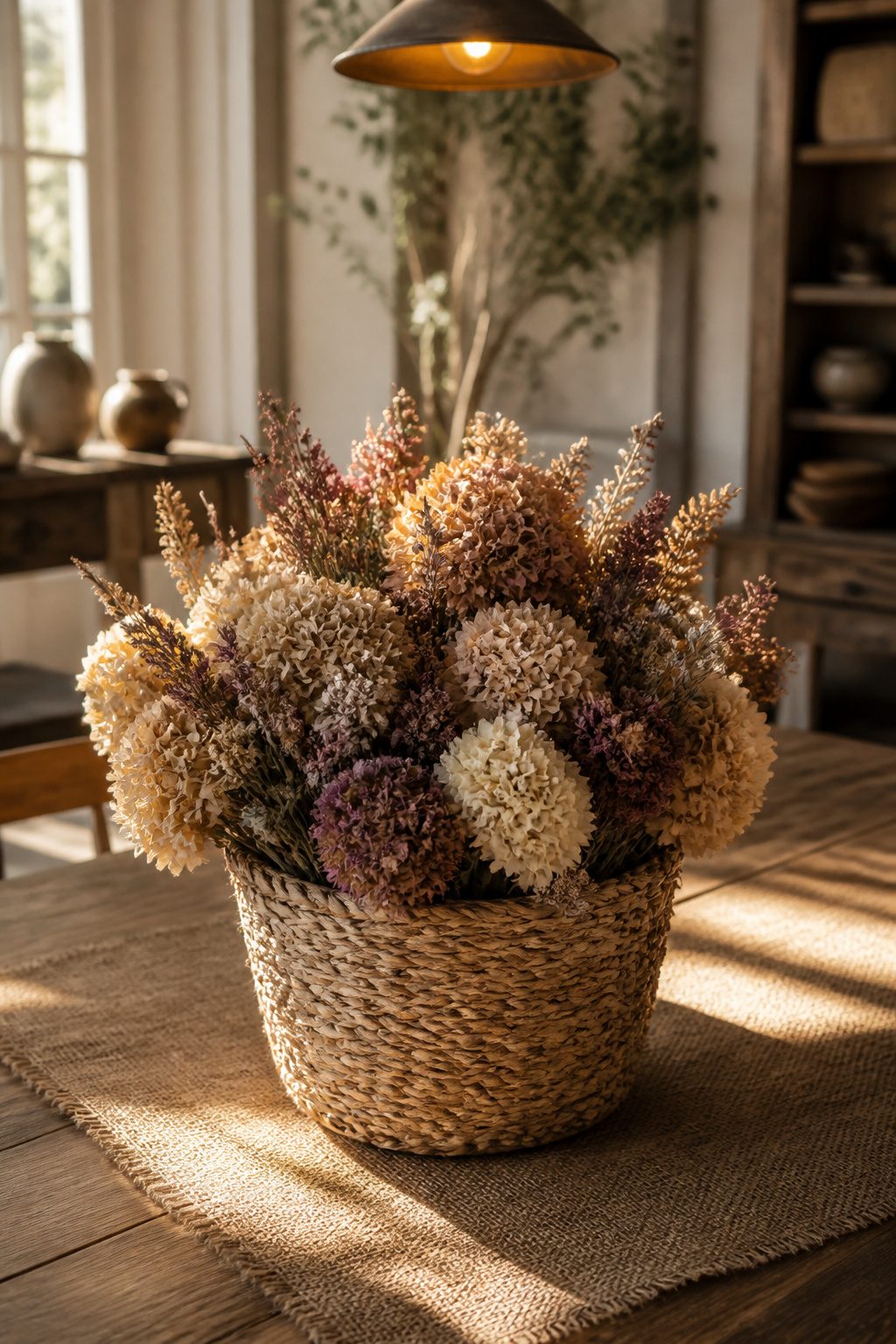
Dried hydrangea, statice, and strawflowers hold their color for months, which is why they are the backbone of most fall arrangements. Some flowers dry well at home with patience; others are better bought already dried.
Limelight hydrangeas and baby’s breath air-dry easily. Bundle them stems-down in a dark corner and wait.
That works for about a third of the stems I try each year. The rest, delicate strawflowers especially, I buy already dried.
The vessel matters as much as the fill. This year I spotted a woven basket for $2.99 at the thrift store that now corrals a mix of dried stems.
Ten inches wide, pale enough to read as neutral. Thrift store baskets age faster than they wear out.
9. Go Neutral and Omit Traditional Orange
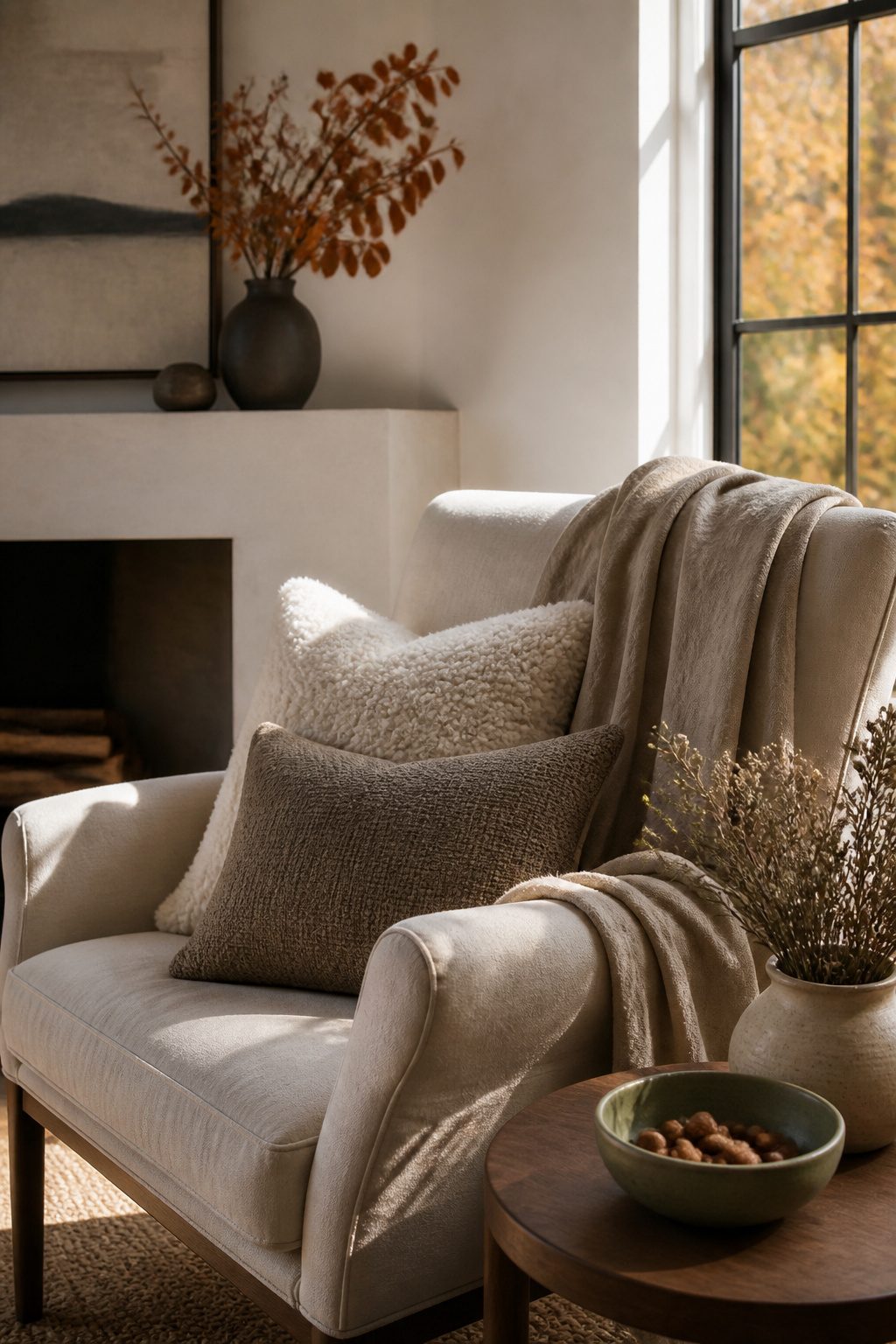
Cream, taupe, brown, and sage feel like fall without shouting it. I started with what I already owned: a linen throw in oatmeal, a set of stoneware bowls in matte sand, and a wool rug the color of dried wheat.
Nothing read seasonal on its own, but together they built a quiet shift.
The new purchase was a set of four velvet pillow covers in a grayed sage, about $40 total from a clearance end cap where the summer stock sat. I passed on the rust and burnt orange versions three shelves down.
Those colors feel like a costume to me now, something the house wears for six weeks and then sheds.
What surprised me was how the palette let the late light do the work. At four o’clock, the room goes amber on its own.
The neutrals catch that warmth instead of competing with it. My mistake last year was adding a copper tray for "warmth" that only clashed.
This year I kept the metal to brushed nickel and raw wood.
The tonal approach also means pieces move back into the everyday rotation faster. The sage pillows live on the sofa into January; they read as winter green by then.
The orange ones from 2022 are still in a bin, waiting for a donation run I keep postponing.
10. Create a Full Pumpkin Vignette
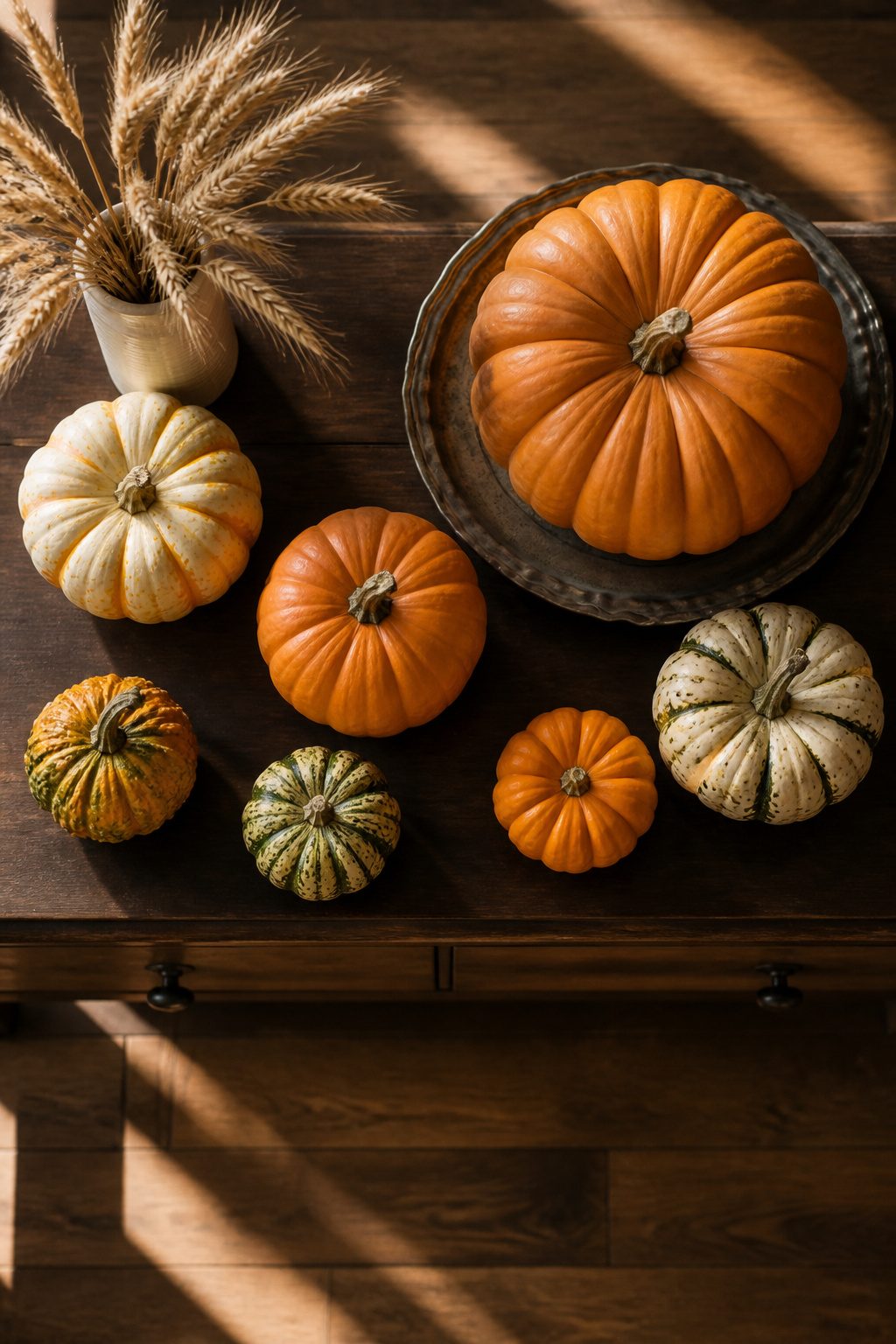
The first time I clustered pumpkins on a surface instead of spreading them around, the arrangement actually read as fall rather than looking like I’d set down groceries and forgotten them.
A credenza can carry seven to nine pieces comfortably: one large anchor pumpkin, three to four medium ones, and the rest in the smallest sizes tucked into gaps.
The variation in shape matters more than the variation in color, which surprised me. A flat-topped cheese pumpkin next to a round sugar pie and a squat kabocha creates depth that same-size globes just don’t.
For a balcony table, three to five pumpkins total keeps the grouping tight enough to survive wind and still look deliberate. Two medium and two small works, or one large with three tiny ones at its base.
I learned the hard way that one heavy pumpkin on a lightweight bistro table will slide toward the edge the first time someone leans on the rim, so the base pieces need to sit flat and close together.
The surface itself becomes part of the composition. A dark wooden table lets pale pumpkins and the warty orange ones stand out; a white painted surface needs deeper color or the display washes out.
I leave stems on when they have them, and when they don’t I don’t fake it. Tops look stranger with corks or picked stems glued on than they do simply bare.
11. Press Autumn Leaves for a Gallery Wall
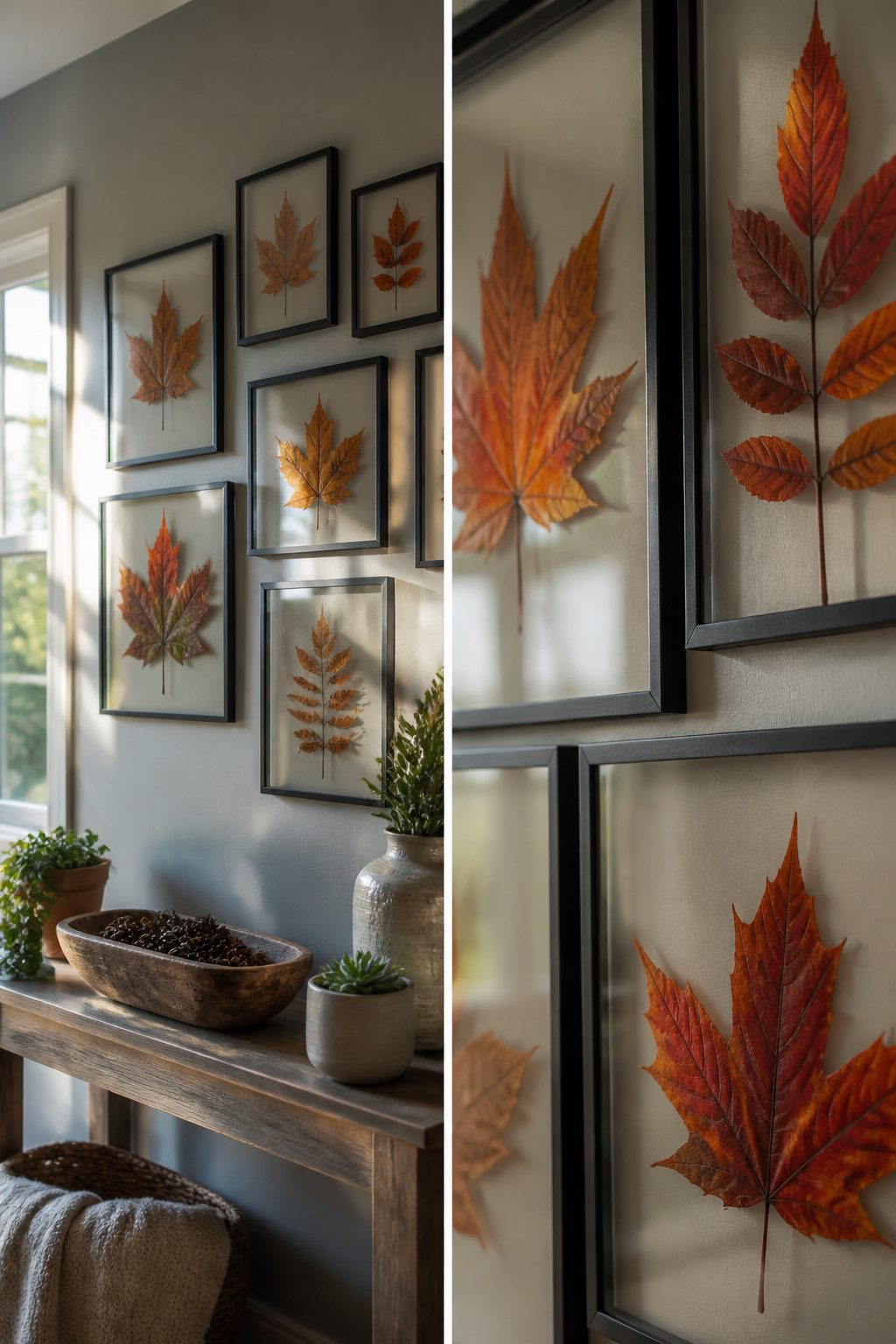
Leaves turn color when sugars trapped between leaf and branch break into pigments, but that chemistry stops when the leaf hits the ground.
Collect them on the tree the day the color peaks: bright red, burnt orange, or yellow that still bends without cracking.
I lay mine between sheets of printer paper inside a heavy book, weight it with two more, and wait two weeks.
The ones that brown usually went in too late, too dry, or too thick; sugar maple and oak hold better than the soft-leaved poplars.
Clip frames cost a few dollars each and need no mat. I arrange five or seven leaves per frame the way they fell, overlapping stems, glass pressing them flat enough to read like specimen pages.
Hang them where morning light comes sideways; backlit chlorophyll remnants glow even after the browning starts, which for me happens around month four no matter the species.
12. Style a Woven Basket with Fall Stems
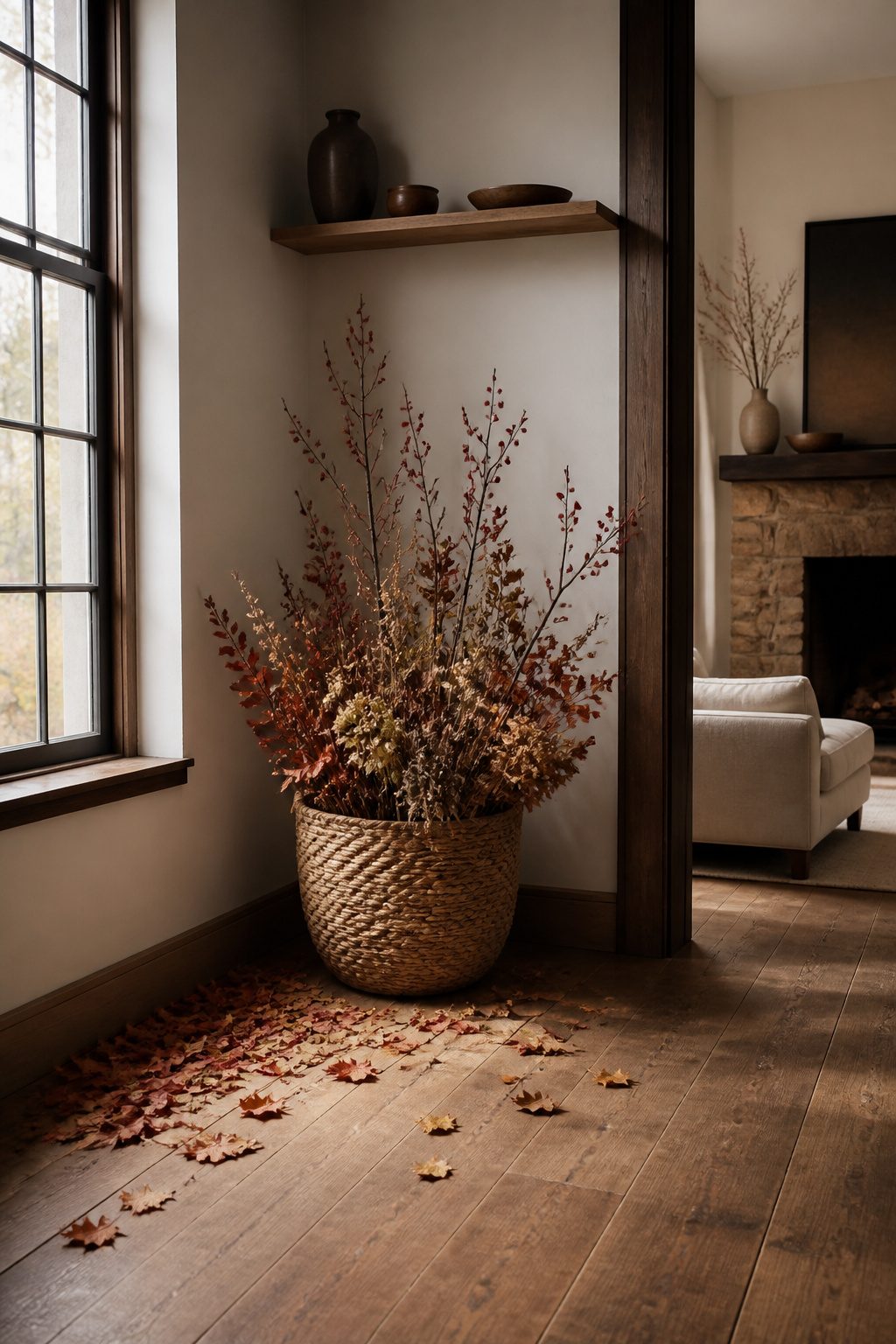
A tall basket of dried branches does the same work as a vase arrangement at half the height and practically no cost. Thrift stores usually have woven baskets for under three dollars.
I found mine for $2.99, about fourteen inches across, with a slope-sided profile that sits steady on the floor without tipping.
The rim is the number to plan around. Branches need to stand six to eight inches above it, minimum, or the whole piece reads as a basket with sticks jammed in it.
Dried hydrangeas, if you have them, hit that mark naturally. Fall branches from the yard work too, though you will need heavier material in the base to keep tall stems from leaning.
Weight matters more than height alone. A wide-based river stone or a sand-filled paper sack taped flat and dropped in first keeps the silhouette upright.
Without that ballast, even perfectly tall branches drift toward the door by Tuesday.
Scale this to the spot. Floor placement needs the fullness, table placement means fewer stems so you can still see past it to the person across.
13. Use Pears in Your Fall Decor
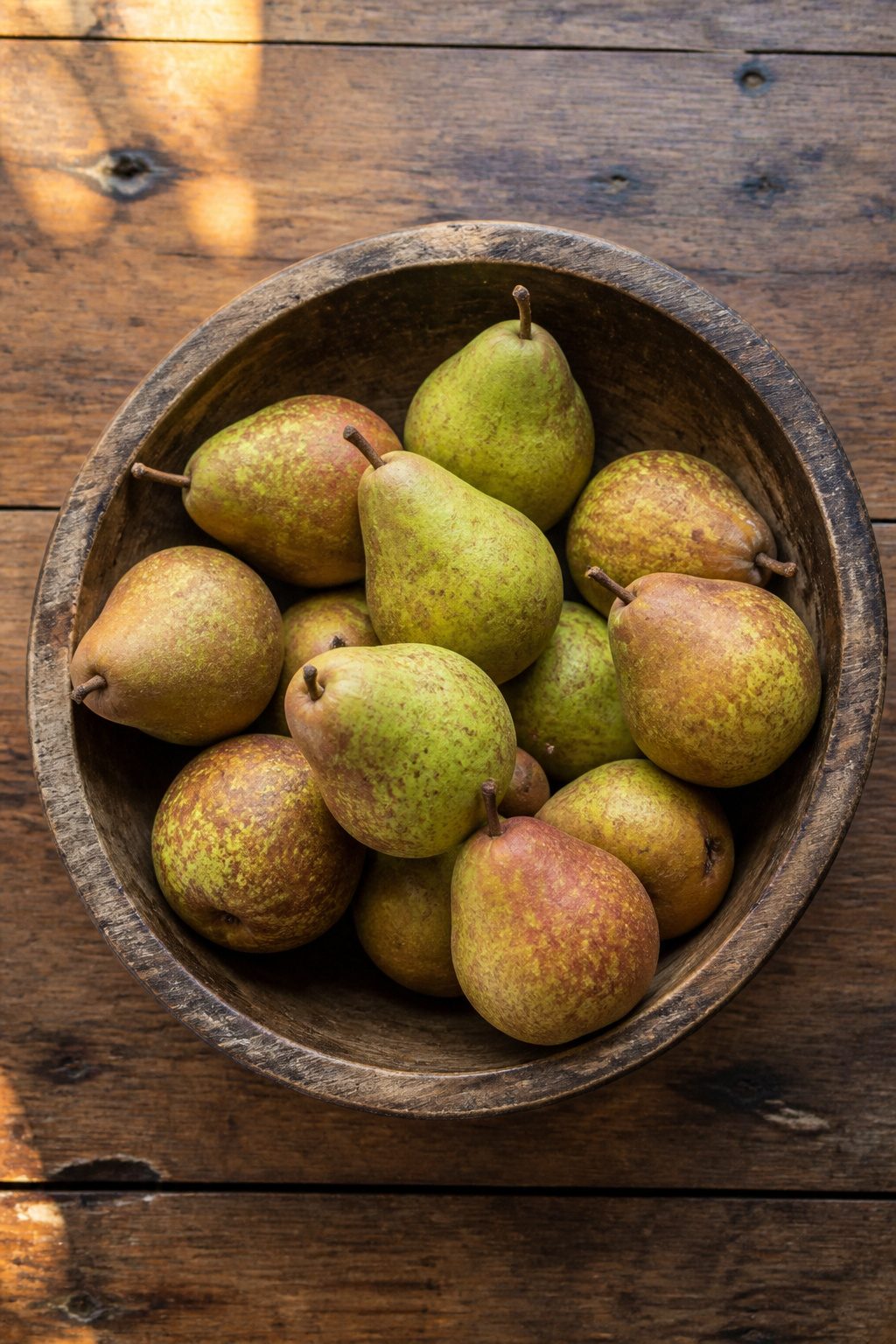
Seckel pears do the most for fall decor if you buy them for color first and a galette second.
Their russet skin and squat shape hit the right mood for a kitchen table or sideboard, and a bowl of them feels chosen rather than leftover.
I set out six or seven in a wide ceramic bowl, stem ends up, and that fills the space without crowding.
Bosc pears last a week to ten days at room temperature before the neck softens, Seckel closer to two weeks because the skin is thicker.
The bowl stays where I can see it, because the shift from firm to ripe happens fast once it starts, and move them to the pie as soon as the give at the stem end is deeper than a polite press.
Waiting for full softness means mealy fruit and a sad crust. A pear kept too long splits its skin at the base and leaks juice into the bowl; that ring never scrubs out of raw wood.
14. Go High Contrast with Black and Cream
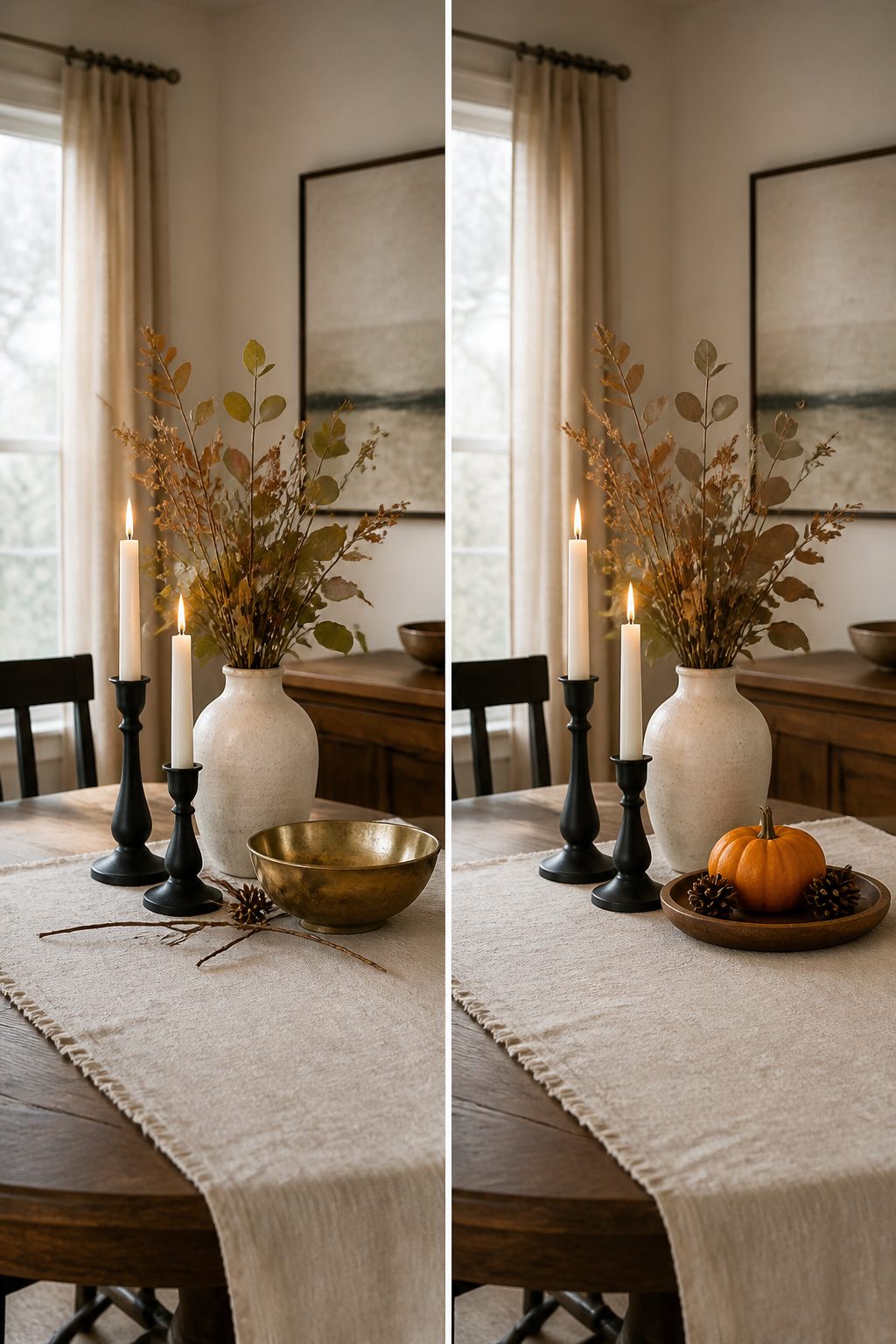
Black candlesticks against cream linen read as autumn to me because the contrast feels like shortening days without spelling it out in orange.
The graphic punch works best when the black is small and structural and the cream carries the softness.
I never buy black accents new. Thrift stores are where the good shapes hide.
Handmade pottery candlesticks and vintage metal frames turn up regularly for a dollar or two, and the worn finish is what makes the black feel grounded rather than harsh.
Copper candlesticks do the same seasonal work if black feels too severe for a room, and copper thrifts just as easily.
Cream throws or a slubby cotton runner keep the pairing from going stark.
Add one natural material, a split log or a rough ceramic bowl, and the tension between dark and light relaxes into something you actually want to live with through November.
15. Incorporate Corn Stalks
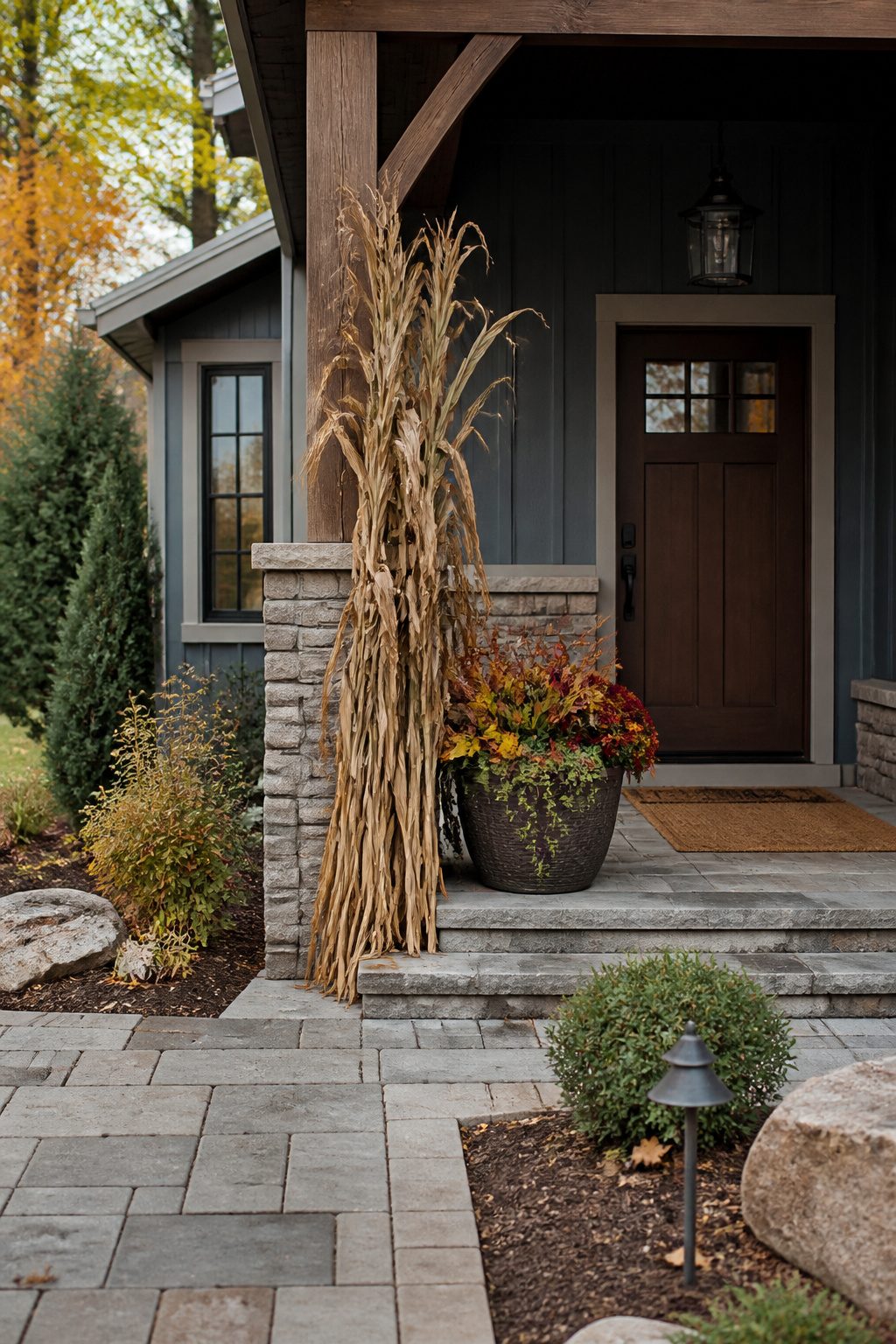
Dried corn stalks need something solid to lean against or tie to; a porch post, a corner by the front door, or the inside frame of a covered entryway all work.
Two or three stalks are enough to read as intentional, not abandoned. Farm stands and garden centers sell them bundled from late September through October, though a local farmer will usually let you pull a few if you ask.
Plan to replace them every season: they shed silk and bits of dried husk no matter how carefully you handle them, so set them on a mat or old sheet if you bring them through the house.
Secure them with jute twine in two places or zip-tie them to a post at ankle and chest height so they do not flap loose in an October wind. Sweep the base every few days, or the debris collects fast.
I skip the spot directly in front of the door after stepping on a fine layer of husk once too often.
16. Include Apple Decor
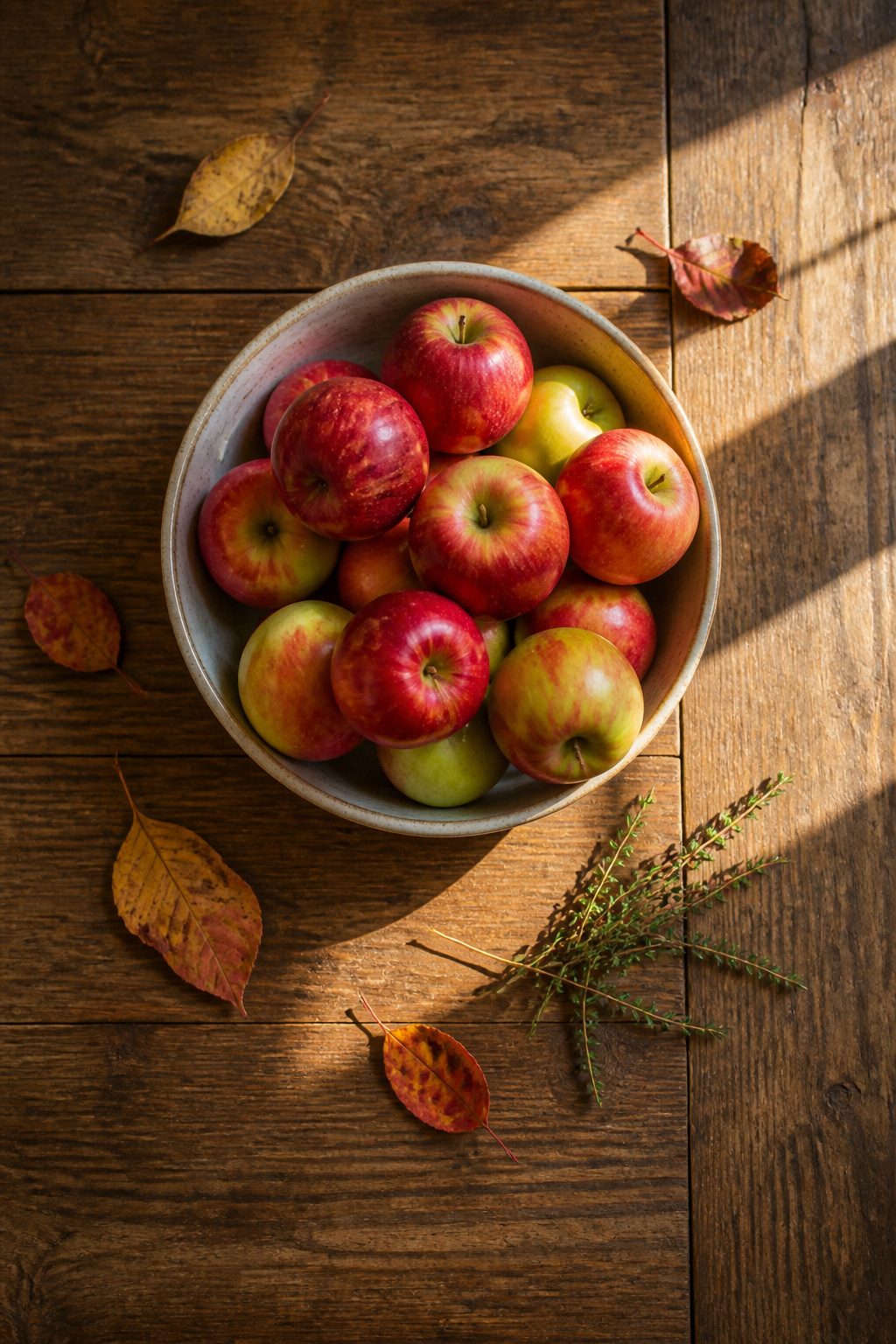
A wooden bowl of red and yellow apples bridges late summer into fall better than almost anything else.
Varieties like Fuji and Granny Smith hold up longest at room temperature, often keeping their shape and color for two to three weeks. The trick is checking stems: a dry, loose stem means that apple is already close to turning.
Move any bruised or softening fruit to sauce before it affects the rest, since one spoiling apple does exactly what the proverb says.
I often set a reminder on my phone after two weeks, not because the display looks bad, but because sauce-making is easier before the texture turns mealy.
A few scattered apples down a table runner looks intentional; a full bowl with wrinkles and spots looks neglected, and the line between them is about five days of watching.
17. Use Copper to Add Fall Warmth
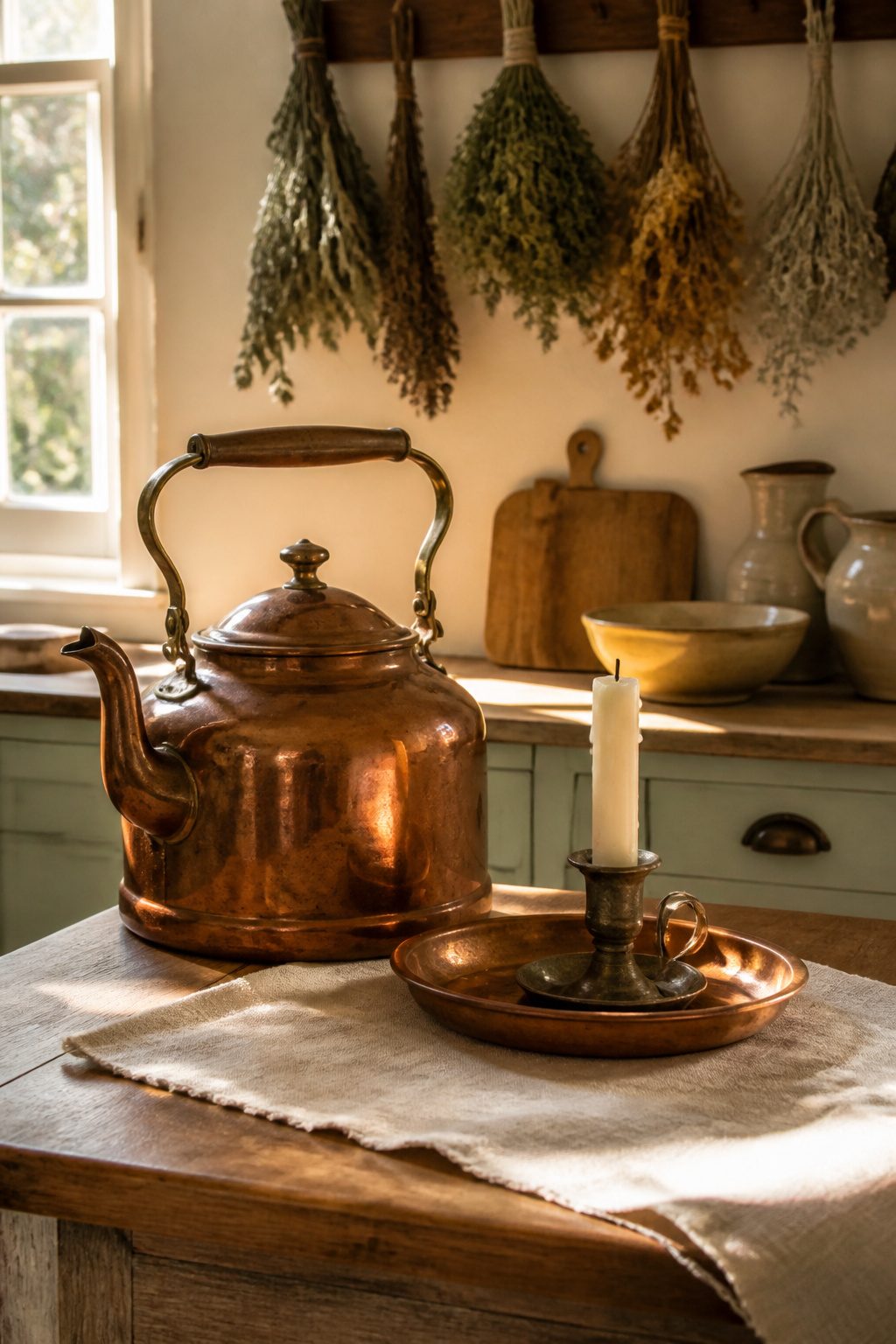
Copper catches light in a way that reads autumnal even without a single leaf nearby.
A small copper mug left out on a kitchen counter, a bowl tucked onto a shelf, or one kettle on the stovetop does the work of a whole color scheme.
Thrifted copper is usually the better buy. Vintage pieces run a dollar or two at most sales, and the weight alone tells you whether you are holding solid metal or a thin wash over something else.
New copper can cost ten or twenty times that for the same silhouette, and the shine out of the box often feels colder anyway.
The patina question splits the room. Some people polish theirs weekly to keep that bright penny glow.
Others let the darker, mottled surface build, which reads as older and warmer and hides the water spots that otherwise need wiping. The kitchen leans practical, so I leave mine alone after the first faint dulling.
A kettle that looks used is a kettle that belongs there.
18. Feature a Singular Classy Pumpkin
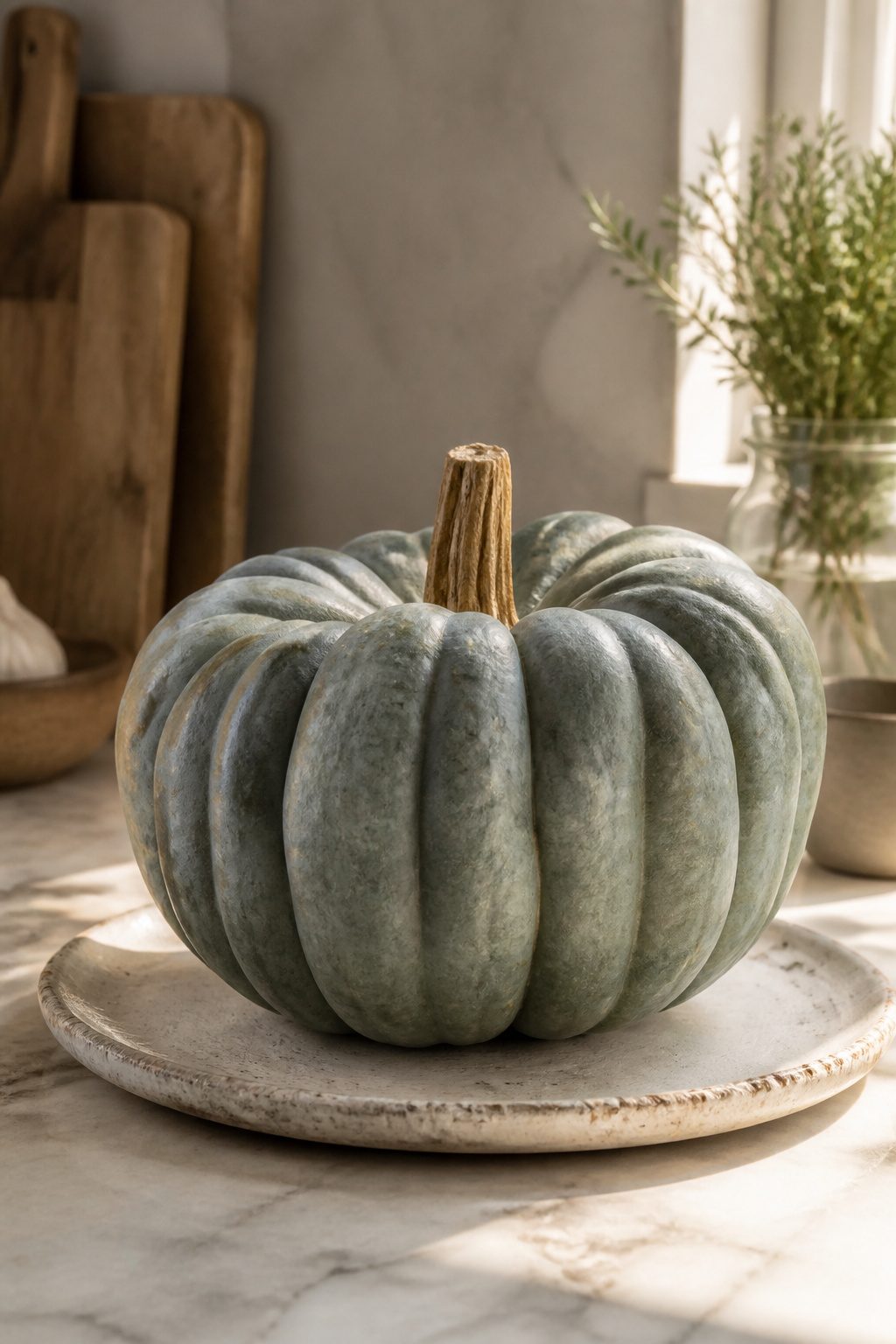
A single heirloom pumpkin on a countertop does more work than a cluster of the grocery-store variety ever could.
The ridged, almost sculpted surface of a Jarrahdale or the flattened, pale silhouette of a Long Island Cheese reads like pottery someone forgot to glaze.
I used to set out four or five small pie pumpkins and wonder why the arrangement still looked like produce. One oversized Cinderella pumpkin, stem still cork-screwed and dry, fixed that immediately.
Unusual varieties turn up at farm stands on the county roads just outside my town, and at a single booth in the public market downtown where the seller stacks them in milk crates labeled by county of origin.
The wormy, thick stems are the giveaway; the supermarket trims them smooth for stacking. A statement piece needs negative space around it.
Mine sits on a folded linen napkin beside a stack of mailed catalogs I never read. The lean of the pumpkin, the curve of its ribs, does the whole season’s work without a candle or a wreath in sight.
19. Create a Lush Fall Mantel
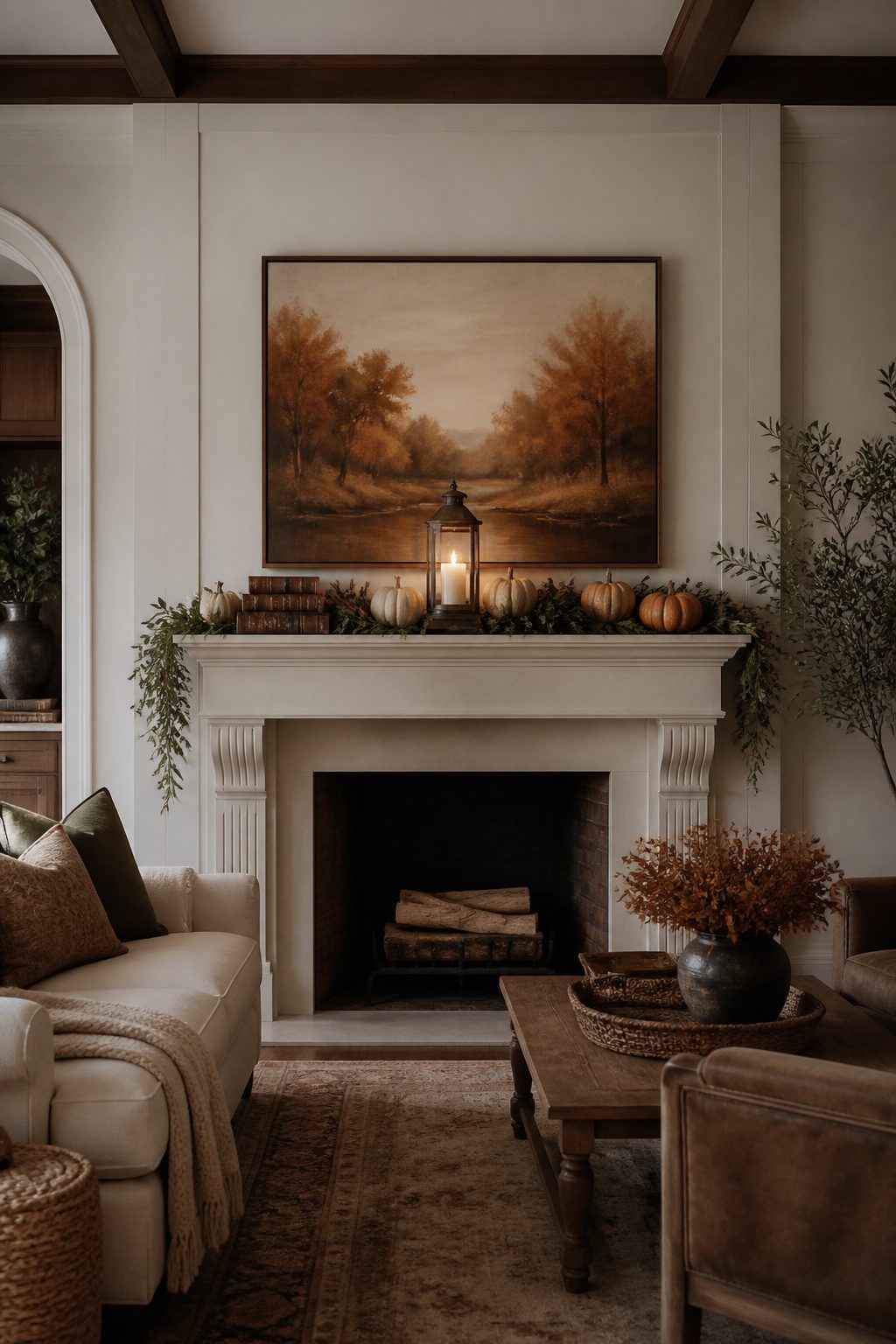
A mantel in a small room collapses into clutter the moment anything crosses the 12-inch depth line. I keep every layer of fall decor inside that boundary, and the difference is what separates a vignette from a junk shelf.
Up top, a single focal point carries the eye: a lantern, a dough bowl, or a vase of tall branches that reaches for height without tipping past the midpoint between mantel and ceiling.
From there, one natural element threads through the middle: a strand of faux garland, or small pumpkins grouped in odd numbers, nothing so wide it breaks the plane.
Books stack at one end or both, leather-bound vintage ones in deep reds if you can find them, bringing that harvest tone without any orange in sight.
Candlestick holders sit between the stacks; thrifted pottery or copper ones run about a dollar or two, and white pillars inside them do the warm work after dark.
Nothing on the mantel should sit closer than two inches to the edge. That breathing room is what keeps the whole arrangement from reading like a tabletop pushed against a wall.
If the room is tight, keep the tallest piece under 18 inches and let the rest descend from it like a loose staircase. It looks considered, not crammed in.
20. Frame Doorways in Garland
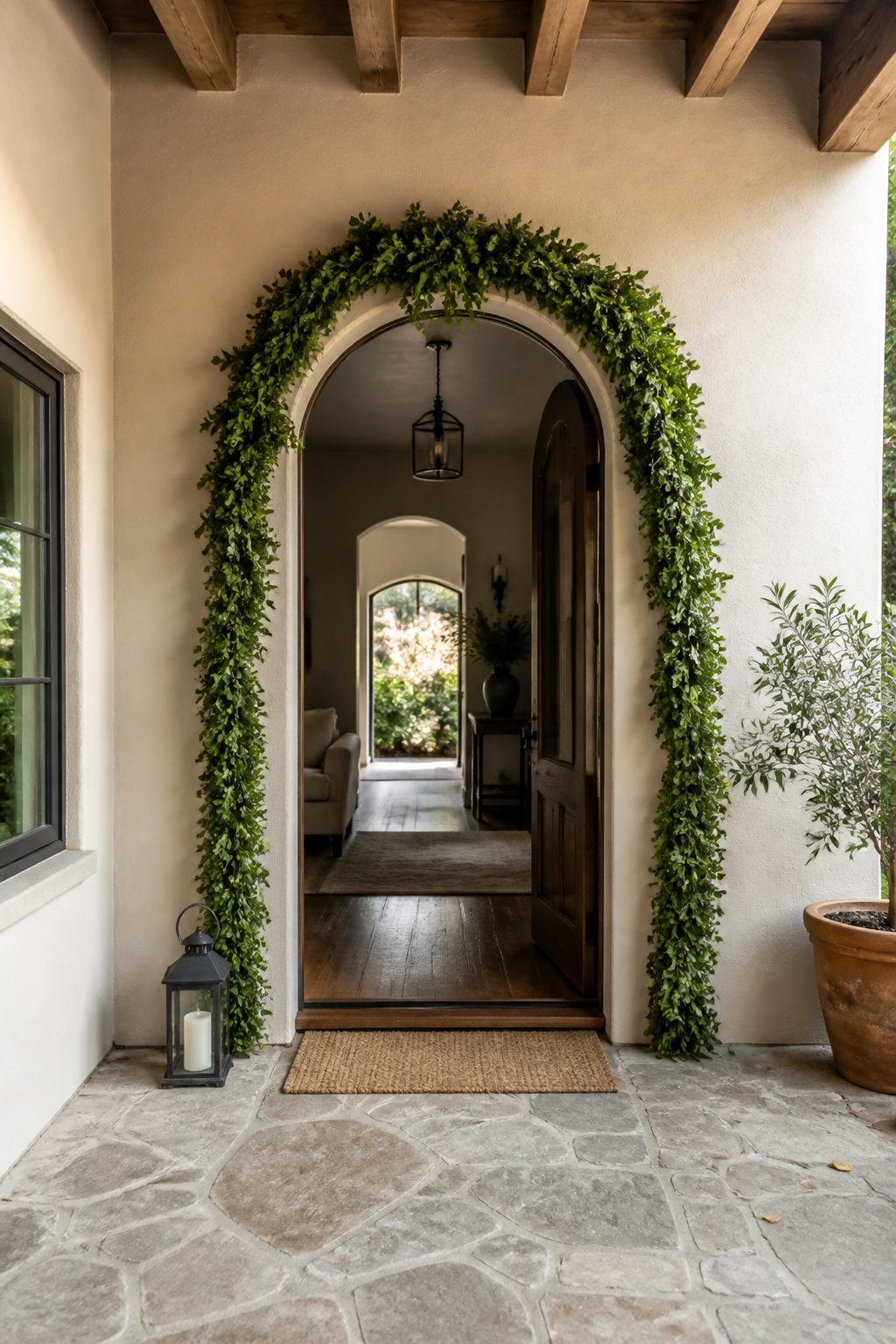
A doorway framed in garland reads as architecture rather than clutter, and it costs far less than a console table or seasonal rug.
Faux boxwood or dried hops both work; the trick is purchasing enough length so the drape hangs naturally rather than stretching tight across the top.
For a standard 32–36 inch interior door, order roughly one and a half times the frame perimeter. That extra half-length gives the soft sag you see in magazine shots, not the tense dental-floss look of skimping.
My first attempt ran the exact frame width and looked like I was trying to cordon off a crime scene.
Adhesive hooks placed at the top corners, facing up so the garland rests in the hook rather than pulling against it, hold most lightweight faux options without touching paint.
Dried material needs more support; florist wire looped over a finish nail tapped into the upper door jamb, then bent flat with pliers, disappears behind the trim and leaves a hole you can fill in spring with a dab of spackle.
Painter’s tape folded into a loop will fail by Thanksgiving. I have cleaned that sticky stripe off casings twice and do not plan a third.
21. Try Pops of Bright Color
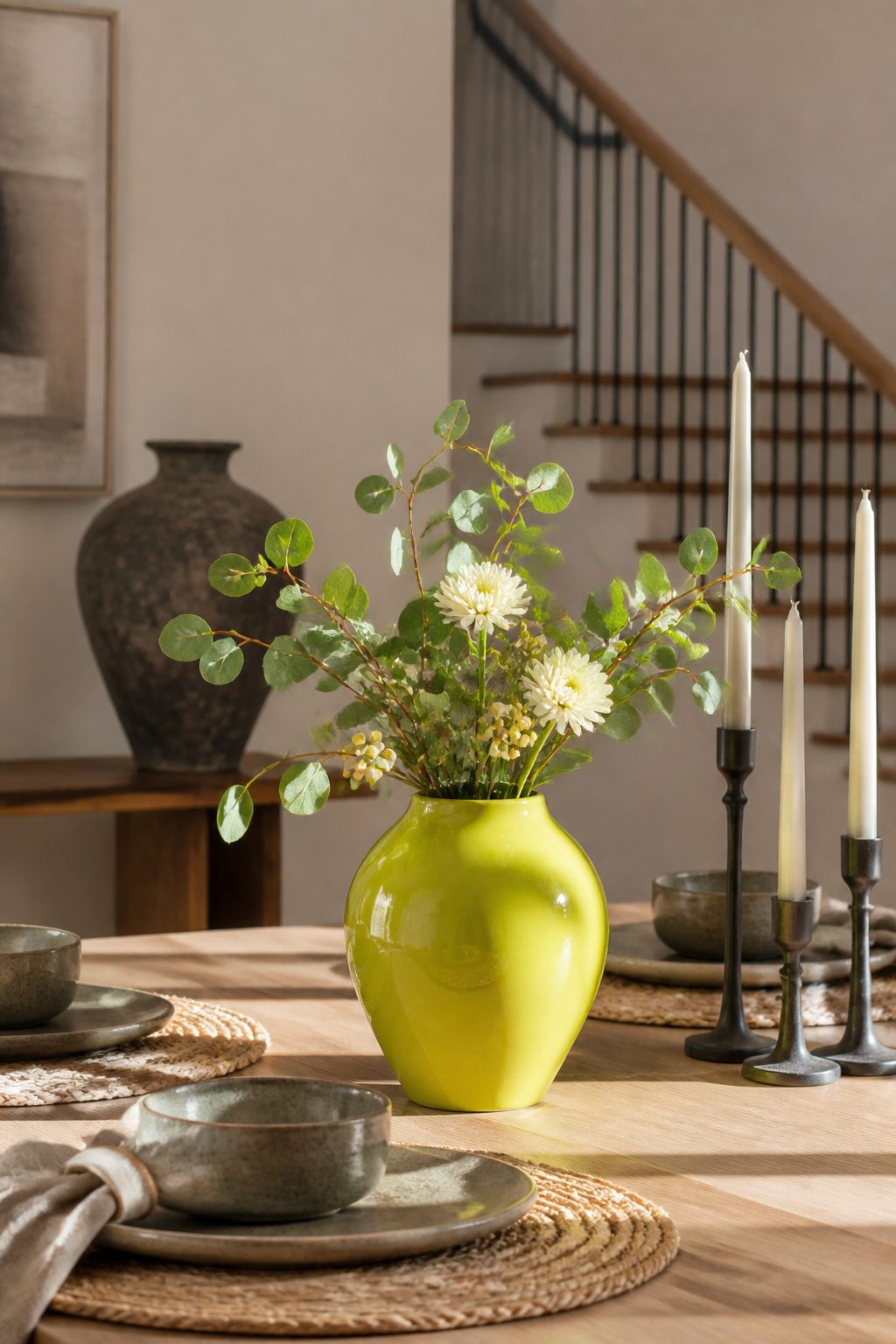
Fall palettes can flatten into a wash of rust and beige faster than you notice. One way to stop it is a single saturated accent dropped in like a counterweight: fuchsia, electric blue, or chartreuse against the muted stuff.
The effect is immediate and almost physical, like turning up the dimmer on a room that went sleepy too soon.
Placement is where this lives or dies. A moody pink in dishware and a small floral arrangement, grounded with rattan or raw wood, earns its keep because the surrounding textures absorb the shock.
The same electric blue scattered across four surfaces reads as panic, not energy. One object, one hue, one location is the workable limit in an open living area or a dining room where people gather for long stretches.
I have seen chartreuse work beautifully on a single ceramic vase in a bookcase, and I have seen it fracture the calm of a bedroom when it showed up on the bedding, the lamp, and the curtains all at once.
Bedrooms want less of this; the eye needs somewhere to rest. The porch has more tolerance.
A bright purple door wreath against grey siding carries the same logic, energetic and moody at once, because the sky and the architecture hold it in check.
The test is subtraction. If removing the bright piece leaves the room still coherent, you placed it right.
If removing it solves a problem you could not name, you had too many, or they sat too close together.
22. Fill a Bucket with Fall Florals
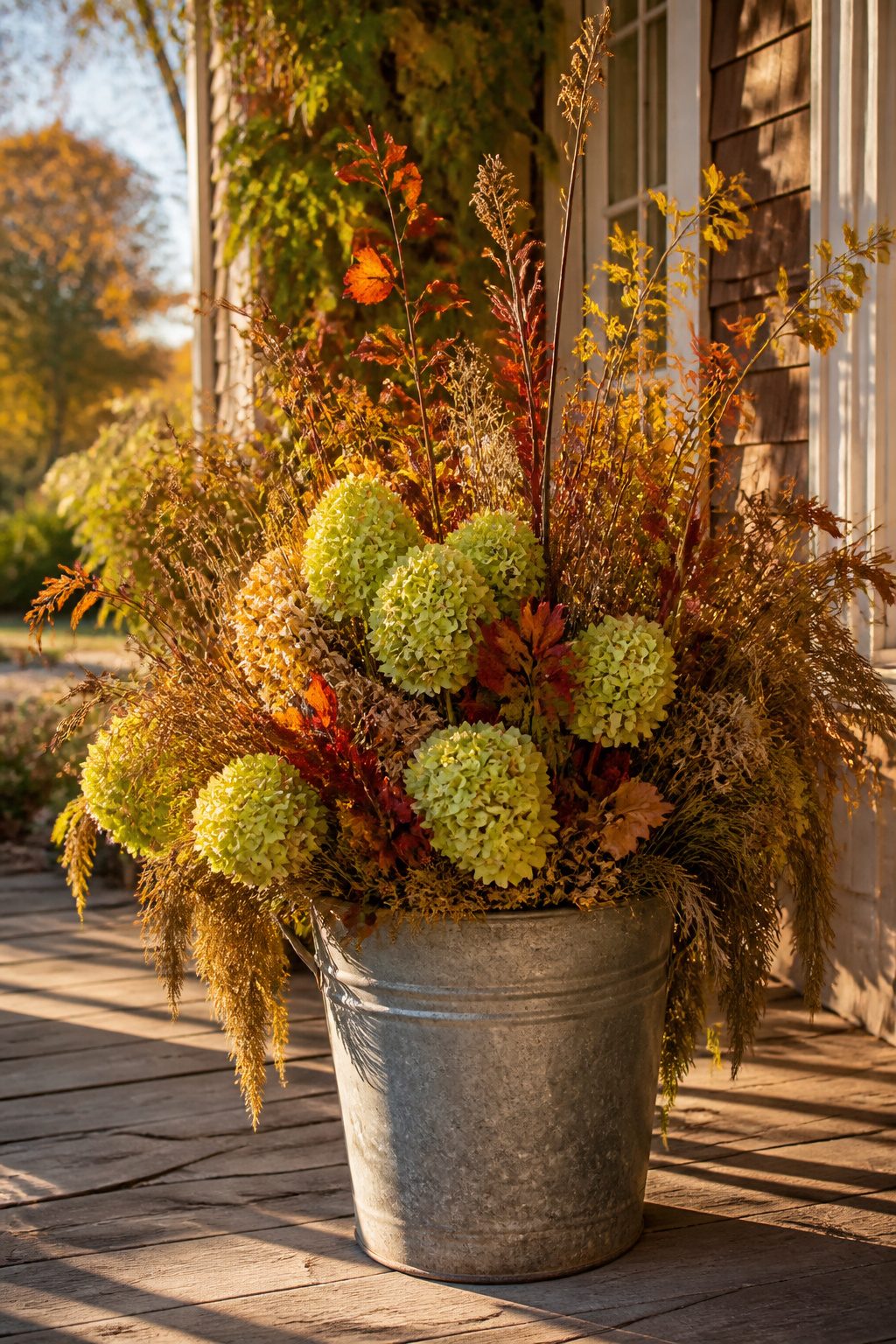
A galvanized bucket or terra cotta pot crammed with mixed dried and fresh stems becomes a floor piece worth walking around.
The question is what to put where, because water changes everything: weight, placement, and which stems you can even use.
Fresh stems need a vessel that holds water. A galvanized bucket with a liner works, but a terra cotta pot glazed inside does too, and either one gets heavy.
Terra cotta gains real pounds once it is soaked, which matters if you are lifting it onto a pedestal or need to roll the arrangement inside on frost nights. Dried hydrangea and baby’s breath carry none of that problem.
They last year to year, though they eventually go brittle and shed.
The practical move is to split the job. Use the heavy, water-holding container for the fresh foundation, limelight hydrangeas if you can get them, then tuck dried stems around the edges where they stay clear of the water line.
Or skip water entirely, bunch dried stems into a dry bucket with sand or florist foam hidden at the base, and arrange fresh ones in a separate smaller pot nearby.
I have reused the same dried baby’s breath across three falls now. The brittleness is real by year three, so I replace it before it powders on the floor.
23. Use Vintage Decor in Fall Colors
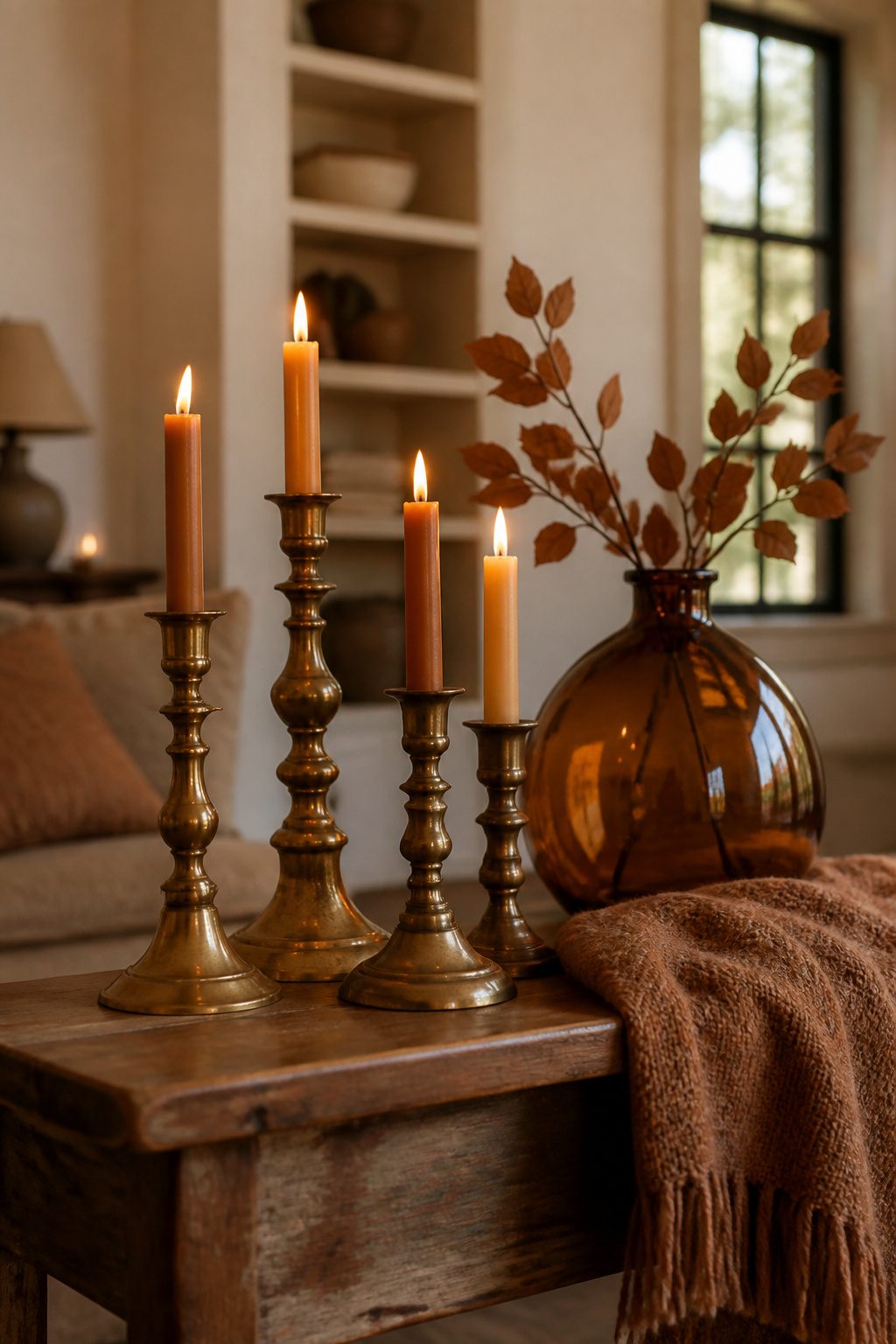
Amber glass glows differently under October light than anything boxed as seasonal decor at full retail.
The same goes for brass candlesticks with honest patina, wool blankets with frayed edges, and ceramic vases in tones that only time could settle into. Each piece carries the weight of having already survived another owner’s life.
I find most of mine at Goodwill, where brass and pottery candlestick holders run $1 to $2 and sit crowded on the same shelf between floral teacups and 1980s desk lamps. The trick is looking past the dust.
A handmade pottery candlestick with a drip of old wax still in its bowl is not damaged goods; it is evidence that someone else already trusted it for the same purpose.
Wool blankets turn up in the textile bins, sometimes still tagged from Target or West Elm at half the store price.
The blue striped ones stay in my summer rotation, and I trade them out for anything in ochre, rust, or cream the minute the thrift rack turns over.
Last season I pulled a textured cream throw that still had its original tag, proof that someone else bought and donated before using it.
The ceramic vases are harder to spot because they hide among the mass-produced florist glass. Look for matte glazes, hand-painted bands, or shapes that lean slightly off-center.
Grouped with a few branches of dried grass or bare twigs from the yard, one $3 vase holds more autumn than a shelf of new merchandise ever could.
24. Include Subtle Touches in the Entryway
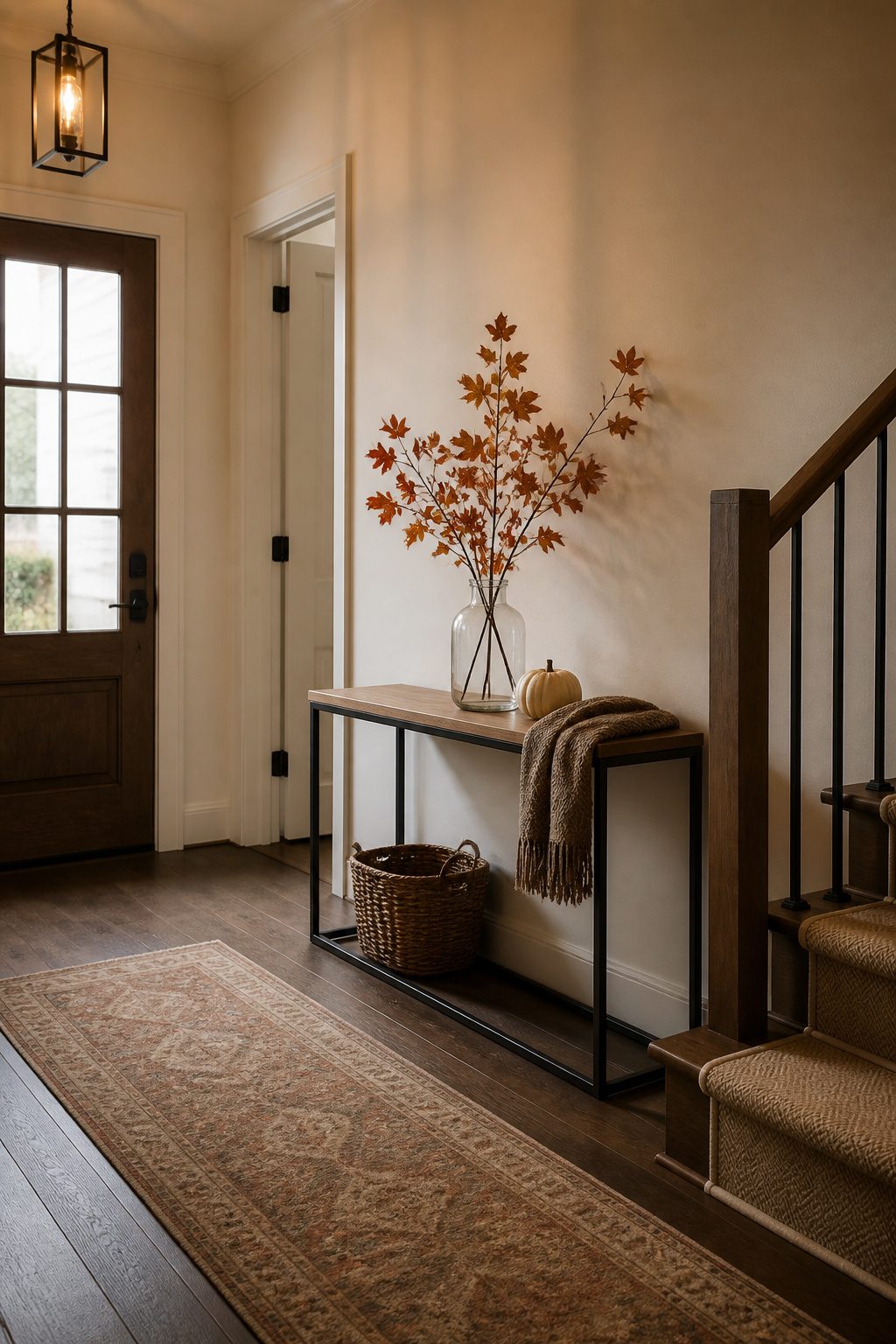
A single branch clipped from the backyard, dropped into a clean vase on the nearest flat surface, reads autumn faster than any staged display. In my first apartment the flat surface was a radiator cover two steps from the door.
That was the whole entry. No hall, no console, no coat closet even.
The branch sat where I’d see it coming and going, and that narrow sight line was enough.
One pumpkin by the door, one swapped pillow on the single chair, a scarf looped over the hook instead of the sun hat; each of these replaces rather than adds.
The radiator held the vase, the hook traded seasons, nothing new needed storage come November. A bowl of acorns or pinecones works the same way if it lives where the mail already lands.
Kate Marker calls this mixing materials and shapes to create invitation. I think of it as giving the eye one place to land so the rest of the small space can keep breathing.
A lantern or dough bowl as the single focal point, one natural element layered in, and something already owned to finish; this three-part rule keeps the tiny entry from cluttering itself into a closet.
The scarf or pillow nods to autumn without shouting pumpkin, and the branch dies back gracefully when the season turns.
25. Use a Chair for Fall Decor
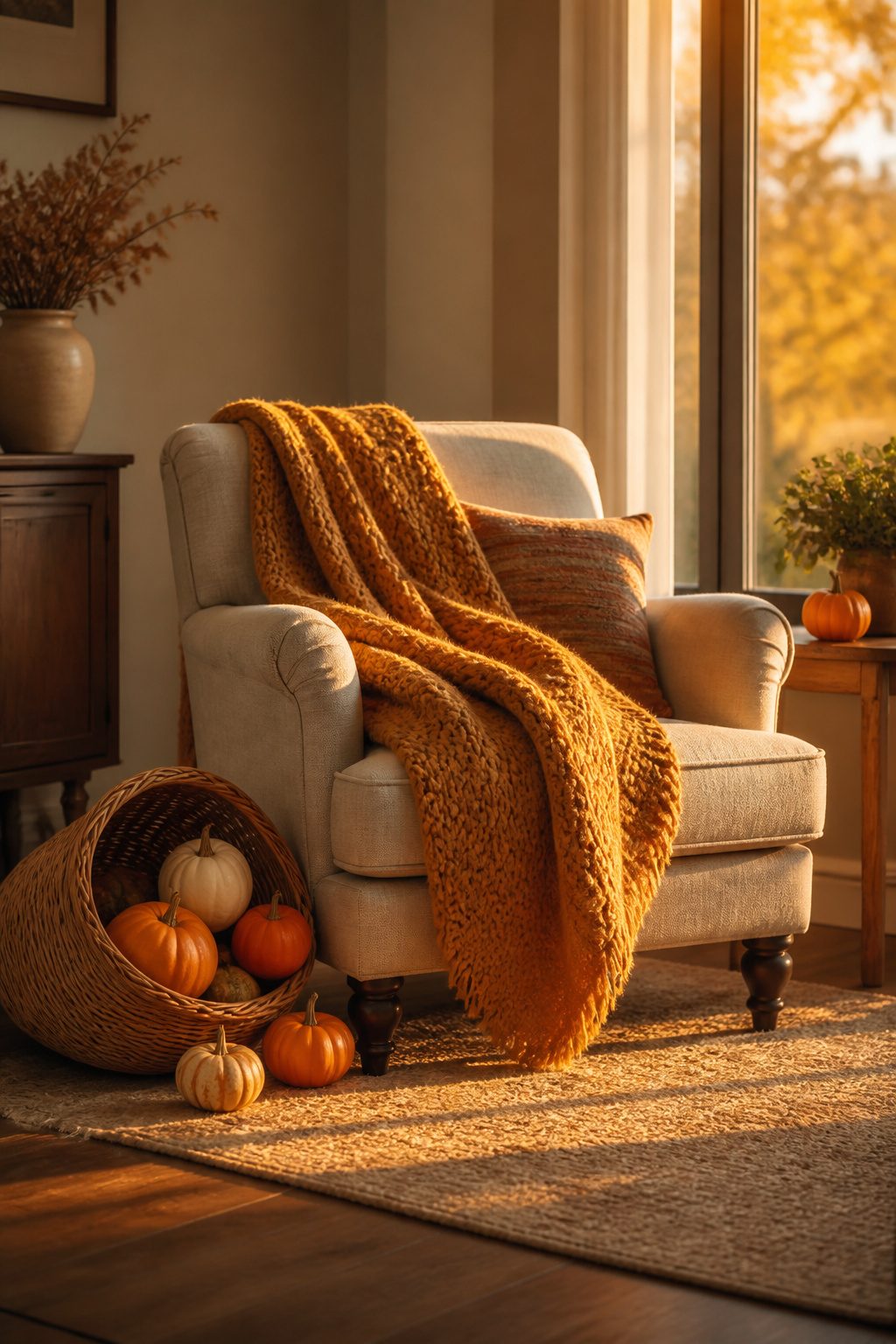
A single chair can carry an entire corner of fall decor without eating up the floor plan you actually need for living.
The mission is to pick the chair that already sits where traffic does not go: the one angled toward a window, or parked at the end of a hallway, or waiting in a bedroom corner that no one uses for sitting anyway.
I drape a throw there first, something with weight and a visible weave, then lean a basket against one leg so the pairing looks intentional, not like laundry waiting to happen.
A pumpkin on the seat finishes it, but the pumpkin sits where a person would not; that is the whole trick. If the chair is out in the open, keep the arrangement to two items, not three.
Bedroom corners and hallway ends can take the full composition because they are already visually quiet.
The throw does the actual work of seasonality; the basket and pumpkin are just proof you meant it. In a small space, that distinction matters.
A chair you walk past every day becomes invisible furniture. A chair you styled once in late September and left alone reads as decor until Thanksgiving.
Budget Breakdown
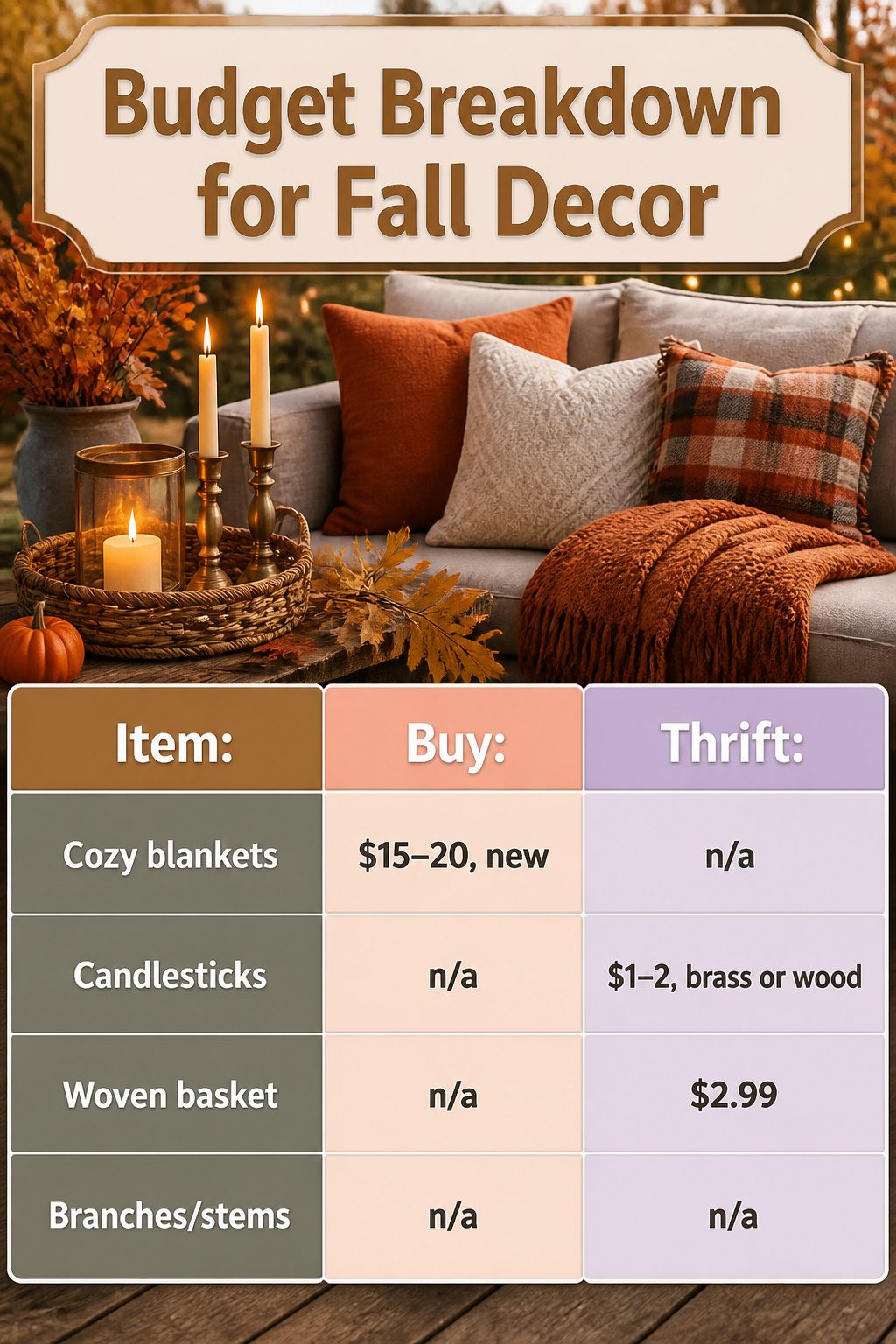
A $500–800 annual garden and decor budget leaves roughly $150–200 for fall if you spread it evenly across seasons, though most of us front-load spring and skimp by September.
The trick is knowing which pieces earn a buy and which get thrifted or skipped entirely.
| Item | Buy | Thrift | Forage | Skip |
|---|---|---|---|---|
| Cozy blankets | $15–20, new, for washability | n/a | n/a | Cheap acrylic that pills in one season |
| Candlesticks | n/a | $1–2, brass or wood | n/a | Trendy resin shapes you’ll tire of |
| Woven basket | n/a | $2.99, holds blankets or firewood | n/a | Matching sets; one odd basket has more character |
| Branches/stems | n/a | n/a | Free, gathered on a walk | n/a |
I put money into textiles that get washed weekly and save on anything that sits still. One splurge every few years, like oak branches used for a decade, beats annual replacements.
The basket from the thrift store works harder than anything I have bought new.
Natural Elements Quick Guide
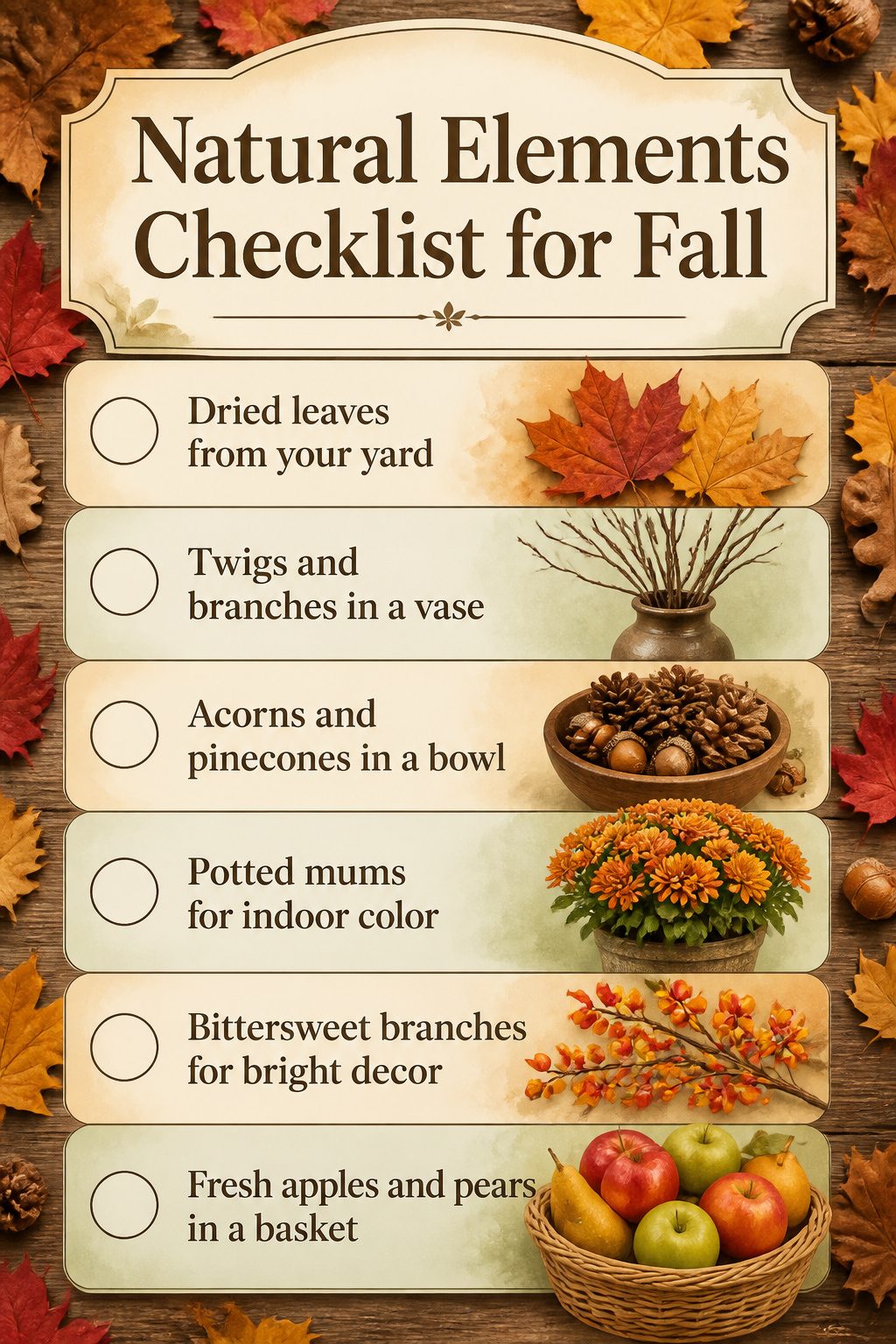
Every fall, a few walks outdoors keep the whole season’s decorating cheap.
Free natural materials and how long they actually last:
- Dried leaves clipped from your own yard last the season if you dry them before use. Redbud branches hold color well enough if you pick them when the turn starts.
- Twigs and branches in a vase stay clean for weeks. They shed nothing and cost nothing.
- Acorns and pinecones stored in a bowl or basket keep indefinitely if they dry first.
- Potted mums give you weeks of indoor color for cheap. No replacement needed.
- Bittersweet branches carry that bright orange look if roadside cutting is allowed where you live. Invasive in some zones, so check local rules before gathering.
- Fresh apples and pears for a kitchen basket look good for roughly a week, then go soft. Plan the eat date. No single apple survives a whole fall as décor.
Skip anything damp or bruised from the start. Mold spreads to whatever sits next to it.
Texture Layering Basics
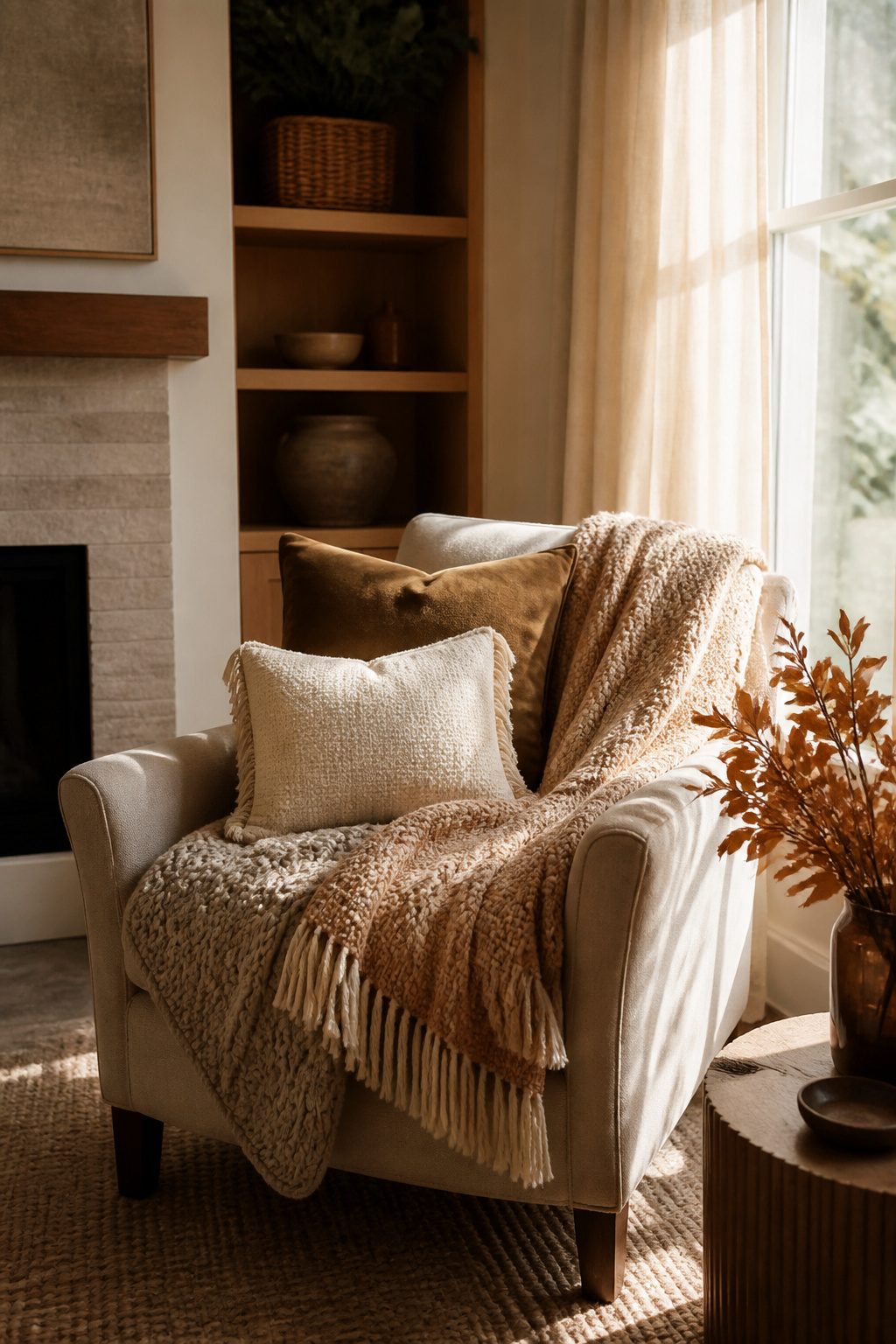
Heavier fabrics read as cozier, not cluttered, if you keep the weave open enough that light still passes through.
I learned this the winter I draped a solid canvas drop cloth over a chair and watched the room go flat; swap it for a loose, open weave and the same corner felt layered but still breathable.
The three textures I settle on are woven, knitted, and smooth, and I keep them in that order from the outside in.
The woven piece, a nubby throw or fringed pillow, sits where the eye lands first because its irregular surface breaks up the light.
Knitted work belongs closer to the body, a chunky lap blanket or a cable-knit cushion you actually sink into. Smooth fabric anchors everything: a velvet pillow or fine cotton sheet that gives the eye a place to rest.
The trap is adding too much of any one. I limit myself to one dominant texture per surface.
A woven ottoman means knitted and smooth stay off it. The sofa can carry two, never three.
Four pumpkins’ worth of budget, maybe five, covers a good yard of each textile on sale in October, enough to rotate rather than pile on.
Thrifted and Vintage Finds
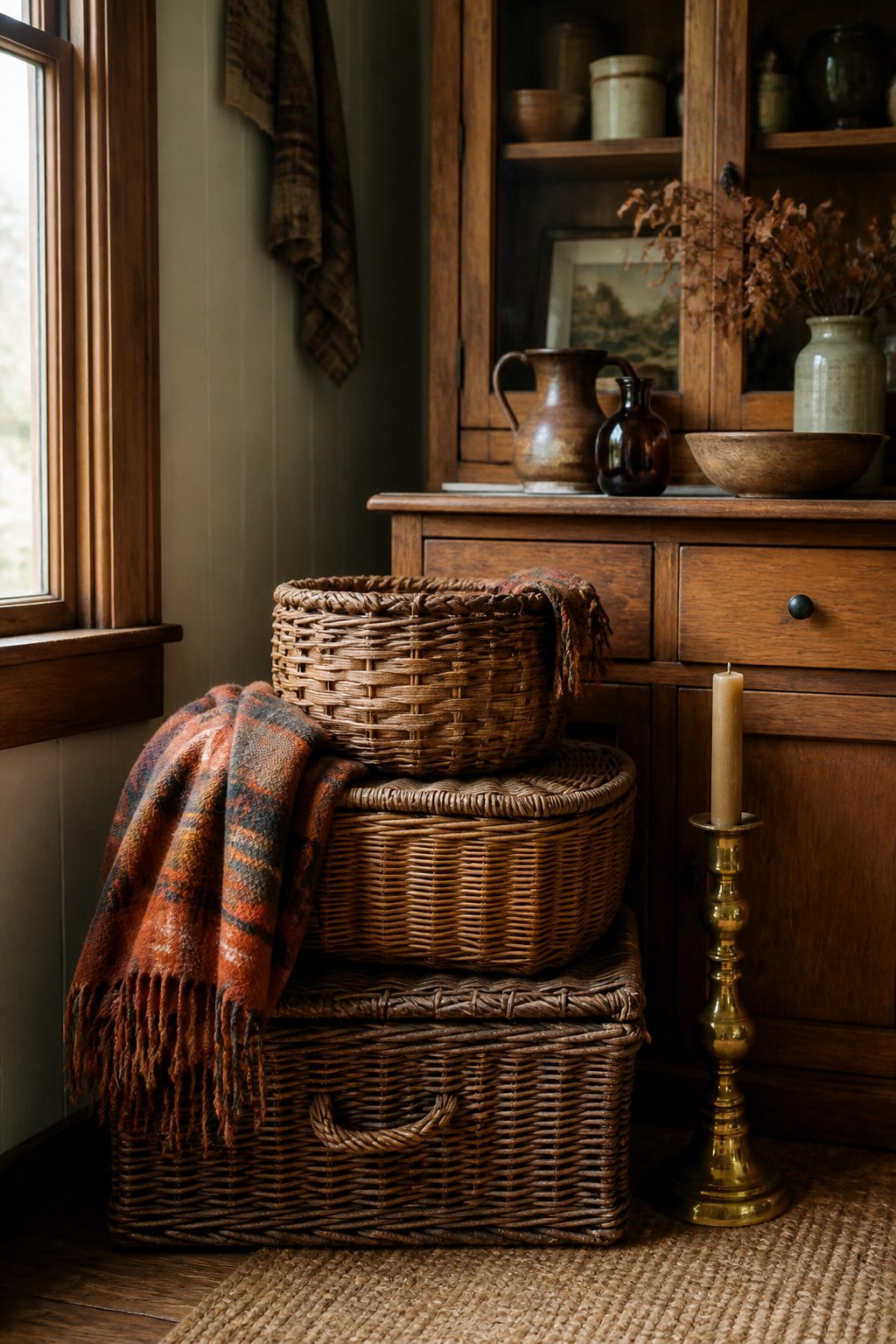
Baskets that stack flat and brass with a living finish both read fall without trying too hard.
I pass on any basket with broken ribs or a musty weave that storage won’t fix, and on brass that’s been lacquered to that dead yellow shine; the patina is the point, and stripping it is a weekend you won’t get back.
Wool blankets get checked for moth holes along the fold lines and for thinning at the center where someone actually used it.
A single hole means it stays, but two or more and the damage is already farther along than it looks.
Ceramic should ring when you flick it, not thud; a dull sound means a hairline crack that heat will finish.
Glass is harder to date than sellers claim, so I look for chips at the rim or base stress cracks and let the rest go.
The seasonal aisle at every thrift is where plastic pumpkins and orange string lights go to wait out the year. Those skip themselves.
Kitchen-to-Decor Produce
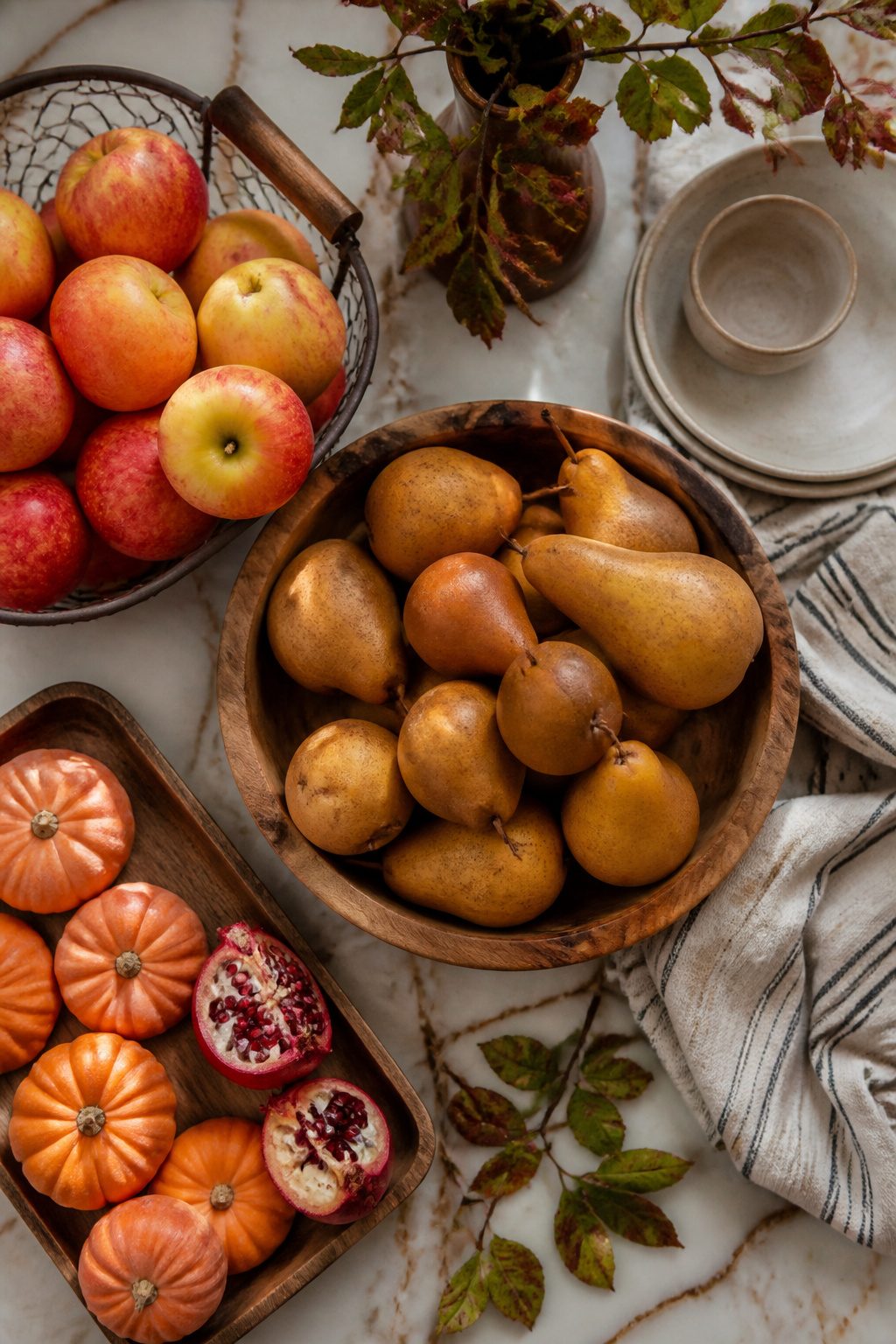
A wooden bowl of Bosc pears on the counter costs nothing extra if you already bought them for eating.
The same goes for a wire basket of Honeycrisp apples, or a shallow tray lined with squat sugar pie pumpkins and a few pomegranates split just enough to show the seeds.
The line between decoration and compost is about four days, and once you cross it, the fruit flies arrive in clouds that no vinegar trap fully clears.
Faux pears solve the timing problem. Last season I found a set at a thrift store for two dollars that looked real enough to fool guests from across the room.
They sat in an ironstone bowl through Thanksgiving without a single gnat. Real fruit still wins for the first week of October, when the stems are fresh and the skin has that tight gloss.
After that, the swap to artificial or dried gourds keeps the look without the rot.
Persimmons are the exception that stays pretty while it softens. A bowl of Fuyus graduates from firm orange globes to wrinkled, jam-ready sweetness over two weeks, and the color only deepens.
Squash works the same way: a Hubbard or kuri on the windowsill decorates until you need it for soup. The trick is buying what you will actually eat, so the display empties itself before the flies move in.
Frequently Asked Questions
What are some budget-friendly fall decorating ideas?
Start with what you already own, thrift for baskets and copper pieces, and gather real branches and seed heads from outside. One writer found a woven basket for $2.99 and used it to corral dried stems all season.
Faux wheat and eucalyptus fill gaps cheaply, and a single well-chosen pumpkin does more work than a cluttered cluster.
How can I incorporate natural elements into my fall decor?
Clip bare twigs, seed heads, and red twig dogwood branches from your yard, or dry flat leaves from a redbud tree between book pages. Pressed sugar maple and oak leaves framed in clip frames glow when backlit.
Pears, apples, and flowering kale from the market bridge the gap between decoration and something you will actually use or eat.
What color palette should I use for fall decorating?
Soft blushes, amber, creams, and muted golds read as autumn without the usual orange shout, or go fully neutral with cream, taupe, brown, and sage. Dusty blue paired with amber, or olive with blush, catches candlelight while keeping the warmth.
The late afternoon sun will do the orange work for you if you let the room stay quiet.